
Corporate accountability, CSR, ESG and sustainability — student companion
Original branded notes, diagrams and practice with worked answers for Part A.1: follow the widening idea of corporate responsibility and distinguish sustainability, sustainable development, CSR and ESG.
Read the handout text
Accounting Ahead | Original study resource | accountingahead.com.au
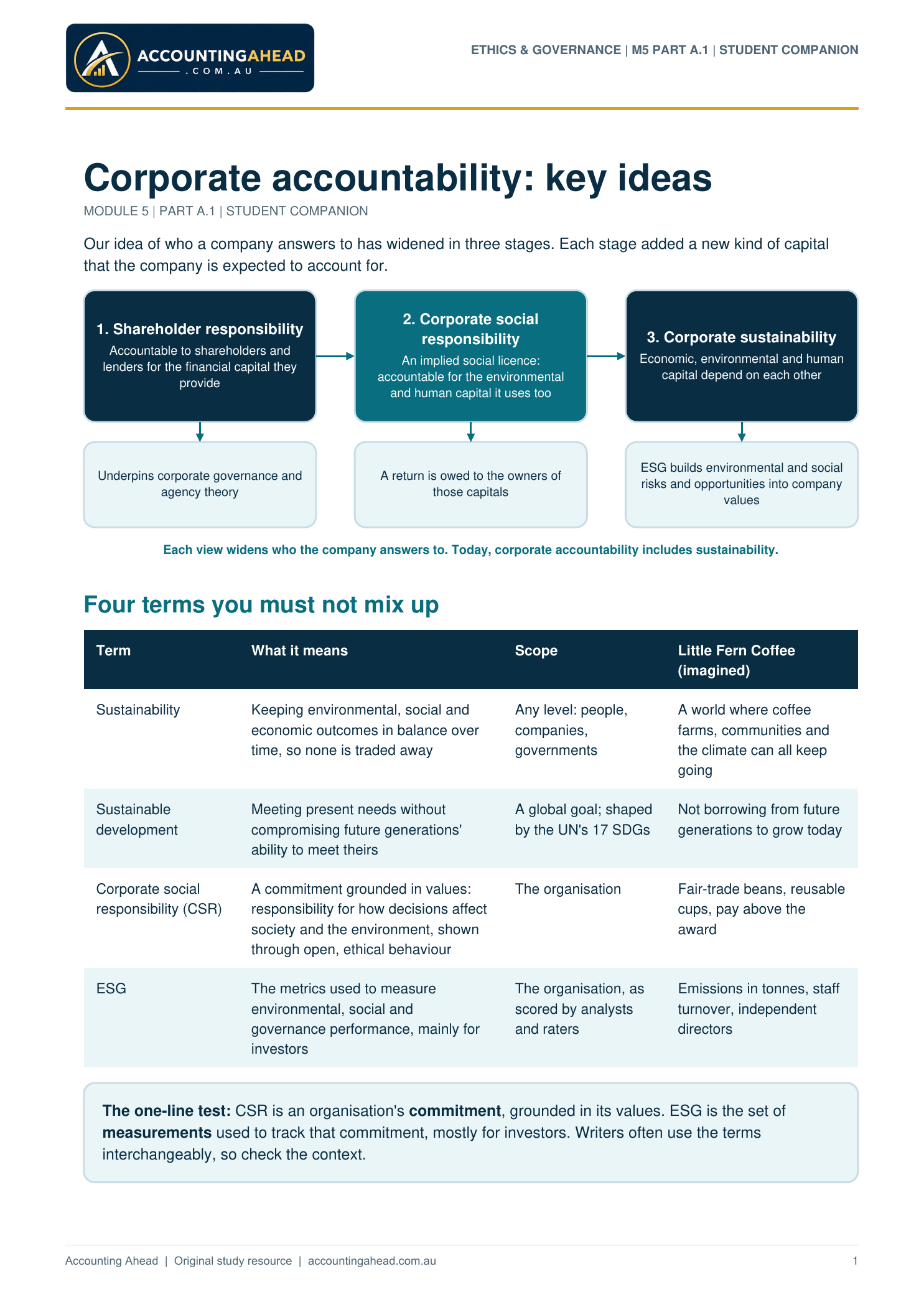
Corporate accountability: key ideas
MODULE 5 | PART A.1 | STUDENT COMPANION
Our idea of who a company answers to has widened in three stages. Each stage added a new kind of capital
that the company is expected to account for.
1. Shareholder responsibility
Accountable to shareholders and
lenders for the financial capital they
provide
Underpins corporate governance and
agency theory
2. Corporate social
responsibility
An implied social licence:
accountable for the environmental
and human capital it uses too
A return is owed to the owners of
those capitals
3. Corporate sustainability
Economic, environmental and human
capital depend on each other
ESG builds environmental and social
risks and opportunities into company
values
Each view widens who the company answers to. Today, corporate accountability includes sustainability.
Four terms you must not mix up
Term What it means Scope Little Fern Coffee
(imagined)
Sustainability Keeping environmental, social and
economic outcomes in balance over
time, so none is traded away
Any level: people,
companies,
governments
A world where coffee
farms, communities and
the climate can all keep
going
Sustainable
development
Meeting present needs without
compromising future generations'
ability to meet theirs
A global goal; shaped
by the UN's 17 SDGs
Not borrowing from future
generations to grow today
Corporate social
responsibility (CSR)
A commitment grounded in values:
responsibility for how decisions affect
society and the environment, shown
through open, ethical behaviour
The organisation Fair-trade beans, reusable
cups, pay above the
award
ESG The metrics used to measure
environmental, social and
governance performance, mainly for
investors
The organisation, as
scored by analysts
and raters
Emissions in tonnes, staff
turnover, independent
directors
The one-line test: CSR is an organisation's commitment, grounded in its values. ESG is the set of
measurements used to track that commitment, mostly for investors. Writers often use the terms
interchangeably, so check the context.
ETHICS & GOVERNANCE | M5 PART A.1 | STUDENT COMPANION
1
Accounting Ahead | Original study resource | accountingahead.com.au
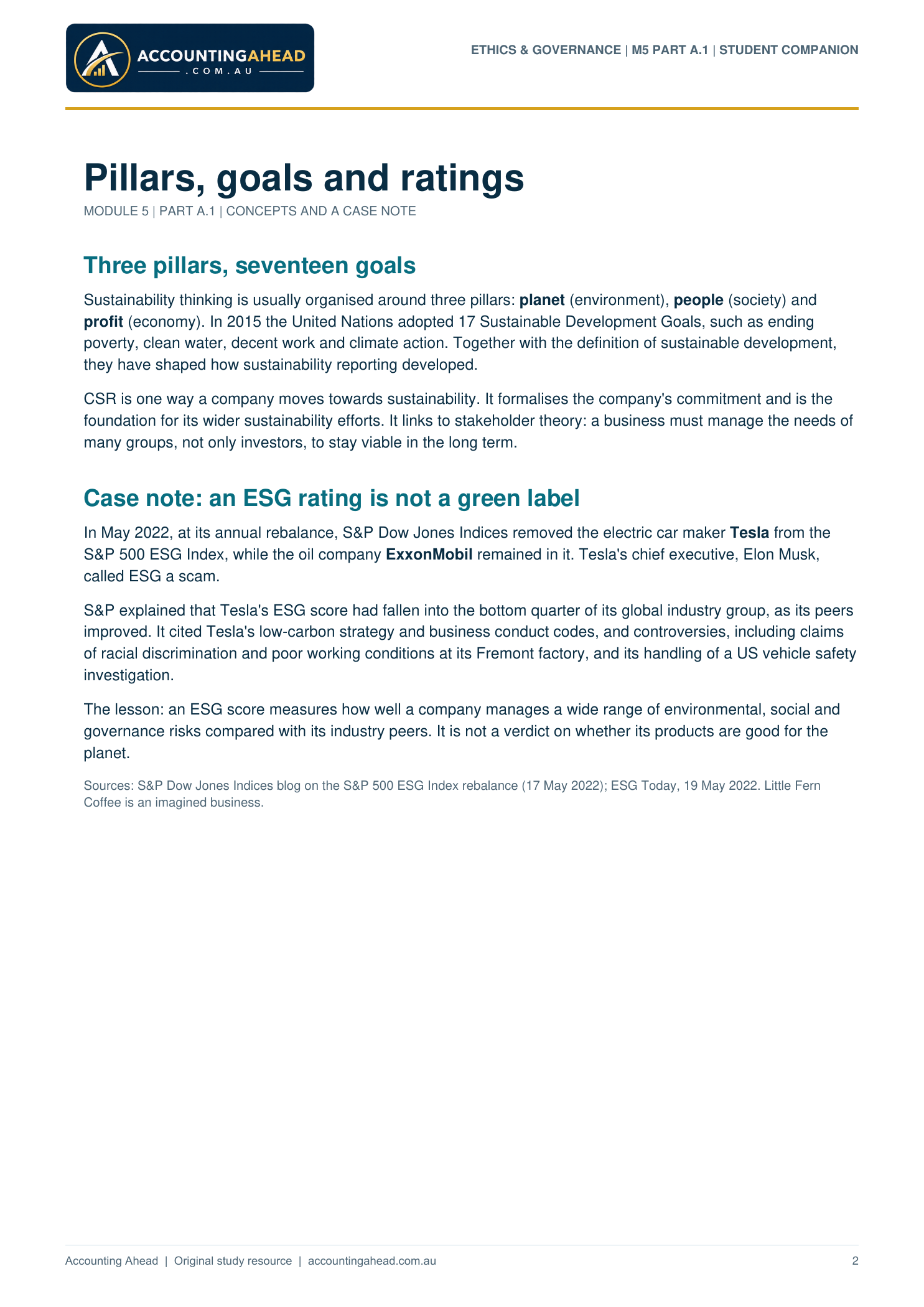
Pillars, goals and ratings
MODULE 5 | PART A.1 | CONCEPTS AND A CASE NOTE
Three pillars, seventeen goals
Sustainability thinking is usually organised around three pillars: planet (environment), people (society) and
profit (economy). In 2015 the United Nations adopted 17 Sustainable Development Goals, such as ending
poverty, clean water, decent work and climate action. Together with the definition of sustainable development,
they have shaped how sustainability reporting developed.
CSR is one way a company moves towards sustainability. It formalises the company's commitment and is the
foundation for its wider sustainability efforts. It links to stakeholder theory: a business must manage the needs of
many groups, not only investors, to stay viable in the long term.
Case note: an ESG rating is not a green label
In May 2022, at its annual rebalance, S&P Dow Jones Indices removed the electric car maker Tesla from the
S&P 500 ESG Index, while the oil company ExxonMobil remained in it. Tesla's chief executive, Elon Musk,
called ESG a scam.
S&P explained that Tesla's ESG score had fallen into the bottom quarter of its global industry group, as its peers
improved. It cited Tesla's low-carbon strategy and business conduct codes, and controversies, including claims
of racial discrimination and poor working conditions at its Fremont factory, and its handling of a US vehicle safety
investigation.
The lesson: an ESG score measures how well a company manages a wide range of environmental, social and
governance risks compared with its industry peers. It is not a verdict on whether its products are good for the
planet.
Sources: S&P Dow Jones Indices blog on the S&P 500 ESG Index rebalance (17 May 2022); ESG Today, 19 May 2022. Little Fern
Coffee is an imagined business.
ETHICS & GOVERNANCE | M5 PART A.1 | STUDENT COMPANION
2
Accounting Ahead | Original study resource | accountingahead.com.au
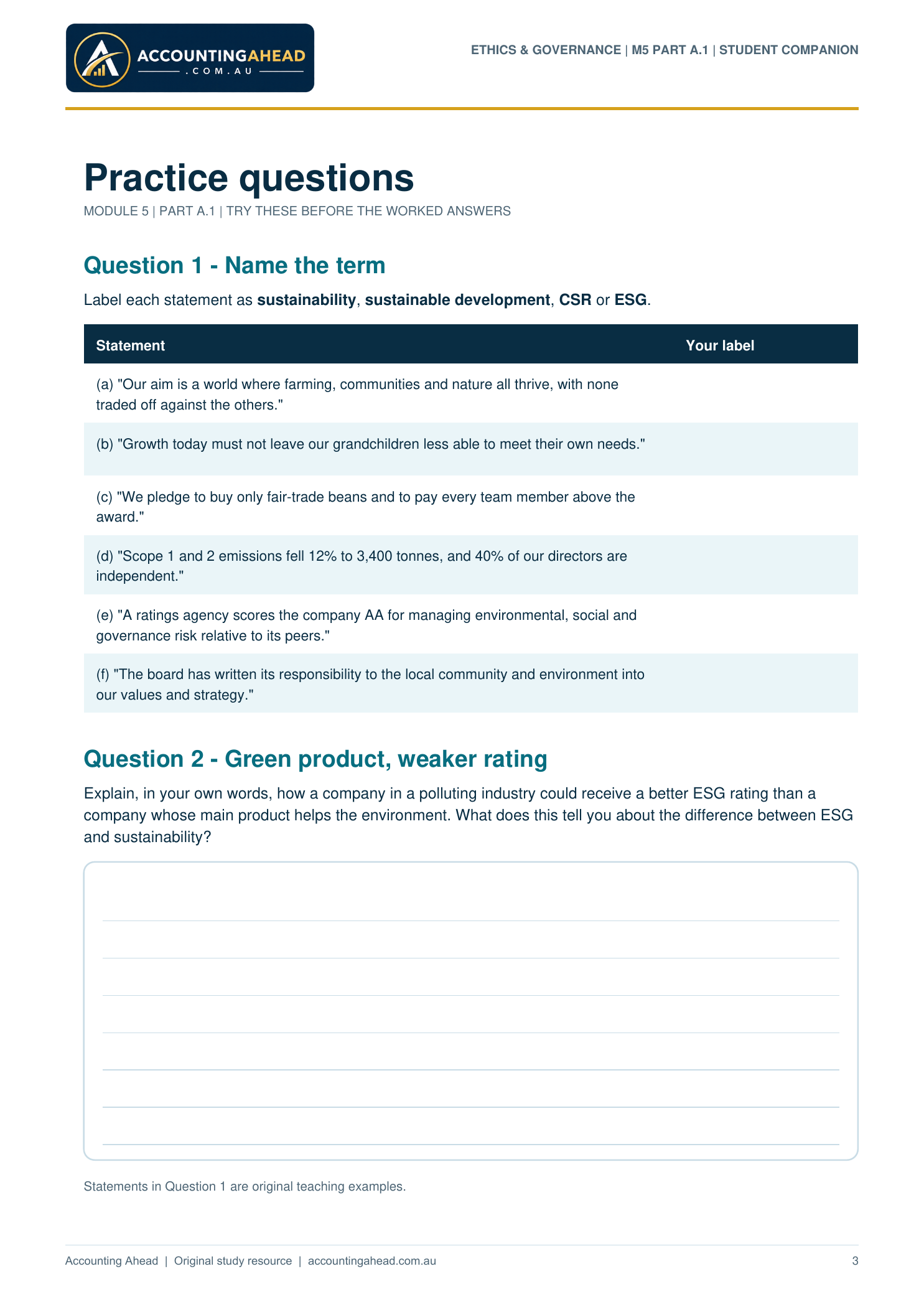
Practice questions
MODULE 5 | PART A.1 | TRY THESE BEFORE THE WORKED ANSWERS
Question 1 - Name the term
Label each statement as sustainability, sustainable development, CSR or ESG.
Statement Your label
(a) "Our aim is a world where farming, communities and nature all thrive, with none
traded off against the others."
(b) "Growth today must not leave our grandchildren less able to meet their own needs."
(c) "We pledge to buy only fair-trade beans and to pay every team member above the
award."
(d) "Scope 1 and 2 emissions fell 12% to 3,400 tonnes, and 40% of our directors are
independent."
(e) "A ratings agency scores the company AA for managing environmental, social and
governance risk relative to its peers."
(f) "The board has written its responsibility to the local community and environment into
our values and strategy."
Question 2 - Green product, weaker rating
Explain, in your own words, how a company in a polluting industry could receive a better ESG rating than a
company whose main product helps the environment. What does this tell you about the difference between ESG
and sustainability?
Statements in Question 1 are original teaching examples.
ETHICS & GOVERNANCE | M5 PART A.1 | STUDENT COMPANION
3
Accounting Ahead | Original study resource | accountingahead.com.au
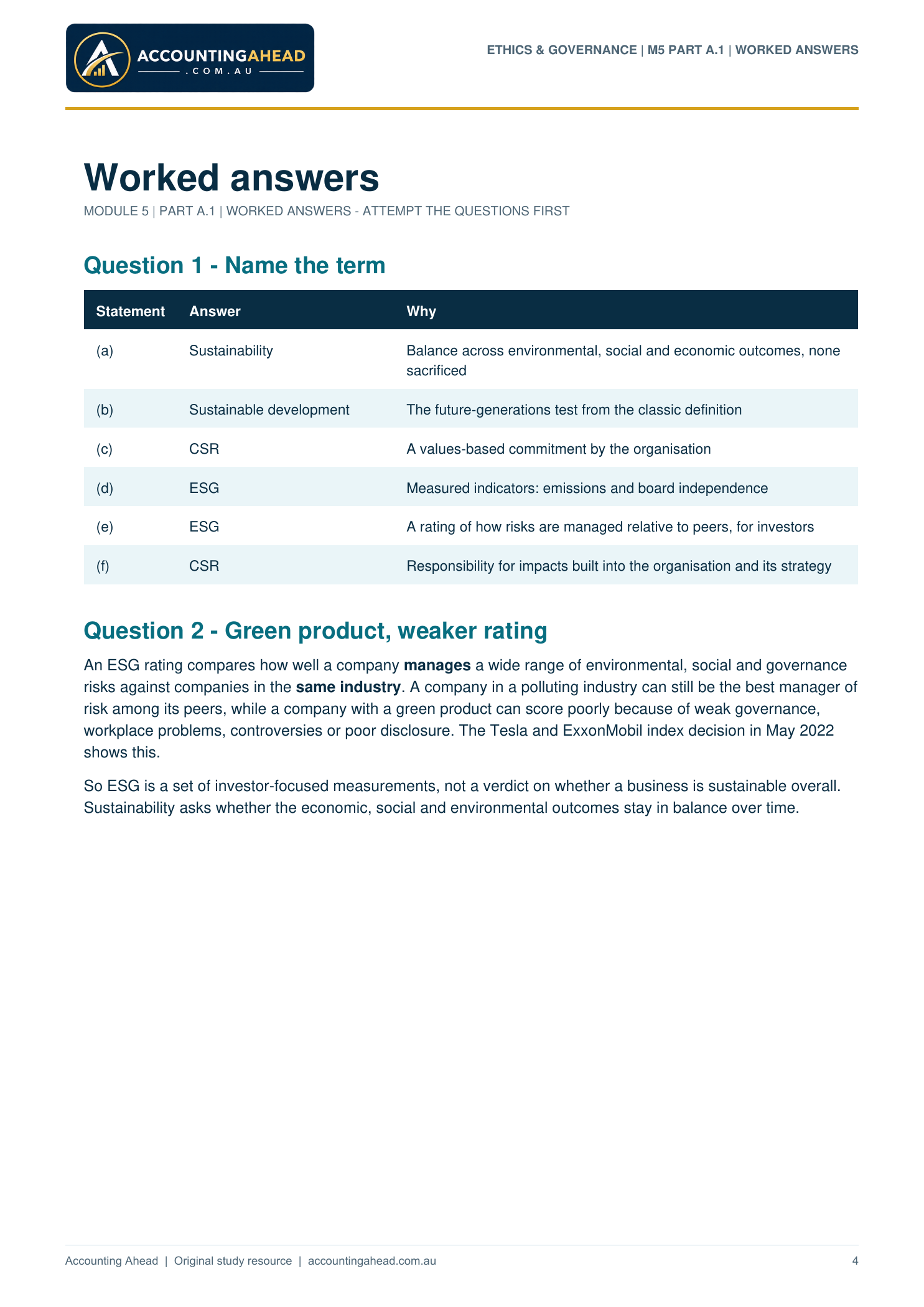
Worked answers
MODULE 5 | PART A.1 | WORKED ANSWERS - ATTEMPT THE QUESTIONS FIRST
Question 1 - Name the term
Statement Answer Why
(a) Sustainability Balance across environmental, social and economic outcomes, none
sacrificed
(b) Sustainable development The future-generations test from the classic definition
(c) CSR A values-based commitment by the organisation
(d) ESG Measured indicators: emissions and board independence
(e) ESG A rating of how risks are managed relative to peers, for investors
(f) CSR Responsibility for impacts built into the organisation and its strategy
Question 2 - Green product, weaker rating
An ESG rating compares how well a company manages a wide range of environmental, social and governance
risks against companies in the same industry. A company in a polluting industry can still be the best manager of
risk among its peers, while a company with a green product can score poorly because of weak governance,
workplace problems, controversies or poor disclosure. The Tesla and ExxonMobil index decision in May 2022
shows this.
So ESG is a set of investor-focused measurements, not a verdict on whether a business is sustainable overall.
Sustainability asks whether the economic, social and environmental outcomes stay in balance over time.
ETHICS & GOVERNANCE | M5 PART A.1 | WORKED ANSWERS
4