
Social audits and environmental management accounting — student companion
Original branded notes, diagrams and practice with worked answers for Part E.3: connect social audit, governance structures and environmental cost drivers with better decisions and circular-economy thinking.
Read the handout text
Accounting Ahead | Original study resource | accountingahead.com.au
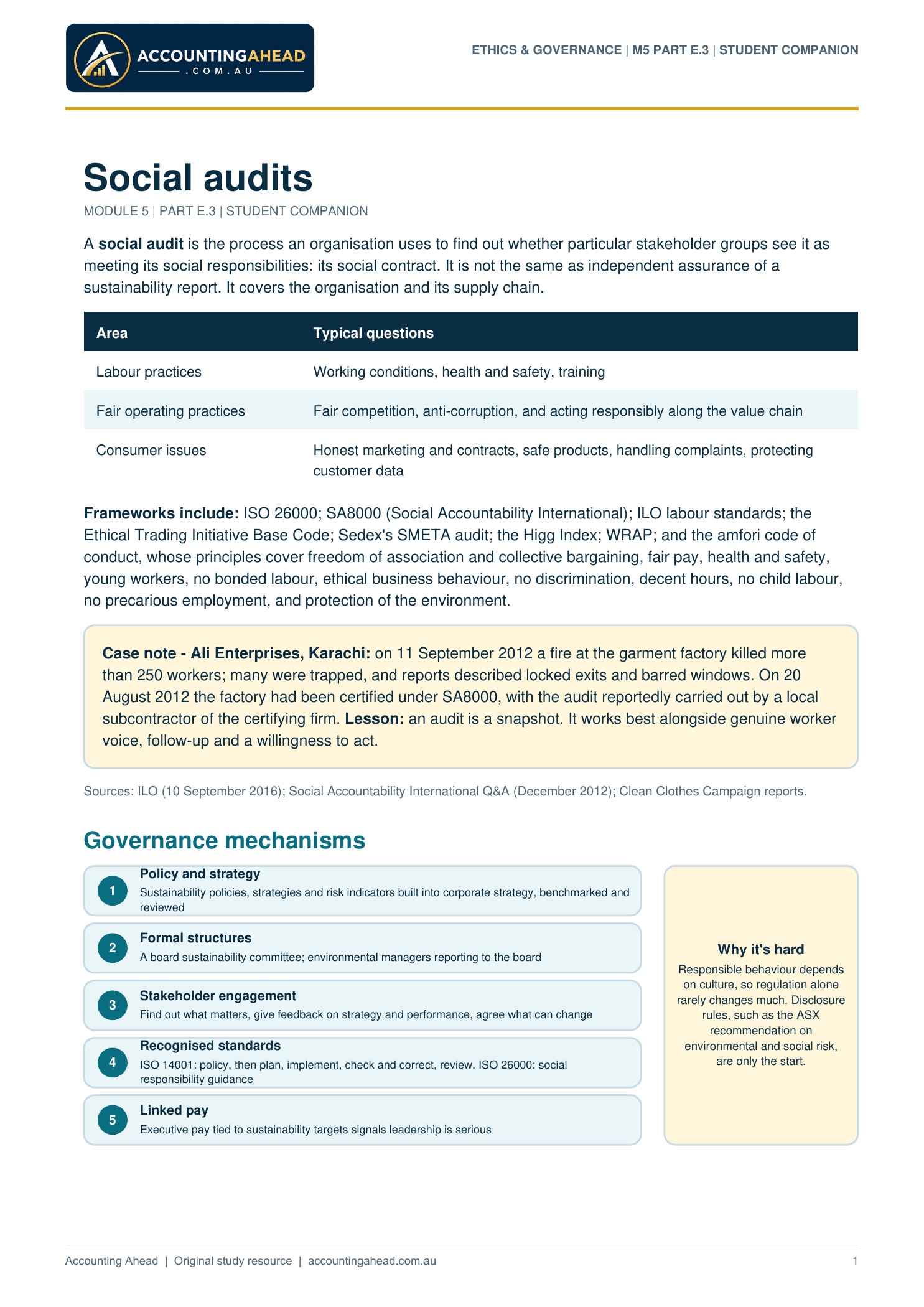
Social audits
MODULE 5 | PART E.3 | STUDENT COMPANION
A social audit is the process an organisation uses to find out whether particular stakeholder groups see it as
meeting its social responsibilities: its social contract. It is not the same as independent assurance of a
sustainability report. It covers the organisation and its supply chain.
Area Typical questions
Labour practices Working conditions, health and safety, training
Fair operating practices Fair competition, anti-corruption, and acting responsibly along the value chain
Consumer issues Honest marketing and contracts, safe products, handling complaints, protecting
customer data
Frameworks include: ISO 26000; SA8000 (Social Accountability International); ILO labour standards; the
Ethical Trading Initiative Base Code; Sedex's SMETA audit; the Higg Index; WRAP; and the amfori code of
conduct, whose principles cover freedom of association and collective bargaining, fair pay, health and safety,
young workers, no bonded labour, ethical business behaviour, no discrimination, decent hours, no child labour,
no precarious employment, and protection of the environment.
Case note - Ali Enterprises, Karachi: on 11 September 2012 a fire at the garment factory killed more
than 250 workers; many were trapped, and reports described locked exits and barred windows. On 20
August 2012 the factory had been certified under SA8000, with the audit reportedly carried out by a local
subcontractor of the certifying firm. Lesson: an audit is a snapshot. It works best alongside genuine worker
voice, follow-up and a willingness to act.
Sources: ILO (10 September 2016); Social Accountability International Q&A (December 2012); Clean Clothes Campaign reports.
Governance mechanisms
1
Policy and strategy
Sustainability policies, strategies and risk indicators built into corporate strategy, benchmarked and
reviewed
2 Formal structures
A board sustainability committee; environmental managers reporting to the board
3 Stakeholder engagement
Find out what matters, give feedback on strategy and performance, agree what can change
4
Recognised standards
ISO 14001: policy, then plan, implement, check and correct, review. ISO 26000: social
responsibility guidance
5 Linked pay
Executive pay tied to sustainability targets signals leadership is serious
Why it's hard
Responsible behaviour depends
on culture, so regulation alone
rarely changes much. Disclosure
rules, such as the ASX
recommendation on
environmental and social risk,
are only the start.
ETHICS & GOVERNANCE | M5 PART E.3 | STUDENT COMPANION
1
Accounting Ahead | Original study resource | accountingahead.com.au
Environmental management accounting
MODULE 5 | PART E.3 | CONCEPTS AND A WORKED EXAMPLE
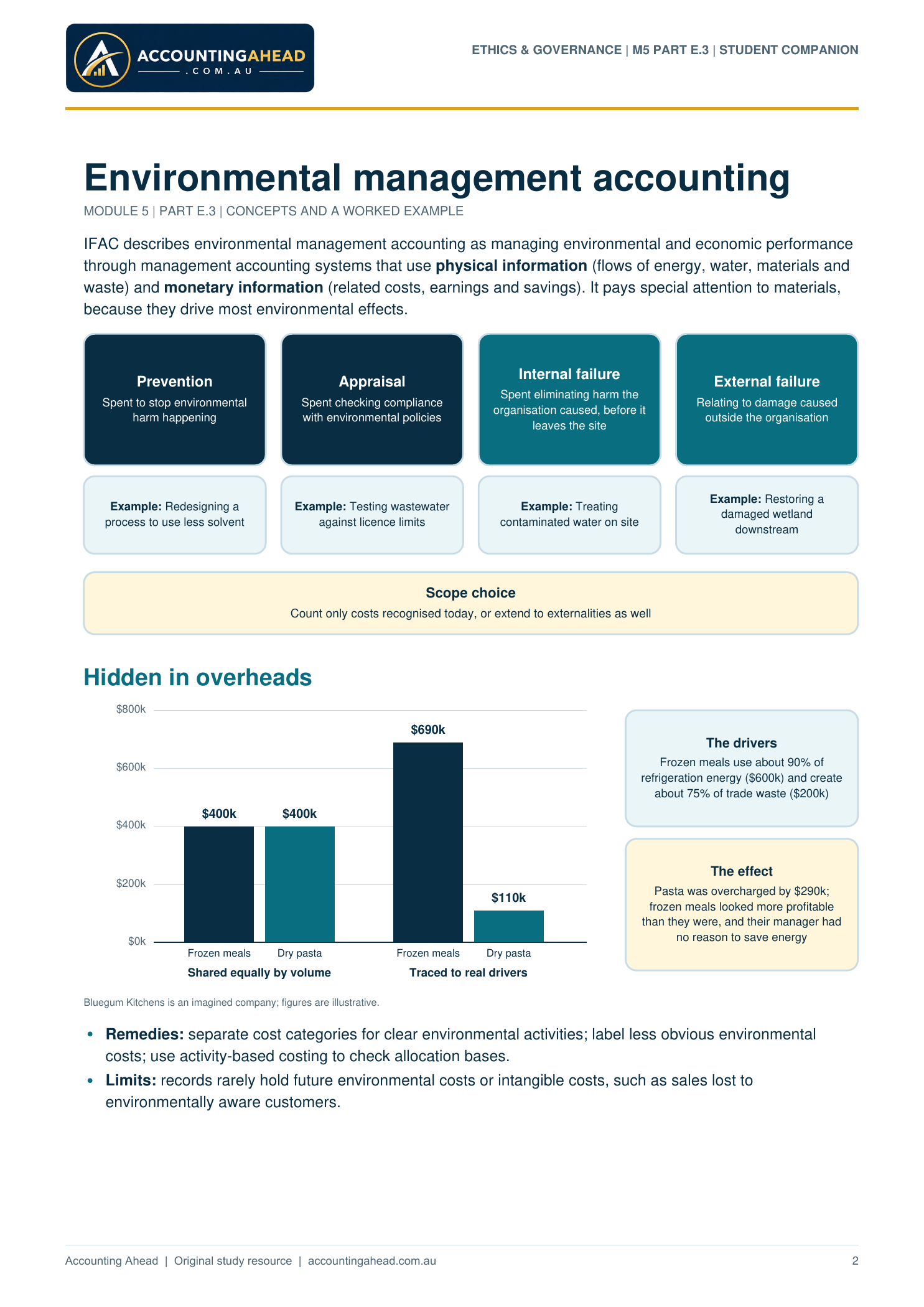
IFAC describes environmental management accounting as managing environmental and economic performance
through management accounting systems that use physical information (flows of energy, water, materials and
waste) and monetary information (related costs, earnings and savings). It pays special attention to materials,
because they drive most environmental effects.
Prevention
Spent to stop environmental
harm happening
Example: Redesigning a
process to use less solvent
Appraisal
Spent checking compliance
with environmental policies
Example: Testing wastewater
against licence limits
Internal failure
Spent eliminating harm the
organisation caused, before it
leaves the site
Example: Treating
contaminated water on site
External failure
Relating to damage caused
outside the organisation
Example: Restoring a
damaged wetland
downstream
Scope choice
Count only costs recognised today, or extend to externalities as well
Hidden in overheads
$0k
$200k
$400k
$600k
$800k
$400k
Frozen meals
$400k
Dry pasta
Shared equally by volume
$690k
Frozen meals
$110k
Dry pasta
Traced to real drivers
The drivers
Frozen meals use about 90% of
refrigeration energy ($600k) and create
about 75% of trade waste ($200k)
The effect
Pasta was overcharged by $290k;
frozen meals looked more profitable
than they were, and their manager had
no reason to save energy
Bluegum Kitchens is an imagined company; figures are illustrative.
Remedies: separate cost categories for clear environmental activities; label less obvious environmental
costs; use activity-based costing to check allocation bases.
Limits: records rarely hold future environmental costs or intangible costs, such as sales lost to
environmentally aware customers.
ETHICS & GOVERNANCE | M5 PART E.3 | STUDENT COMPANION
2
Accounting Ahead | Original study resource | accountingahead.com.au
Circular economy and reporting practice
MODULE 5 | PART E.3 | CONCEPTS
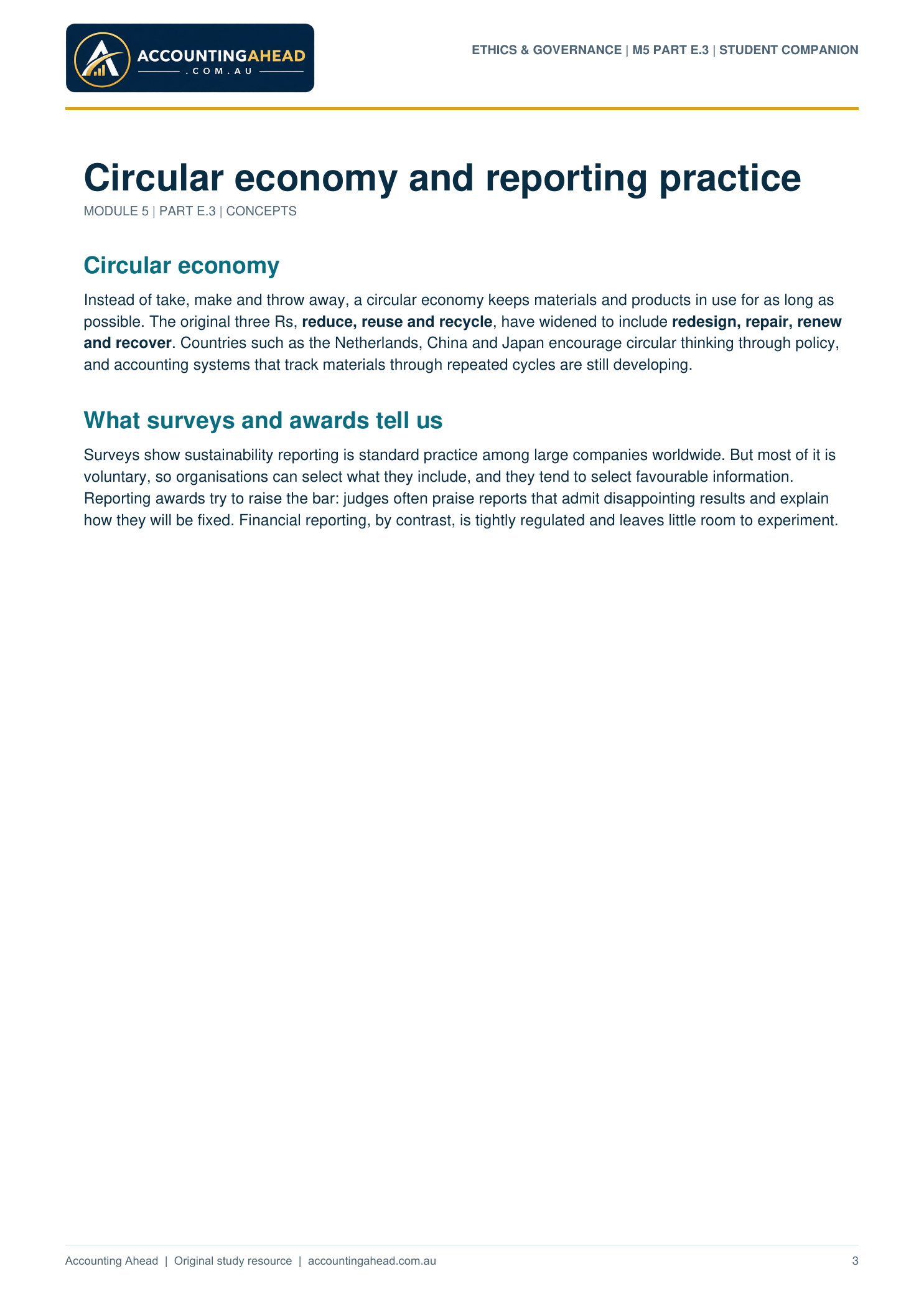
Circular economy
Instead of take, make and throw away, a circular economy keeps materials and products in use for as long as
possible. The original three Rs, reduce, reuse and recycle, have widened to include redesign, repair, renew
and recover. Countries such as the Netherlands, China and Japan encourage circular thinking through policy,
and accounting systems that track materials through repeated cycles are still developing.
What surveys and awards tell us
Surveys show sustainability reporting is standard practice among large companies worldwide. But most of it is
voluntary, so organisations can select what they include, and they tend to select favourable information.
Reporting awards try to raise the bar: judges often praise reports that admit disappointing results and explain
how they will be fixed. Financial reporting, by contrast, is tightly regulated and leaves little room to experiment.
ETHICS & GOVERNANCE | M5 PART E.3 | STUDENT COMPANION
3
Accounting Ahead | Original study resource | accountingahead.com.au
Practice questions
MODULE 5 | PART E.3 | TRY THESE BEFORE THE WORKED ANSWERS
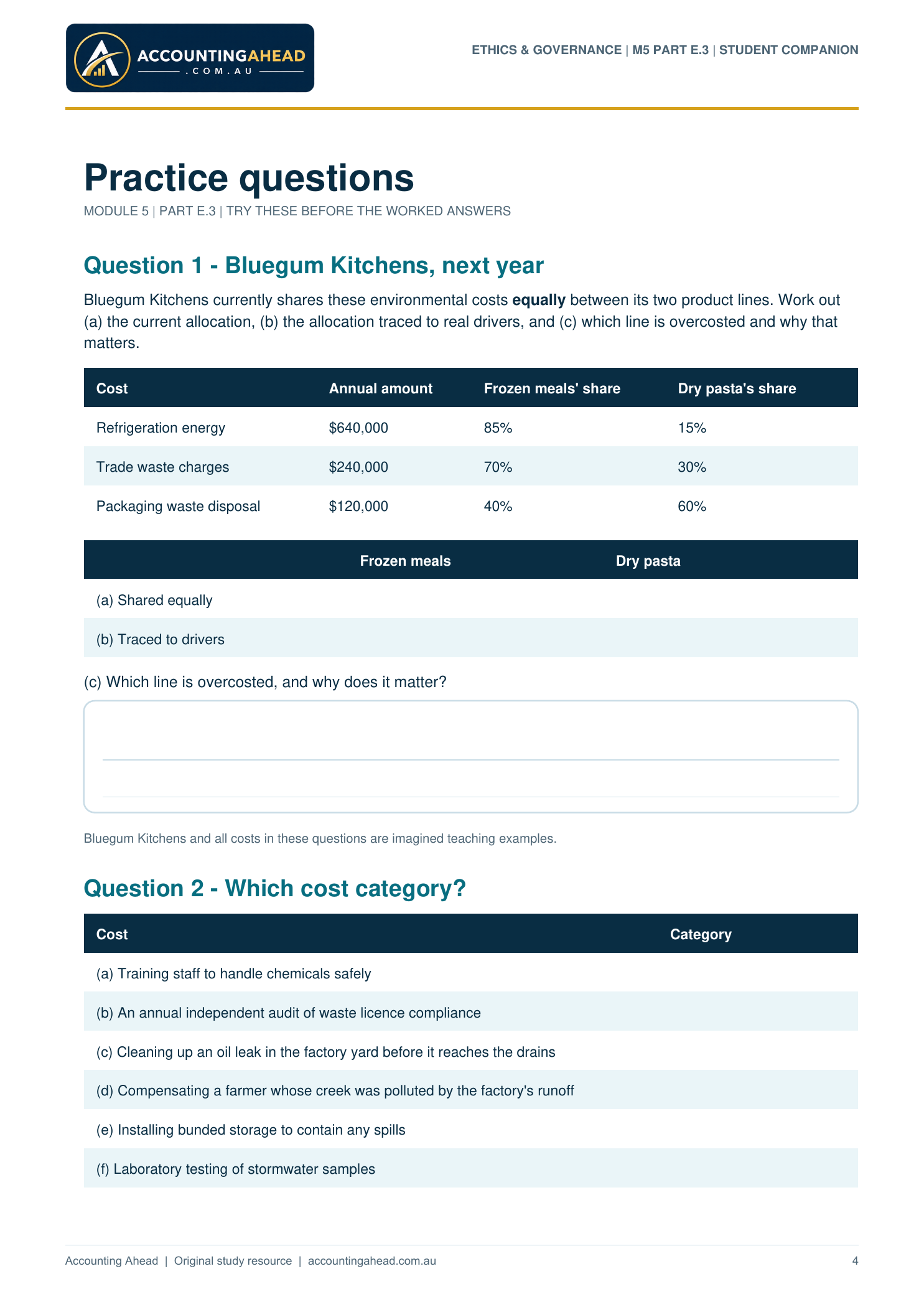
Question 1 - Bluegum Kitchens, next year
Bluegum Kitchens currently shares these environmental costs equally between its two product lines. Work out
(a) the current allocation, (b) the allocation traced to real drivers, and (c) which line is overcosted and why that
matters.
Cost Annual amount Frozen meals' share Dry pasta's share
Refrigeration energy $640,000 85% 15%
Trade waste charges $240,000 70% 30%
Packaging waste disposal $120,000 40% 60%
Frozen meals Dry pasta
(a) Shared equally
(b) Traced to drivers
(c) Which line is overcosted, and why does it matter?
Bluegum Kitchens and all costs in these questions are imagined teaching examples.
Question 2 - Which cost category?
Cost Category
(a) Training staff to handle chemicals safely
(b) An annual independent audit of waste licence compliance
(c) Cleaning up an oil leak in the factory yard before it reaches the drains
(d) Compensating a farmer whose creek was polluted by the factory's runoff
(e) Installing bunded storage to contain any spills
(f) Laboratory testing of stormwater samples
ETHICS & GOVERNANCE | M5 PART E.3 | STUDENT COMPANION
4
Accounting Ahead | Original study resource | accountingahead.com.au
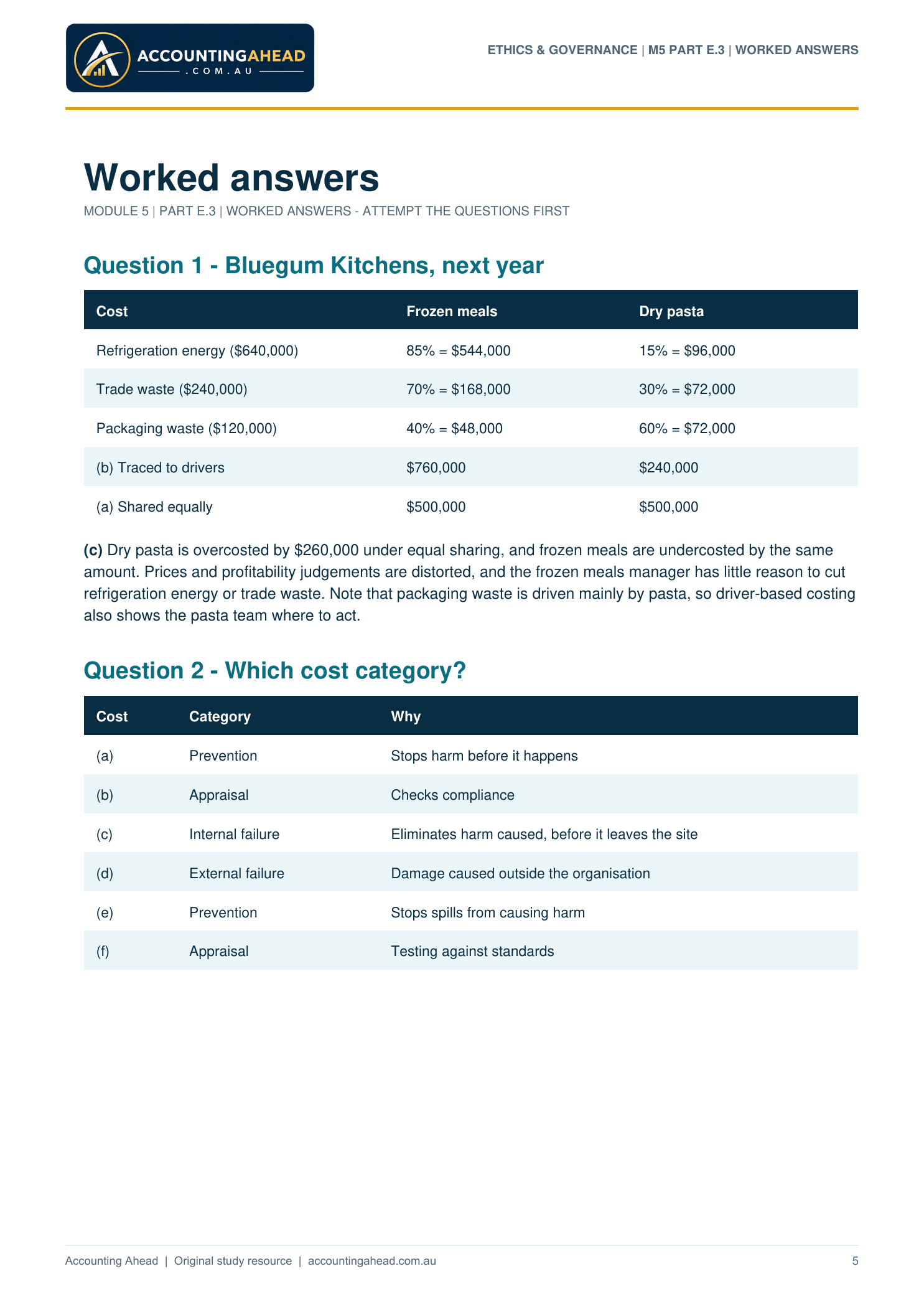
Worked answers
MODULE 5 | PART E.3 | WORKED ANSWERS - ATTEMPT THE QUESTIONS FIRST
Question 1 - Bluegum Kitchens, next year
Cost Frozen meals Dry pasta
Refrigeration energy ($640,000) 85% = $544,000 15% = $96,000
Trade waste ($240,000) 70% = $168,000 30% = $72,000
Packaging waste ($120,000) 40% = $48,000 60% = $72,000
(b) Traced to drivers $760,000 $240,000
(a) Shared equally $500,000 $500,000
(c) Dry pasta is overcosted by $260,000 under equal sharing, and frozen meals are undercosted by the same
amount. Prices and profitability judgements are distorted, and the frozen meals manager has little reason to cut
refrigeration energy or trade waste. Note that packaging waste is driven mainly by pasta, so driver-based costing
also shows the pasta team where to act.
Question 2 - Which cost category?
Cost Category Why
(a) Prevention Stops harm before it happens
(b) Appraisal Checks compliance
(c) Internal failure Eliminates harm caused, before it leaves the site
(d) External failure Damage caused outside the organisation
(e) Prevention Stops spills from causing harm
(f) Appraisal Testing against standards
ETHICS & GOVERNANCE | M5 PART E.3 | WORKED ANSWERS
5