
The three sustainability pillars and the board — student companion
Original branded notes, diagrams and practice with worked answers for Part D.1: connect environmental, social and economic sustainability and identify the board’s ethical responsibilities and business case.
Read the handout text
Accounting Ahead | Original study resource | accountingahead.com.au
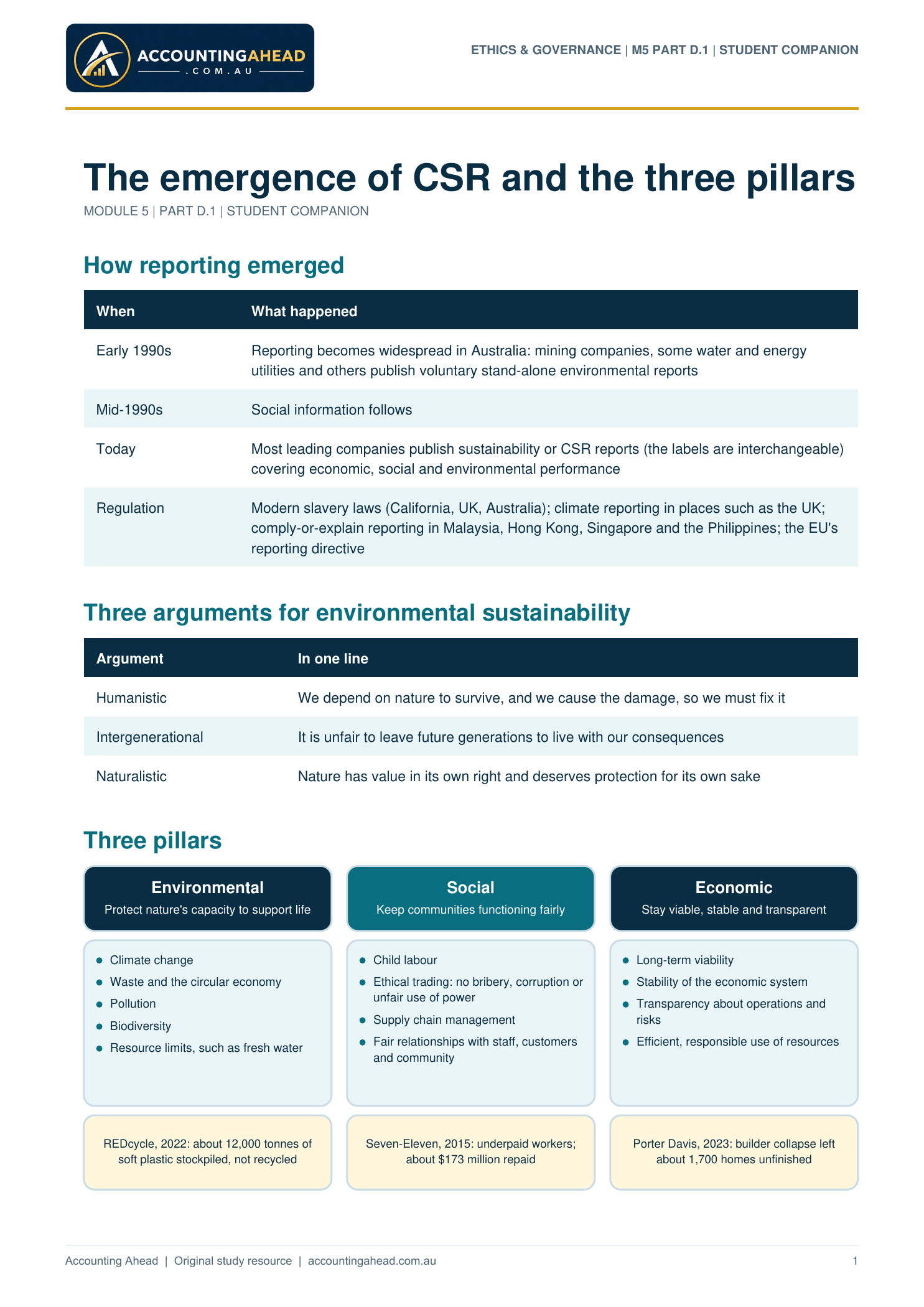
The emergence of CSR and the three pillars
MODULE 5 | PART D.1 | STUDENT COMPANION
How reporting emerged
When What happened
Early 1990s Reporting becomes widespread in Australia: mining companies, some water and energy
utilities and others publish voluntary stand-alone environmental reports
Mid-1990s Social information follows
Today Most leading companies publish sustainability or CSR reports (the labels are interchangeable)
covering economic, social and environmental performance
Regulation Modern slavery laws (California, UK, Australia); climate reporting in places such as the UK;
comply-or-explain reporting in Malaysia, Hong Kong, Singapore and the Philippines; the EU's
reporting directive
Three arguments for environmental sustainability
Argument In one line
Humanistic We depend on nature to survive, and we cause the damage, so we must fix it
Intergenerational It is unfair to leave future generations to live with our consequences
Naturalistic Nature has value in its own right and deserves protection for its own sake
Three pillars
Environmental
Protect nature's capacity to support life
Climate change
Waste and the circular economy
Pollution
Biodiversity
Resource limits, such as fresh water
REDcycle, 2022: about 12,000 tonnes of
soft plastic stockpiled, not recycled
Social
Keep communities functioning fairly
Child labour
Ethical trading: no bribery, corruption or
unfair use of power
Supply chain management
Fair relationships with staff, customers
and community
Seven-Eleven, 2015: underpaid workers;
about $173 million repaid
Economic
Stay viable, stable and transparent
Long-term viability
Stability of the economic system
Transparency about operations and
risks
Efficient, responsible use of resources
Porter Davis, 2023: builder collapse left
about 1,700 homes unfinished
ETHICS & GOVERNANCE | M5 PART D.1 | STUDENT COMPANION
1
Accounting Ahead | Original study resource | accountingahead.com.au
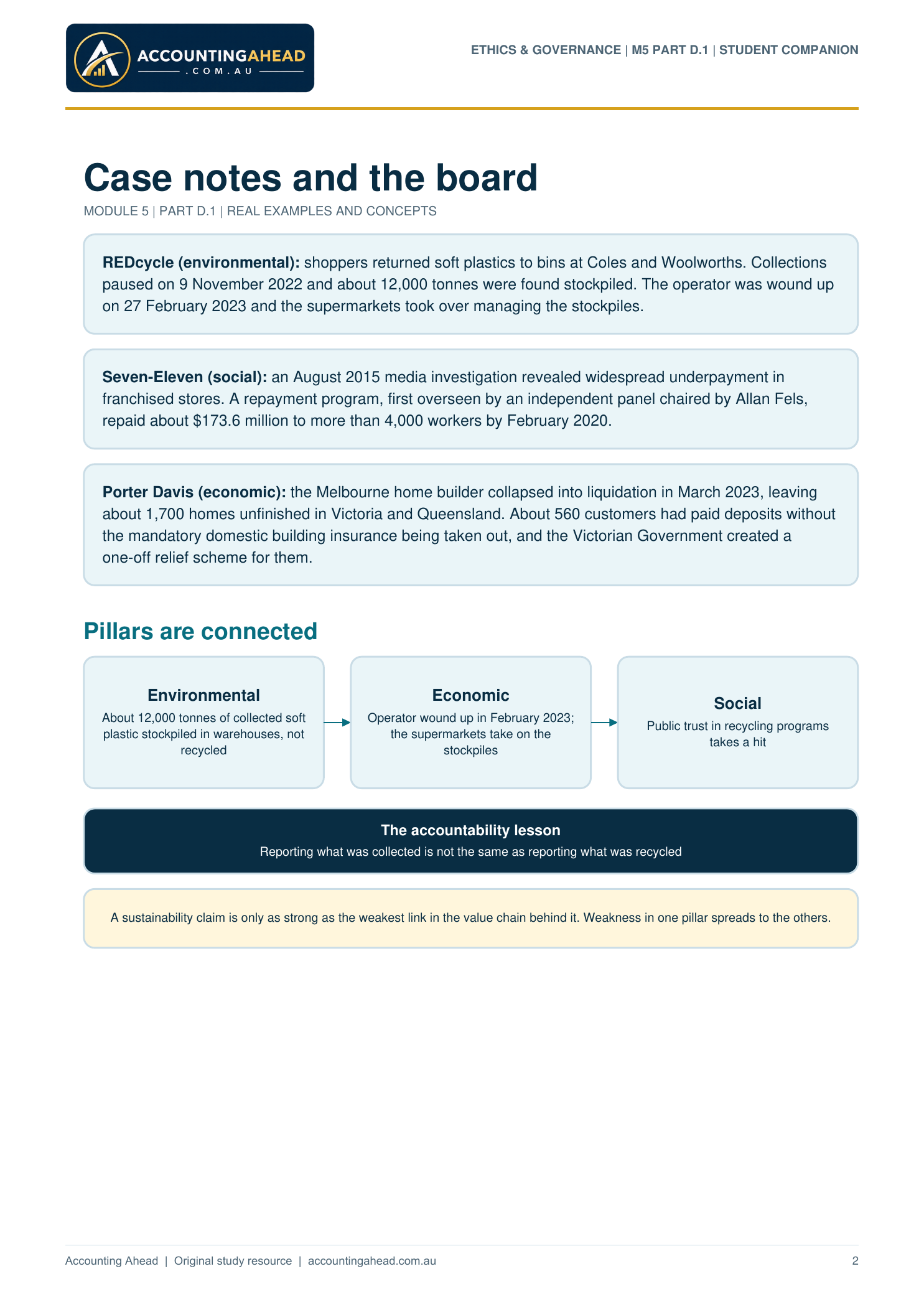
Case notes and the board
MODULE 5 | PART D.1 | REAL EXAMPLES AND CONCEPTS
REDcycle (environmental): shoppers returned soft plastics to bins at Coles and Woolworths. Collections
paused on 9 November 2022 and about 12,000 tonnes were found stockpiled. The operator was wound up
on 27 February 2023 and the supermarkets took over managing the stockpiles.
Seven-Eleven (social): an August 2015 media investigation revealed widespread underpayment in
franchised stores. A repayment program, first overseen by an independent panel chaired by Allan Fels,
repaid about $173.6 million to more than 4,000 workers by February 2020.
Porter Davis (economic): the Melbourne home builder collapsed into liquidation in March 2023, leaving
about 1,700 homes unfinished in Victoria and Queensland. About 560 customers had paid deposits without
the mandatory domestic building insurance being taken out, and the Victorian Government created a
one-off relief scheme for them.
Pillars are connected
Environmental
About 12,000 tonnes of collected soft
plastic stockpiled in warehouses, not
recycled
Economic
Operator wound up in February 2023;
the supermarkets take on the
stockpiles
Social
Public trust in recycling programs
takes a hit
The accountability lesson
Reporting what was collected is not the same as reporting what was recycled
A sustainability claim is only as strong as the weakest link in the value chain behind it. Weakness in one pillar spreads to the others.
ETHICS & GOVERNANCE | M5 PART D.1 | STUDENT COMPANION
2
Accounting Ahead | Original study resource | accountingahead.com.au
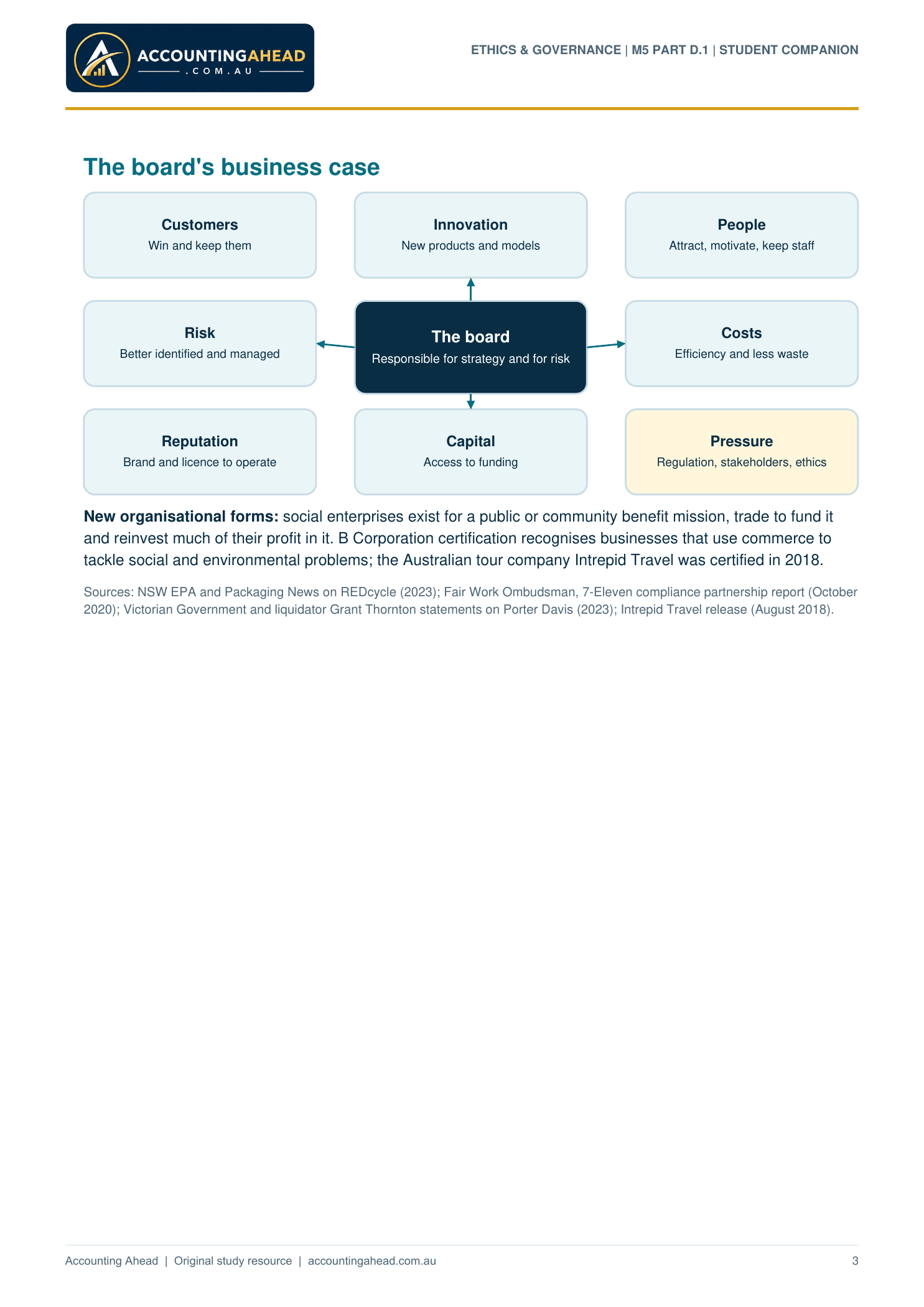
The board's business case
The board
Responsible for strategy and for risk
Customers
Win and keep them
Innovation
New products and models
People
Attract, motivate, keep staff
Risk
Better identified and managed
Costs
Efficiency and less waste
Reputation
Brand and licence to operate
Capital
Access to funding
Pressure
Regulation, stakeholders, ethics
New organisational forms: social enterprises exist for a public or community benefit mission, trade to fund it
and reinvest much of their profit in it. B Corporation certification recognises businesses that use commerce to
tackle social and environmental problems; the Australian tour company Intrepid Travel was certified in 2018.
Sources: NSW EPA and Packaging News on REDcycle (2023); Fair Work Ombudsman, 7-Eleven compliance partnership report (October
2020); Victorian Government and liquidator Grant Thornton statements on Porter Davis (2023); Intrepid Travel release (August 2018).
ETHICS & GOVERNANCE | M5 PART D.1 | STUDENT COMPANION
3
Accounting Ahead | Original study resource | accountingahead.com.au
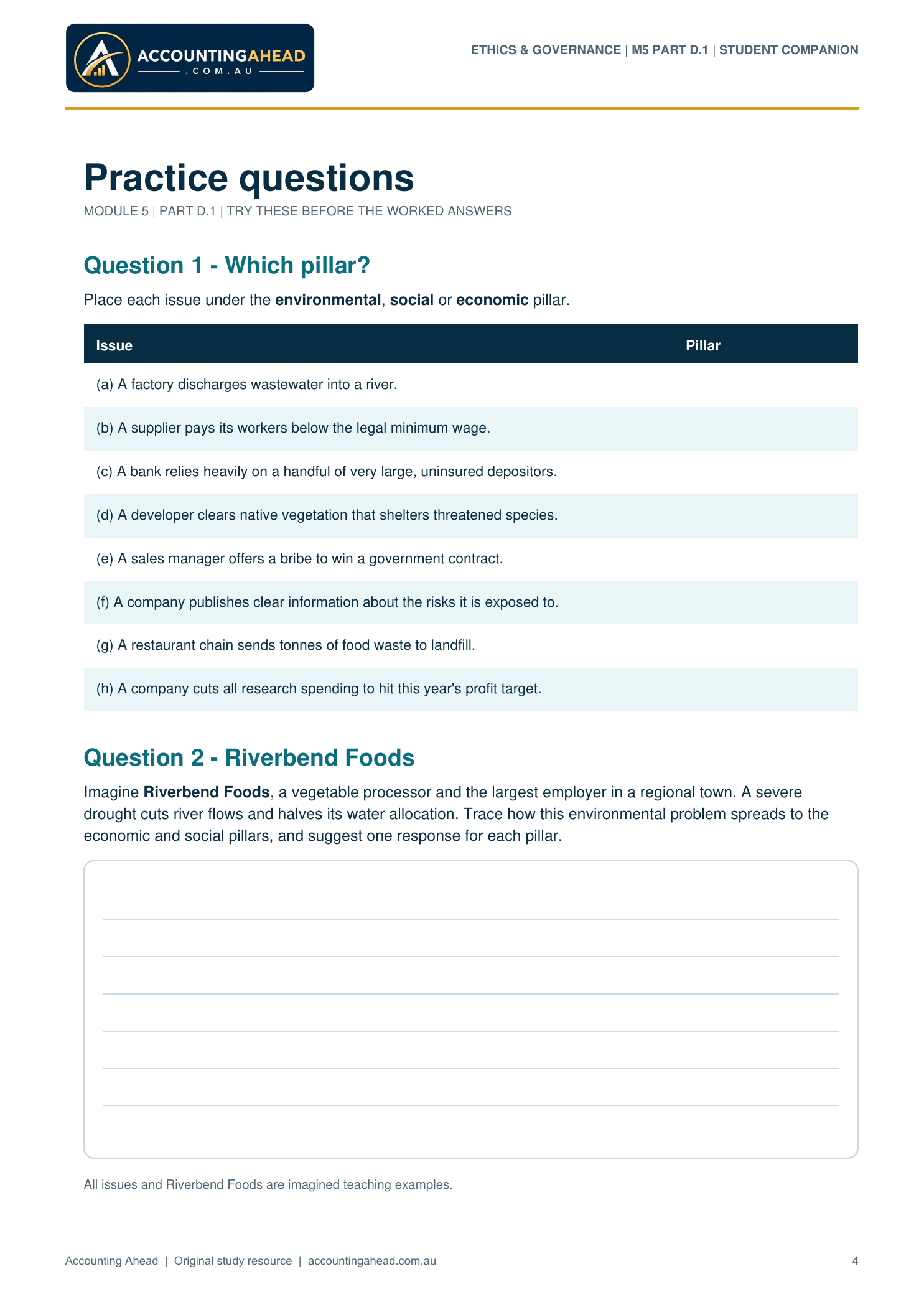
Practice questions
MODULE 5 | PART D.1 | TRY THESE BEFORE THE WORKED ANSWERS
Question 1 - Which pillar?
Place each issue under the environmental, social or economic pillar.
Issue Pillar
(a) A factory discharges wastewater into a river.
(b) A supplier pays its workers below the legal minimum wage.
(c) A bank relies heavily on a handful of very large, uninsured depositors.
(d) A developer clears native vegetation that shelters threatened species.
(e) A sales manager offers a bribe to win a government contract.
(f) A company publishes clear information about the risks it is exposed to.
(g) A restaurant chain sends tonnes of food waste to landfill.
(h) A company cuts all research spending to hit this year's profit target.
Question 2 - Riverbend Foods
Imagine Riverbend Foods, a vegetable processor and the largest employer in a regional town. A severe
drought cuts river flows and halves its water allocation. Trace how this environmental problem spreads to the
economic and social pillars, and suggest one response for each pillar.
All issues and Riverbend Foods are imagined teaching examples.
ETHICS & GOVERNANCE | M5 PART D.1 | STUDENT COMPANION
4
Accounting Ahead | Original study resource | accountingahead.com.au
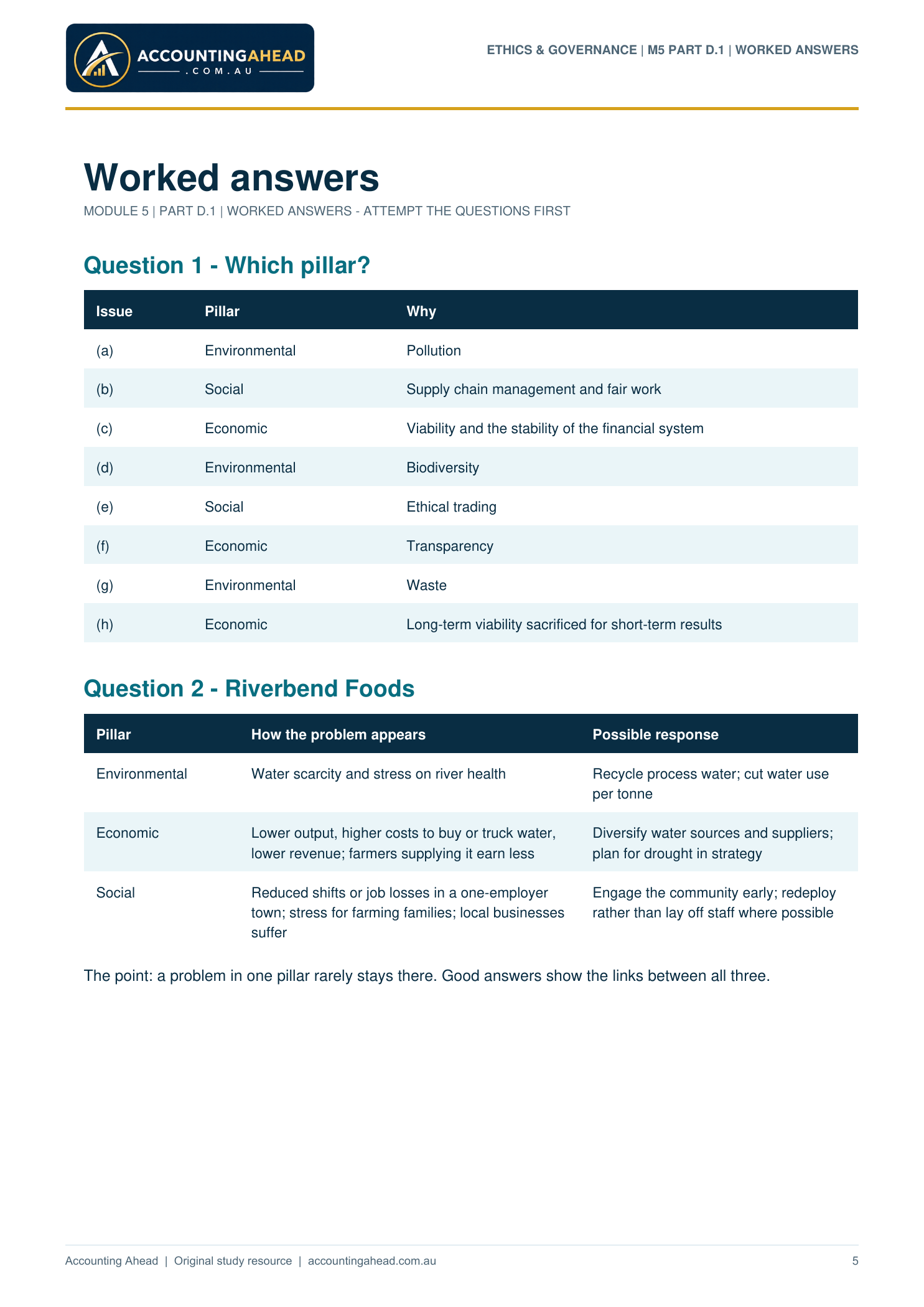
Worked answers
MODULE 5 | PART D.1 | WORKED ANSWERS - ATTEMPT THE QUESTIONS FIRST
Question 1 - Which pillar?
Issue Pillar Why
(a) Environmental Pollution
(b) Social Supply chain management and fair work
(c) Economic Viability and the stability of the financial system
(d) Environmental Biodiversity
(e) Social Ethical trading
(f) Economic Transparency
(g) Environmental Waste
(h) Economic Long-term viability sacrificed for short-term results
Question 2 - Riverbend Foods
Pillar How the problem appears Possible response
Environmental Water scarcity and stress on river health Recycle process water; cut water use
per tonne
Economic Lower output, higher costs to buy or truck water,
lower revenue; farmers supplying it earn less
Diversify water sources and suppliers;
plan for drought in strategy
Social Reduced shifts or job losses in a one-employer
town; stress for farming families; local businesses
suffer
Engage the community early; redeploy
rather than lay off staff where possible
The point: a problem in one pillar rarely stays there. Good answers show the links between all three.
ETHICS & GOVERNANCE | M5 PART D.1 | WORKED ANSWERS
5