
Who business is responsible to — student companion
Original branded notes, diagrams and practice with worked answers for Part B.2: compare shareholder primacy with the social contract, distinguish Australian and UK duties, and plan reporting around purpose, audience and content.
Read the handout text
Accounting Ahead | Original study resource | accountingahead.com.au
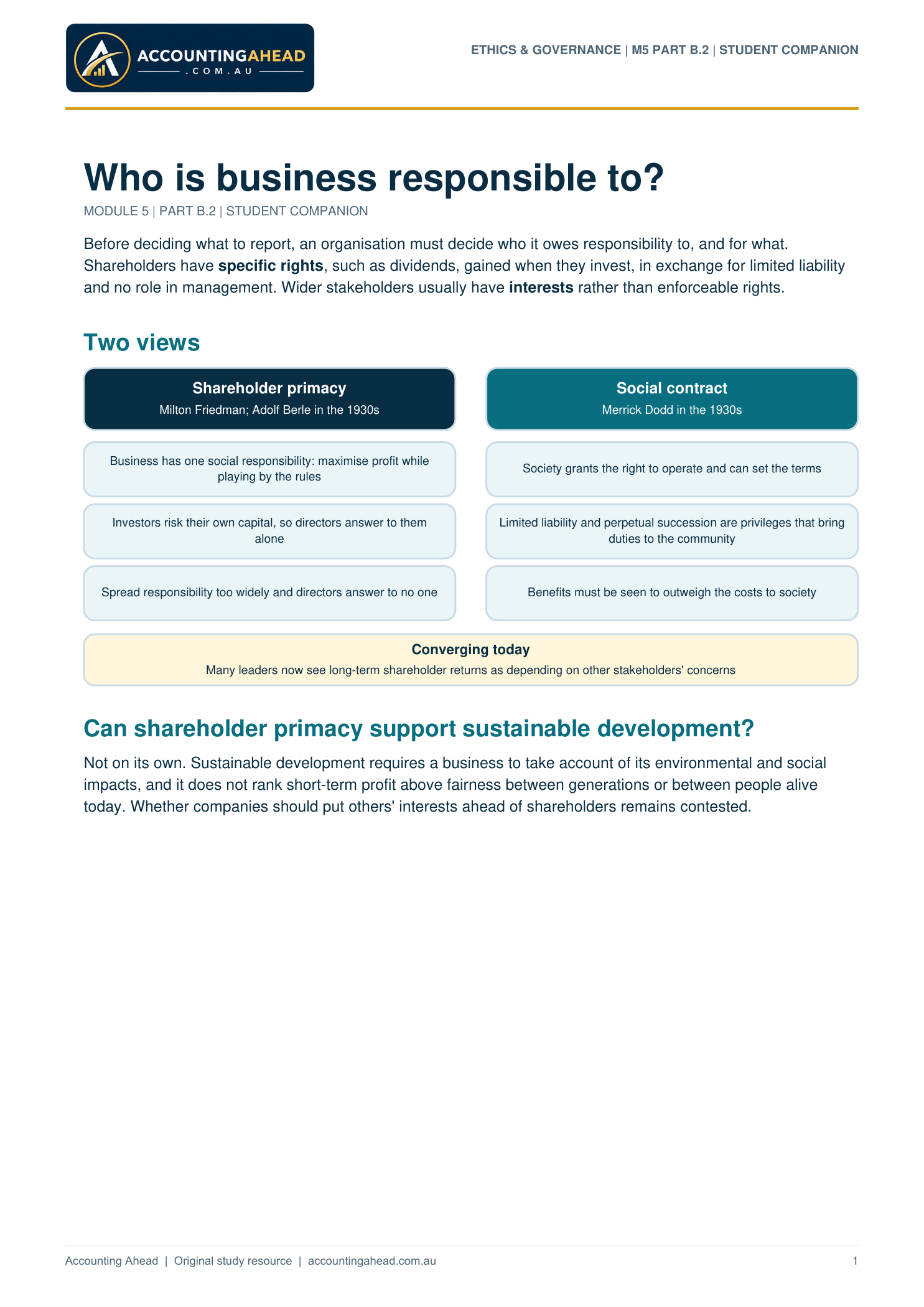
Who is business responsible to?
MODULE 5 | PART B.2 | STUDENT COMPANION
Before deciding what to report, an organisation must decide who it owes responsibility to, and for what.
Shareholders have specific rights, such as dividends, gained when they invest, in exchange for limited liability
and no role in management. Wider stakeholders usually have interests rather than enforceable rights.
Two views
Shareholder primacy
Milton Friedman; Adolf Berle in the 1930s
Social contract
Merrick Dodd in the 1930s
Business has one social responsibility: maximise profit while
playing by the rules Society grants the right to operate and can set the terms
Investors risk their own capital, so directors answer to them
alone
Limited liability and perpetual succession are privileges that bring
duties to the community
Spread responsibility too widely and directors answer to no one Benefits must be seen to outweigh the costs to society
Converging today
Many leaders now see long-term shareholder returns as depending on other stakeholders' concerns
Can shareholder primacy support sustainable development?
Not on its own. Sustainable development requires a business to take account of its environmental and social
impacts, and it does not rank short-term profit above fairness between generations or between people alive
today. Whether companies should put others' interests ahead of shareholders remains contested.
ETHICS & GOVERNANCE | M5 PART B.2 | STUDENT COMPANION
1
Accounting Ahead | Original study resource | accountingahead.com.au
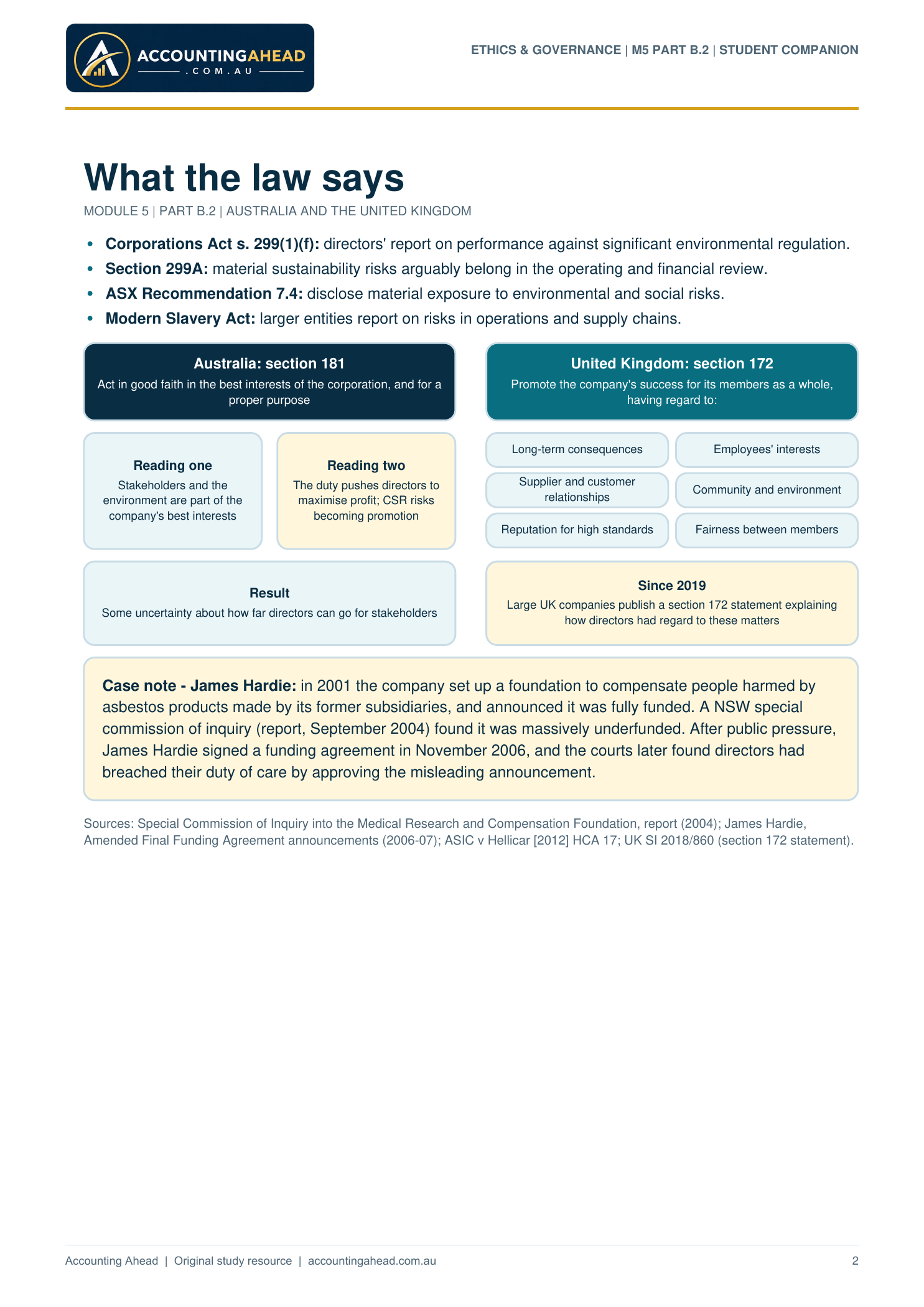
What the law says
MODULE 5 | PART B.2 | AUSTRALIA AND THE UNITED KINGDOM
Corporations Act s. 299(1)(f): directors' report on performance against significant environmental regulation.
Section 299A: material sustainability risks arguably belong in the operating and financial review.
ASX Recommendation 7.4: disclose material exposure to environmental and social risks.
Modern Slavery Act: larger entities report on risks in operations and supply chains.
Australia: section 181
Act in good faith in the best interests of the corporation, and for a
proper purpose
Reading one
Stakeholders and the
environment are part of the
company's best interests
Reading two
The duty pushes directors to
maximise profit; CSR risks
becoming promotion
Result
Some uncertainty about how far directors can go for stakeholders
United Kingdom: section 172
Promote the company's success for its members as a whole,
having regard to:
Long-term consequences Employees' interests
Supplier and customer
relationships Community and environment
Reputation for high standards Fairness between members
Since 2019
Large UK companies publish a section 172 statement explaining
how directors had regard to these matters
Case note - James Hardie: in 2001 the company set up a foundation to compensate people harmed by
asbestos products made by its former subsidiaries, and announced it was fully funded. A NSW special
commission of inquiry (report, September 2004) found it was massively underfunded. After public pressure,
James Hardie signed a funding agreement in November 2006, and the courts later found directors had
breached their duty of care by approving the misleading announcement.
Sources: Special Commission of Inquiry into the Medical Research and Compensation Foundation, report (2004); James Hardie,
Amended Final Funding Agreement announcements (2006-07); ASIC v Hellicar [2012] HCA 17; UK SI 2018/860 (section 172 statement).
ETHICS & GOVERNANCE | M5 PART B.2 | STUDENT COMPANION
2
Accounting Ahead | Original study resource | accountingahead.com.au
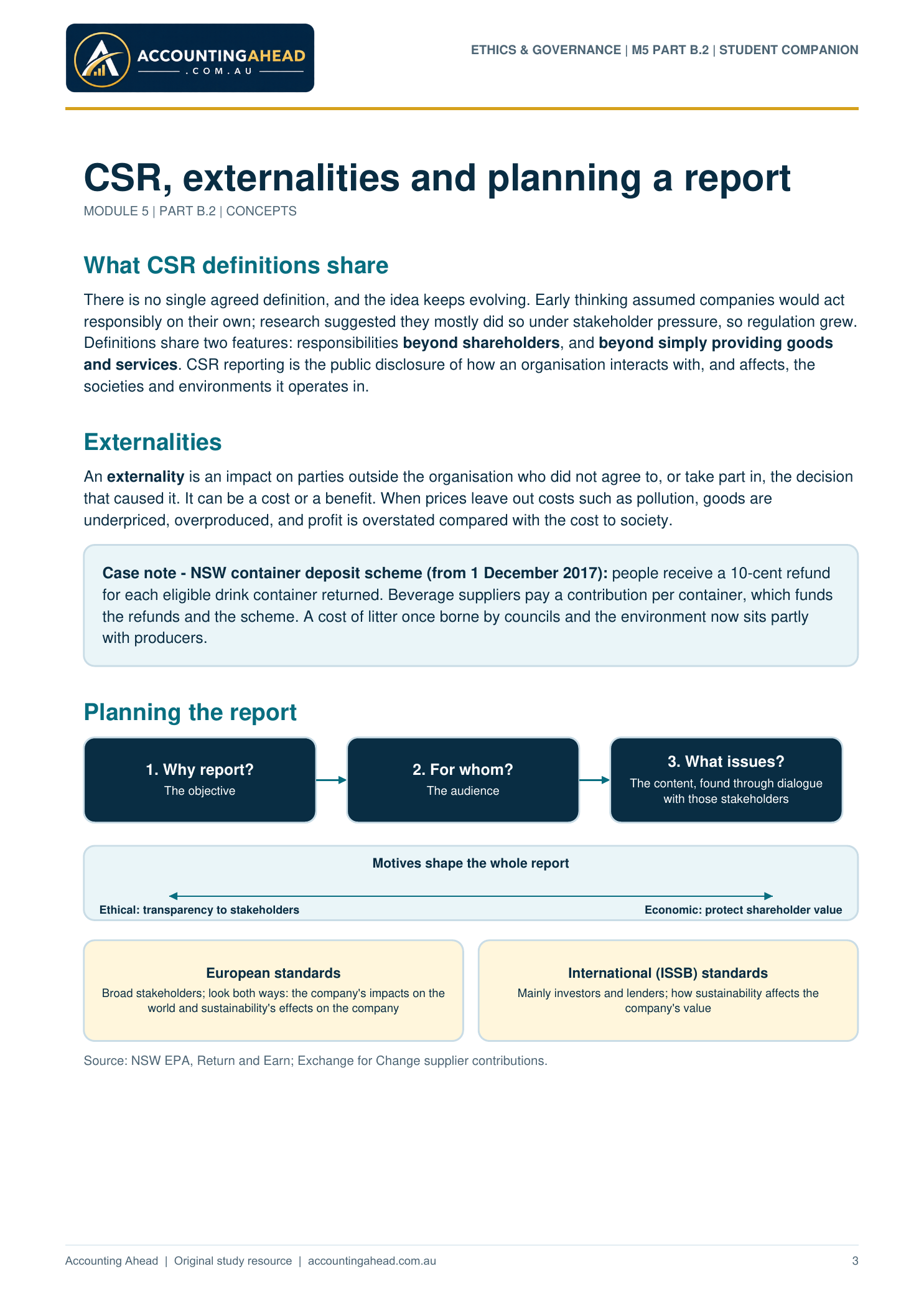
CSR, externalities and planning a report
MODULE 5 | PART B.2 | CONCEPTS
What CSR definitions share
There is no single agreed definition, and the idea keeps evolving. Early thinking assumed companies would act
responsibly on their own; research suggested they mostly did so under stakeholder pressure, so regulation grew.
Definitions share two features: responsibilities beyond shareholders, and beyond simply providing goods
and services. CSR reporting is the public disclosure of how an organisation interacts with, and affects, the
societies and environments it operates in.
Externalities
An externality is an impact on parties outside the organisation who did not agree to, or take part in, the decision
that caused it. It can be a cost or a benefit. When prices leave out costs such as pollution, goods are
underpriced, overproduced, and profit is overstated compared with the cost to society.
Case note - NSW container deposit scheme (from 1 December 2017): people receive a 10-cent refund
for each eligible drink container returned. Beverage suppliers pay a contribution per container, which funds
the refunds and the scheme. A cost of litter once borne by councils and the environment now sits partly
with producers.
Planning the report
1. Why report?
The objective
2. For whom?
The audience
3. What issues?
The content, found through dialogue
with those stakeholders
Motives shape the whole report
Ethical: transparency to stakeholders Economic: protect shareholder value
European standards
Broad stakeholders; look both ways: the company's impacts on the
world and sustainability's effects on the company
International (ISSB) standards
Mainly investors and lenders; how sustainability affects the
company's value
Source: NSW EPA, Return and Earn; Exchange for Change supplier contributions.
ETHICS & GOVERNANCE | M5 PART B.2 | STUDENT COMPANION
3
Accounting Ahead | Original study resource | accountingahead.com.au
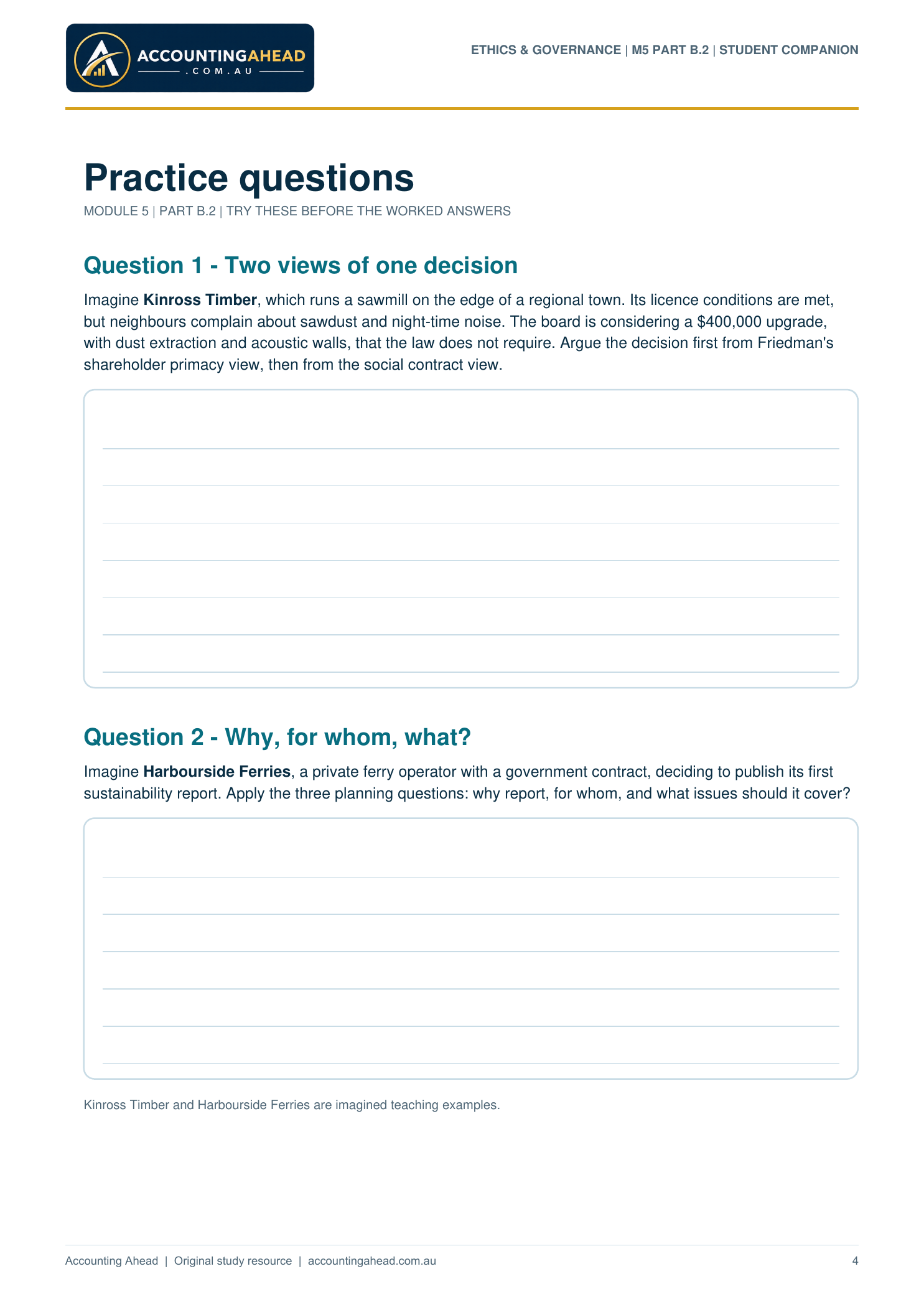
Practice questions
MODULE 5 | PART B.2 | TRY THESE BEFORE THE WORKED ANSWERS
Question 1 - Two views of one decision
Imagine Kinross Timber, which runs a sawmill on the edge of a regional town. Its licence conditions are met,
but neighbours complain about sawdust and night-time noise. The board is considering a $400,000 upgrade,
with dust extraction and acoustic walls, that the law does not require. Argue the decision first from Friedman's
shareholder primacy view, then from the social contract view.
Question 2 - Why, for whom, what?
Imagine Harbourside Ferries, a private ferry operator with a government contract, deciding to publish its first
sustainability report. Apply the three planning questions: why report, for whom, and what issues should it cover?
Kinross Timber and Harbourside Ferries are imagined teaching examples.
ETHICS & GOVERNANCE | M5 PART B.2 | STUDENT COMPANION
4
Accounting Ahead | Original study resource | accountingahead.com.au
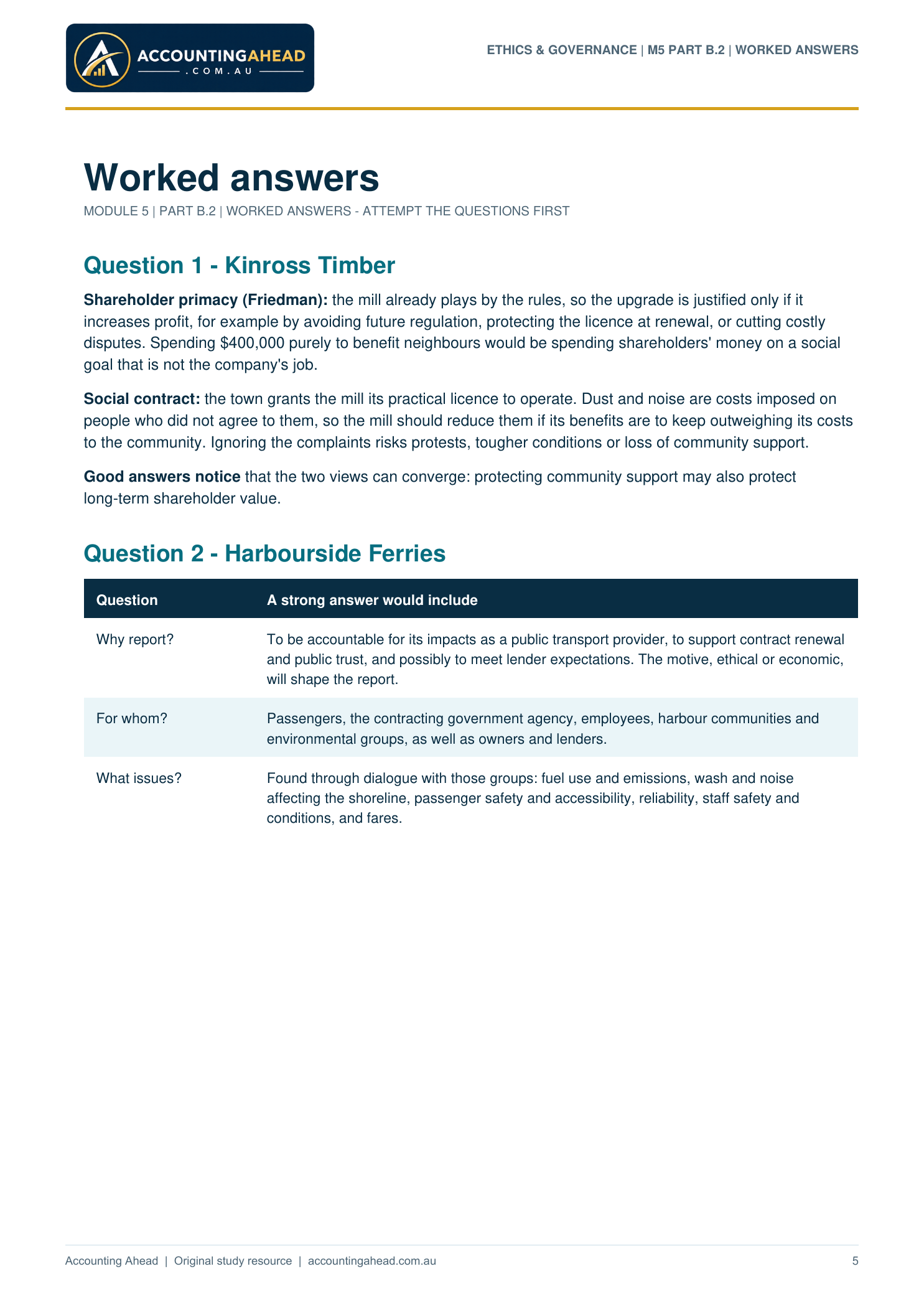
Worked answers
MODULE 5 | PART B.2 | WORKED ANSWERS - ATTEMPT THE QUESTIONS FIRST
Question 1 - Kinross Timber
Shareholder primacy (Friedman): the mill already plays by the rules, so the upgrade is justified only if it
increases profit, for example by avoiding future regulation, protecting the licence at renewal, or cutting costly
disputes. Spending $400,000 purely to benefit neighbours would be spending shareholders' money on a social
goal that is not the company's job.
Social contract: the town grants the mill its practical licence to operate. Dust and noise are costs imposed on
people who did not agree to them, so the mill should reduce them if its benefits are to keep outweighing its costs
to the community. Ignoring the complaints risks protests, tougher conditions or loss of community support.
Good answers notice that the two views can converge: protecting community support may also protect
long-term shareholder value.
Question 2 - Harbourside Ferries
Question A strong answer would include
Why report? To be accountable for its impacts as a public transport provider, to support contract renewal
and public trust, and possibly to meet lender expectations. The motive, ethical or economic,
will shape the report.
For whom? Passengers, the contracting government agency, employees, harbour communities and
environmental groups, as well as owners and lenders.
What issues? Found through dialogue with those groups: fuel use and emissions, wash and noise
affecting the shoreline, passenger safety and accessibility, reliability, staff safety and
conditions, and fares.
ETHICS & GOVERNANCE | M5 PART B.2 | WORKED ANSWERS
5