
Officers, independence and company powers — study companion
Distinguish officeholders, test director independence and trace the powers of members, directors and management. Includes structured notes, practice questions and worked answers.
Read the handout text
Accounting Ahead | Original study resource | accountingahead.com.au
Officers and independence
MODULE 3 | PART A.3 | STUDENT COMPANION
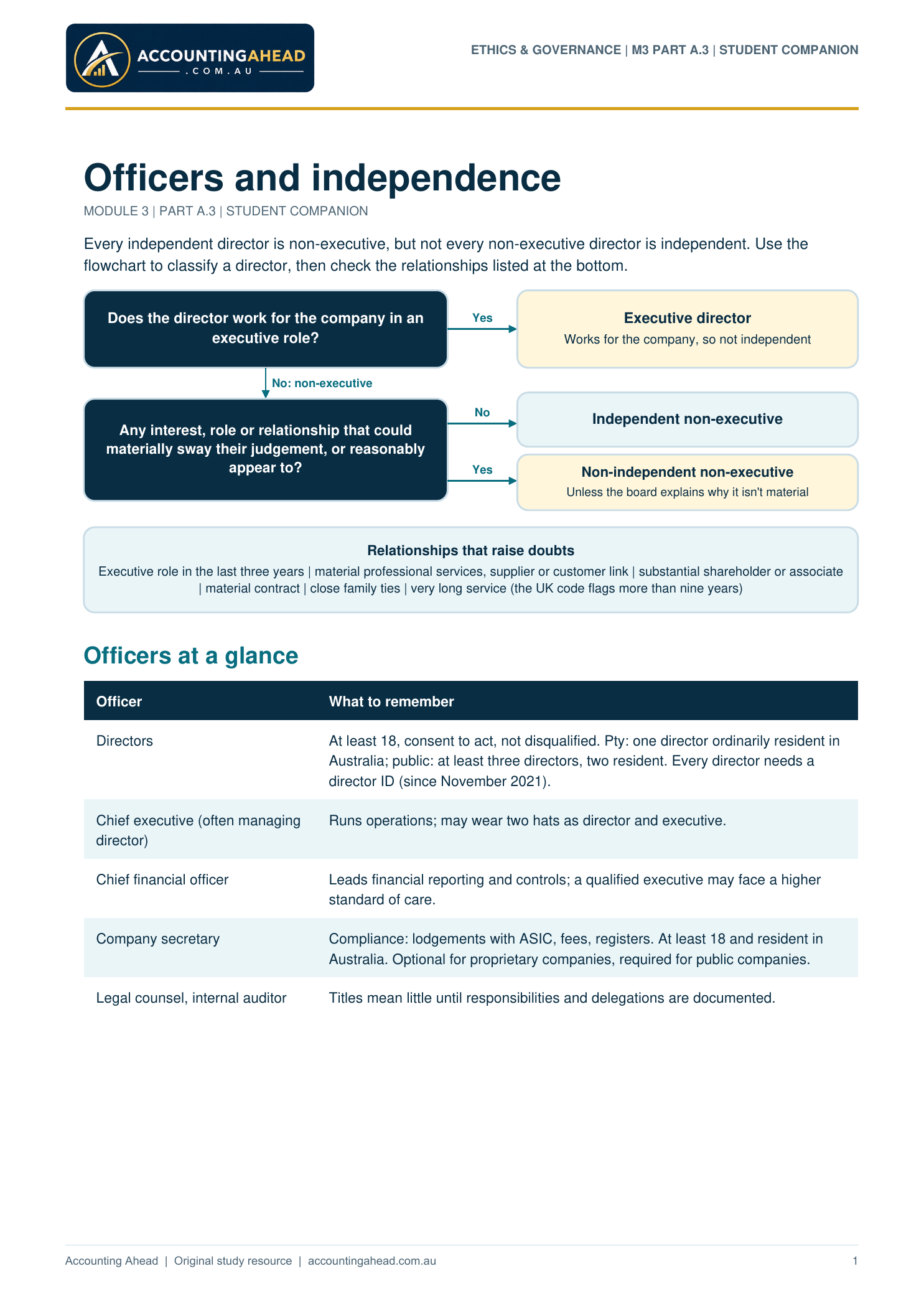
Every independent director is non-executive, but not every non-executive director is independent. Use the
flowchart to classify a director, then check the relationships listed at the bottom.
Does the director work for the company in an
executive role?
Yes Executive director
Works for the company, so not independent
No: non-executive
Any interest, role or relationship that could
materially sway their judgement, or reasonably
appear to?
No Independent non-executive
Yes Non-independent non-executive
Unless the board explains why it isn't material
Relationships that raise doubts
Executive role in the last three years | material professional services, supplier or customer link | substantial shareholder or associate
| material contract | close family ties | very long service (the UK code flags more than nine years)
Officers at a glance
Officer What to remember
Directors At least 18, consent to act, not disqualified. Pty: one director ordinarily resident in
Australia; public: at least three directors, two resident. Every director needs a
director ID (since November 2021).
Chief executive (often managing
director)
Runs operations; may wear two hats as director and executive.
Chief financial officer Leads financial reporting and controls; a qualified executive may face a higher
standard of care.
Company secretary Compliance: lodgements with ASIC, fees, registers. At least 18 and resident in
Australia. Optional for proprietary companies, required for public companies.
Legal counsel, internal auditor Titles mean little until responsibilities and delegations are documented.
ETHICS & GOVERNANCE | M3 PART A.3 | STUDENT COMPANION
1
Accounting Ahead | Original study resource | accountingahead.com.au
Who holds which power?
MODULE 3 | PART A.3 | DIVISION OF CORPORATE POWERS
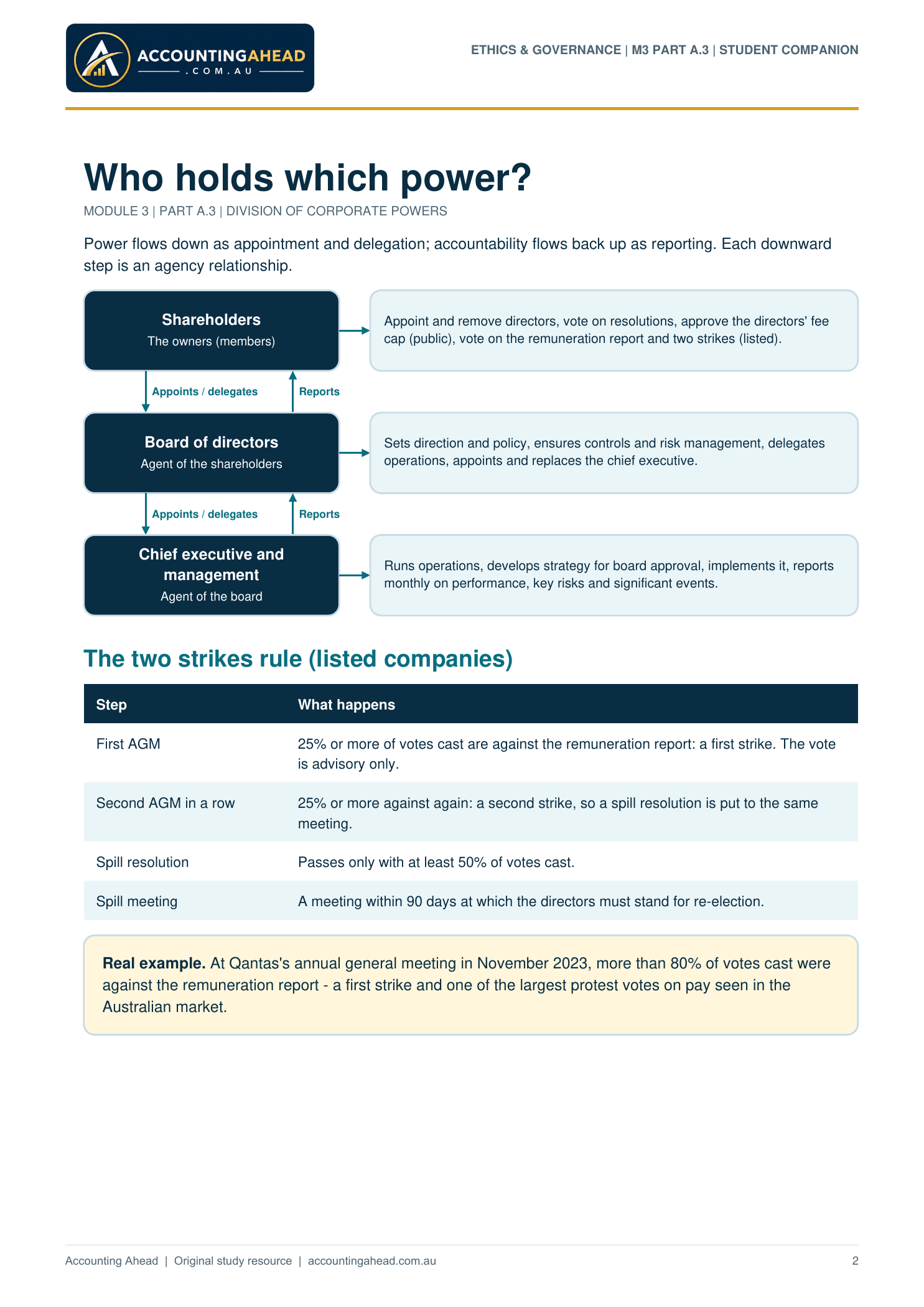
Power flows down as appointment and delegation; accountability flows back up as reporting. Each downward
step is an agency relationship.
Shareholders
The owners (members)
Appoint and remove directors, vote on resolutions, approve the directors' fee
cap (public), vote on the remuneration report and two strikes (listed).
Appoints / delegates Reports
Board of directors
Agent of the shareholders
Sets direction and policy, ensures controls and risk management, delegates
operations, appoints and replaces the chief executive.
Appoints / delegates Reports
Chief executive and
management
Agent of the board
Runs operations, develops strategy for board approval, implements it, reports
monthly on performance, key risks and significant events.
The two strikes rule (listed companies)
Step What happens
First AGM 25% or more of votes cast are against the remuneration report: a first strike. The vote
is advisory only.
Second AGM in a row 25% or more against again: a second strike, so a spill resolution is put to the same
meeting.
Spill resolution Passes only with at least 50% of votes cast.
Spill meeting A meeting within 90 days at which the directors must stand for re-election.
Real example. At Qantas's annual general meeting in November 2023, more than 80% of votes cast were
against the remuneration report - a first strike and one of the largest protest votes on pay seen in the
Australian market.
ETHICS & GOVERNANCE | M3 PART A.3 | STUDENT COMPANION
2
Accounting Ahead | Original study resource | accountingahead.com.au
Practice questions
MODULE 3 | PART A.3 | TRY THESE BEFORE THE WORKED ANSWERS
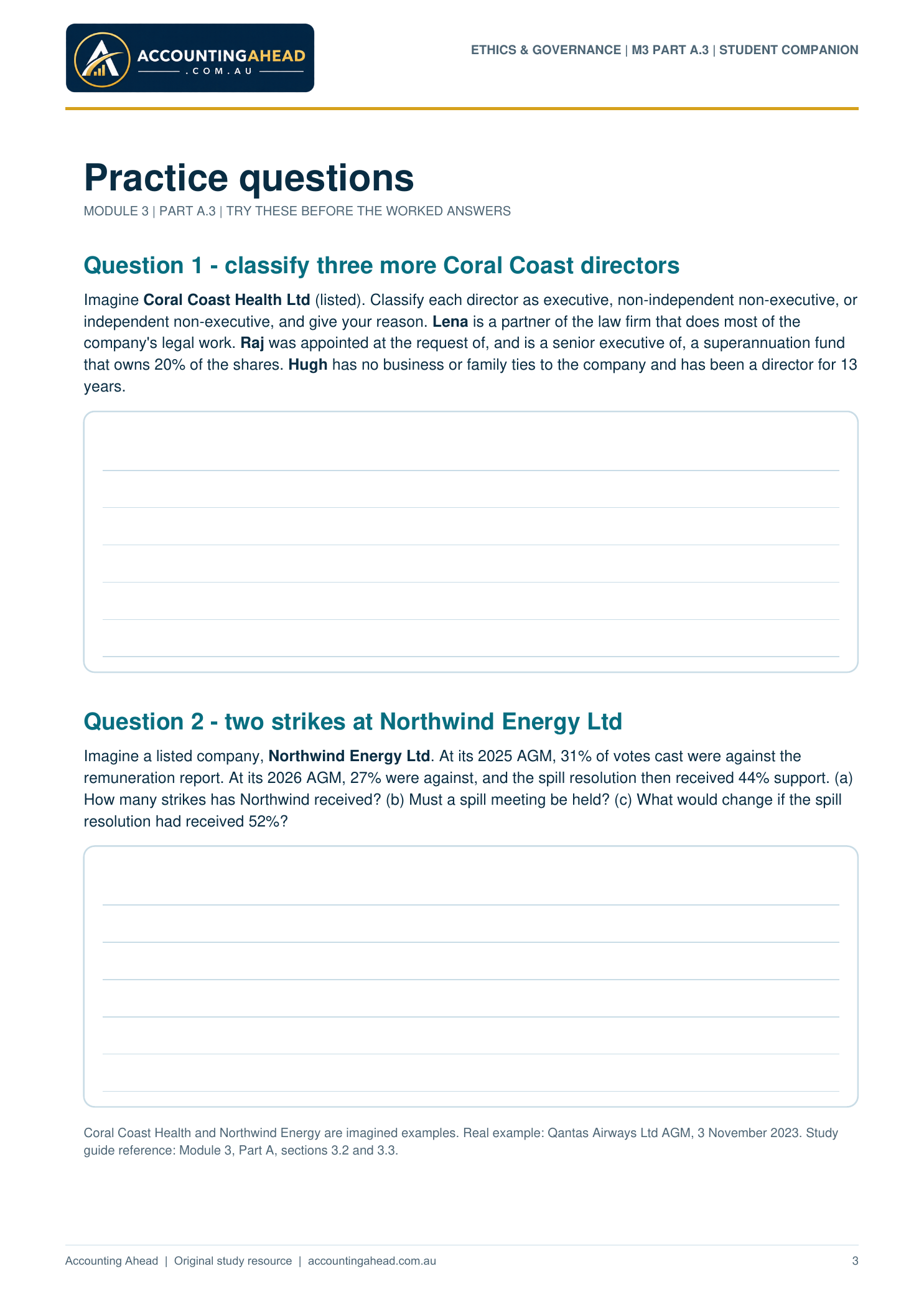
Question 1 - classify three more Coral Coast directors
Imagine Coral Coast Health Ltd (listed). Classify each director as executive, non-independent non-executive, or
independent non-executive, and give your reason. Lena is a partner of the law firm that does most of the
company's legal work. Raj was appointed at the request of, and is a senior executive of, a superannuation fund
that owns 20% of the shares. Hugh has no business or family ties to the company and has been a director for 13
years.
Question 2 - two strikes at Northwind Energy Ltd
Imagine a listed company, Northwind Energy Ltd. At its 2025 AGM, 31% of votes cast were against the
remuneration report. At its 2026 AGM, 27% were against, and the spill resolution then received 44% support. (a)
How many strikes has Northwind received? (b) Must a spill meeting be held? (c) What would change if the spill
resolution had received 52%?
Coral Coast Health and Northwind Energy are imagined examples. Real example: Qantas Airways Ltd AGM, 3 November 2023. Study
guide reference: Module 3, Part A, sections 3.2 and 3.3.
ETHICS & GOVERNANCE | M3 PART A.3 | STUDENT COMPANION
3
Accounting Ahead | Original study resource | accountingahead.com.au
Worked answers
MODULE 3 | PART A.3 | WORKED ANSWERS - ATTEMPT THE QUESTIONS FIRST
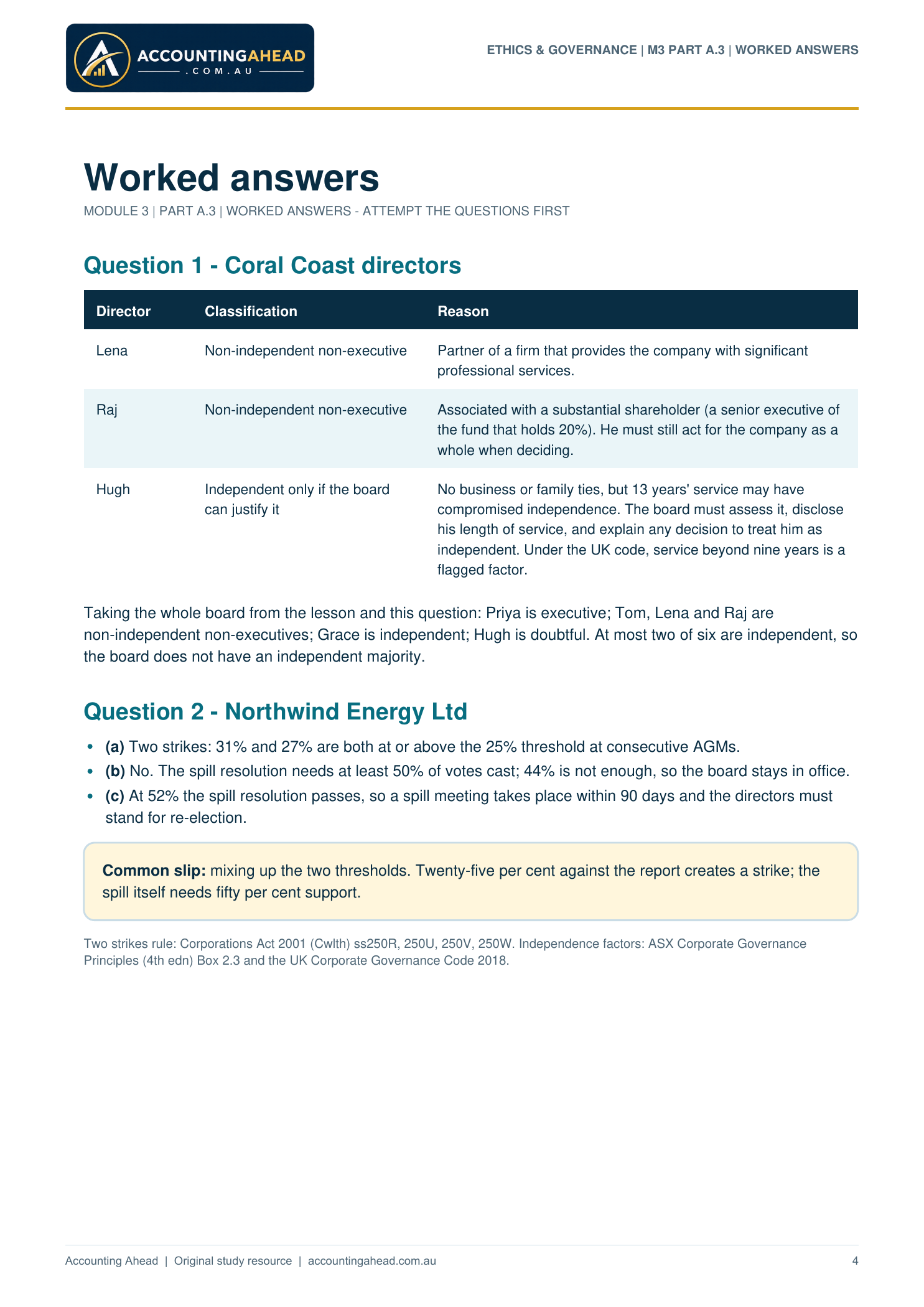
Question 1 - Coral Coast directors
Director Classification Reason
Lena Non-independent non-executive Partner of a firm that provides the company with significant
professional services.
Raj Non-independent non-executive Associated with a substantial shareholder (a senior executive of
the fund that holds 20%). He must still act for the company as a
whole when deciding.
Hugh Independent only if the board
can justify it
No business or family ties, but 13 years' service may have
compromised independence. The board must assess it, disclose
his length of service, and explain any decision to treat him as
independent. Under the UK code, service beyond nine years is a
flagged factor.
Taking the whole board from the lesson and this question: Priya is executive; Tom, Lena and Raj are
non-independent non-executives; Grace is independent; Hugh is doubtful. At most two of six are independent, so
the board does not have an independent majority.
Question 2 - Northwind Energy Ltd
(a) Two strikes: 31% and 27% are both at or above the 25% threshold at consecutive AGMs.
(b) No. The spill resolution needs at least 50% of votes cast; 44% is not enough, so the board stays in office.
(c) At 52% the spill resolution passes, so a spill meeting takes place within 90 days and the directors must
stand for re-election.
Common slip: mixing up the two thresholds. Twenty-five per cent against the report creates a strike; the
spill itself needs fifty per cent support.
Two strikes rule: Corporations Act 2001 (Cwlth) ss250R, 250U, 250V, 250W. Independence factors: ASX Corporate Governance
Principles (4th edn) Box 2.3 and the UK Corporate Governance Code 2018.
ETHICS & GOVERNANCE | M3 PART A.3 | WORKED ANSWERS
4