
Appointments, independence and NOCLAR companion
Compare appointment and independence decisions, then follow the role-based response to non-compliance.
Read the handout text
Accounting Ahead | Original study resource | accountingahead.com.au
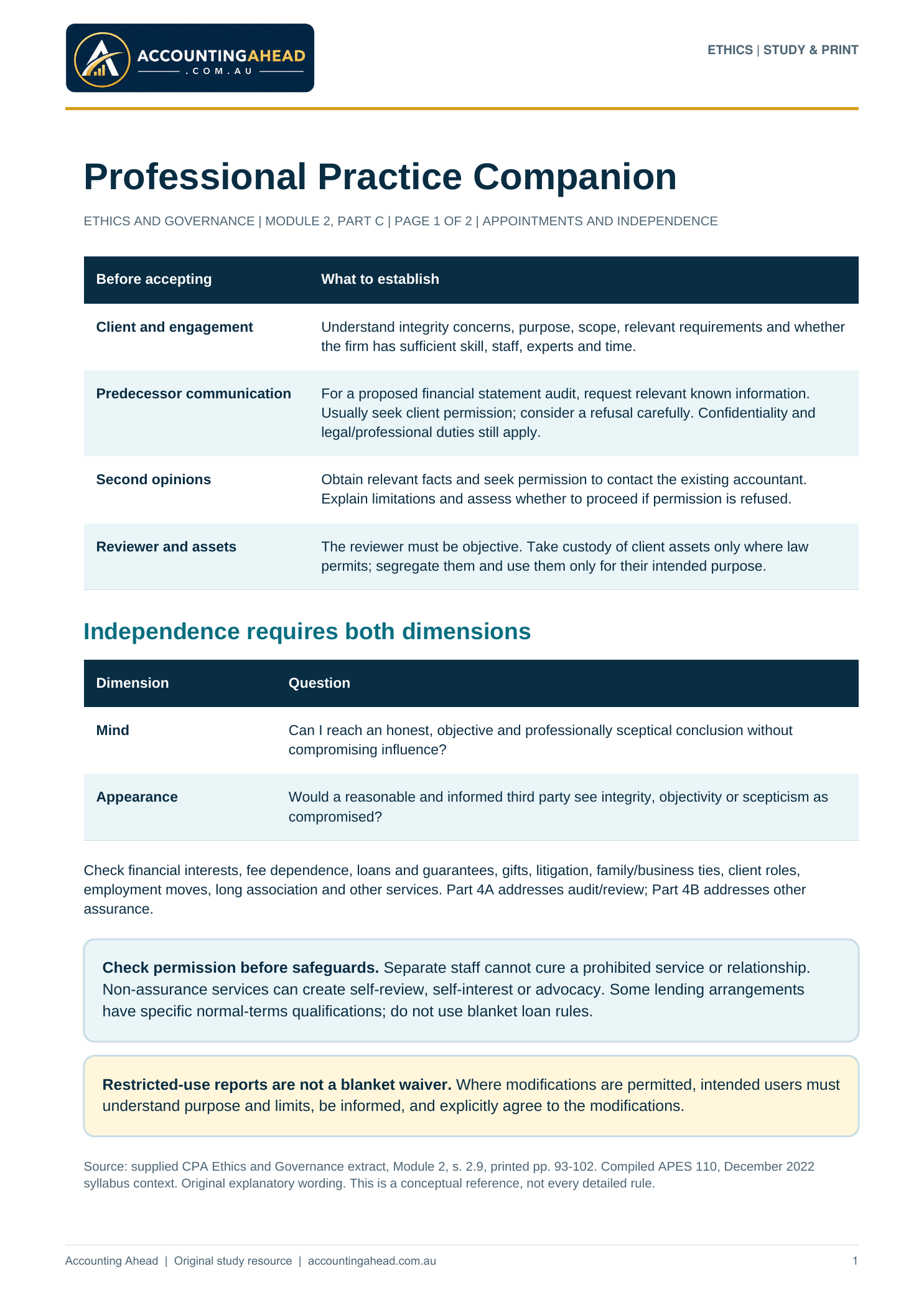
Professional Practice Companion
ETHICS AND GOVERNANCE | MODULE 2, PART C | PAGE 1 OF 2 | APPOINTMENTS AND INDEPENDENCE
Before accepting
What to establish
Client and engagement
Understand integrity concerns, purpose, scope, relevant requirements and whether
the firm has sufficient skill, staff, experts and time.
Predecessor communication
For a proposed financial statement audit, request relevant known information.
Usually seek client permission; consider a refusal carefully. Confidentiality and
legal/professional duties still apply.
Second opinions
Obtain relevant facts and seek permission to contact the existing accountant.
Explain limitations and assess whether to proceed if permission is refused.
Reviewer and assets
The reviewer must be objective. Take custody of client assets only where law
permits; segregate them and use them only for their intended purpose.
Independence requires both dimensions
Dimension
Question
Mind
Can I reach an honest, objective and professionally sceptical conclusion without
compromising influence?
Appearance
Would a reasonable and informed third party see integrity, objectivity or scepticism as
compromised?
Check financial interests, fee dependence, loans and guarantees, gifts, litigation, family/business ties, client roles,
employment moves, long association and other services. Part 4A addresses audit/review; Part 4B addresses other
assurance.
Check permission before safeguards. Separate staff cannot cure a prohibited service or relationship.
Non-assurance services can create self-review, self-interest or advocacy. Some lending arrangements
have specific normal-terms qualifications; do not use blanket loan rules.
Restricted-use reports are not a blanket waiver. Where modifications are permitted, intended users must
understand purpose and limits, be informed, and explicitly agree to the modifications.
Source: supplied CPA Ethics and Governance extract, Module 2, s. 2.9, printed pp. 93-102. Compiled APES 110, December 2022
syllabus context. Original explanatory wording. This is a conceptual reference, not every detailed rule.
ETHICS | STUDY & PRINT
1
Accounting Ahead | Original study resource | accountingahead.com.au
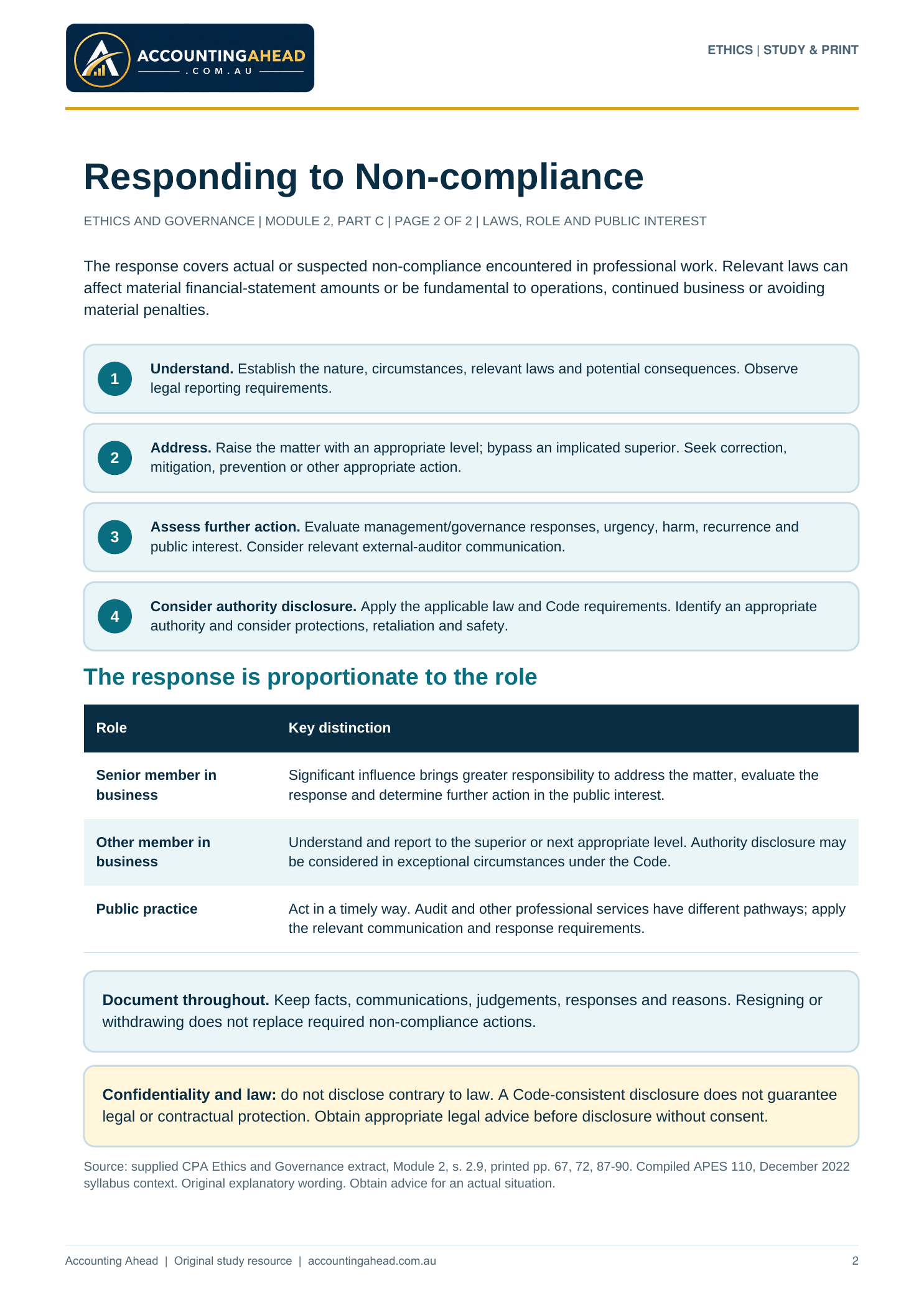
Responding to Non-compliance
ETHICS AND GOVERNANCE | MODULE 2, PART C | PAGE 2 OF 2 | LAWS, ROLE AND PUBLIC INTEREST
The response covers actual or suspected non-compliance encountered in professional work. Relevant laws can
affect material financial-statement amounts or be fundamental to operations, continued business or avoiding
material penalties.
1
Understand. Establish the nature, circumstances, relevant laws and potential consequences. Observe
legal reporting requirements.
2
Address. Raise the matter with an appropriate level; bypass an implicated superior. Seek correction,
mitigation, prevention or other appropriate action.
3
Assess further action. Evaluate management/governance responses, urgency, harm, recurrence and
public interest. Consider relevant external-auditor communication.
4
Consider authority disclosure. Apply the applicable law and Code requirements. Identify an appropriate
authority and consider protections, retaliation and safety.
The response is proportionate to the role
Role
Key distinction
Senior member in
business
Significant influence brings greater responsibility to address the matter, evaluate the
response and determine further action in the public interest.
Other member in
business
Understand and report to the superior or next appropriate level. Authority disclosure may
be considered in exceptional circumstances under the Code.
Public practice
Act in a timely way. Audit and other professional services have different pathways; apply
the relevant communication and response requirements.
Document throughout. Keep facts, communications, judgements, responses and reasons. Resigning or
withdrawing does not replace required non-compliance actions.
Confidentiality and law: do not disclose contrary to law. A Code-consistent disclosure does not guarantee
legal or contractual protection. Obtain appropriate legal advice before disclosure without consent.
Source: supplied CPA Ethics and Governance extract, Module 2, s. 2.9, printed pp. 67, 72, 87-90. Compiled APES 110, December 2022
syllabus context. Original explanatory wording. Obtain advice for an actual situation.
ETHICS | STUDY & PRINT
2