
Shareholders, boards and board committees — study companion
Follow the accountability chain and assess the work, membership and independence of board committees. Includes structured notes, practice questions and worked answers.
Read the handout text
Accounting Ahead | Original study resource | accountingahead.com.au
The governance framework
MODULE 3 | PART B.2 | STUDENT COMPANION
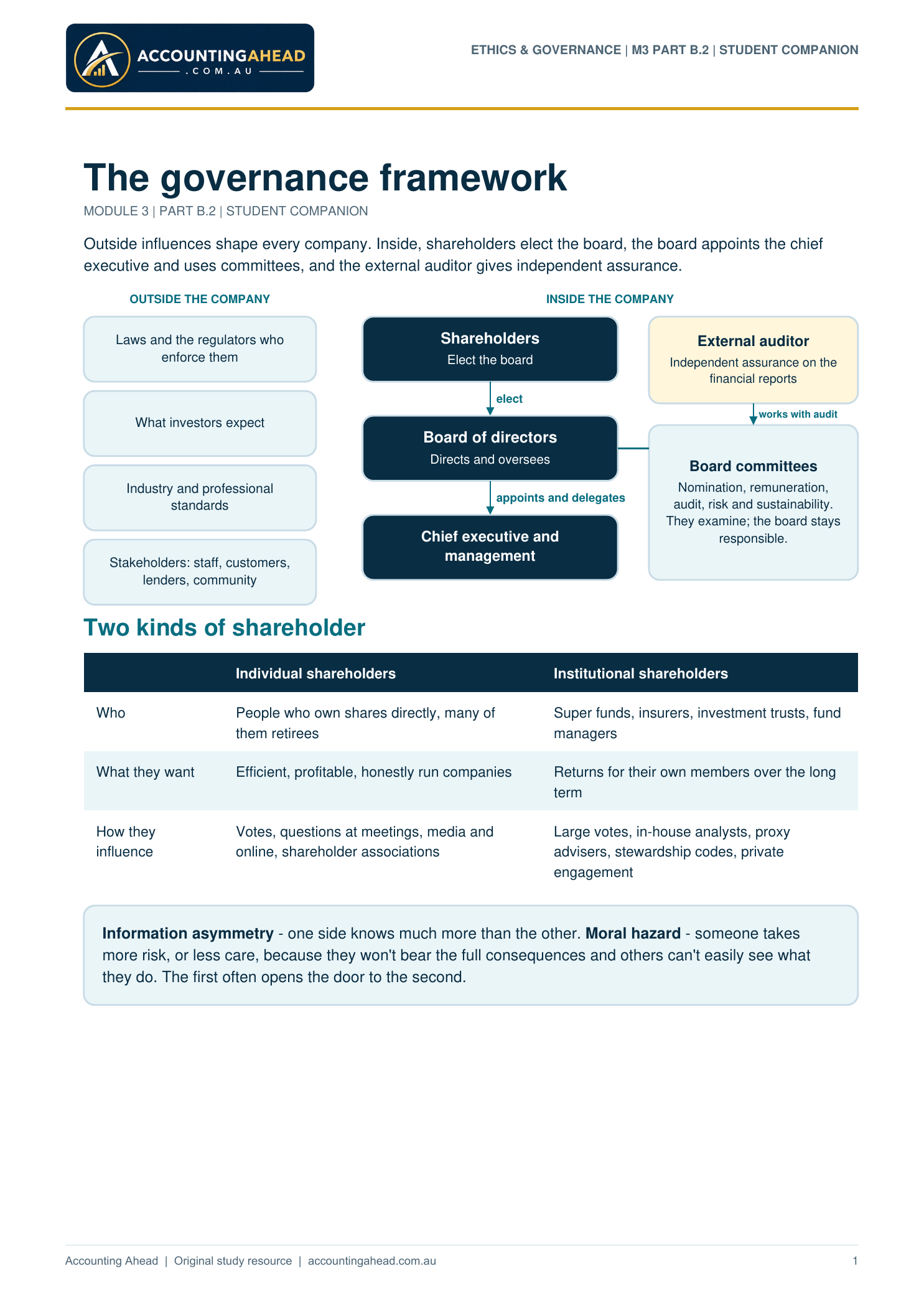
Outside influences shape every company. Inside, shareholders elect the board, the board appoints the chief
executive and uses committees, and the external auditor gives independent assurance.
OUTSIDE THE COMPANY INSIDE THE COMPANY
Laws and the regulators who
enforce them
What investors expect
Industry and professional
standards
Stakeholders: staff, customers,
lenders, community
Shareholders
Elect the board
elect
Board of directors
Directs and oversees
appoints and delegates
Chief executive and
management
External auditor
Independent assurance on the
financial reports
Board committees
Nomination, remuneration,
audit, risk and sustainability.
They examine; the board stays
responsible.
works with audit
Two kinds of shareholder
Individual shareholders Institutional shareholders
Who People who own shares directly, many of
them retirees
Super funds, insurers, investment trusts, fund
managers
What they want Efficient, profitable, honestly run companies Returns for their own members over the long
term
How they
influence
Votes, questions at meetings, media and
online, shareholder associations
Large votes, in-house analysts, proxy
advisers, stewardship codes, private
engagement
Information asymmetry - one side knows much more than the other. Moral hazard - someone takes
more risk, or less care, because they won't bear the full consequences and others can't easily see what
they do. The first often opens the door to the second.
ETHICS & GOVERNANCE | M3 PART B.2 | STUDENT COMPANION
1
Accounting Ahead | Original study resource | accountingahead.com.au
Committees and the audit committee
MODULE 3 | PART B.2 | COMMITTEES AT A GLANCE
Committee Main job Who should sit on it
Nomination Succession, board evaluation,
recommending director candidates
Mostly independent directors; executives can
contribute
Remuneration Pay for directors and senior executives Independent directors; executives never set their
own pay
Audit Financial reporting, internal control, internal
and external audit
Non-executives only, mostly independent,
independent chair who is not the board chair,
financial expertise
Risk Risk framework and risk appetite, including
strategic and climate risks
Mostly independent directors
Sustainability Climate, emissions, modern slavery,
cybersecurity, sustainability reporting
Works closely with the risk and audit committees
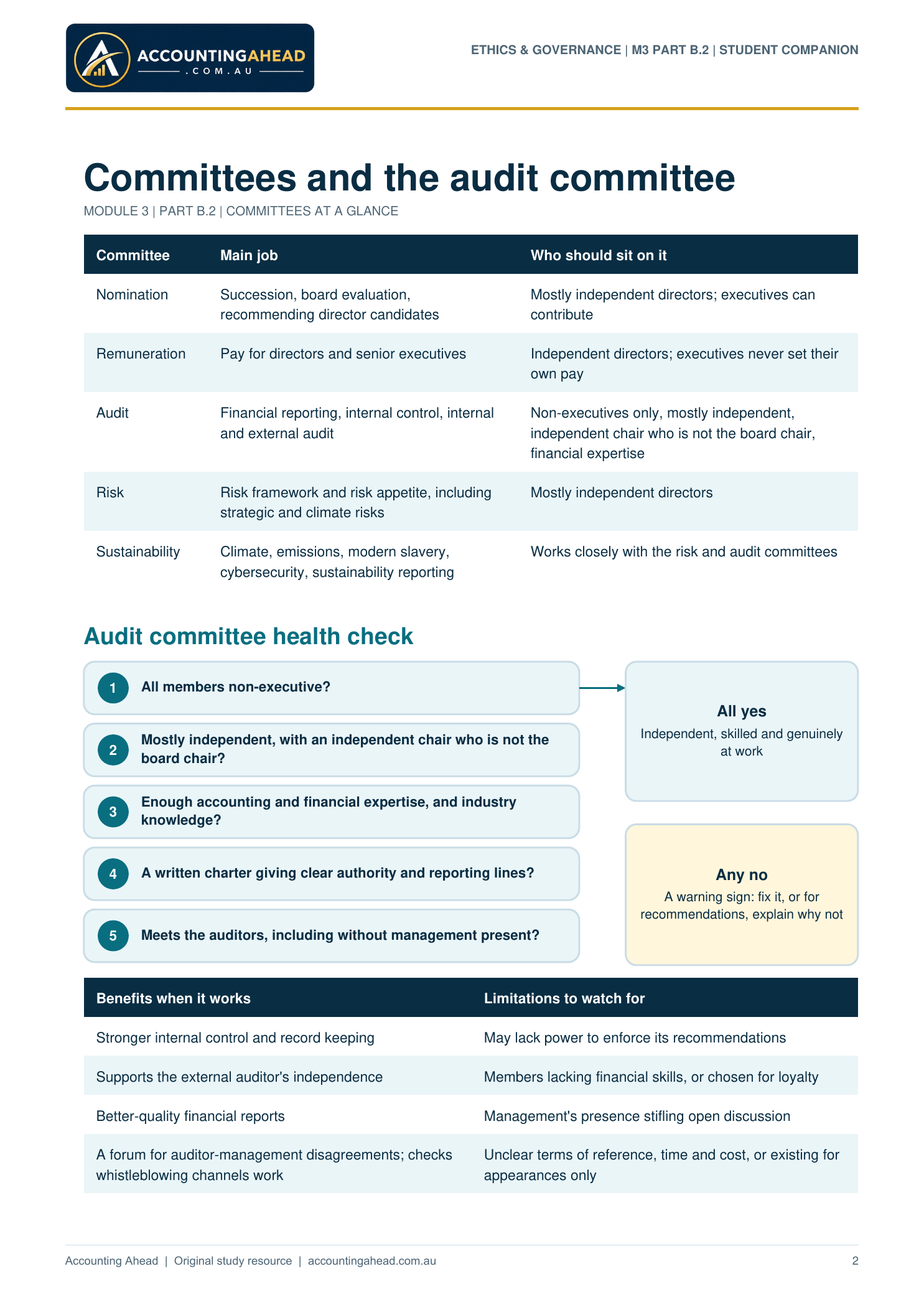
Audit committee health check
1 All members non-executive?
2 Mostly independent, with an independent chair who is not the
board chair?
3 Enough accounting and financial expertise, and industry
knowledge?
4 A written charter giving clear authority and reporting lines?
5 Meets the auditors, including without management present?
All yes
Independent, skilled and genuinely
at work
Any no
A warning sign: fix it, or for
recommendations, explain why not
Benefits when it works Limitations to watch for
Stronger internal control and record keeping May lack power to enforce its recommendations
Supports the external auditor's independence Members lacking financial skills, or chosen for loyalty
Better-quality financial reports Management's presence stifling open discussion
A forum for auditor-management disagreements; checks
whistleblowing channels work
Unclear terms of reference, time and cost, or existing for
appearances only
ETHICS & GOVERNANCE | M3 PART B.2 | STUDENT COMPANION
2
Accounting Ahead | Original study resource | accountingahead.com.au
Practice questions
MODULE 3 | PART B.2 | TRY THESE BEFORE THE WORKED ANSWERS
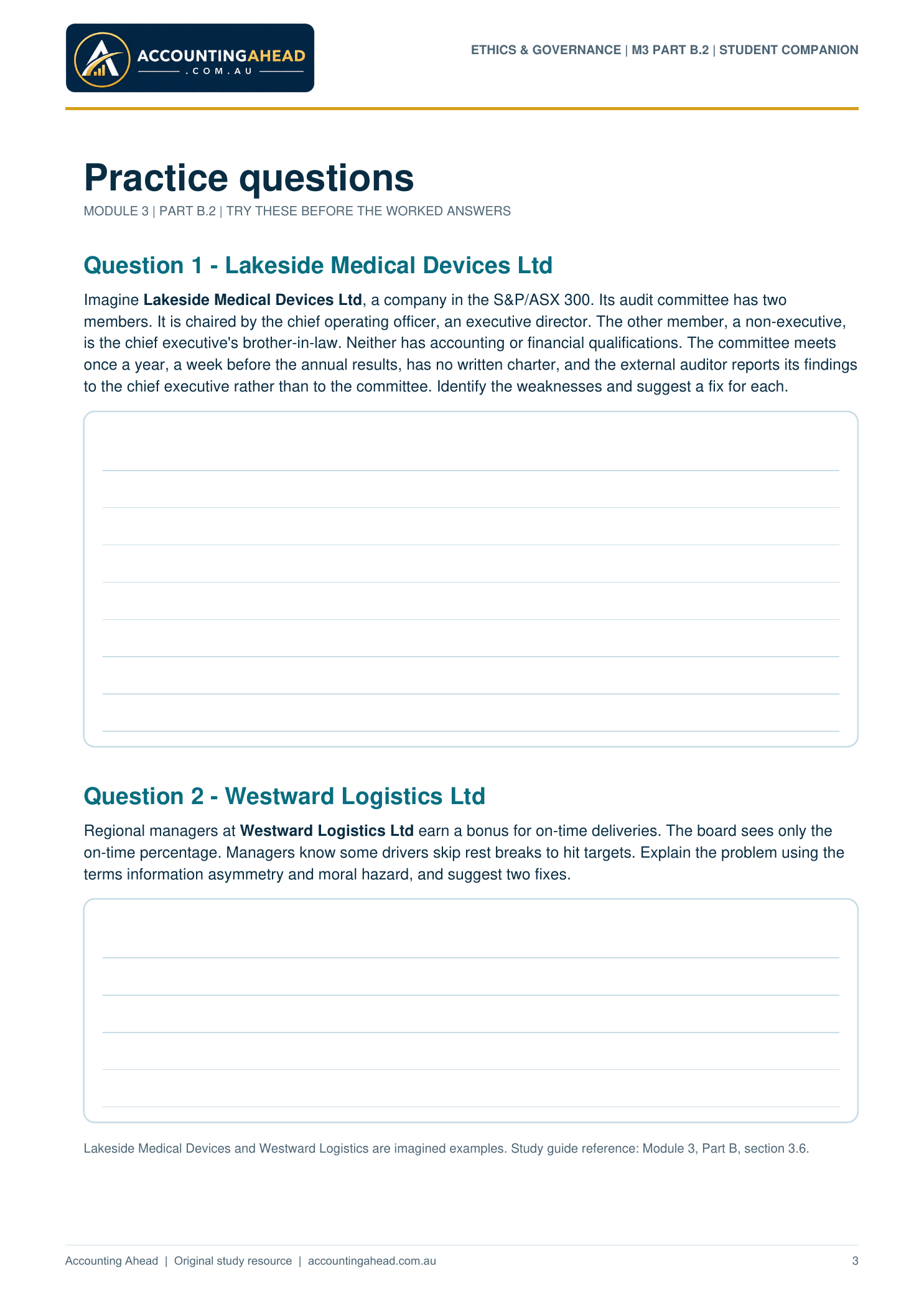
Question 1 - Lakeside Medical Devices Ltd
Imagine Lakeside Medical Devices Ltd, a company in the S&P/ASX 300. Its audit committee has two
members. It is chaired by the chief operating officer, an executive director. The other member, a non-executive,
is the chief executive's brother-in-law. Neither has accounting or financial qualifications. The committee meets
once a year, a week before the annual results, has no written charter, and the external auditor reports its findings
to the chief executive rather than to the committee. Identify the weaknesses and suggest a fix for each.
Question 2 - Westward Logistics Ltd
Regional managers at Westward Logistics Ltd earn a bonus for on-time deliveries. The board sees only the
on-time percentage. Managers know some drivers skip rest breaks to hit targets. Explain the problem using the
terms information asymmetry and moral hazard, and suggest two fixes.
Lakeside Medical Devices and Westward Logistics are imagined examples. Study guide reference: Module 3, Part B, section 3.6.
ETHICS & GOVERNANCE | M3 PART B.2 | STUDENT COMPANION
3
Accounting Ahead | Original study resource | accountingahead.com.au
Worked answers
MODULE 3 | PART B.2 | WORKED ANSWERS - ATTEMPT THE QUESTIONS FIRST
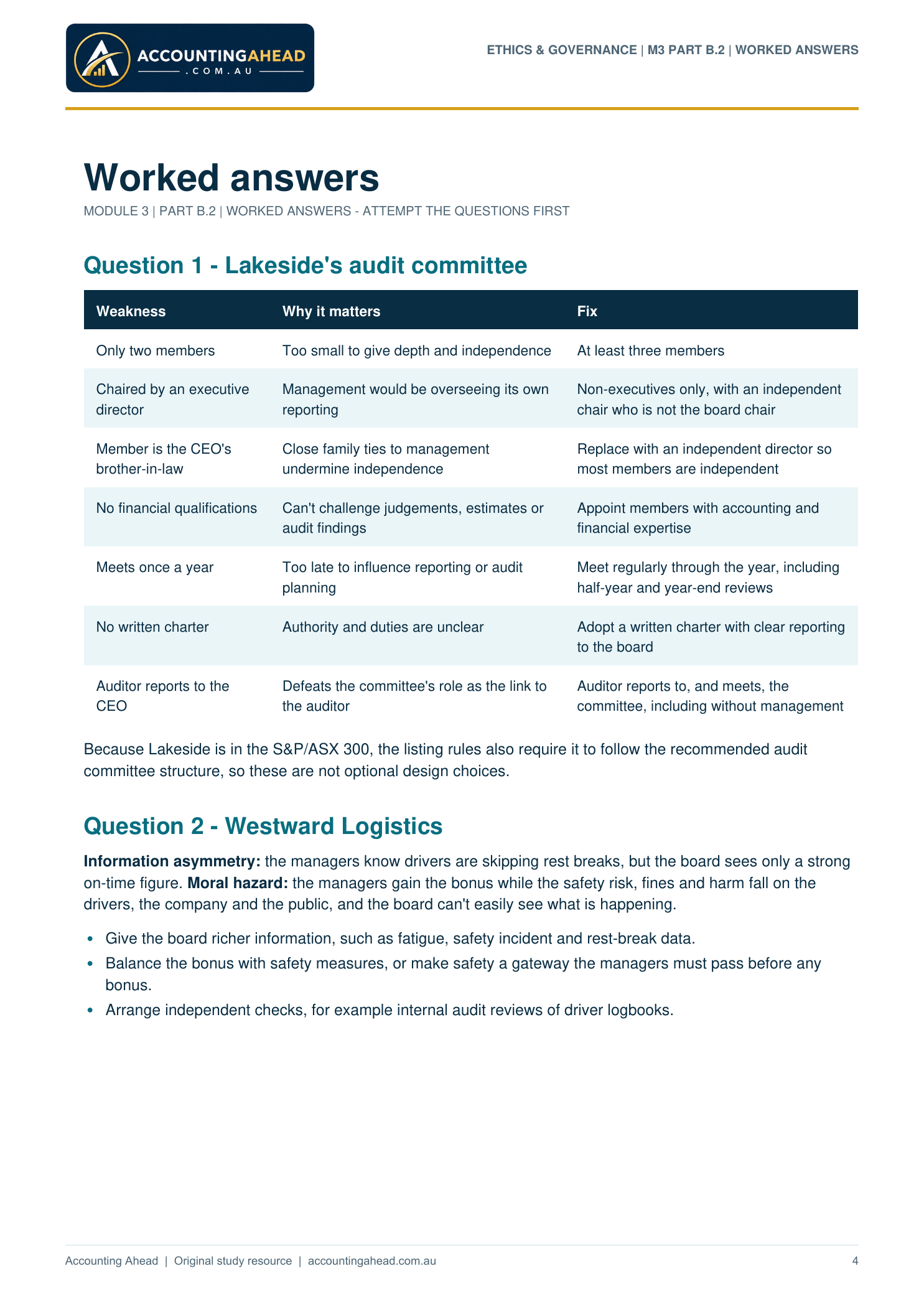
Question 1 - Lakeside's audit committee
Weakness Why it matters Fix
Only two members Too small to give depth and independence At least three members
Chaired by an executive
director
Management would be overseeing its own
reporting
Non-executives only, with an independent
chair who is not the board chair
Member is the CEO's
brother-in-law
Close family ties to management
undermine independence
Replace with an independent director so
most members are independent
No financial qualifications Can't challenge judgements, estimates or
audit findings
Appoint members with accounting and
financial expertise
Meets once a year Too late to influence reporting or audit
planning
Meet regularly through the year, including
half-year and year-end reviews
No written charter Authority and duties are unclear Adopt a written charter with clear reporting
to the board
Auditor reports to the
CEO
Defeats the committee's role as the link to
the auditor
Auditor reports to, and meets, the
committee, including without management
Because Lakeside is in the S&P/ASX 300, the listing rules also require it to follow the recommended audit
committee structure, so these are not optional design choices.
Question 2 - Westward Logistics
Information asymmetry: the managers know drivers are skipping rest breaks, but the board sees only a strong
on-time figure. Moral hazard: the managers gain the bonus while the safety risk, fines and harm fall on the
drivers, the company and the public, and the board can't easily see what is happening.
Give the board richer information, such as fatigue, safety incident and rest-break data.
Balance the bonus with safety measures, or make safety a gateway the managers must pass before any
bonus.
Arrange independent checks, for example internal audit reviews of driver logbooks.
ETHICS & GOVERNANCE | M3 PART B.2 | WORKED ANSWERS
4