
What governance is and why it matters — study companion
Separate governance from management and balance conformance with performance. Includes structured notes, practice questions and worked answers.
Read the handout text
Accounting Ahead | Original study resource | accountingahead.com.au
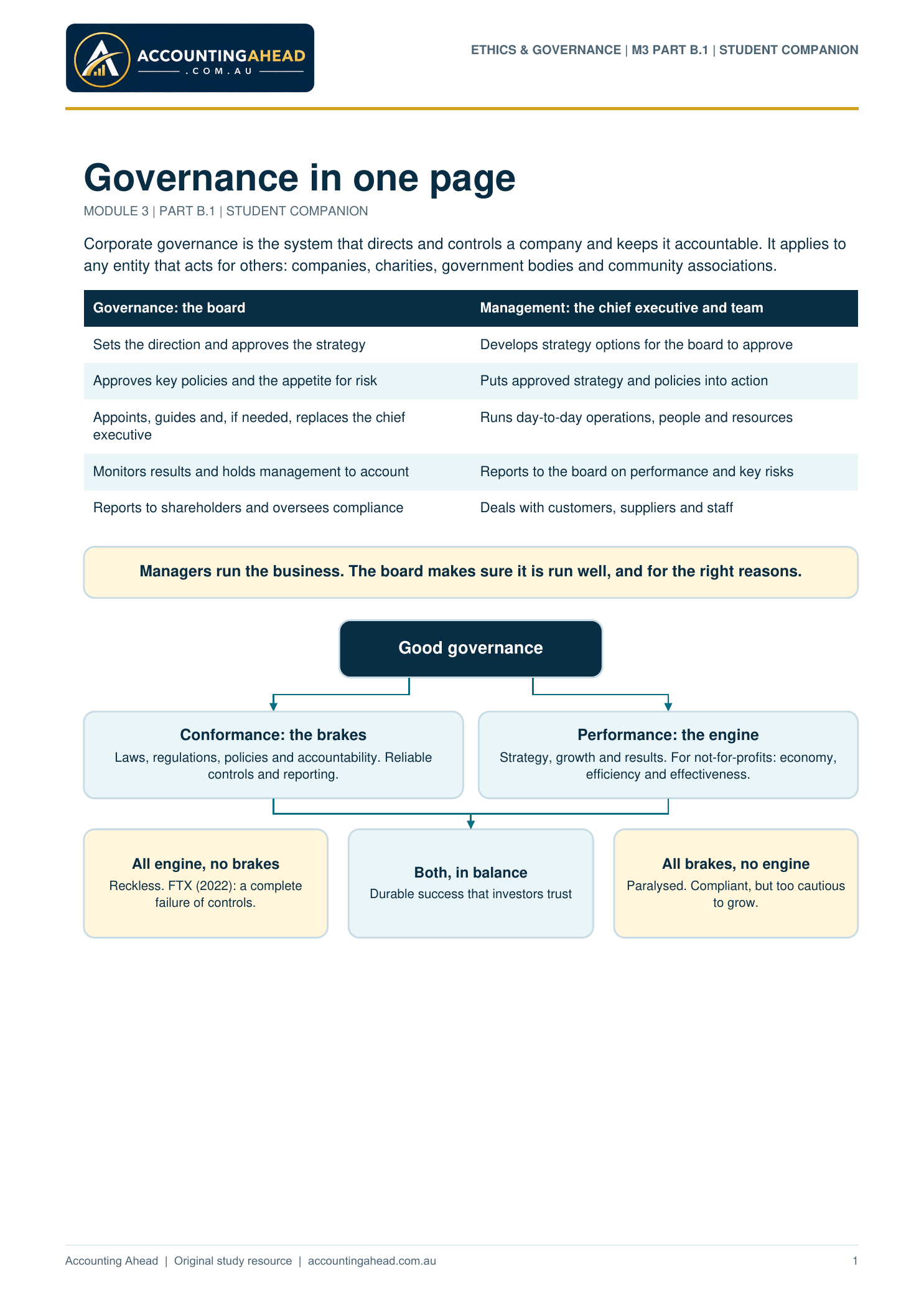
Governance in one page
MODULE 3 | PART B.1 | STUDENT COMPANION
Corporate governance is the system that directs and controls a company and keeps it accountable. It applies to
any entity that acts for others: companies, charities, government bodies and community associations.
Governance: the board Management: the chief executive and team
Sets the direction and approves the strategy Develops strategy options for the board to approve
Approves key policies and the appetite for risk Puts approved strategy and policies into action
Appoints, guides and, if needed, replaces the chief
executive
Runs day-to-day operations, people and resources
Monitors results and holds management to account Reports to the board on performance and key risks
Reports to shareholders and oversees compliance Deals with customers, suppliers and staff
Managers run the business. The board makes sure it is run well, and for the right reasons.
Good governance
Conformance: the brakes
Laws, regulations, policies and accountability. Reliable
controls and reporting.
Performance: the engine
Strategy, growth and results. For not-for-profits: economy,
efficiency and effectiveness.
All engine, no brakes
Reckless. FTX (2022): a complete
failure of controls.
Both, in balance
Durable success that investors trust
All brakes, no engine
Paralysed. Compliant, but too cautious
to grow.
ETHICS & GOVERNANCE | M3 PART B.1 | STUDENT COMPANION
1
Accounting Ahead | Original study resource | accountingahead.com.au
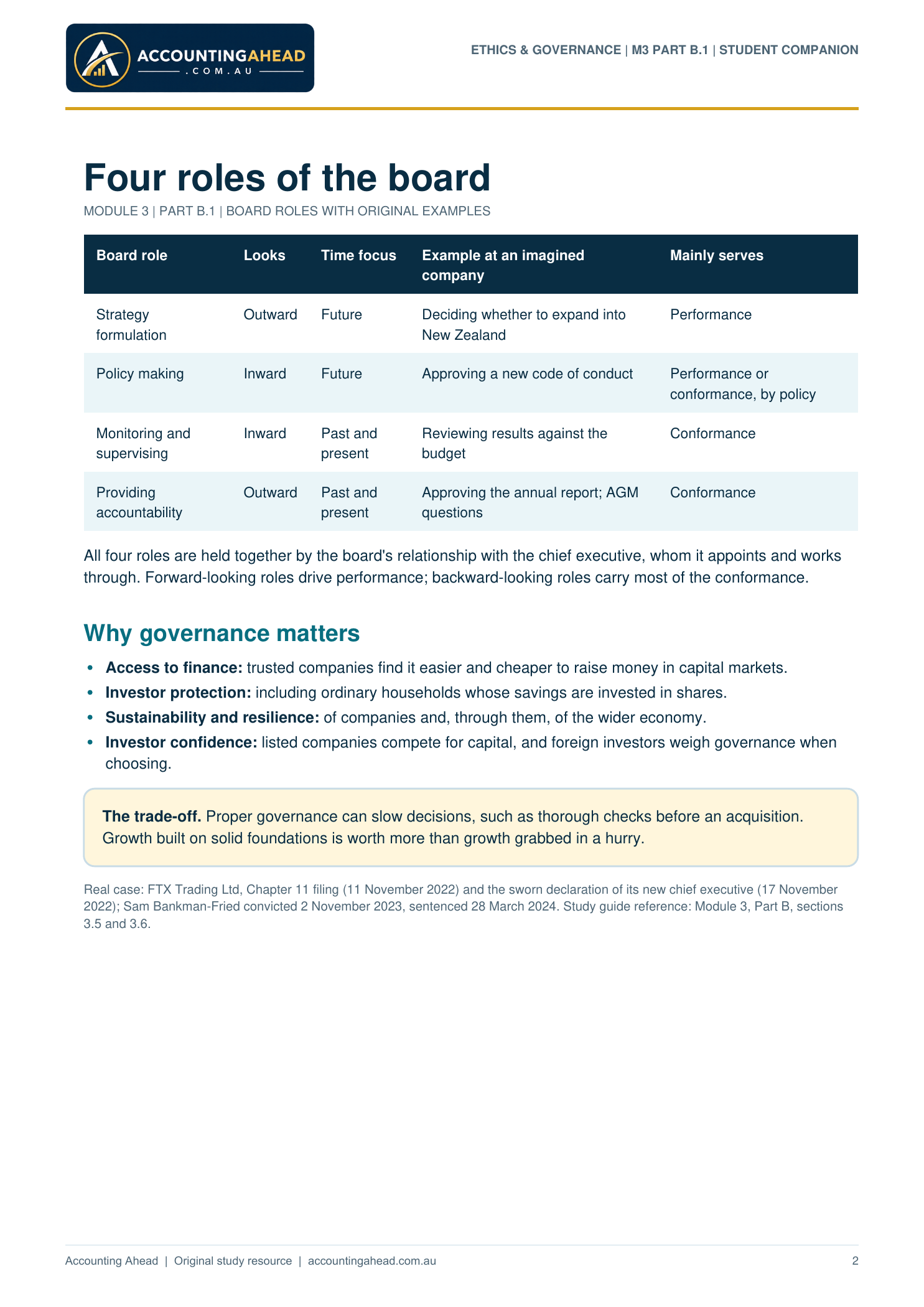
Four roles of the board
MODULE 3 | PART B.1 | BOARD ROLES WITH ORIGINAL EXAMPLES
Board role Looks Time focus Example at an imagined
company
Mainly serves
Strategy
formulation
Outward Future Deciding whether to expand into
New Zealand
Performance
Policy making Inward Future Approving a new code of conduct Performance or
conformance, by policy
Monitoring and
supervising
Inward Past and
present
Reviewing results against the
budget
Conformance
Providing
accountability
Outward Past and
present
Approving the annual report; AGM
questions
Conformance
All four roles are held together by the board's relationship with the chief executive, whom it appoints and works
through. Forward-looking roles drive performance; backward-looking roles carry most of the conformance.
Why governance matters
Access to finance: trusted companies find it easier and cheaper to raise money in capital markets.
Investor protection: including ordinary households whose savings are invested in shares.
Sustainability and resilience: of companies and, through them, of the wider economy.
Investor confidence: listed companies compete for capital, and foreign investors weigh governance when
choosing.
The trade-off. Proper governance can slow decisions, such as thorough checks before an acquisition.
Growth built on solid foundations is worth more than growth grabbed in a hurry.
Real case: FTX Trading Ltd, Chapter 11 filing (11 November 2022) and the sworn declaration of its new chief executive (17 November
2022); Sam Bankman-Fried convicted 2 November 2023, sentenced 28 March 2024. Study guide reference: Module 3, Part B, sections
3.5 and 3.6.
ETHICS & GOVERNANCE | M3 PART B.1 | STUDENT COMPANION
2
Accounting Ahead | Original study resource | accountingahead.com.au
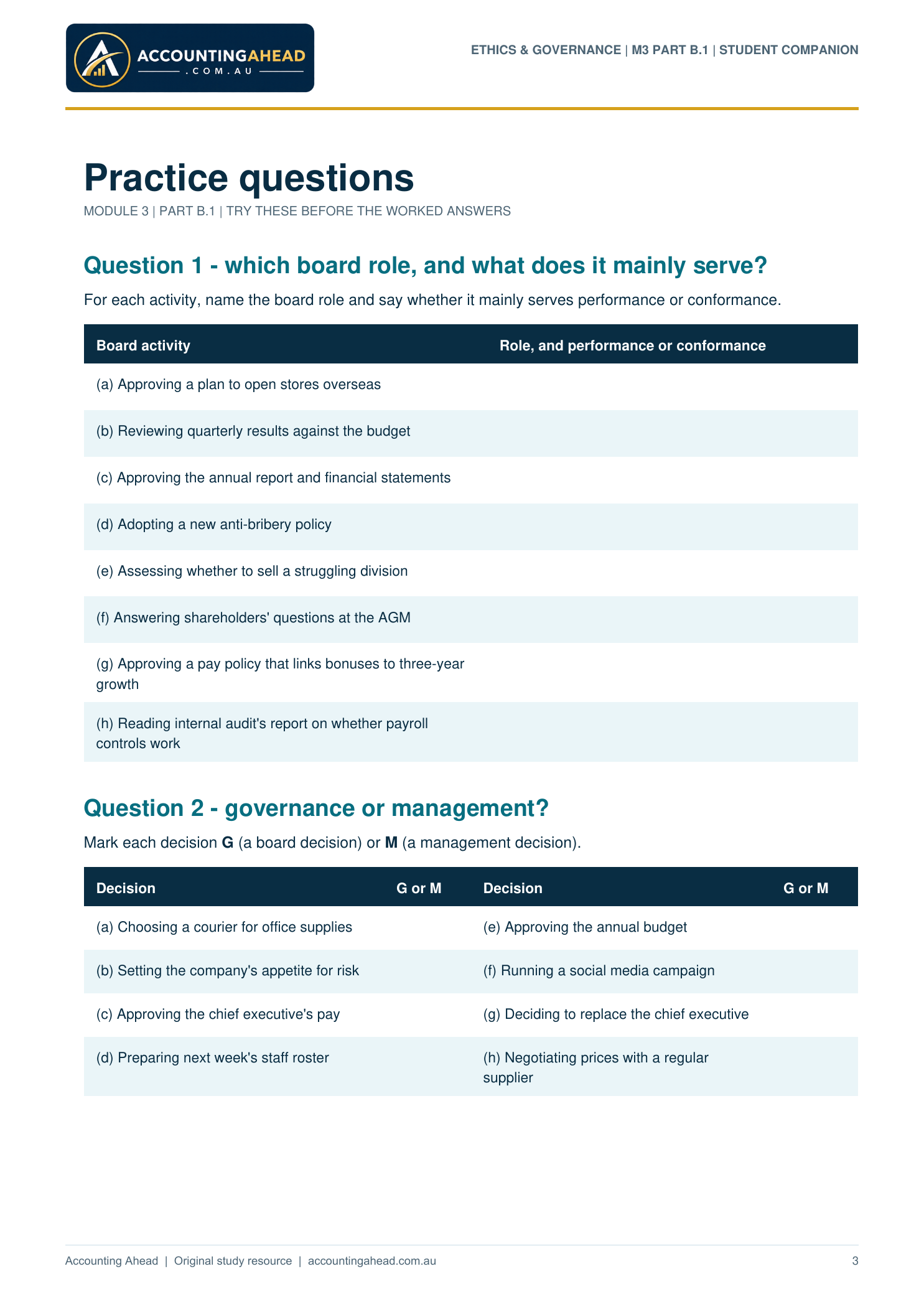
Practice questions
MODULE 3 | PART B.1 | TRY THESE BEFORE THE WORKED ANSWERS
Question 1 - which board role, and what does it mainly serve?
For each activity, name the board role and say whether it mainly serves performance or conformance.
Board activity Role, and performance or conformance
(a) Approving a plan to open stores overseas
(b) Reviewing quarterly results against the budget
(c) Approving the annual report and financial statements
(d) Adopting a new anti-bribery policy
(e) Assessing whether to sell a struggling division
(f) Answering shareholders' questions at the AGM
(g) Approving a pay policy that links bonuses to three-year
growth
(h) Reading internal audit's report on whether payroll
controls work
Question 2 - governance or management?
Mark each decision G (a board decision) or M (a management decision).
Decision G or M Decision G or M
(a) Choosing a courier for office supplies (e) Approving the annual budget
(b) Setting the company's appetite for risk (f) Running a social media campaign
(c) Approving the chief executive's pay (g) Deciding to replace the chief executive
(d) Preparing next week's staff roster (h) Negotiating prices with a regular
supplier
ETHICS & GOVERNANCE | M3 PART B.1 | STUDENT COMPANION
3
Accounting Ahead | Original study resource | accountingahead.com.au
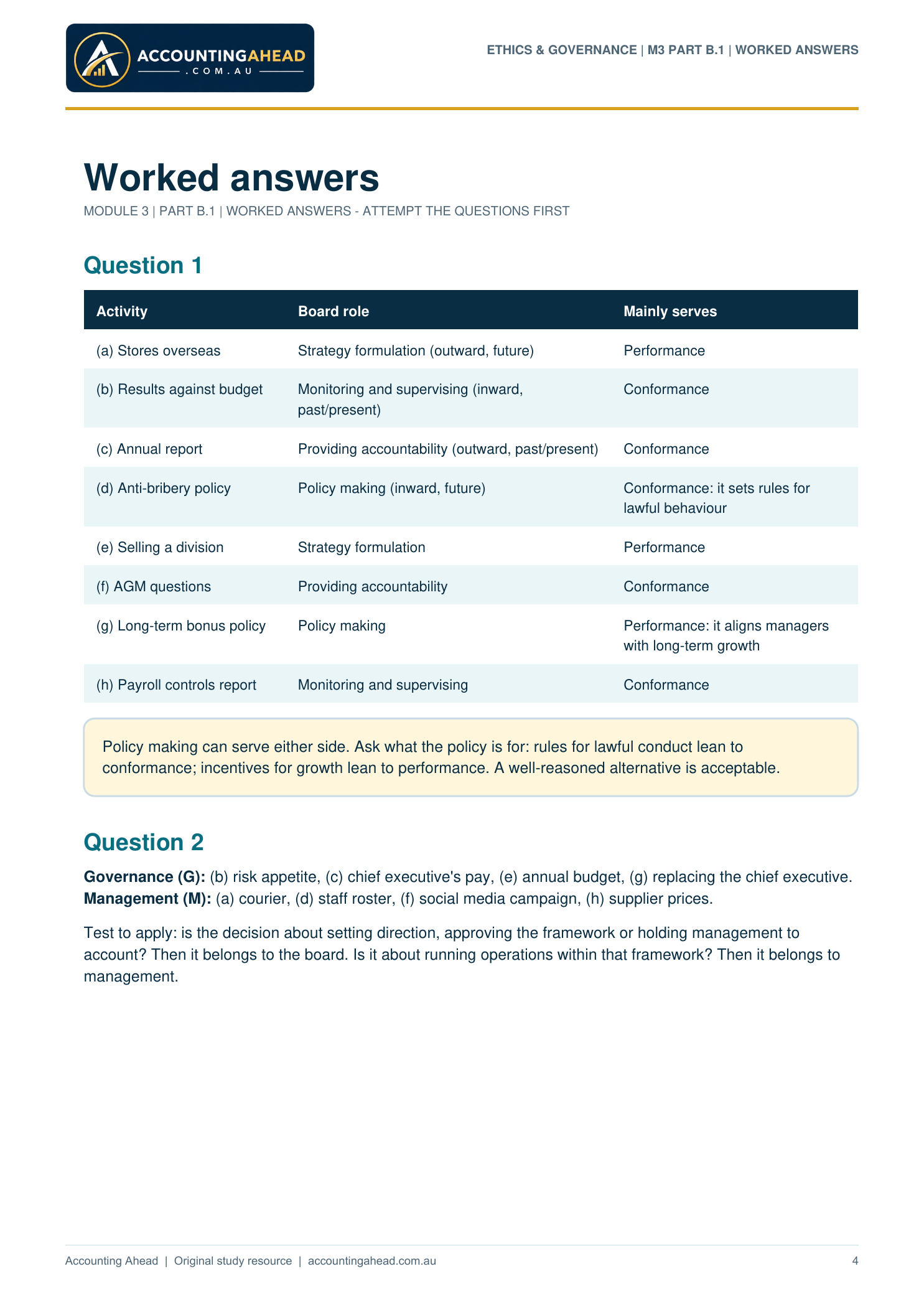
Worked answers
MODULE 3 | PART B.1 | WORKED ANSWERS - ATTEMPT THE QUESTIONS FIRST
Question 1
Activity Board role Mainly serves
(a) Stores overseas Strategy formulation (outward, future) Performance
(b) Results against budget Monitoring and supervising (inward,
past/present)
Conformance
(c) Annual report Providing accountability (outward, past/present) Conformance
(d) Anti-bribery policy Policy making (inward, future) Conformance: it sets rules for
lawful behaviour
(e) Selling a division Strategy formulation Performance
(f) AGM questions Providing accountability Conformance
(g) Long-term bonus policy Policy making Performance: it aligns managers
with long-term growth
(h) Payroll controls report Monitoring and supervising Conformance
Policy making can serve either side. Ask what the policy is for: rules for lawful conduct lean to
conformance; incentives for growth lean to performance. A well-reasoned alternative is acceptable.
Question 2
Governance (G): (b) risk appetite, (c) chief executive's pay, (e) annual budget, (g) replacing the chief executive.
Management (M): (a) courier, (d) staff roster, (f) social media campaign, (h) supplier prices.
Test to apply: is the decision about setting direction, approving the framework or holding management to
account? Then it belongs to the board. Is it about running operations within that framework? Then it belongs to
management.
ETHICS & GOVERNANCE | M3 PART B.1 | WORKED ANSWERS
4