
Credibility in a global profession
About this video lesson
Match credibility pressures with practical responses and distinguish international and local responsibilities.
Study files for this lecture
Read the lecture transcript
Why does credible accounting need more than technically impressive reports? Because people must have good reasons to trust both the information and the process behind it. Let's connect the pressures that weaken that trust with responses that address the actual cause, including when the work crosses national borders.
Credibility means information and professional work deserve confidence. A familiar logo or confident presentation cannot establish that on its own. Users need faithful reporting, competent work, ethical judgement and meaningful accountability. When those fail, the consequences spread beyond one engagement. Other accountants may face greater scrutiny because people question whether the profession's promises are being honoured.
A real example shows why nonfinancial claims matter too. In September twenty twenty-four, Australia's corporate regulator reported that the Federal Court had ordered Vanguard Investments Australia to pay a twelve point nine million dollar penalty over misleading claims about environmental, social and governance screening for a bond fund. Vanguard admitted investors had been misled about whether certain issuers were excluded. This was an investment-product disclosure case. It does not establish misconduct by an individual accountant, or decide an accounting treatment. Its useful lesson here is narrower: descriptions of how information is produced can influence investment choices, so those descriptions need support.
Now connect that to financial reporting. Managers may face pressure to meet a target, protect a financing arrangement or present performance favourably. Earnings management involves manipulating reported earnings through accounting choices or estimates. Creative accounting describes choices used to produce a distorted picture of reality. The existence of judgement does not make every estimate manipulation. New evidence can justify a changed estimate. Selecting an answer simply because it produces the desired result is a different kind of reasoning.
Ask yourself which comes first: the evidence, or the result someone wants? That question helps expose bias, although it cannot settle every case. An accountant still needs to examine the applicable requirements, the available evidence and the explanation for the judgement. An estimate may be uncertain and defensible. A precise-looking number may be poorly supported. More decimal places do not provide more evidence.
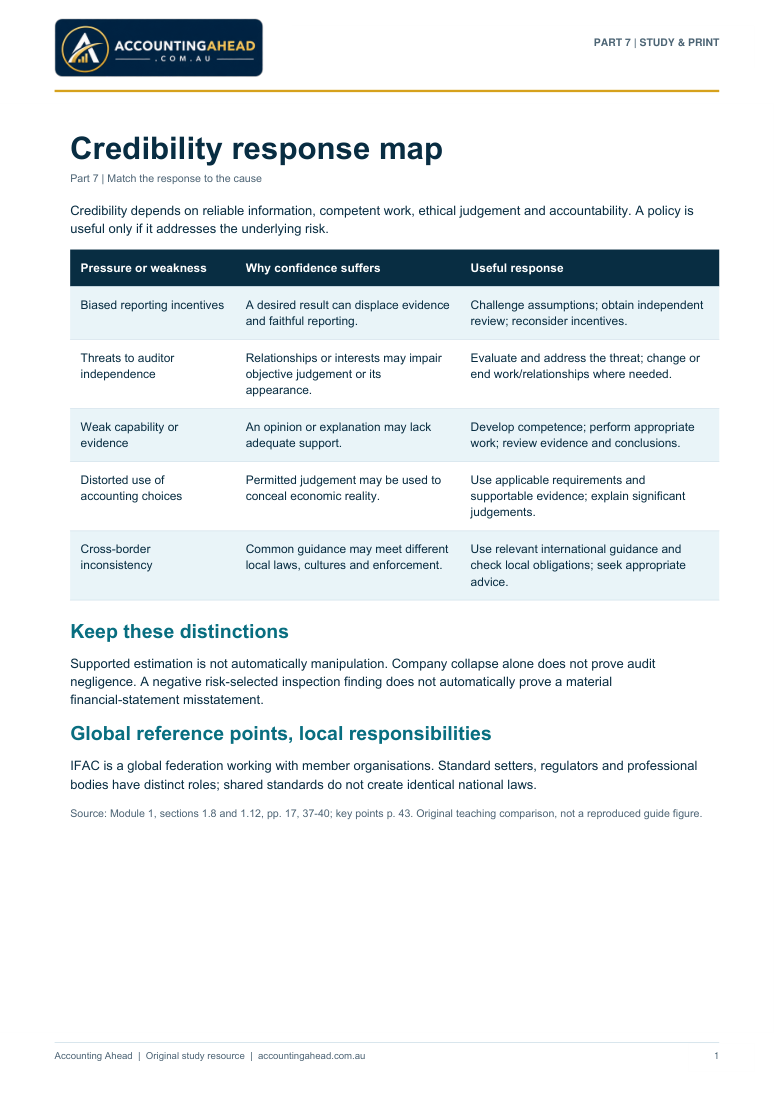
The credibility response map provided with this lesson links pressures to practical responses. Focus on the pressure and response columns. Where rewards encourage biased reporting, useful responses include challenging assumptions, independent review and reconsidering incentives. Where a relationship threatens auditor independence, the response must address that relationship and its significance. Declaring that everyone will behave objectively does not remove a real conflict. Depending on the circumstances, the work or relationship may need to change or end.
Weak capability and weak evidence need different remedies. Training may improve knowledge, but a training certificate does not fill a missing evidence gap in an audit file. The engagement still needs appropriate work, review and a supportable conclusion. Similarly, clear standards reduce opportunities for inconsistent reporting, but written requirements achieve little if people evade them or enforcement is ineffective. The response should match the mechanism causing the problem, rather than adding another policy because a policy is easy to print.
Be careful when interpreting failure. A company collapsing does not, by itself, prove that its auditor was negligent. Equally, a negative finding in a risk-selected audit inspection is not automatically proof that the financial statements were materially misstated. It may indicate that the auditor lacked sufficient support for the opinion. These distinctions help us take deficiencies seriously while asking what the evidence actually establishes.
Accounting also works across borders. International standards can provide common reference points for reporting, auditing and ethics. That supports consistency and makes comparison easier. But shared guidance does not create identical national laws, enforcement capacity or business cultures. The International Federation of Accountants supports the global profession through its member organisations. It is not a government with universal legal power. Standard setters, national authorities and professional bodies have different responsibilities.
Working internationally therefore requires two connected checks: understand the relevant common professional requirements, and establish the applicable local obligations. Cultural awareness helps communication, but local custom is not a sufficient reason to abandon ethical duties. When requirements or expectations conflict, investigate and obtain appropriate guidance. Do not assume that following the practice used in one country settles the position everywhere else.
Before you finish, choose one credibility problem from the response map and explain why its proposed response helps. Pause playback if you would like time. A useful answer identifies the cause, explains how the response reduces it, and recognises what still needs checking. Credibility grows through reliable work, independent judgement and accountability together. For a fuller understanding, always read and study the relevant sections of your CPA study guide alongside this lesson.
Sources for the examples
Historical examples illustrate the concepts in this lesson. They do not change the syllabus context.