
Strategy and the strategy process
Printable study notes to use alongside Part 1.1-1.2.
Read the handout text
Accounting Ahead | Original study resource | accountingahead.com.au
Strategy and the strategy process
MODULE 1 | 1.1-1.2 | STUDENT COMPANION
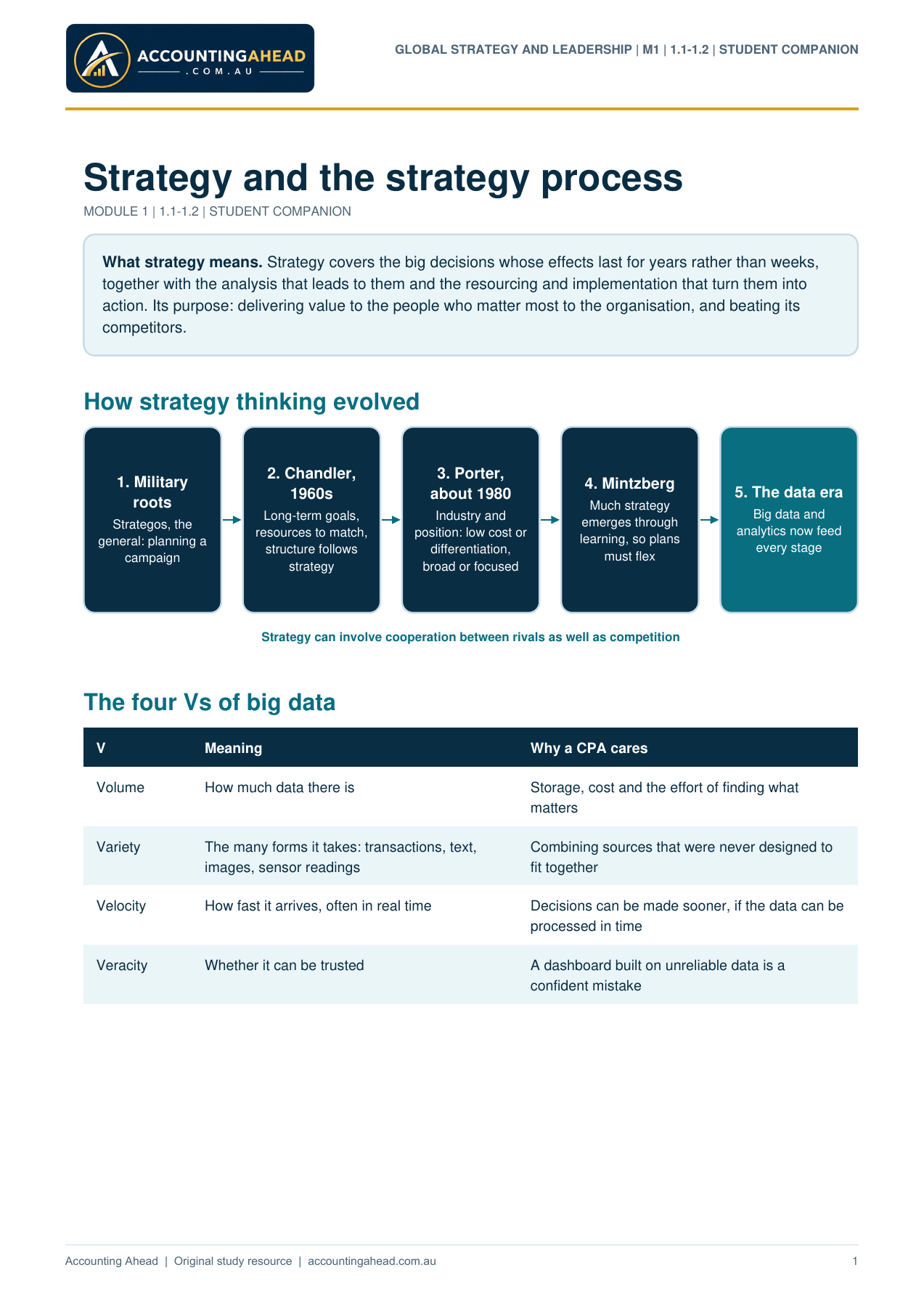
What strategy means. Strategy covers the big decisions whose effects last for years rather than weeks,
together with the analysis that leads to them and the resourcing and implementation that turn them into
action. Its purpose: delivering value to the people who matter most to the organisation, and beating its
competitors.
How strategy thinking evolved
1. Military
roots
Strategos, the
general: planning a
campaign
2. Chandler,
1960s
Long-term goals,
resources to match,
structure follows
strategy
3. Porter,
about 1980
Industry and
position: low cost or
differentiation,
broad or focused
4. Mintzberg
Much strategy
emerges through
learning, so plans
must flex
5. The data era
Big data and
analytics now feed
every stage
Strategy can involve cooperation between rivals as well as competition
The four Vs of big data
V Meaning Why a CPA cares
Volume How much data there is Storage, cost and the effort of finding what
matters
Variety The many forms it takes: transactions, text,
images, sensor readings
Combining sources that were never designed to
fit together
Velocity How fast it arrives, often in real time Decisions can be made sooner, if the data can be
processed in time
Veracity Whether it can be trusted A dashboard built on unreliable data is a
confident mistake
GLOBAL STRATEGY AND LEADERSHIP | M1 | 1.1-1.2 | STUDENT COMPANION
1
Accounting Ahead | Original study resource | accountingahead.com.au
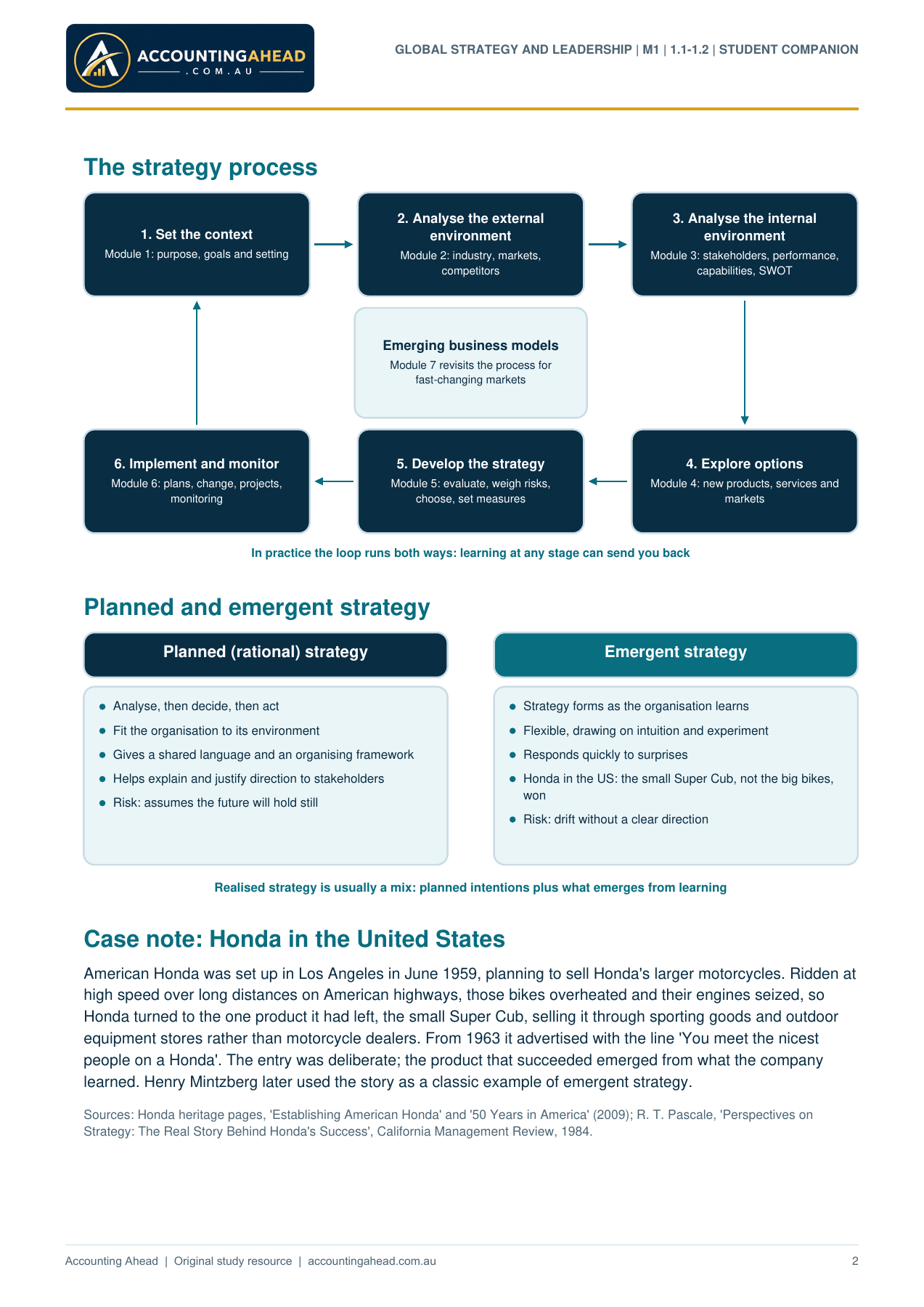
The strategy process
1. Set the context
Module 1: purpose, goals and setting
2. Analyse the external
environment
Module 2: industry, markets,
competitors
3. Analyse the internal
environment
Module 3: stakeholders, performance,
capabilities, SWOT
4. Explore options
Module 4: new products, services and
markets
5. Develop the strategy
Module 5: evaluate, weigh risks,
choose, set measures
6. Implement and monitor
Module 6: plans, change, projects,
monitoring
Emerging business models
Module 7 revisits the process for
fast-changing markets
In practice the loop runs both ways: learning at any stage can send you back
Planned and emergent strategy
Planned (rational) strategy
Analyse, then decide, then act
Fit the organisation to its environment
Gives a shared language and an organising framework
Helps explain and justify direction to stakeholders
Risk: assumes the future will hold still
Emergent strategy
Strategy forms as the organisation learns
Flexible, drawing on intuition and experiment
Responds quickly to surprises
Honda in the US: the small Super Cub, not the big bikes,
won
Risk: drift without a clear direction
Realised strategy is usually a mix: planned intentions plus what emerges from learning
Case note: Honda in the United States
American Honda was set up in Los Angeles in June 1959, planning to sell Honda's larger motorcycles. Ridden at
high speed over long distances on American highways, those bikes overheated and their engines seized, so
Honda turned to the one product it had left, the small Super Cub, selling it through sporting goods and outdoor
equipment stores rather than motorcycle dealers. From 1963 it advertised with the line 'You meet the nicest
people on a Honda'. The entry was deliberate; the product that succeeded emerged from what the company
learned. Henry Mintzberg later used the story as a classic example of emergent strategy.
Sources: Honda heritage pages, 'Establishing American Honda' and '50 Years in America' (2009); R. T. Pascale, 'Perspectives on
Strategy: The Real Story Behind Honda's Success', California Management Review, 1984.
GLOBAL STRATEGY AND LEADERSHIP | M1 | 1.1-1.2 | STUDENT COMPANION
2
Accounting Ahead | Original study resource | accountingahead.com.au
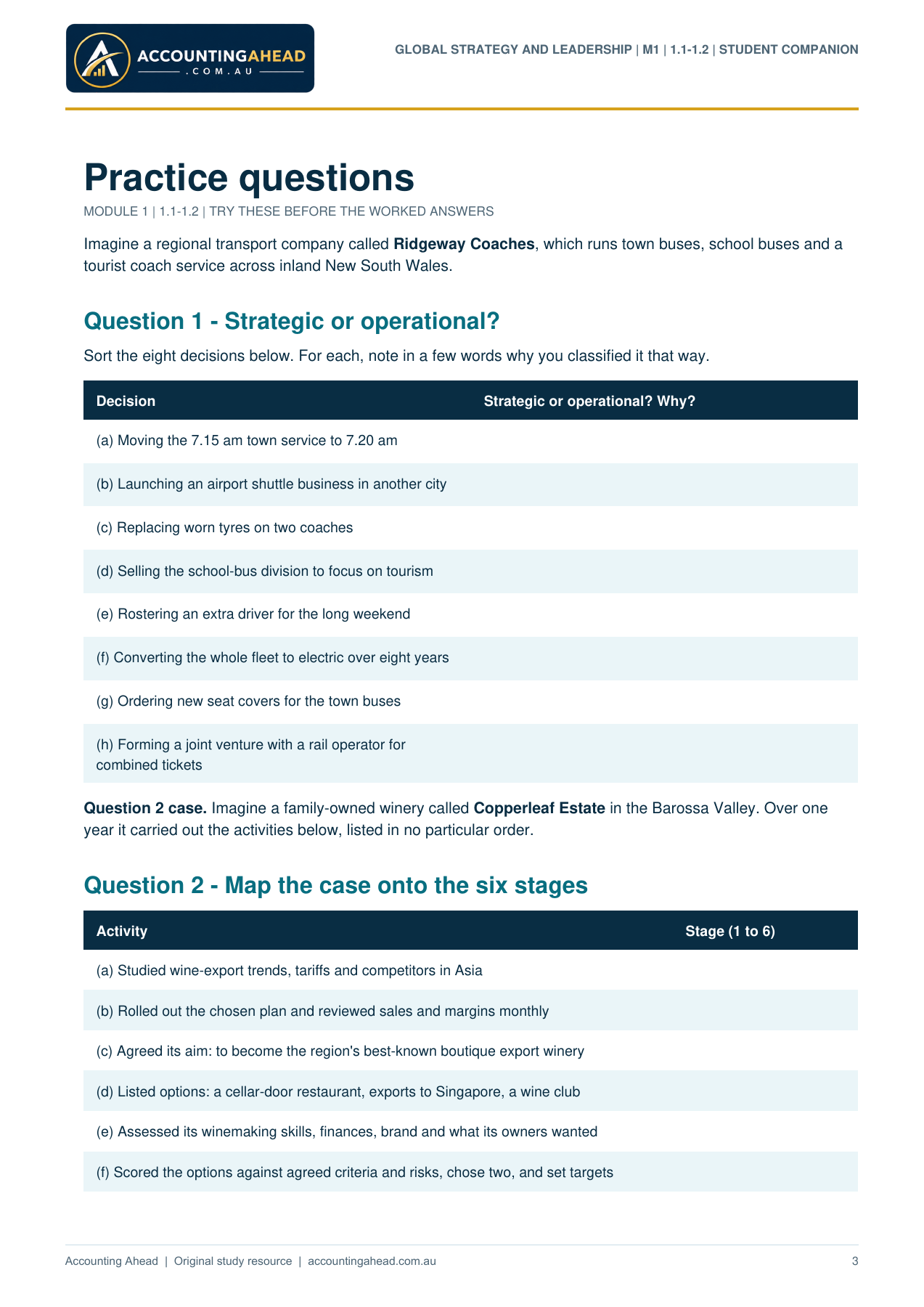
Practice questions
MODULE 1 | 1.1-1.2 | TRY THESE BEFORE THE WORKED ANSWERS
Imagine a regional transport company called Ridgeway Coaches, which runs town buses, school buses and a
tourist coach service across inland New South Wales.
Question 1 - Strategic or operational?
Sort the eight decisions below. For each, note in a few words why you classified it that way.
Decision Strategic or operational? Why?
(a) Moving the 7.15 am town service to 7.20 am
(b) Launching an airport shuttle business in another city
(c) Replacing worn tyres on two coaches
(d) Selling the school-bus division to focus on tourism
(e) Rostering an extra driver for the long weekend
(f) Converting the whole fleet to electric over eight years
(g) Ordering new seat covers for the town buses
(h) Forming a joint venture with a rail operator for
combined tickets
Question 2 case. Imagine a family-owned winery called Copperleaf Estate in the Barossa Valley. Over one
year it carried out the activities below, listed in no particular order.
Question 2 - Map the case onto the six stages
Activity Stage (1 to 6)
(a) Studied wine-export trends, tariffs and competitors in Asia
(b) Rolled out the chosen plan and reviewed sales and margins monthly
(c) Agreed its aim: to become the region's best-known boutique export winery
(d) Listed options: a cellar-door restaurant, exports to Singapore, a wine club
(e) Assessed its winemaking skills, finances, brand and what its owners wanted
(f) Scored the options against agreed criteria and risks, chose two, and set targets
GLOBAL STRATEGY AND LEADERSHIP | M1 | 1.1-1.2 | STUDENT COMPANION
3
Accounting Ahead | Original study resource | accountingahead.com.au
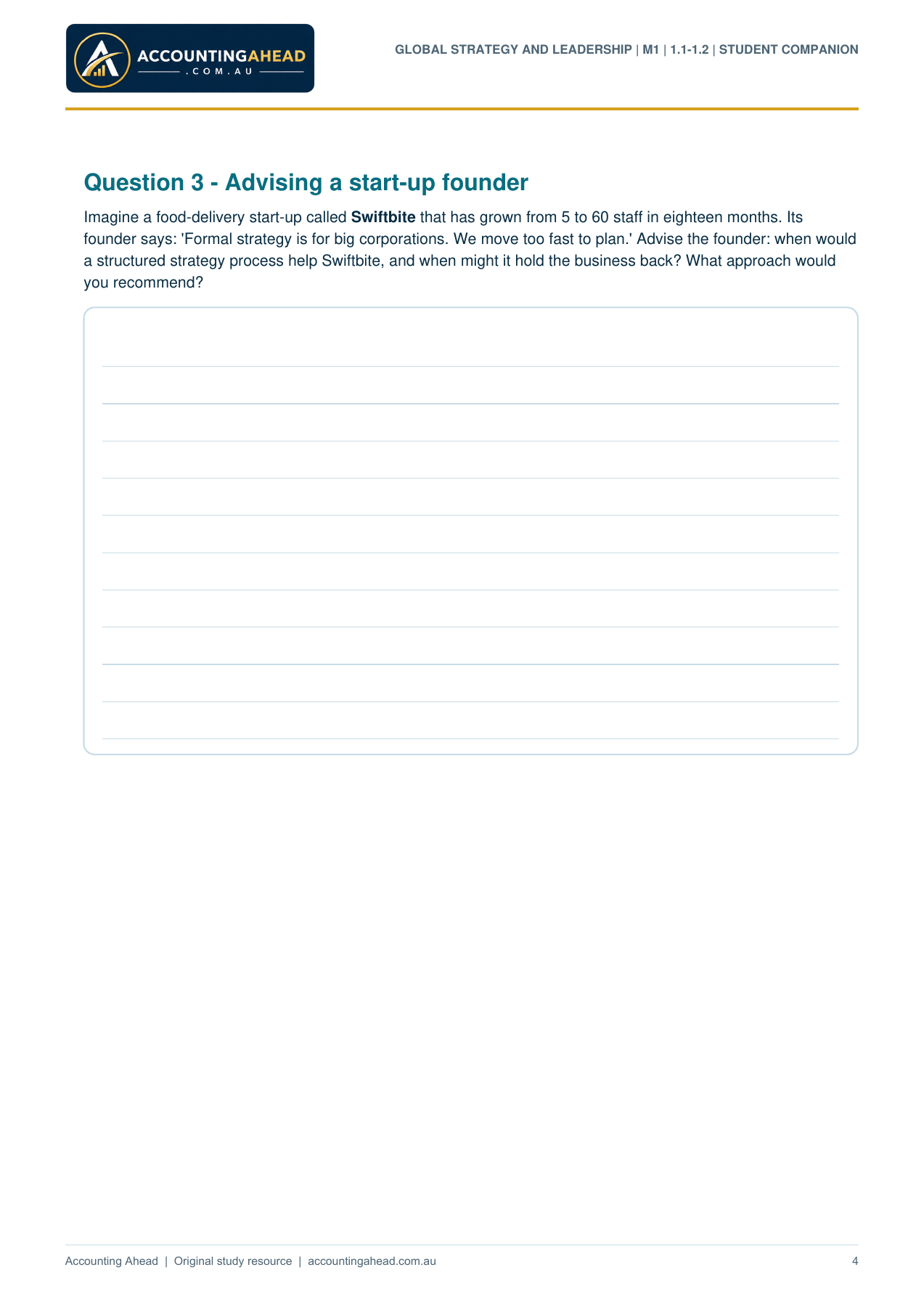
Question 3 - Advising a start-up founder
Imagine a food-delivery start-up called Swiftbite that has grown from 5 to 60 staff in eighteen months. Its
founder says: 'Formal strategy is for big corporations. We move too fast to plan.' Advise the founder: when would
a structured strategy process help Swiftbite, and when might it hold the business back? What approach would
you recommend?
GLOBAL STRATEGY AND LEADERSHIP | M1 | 1.1-1.2 | STUDENT COMPANION
4
Accounting Ahead | Original study resource | accountingahead.com.au
Worked answers
MODULE 1 | 1.1-1.2 | WORKED ANSWERS - ATTEMPT THE QUESTIONS FIRST
Question 1 - Strategic or operational?
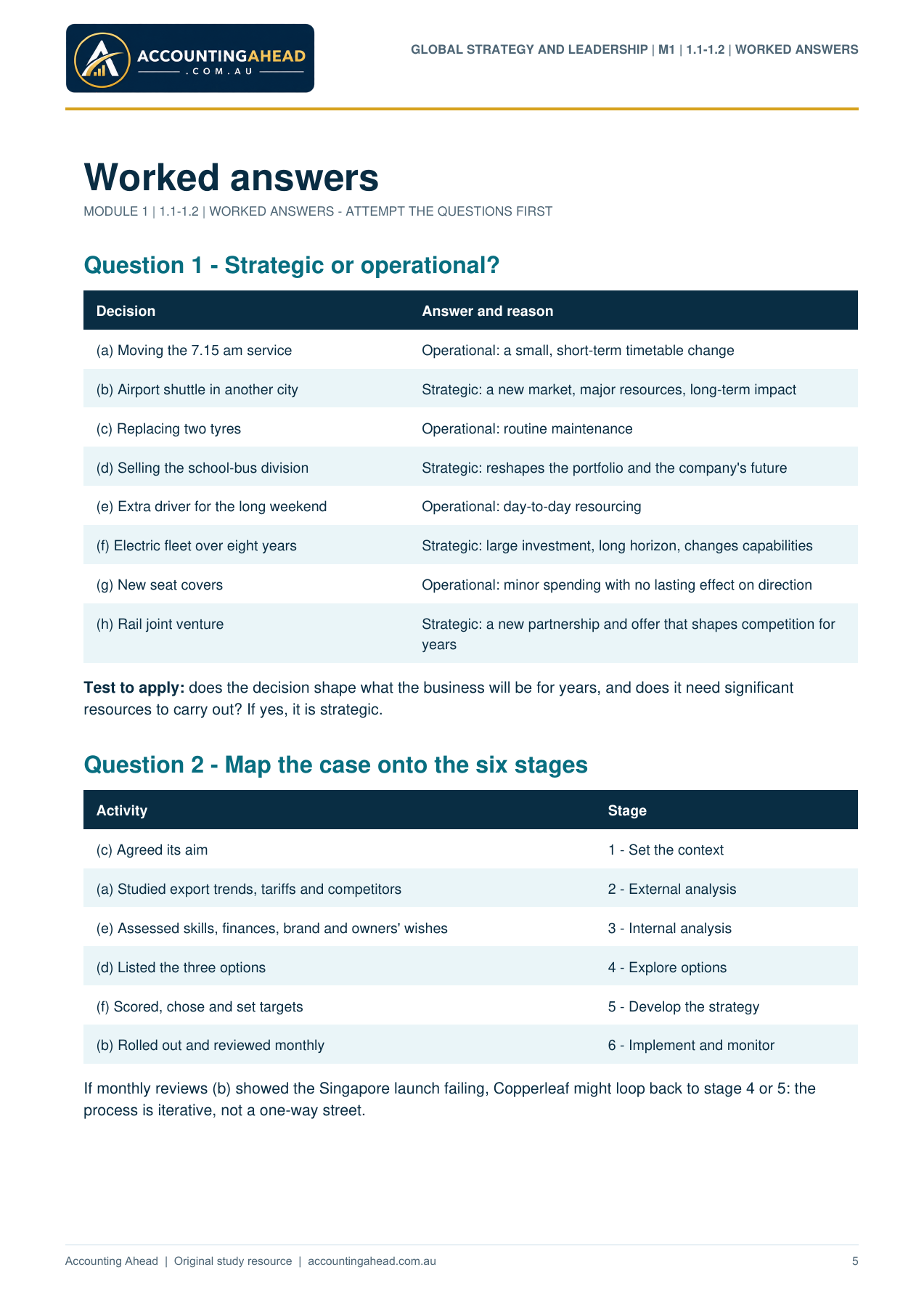
Decision Answer and reason
(a) Moving the 7.15 am service Operational: a small, short-term timetable change
(b) Airport shuttle in another city Strategic: a new market, major resources, long-term impact
(c) Replacing two tyres Operational: routine maintenance
(d) Selling the school-bus division Strategic: reshapes the portfolio and the company's future
(e) Extra driver for the long weekend Operational: day-to-day resourcing
(f) Electric fleet over eight years Strategic: large investment, long horizon, changes capabilities
(g) New seat covers Operational: minor spending with no lasting effect on direction
(h) Rail joint venture Strategic: a new partnership and offer that shapes competition for
years
Test to apply: does the decision shape what the business will be for years, and does it need significant
resources to carry out? If yes, it is strategic.
Question 2 - Map the case onto the six stages
Activity Stage
(c) Agreed its aim 1 - Set the context
(a) Studied export trends, tariffs and competitors 2 - External analysis
(e) Assessed skills, finances, brand and owners' wishes 3 - Internal analysis
(d) Listed the three options 4 - Explore options
(f) Scored, chose and set targets 5 - Develop the strategy
(b) Rolled out and reviewed monthly 6 - Implement and monitor
If monthly reviews (b) showed the Singapore launch failing, Copperleaf might loop back to stage 4 or 5: the
process is iterative, not a one-way street.
GLOBAL STRATEGY AND LEADERSHIP | M1 | 1.1-1.2 | WORKED ANSWERS
5
Accounting Ahead | Original study resource | accountingahead.com.au
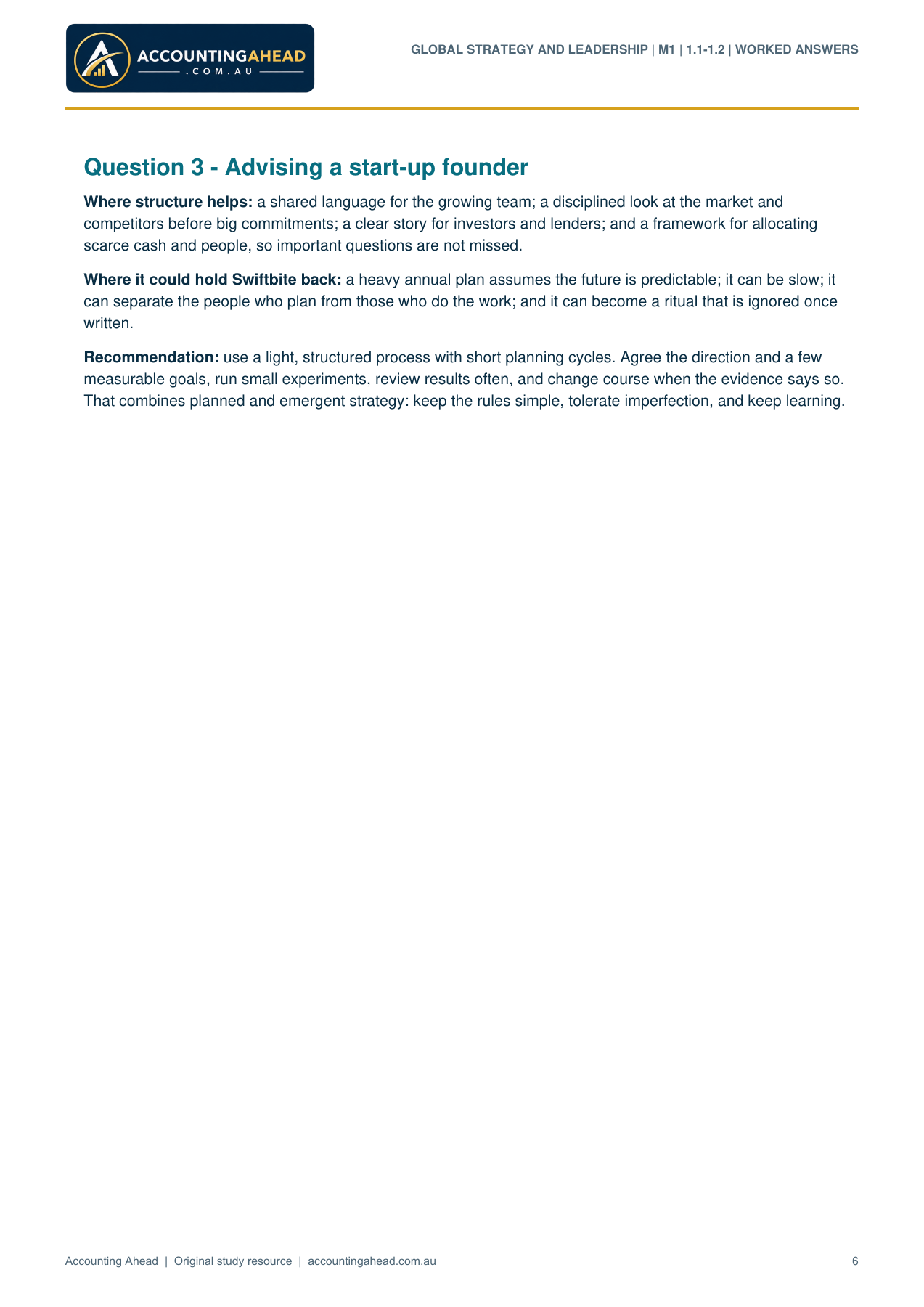
Question 3 - Advising a start-up founder
Where structure helps: a shared language for the growing team; a disciplined look at the market and
competitors before big commitments; a clear story for investors and lenders; and a framework for allocating
scarce cash and people, so important questions are not missed.
Where it could hold Swiftbite back: a heavy annual plan assumes the future is predictable; it can be slow; it
can separate the people who plan from those who do the work; and it can become a ritual that is ignored once
written.
Recommendation: use a light, structured process with short planning cycles. Agree the direction and a few
measurable goals, run small experiments, review results often, and change course when the evidence says so.
That combines planned and emergent strategy: keep the rules simple, tolerate imperfection, and keep learning.
GLOBAL STRATEGY AND LEADERSHIP | M1 | 1.1-1.2 | WORKED ANSWERS
6