
Gaining competitive advantage
Printable study notes to use alongside Part 1.3.

Read the handout text
Accounting Ahead | Original study resource | accountingahead.com.au
Gaining competitive advantage
MODULE 1 | 1.3 | STUDENT COMPANION
Competitive advantage is the ability to outperform competitors, earning more profit than they do from a
comparable set of activities. It comes from doing similar things more efficiently, or from doing different
things, or doing things differently, so customers pay more, choose you more often or stay longer.
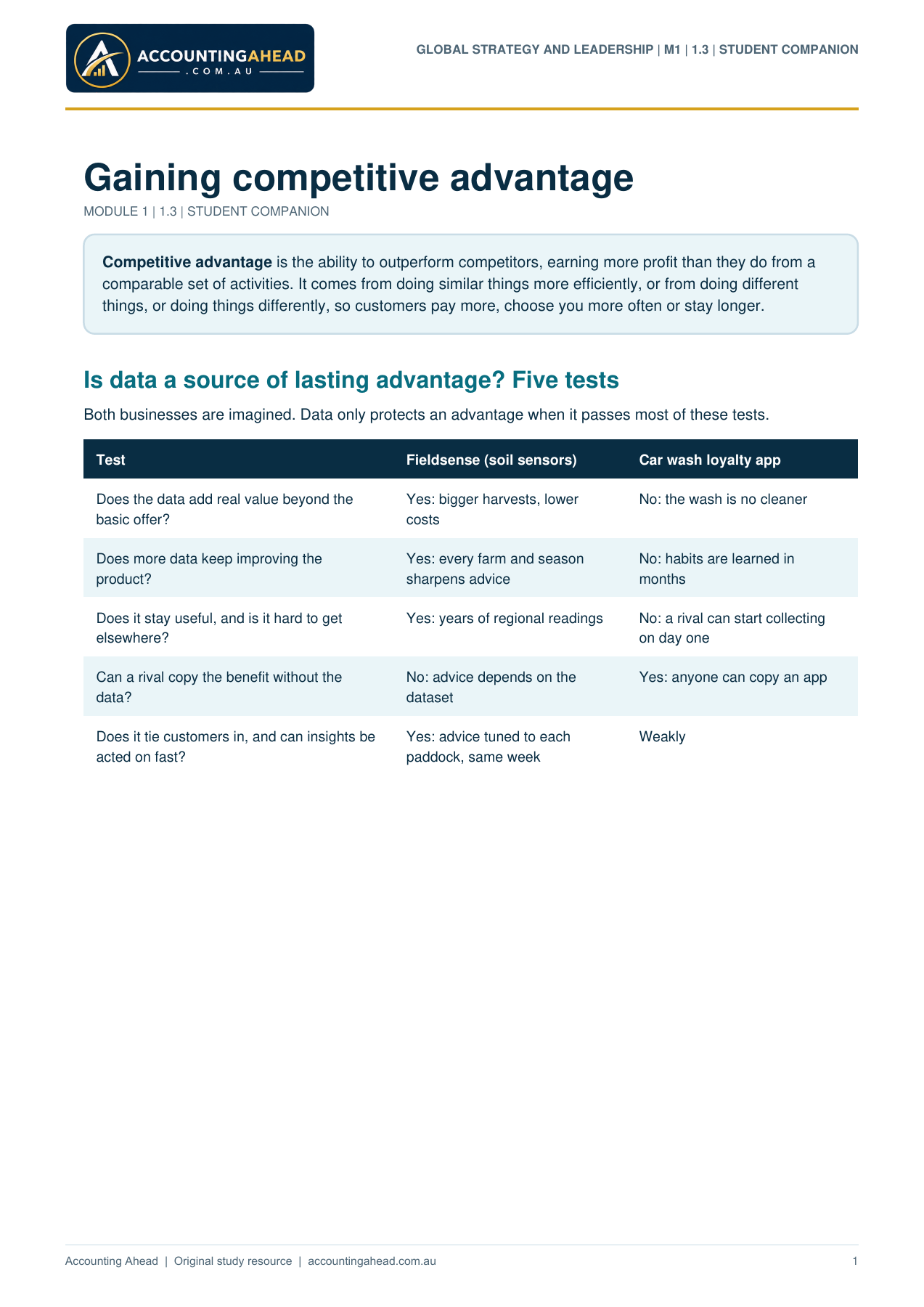
Is data a source of lasting advantage? Five tests
Both businesses are imagined. Data only protects an advantage when it passes most of these tests.
Test Fieldsense (soil sensors) Car wash loyalty app
Does the data add real value beyond the
basic offer?
Yes: bigger harvests, lower
costs
No: the wash is no cleaner
Does more data keep improving the
product?
Yes: every farm and season
sharpens advice
No: habits are learned in
months
Does it stay useful, and is it hard to get
elsewhere?
Yes: years of regional readings No: a rival can start collecting
on day one
Can a rival copy the benefit without the
data?
No: advice depends on the
dataset
Yes: anyone can copy an app
Does it tie customers in, and can insights be
acted on fast?
Yes: advice tuned to each
paddock, same week
Weakly
GLOBAL STRATEGY AND LEADERSHIP | M1 | 1.3 | STUDENT COMPANION
1
Accounting Ahead | Original study resource | accountingahead.com.au
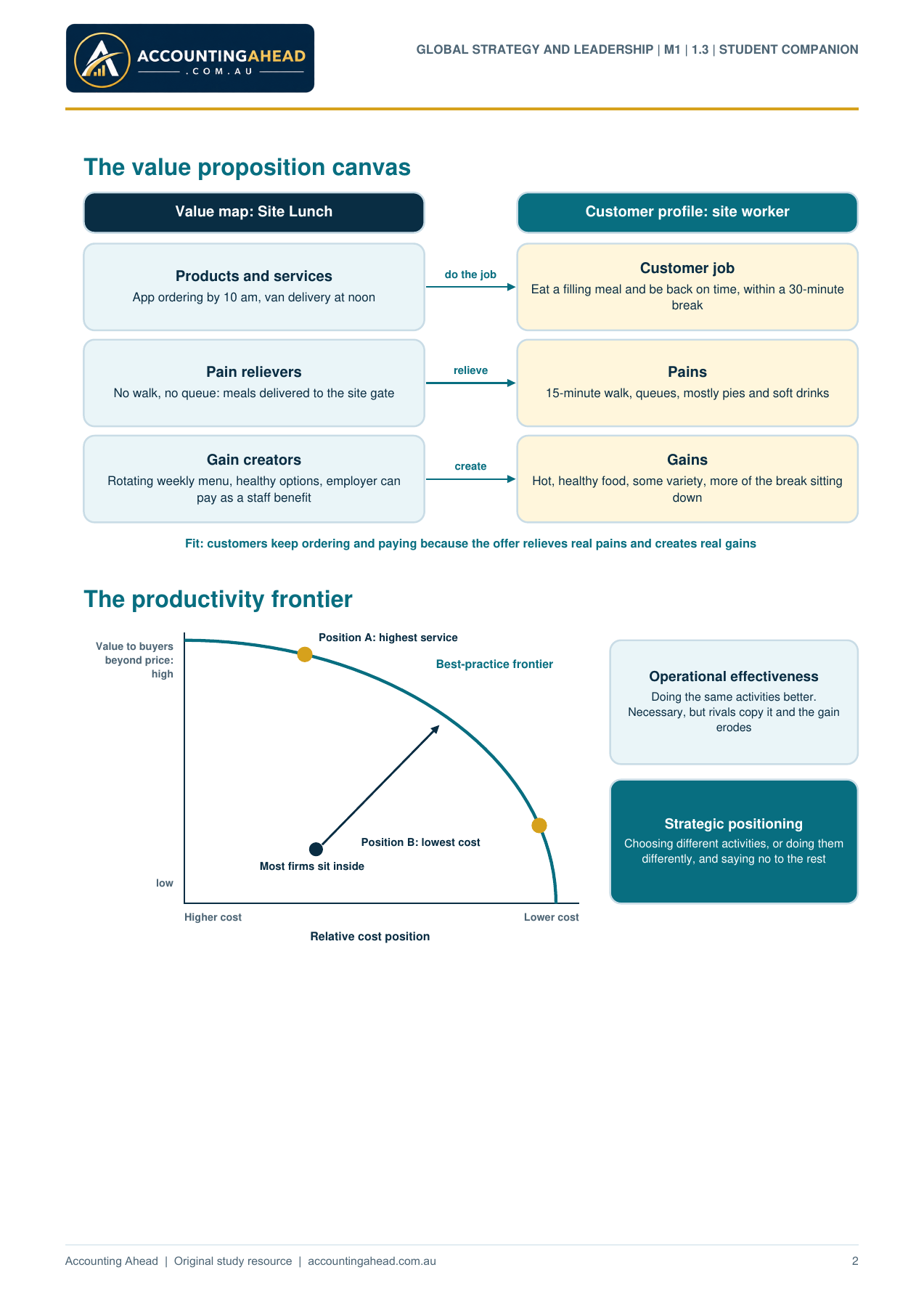
The value proposition canvas
Value map: Site Lunch Customer profile: site worker
Products and services
App ordering by 10 am, van delivery at noon
Customer job
Eat a filling meal and be back on time, within a 30-minute
break
Pain relievers
No walk, no queue: meals delivered to the site gate
Pains
15-minute walk, queues, mostly pies and soft drinks
Gain creators
Rotating weekly menu, healthy options, employer can
pay as a staff benefit
Gains
Hot, healthy food, some variety, more of the break sitting
down
relieve
create
do the job
Fit: customers keep ordering and paying because the offer relieves real pains and creates real gains
The productivity frontier
Best-practice frontier
Value to buyers
beyond price:
high
low
Higher cost Lower cost
Relative cost position
Most firms sit inside
Position A: highest service
Position B: lowest cost
Operational effectiveness
Doing the same activities better.
Necessary, but rivals copy it and the gain
erodes
Strategic positioning
Choosing different activities, or doing them
differently, and saying no to the rest
GLOBAL STRATEGY AND LEADERSHIP | M1 | 1.3 | STUDENT COMPANION
2
Accounting Ahead | Original study resource | accountingahead.com.au
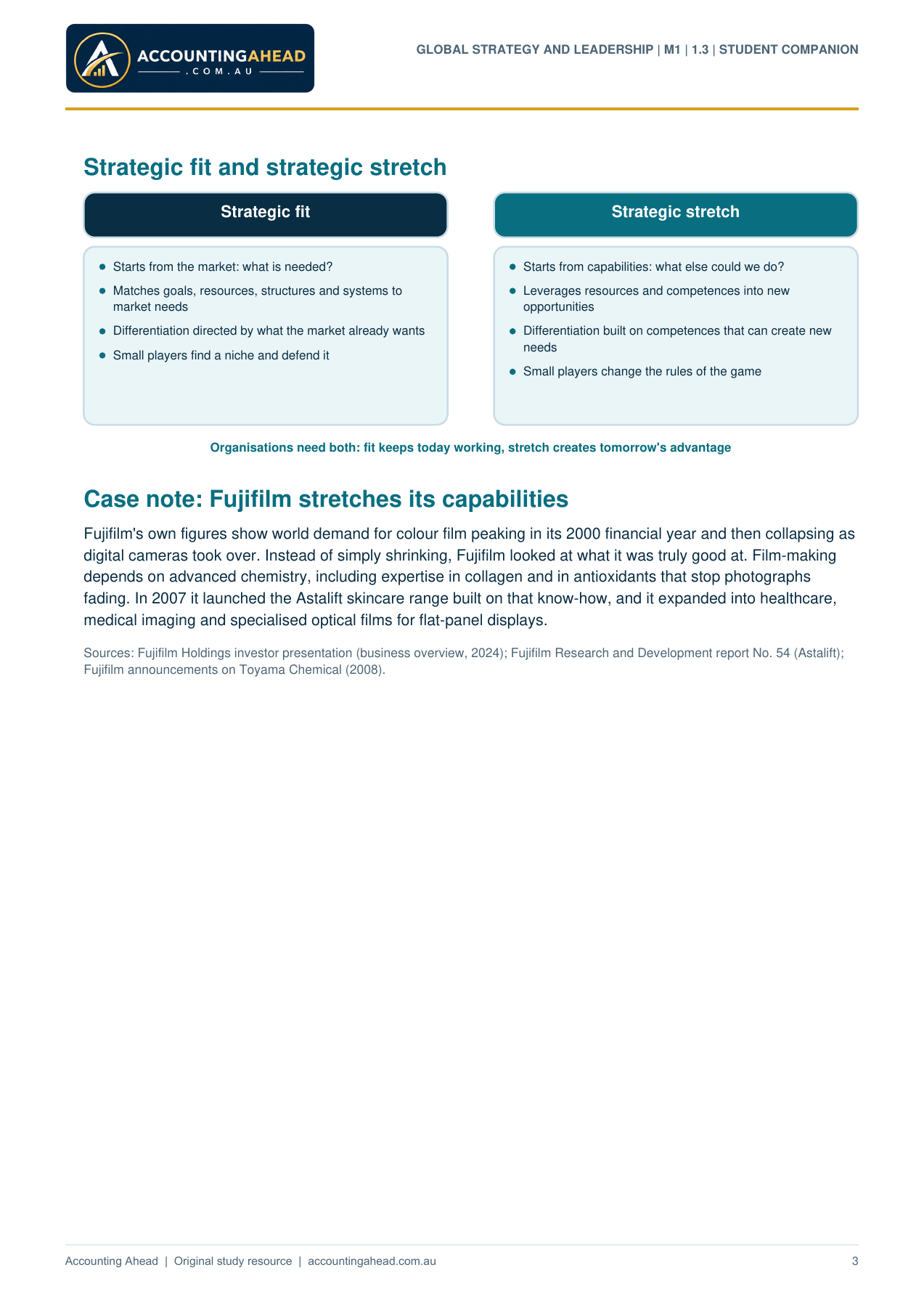
Strategic fit and strategic stretch
Strategic fit
Starts from the market: what is needed?
Matches goals, resources, structures and systems to
market needs
Differentiation directed by what the market already wants
Small players find a niche and defend it
Strategic stretch
Starts from capabilities: what else could we do?
Leverages resources and competences into new
opportunities
Differentiation built on competences that can create new
needs
Small players change the rules of the game
Organisations need both: fit keeps today working, stretch creates tomorrow's advantage
Case note: Fujifilm stretches its capabilities
Fujifilm's own figures show world demand for colour film peaking in its 2000 financial year and then collapsing as
digital cameras took over. Instead of simply shrinking, Fujifilm looked at what it was truly good at. Film-making
depends on advanced chemistry, including expertise in collagen and in antioxidants that stop photographs
fading. In 2007 it launched the Astalift skincare range built on that know-how, and it expanded into healthcare,
medical imaging and specialised optical films for flat-panel displays.
Sources: Fujifilm Holdings investor presentation (business overview, 2024); Fujifilm Research and Development report No. 54 (Astalift);
Fujifilm announcements on Toyama Chemical (2008).
GLOBAL STRATEGY AND LEADERSHIP | M1 | 1.3 | STUDENT COMPANION
3
Accounting Ahead | Original study resource | accountingahead.com.au
Practice questions
MODULE 1 | 1.3 | TRY THESE BEFORE THE WORKED ANSWERS
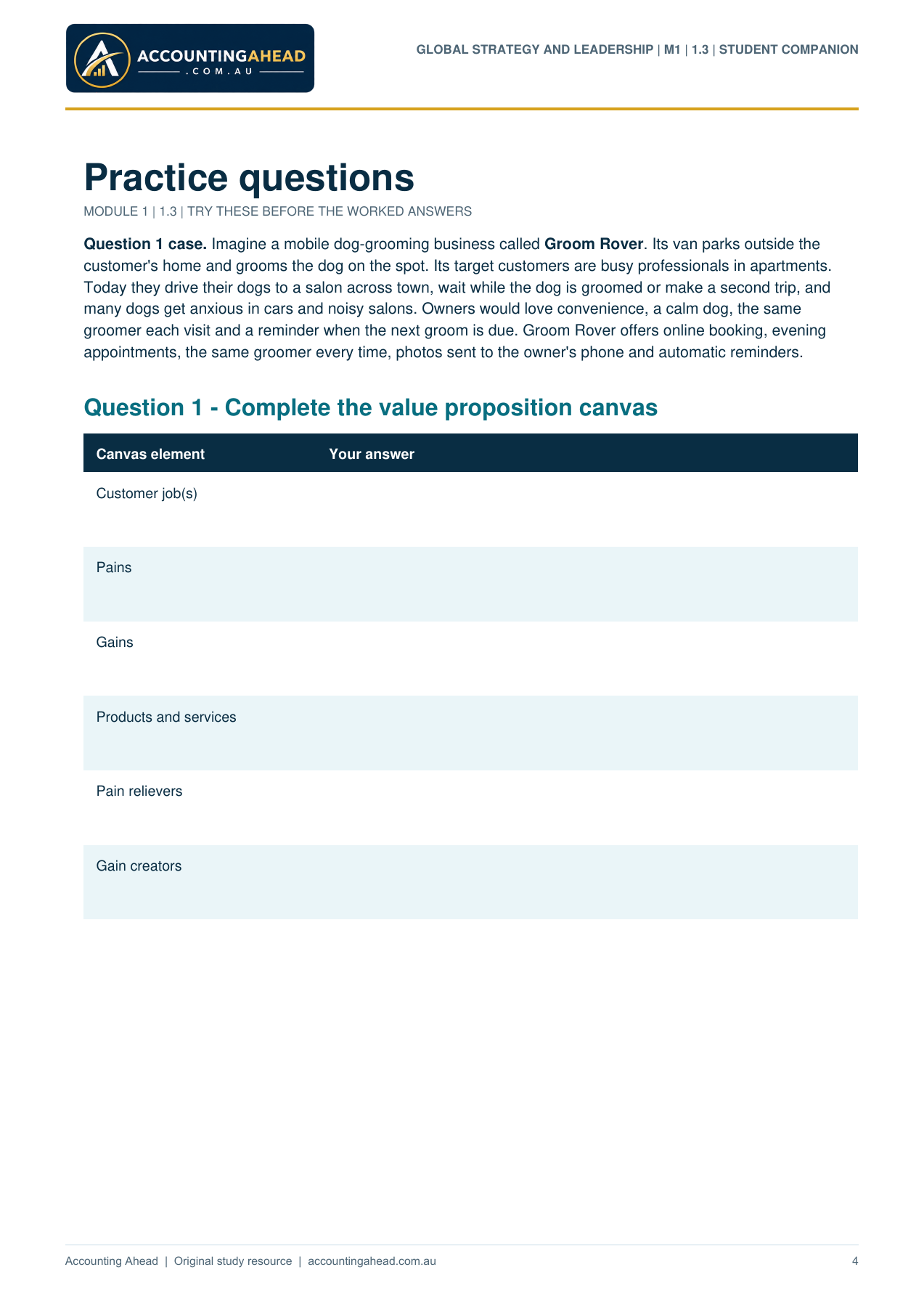
Question 1 case. Imagine a mobile dog-grooming business called Groom Rover. Its van parks outside the
customer's home and grooms the dog on the spot. Its target customers are busy professionals in apartments.
Today they drive their dogs to a salon across town, wait while the dog is groomed or make a second trip, and
many dogs get anxious in cars and noisy salons. Owners would love convenience, a calm dog, the same
groomer each visit and a reminder when the next groom is due. Groom Rover offers online booking, evening
appointments, the same groomer every time, photos sent to the owner's phone and automatic reminders.
Question 1 - Complete the value proposition canvas
Canvas element Your answer
Customer job(s)
Pains
Gains
Products and services
Pain relievers
Gain creators
GLOBAL STRATEGY AND LEADERSHIP | M1 | 1.3 | STUDENT COMPANION
4
Accounting Ahead | Original study resource | accountingahead.com.au
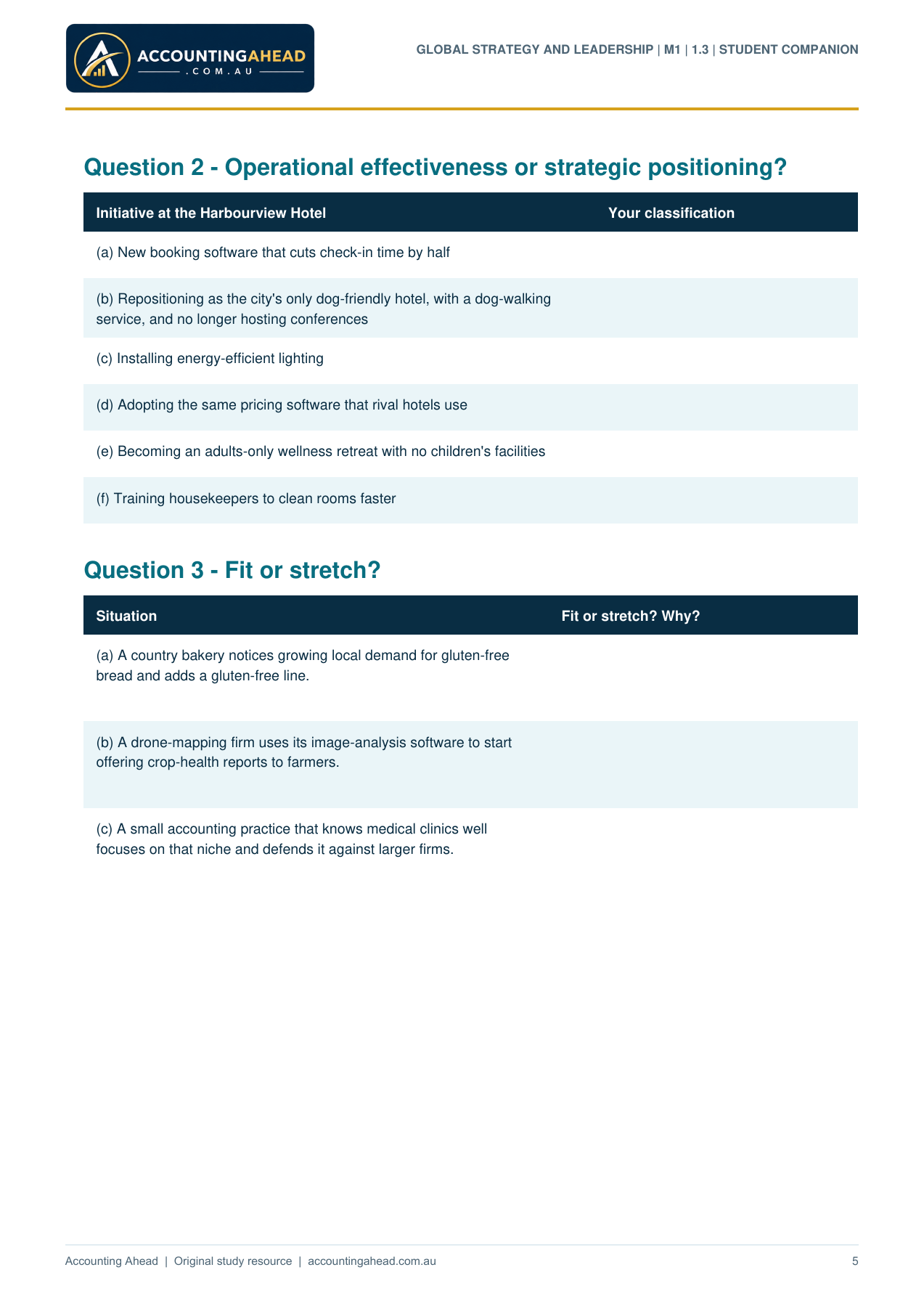
Question 2 - Operational effectiveness or strategic positioning?
Initiative at the Harbourview Hotel Your classification
(a) New booking software that cuts check-in time by half
(b) Repositioning as the city's only dog-friendly hotel, with a dog-walking
service, and no longer hosting conferences
(c) Installing energy-efficient lighting
(d) Adopting the same pricing software that rival hotels use
(e) Becoming an adults-only wellness retreat with no children's facilities
(f) Training housekeepers to clean rooms faster
Question 3 - Fit or stretch?
Situation Fit or stretch? Why?
(a) A country bakery notices growing local demand for gluten-free
bread and adds a gluten-free line.
(b) A drone-mapping firm uses its image-analysis software to start
offering crop-health reports to farmers.
(c) A small accounting practice that knows medical clinics well
focuses on that niche and defends it against larger firms.
GLOBAL STRATEGY AND LEADERSHIP | M1 | 1.3 | STUDENT COMPANION
5
Accounting Ahead | Original study resource | accountingahead.com.au
Worked answers
MODULE 1 | 1.3 | WORKED ANSWERS - ATTEMPT THE QUESTIONS FIRST
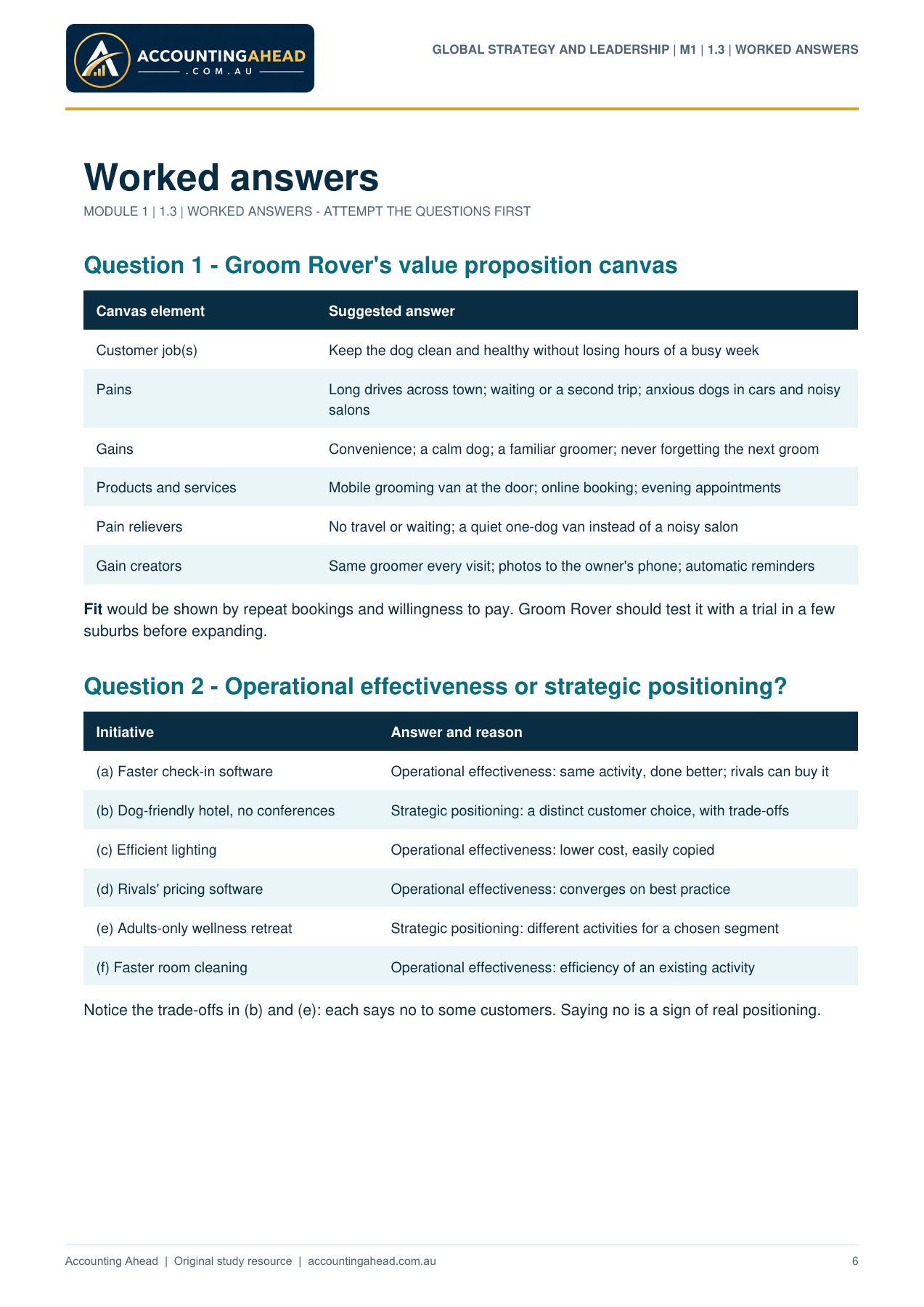
Question 1 - Groom Rover's value proposition canvas
Canvas element Suggested answer
Customer job(s) Keep the dog clean and healthy without losing hours of a busy week
Pains Long drives across town; waiting or a second trip; anxious dogs in cars and noisy
salons
Gains Convenience; a calm dog; a familiar groomer; never forgetting the next groom
Products and services Mobile grooming van at the door; online booking; evening appointments
Pain relievers No travel or waiting; a quiet one-dog van instead of a noisy salon
Gain creators Same groomer every visit; photos to the owner's phone; automatic reminders
Fit would be shown by repeat bookings and willingness to pay. Groom Rover should test it with a trial in a few
suburbs before expanding.
Question 2 - Operational effectiveness or strategic positioning?
Initiative Answer and reason
(a) Faster check-in software Operational effectiveness: same activity, done better; rivals can buy it
(b) Dog-friendly hotel, no conferences Strategic positioning: a distinct customer choice, with trade-offs
(c) Efficient lighting Operational effectiveness: lower cost, easily copied
(d) Rivals' pricing software Operational effectiveness: converges on best practice
(e) Adults-only wellness retreat Strategic positioning: different activities for a chosen segment
(f) Faster room cleaning Operational effectiveness: efficiency of an existing activity
Notice the trade-offs in (b) and (e): each says no to some customers. Saying no is a sign of real positioning.
GLOBAL STRATEGY AND LEADERSHIP | M1 | 1.3 | WORKED ANSWERS
6
Accounting Ahead | Original study resource | accountingahead.com.au
Question 3 - Fit or stretch?
Situation Answer and reason
(a) Gluten-free line Fit: starts from an identified market need and matches the offer to it
(b) Crop-health reports Stretch: leverages an existing capability into a market it never served
(c) Medical-clinic niche Fit: finds a niche where its resources match customer needs, and defends it
GLOBAL STRATEGY AND LEADERSHIP | M1 | 1.3 | WORKED ANSWERS
7