
The global context of business
Printable study notes to use alongside Part 1.5.

Read the handout text
Accounting Ahead | Original study resource | accountingahead.com.au
The global context of business
MODULE 1 | 1.5 | STUDENT COMPANION
Globalisation describes organisations that operate in many countries, with their activities in those
countries connected through money, manufacturing, marketing or selling. Ways in range from importing
and exporting, licensing and franchising, through joint ventures and strategic alliances, to a wholly owned
subsidiary. Generally, more control brings more investment and more risk (entry modes are covered in
Module 4).
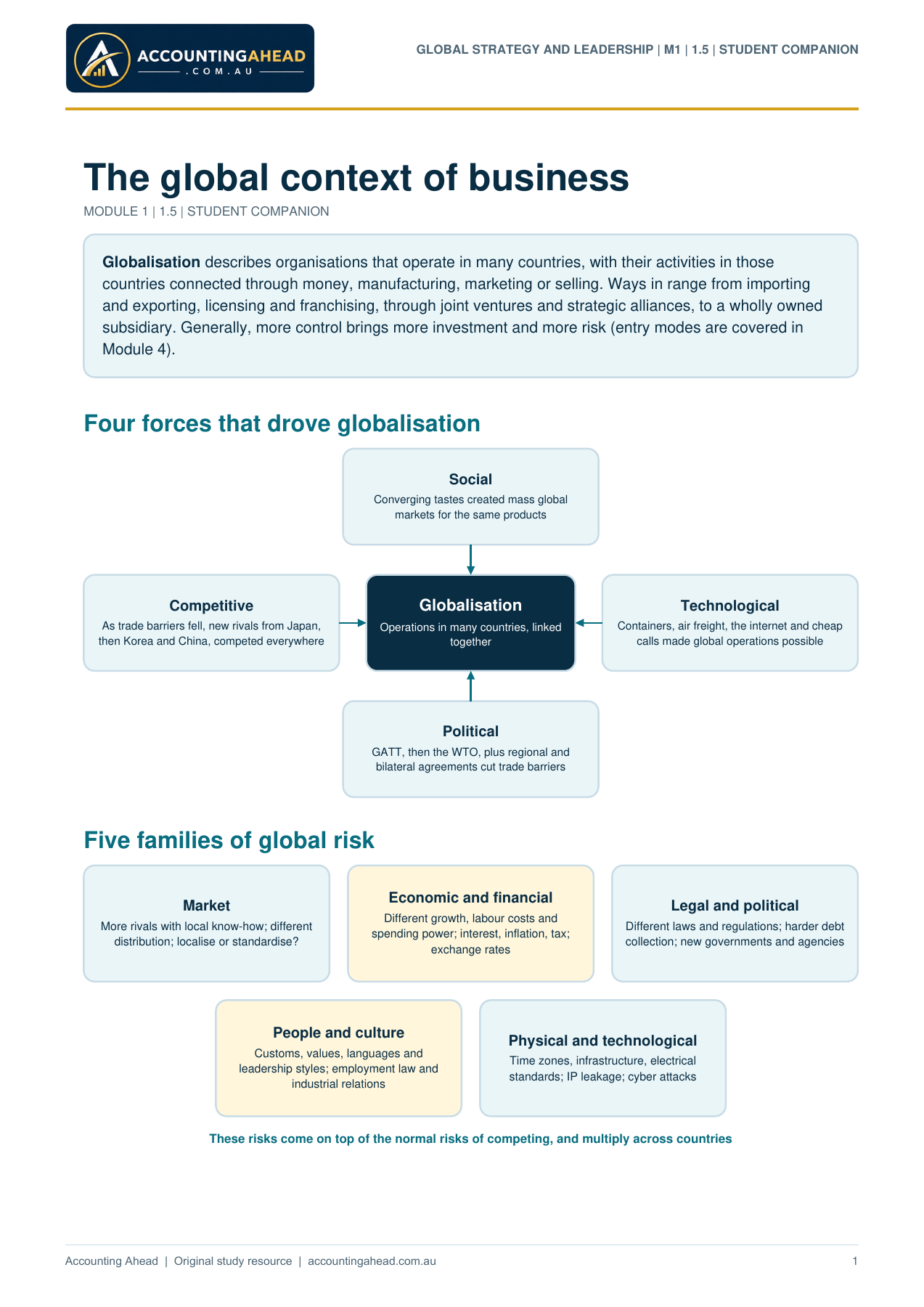
Four forces that drove globalisation
Globalisation
Operations in many countries, linked
together
Competitive
As trade barriers fell, new rivals from Japan,
then Korea and China, competed everywhere
Technological
Containers, air freight, the internet and cheap
calls made global operations possible
Social
Converging tastes created mass global
markets for the same products
Political
GATT, then the WTO, plus regional and
bilateral agreements cut trade barriers
Five families of global risk
Market
More rivals with local know-how; different
distribution; localise or standardise?
Economic and financial
Different growth, labour costs and
spending power; interest, inflation, tax;
exchange rates
Legal and political
Different laws and regulations; harder debt
collection; new governments and agencies
People and culture
Customs, values, languages and
leadership styles; employment law and
industrial relations
Physical and technological
Time zones, infrastructure, electrical
standards; IP leakage; cyber attacks
These risks come on top of the normal risks of competing, and multiply across countries
GLOBAL STRATEGY AND LEADERSHIP | M1 | 1.5 | STUDENT COMPANION
1
Accounting Ahead | Original study resource | accountingahead.com.au
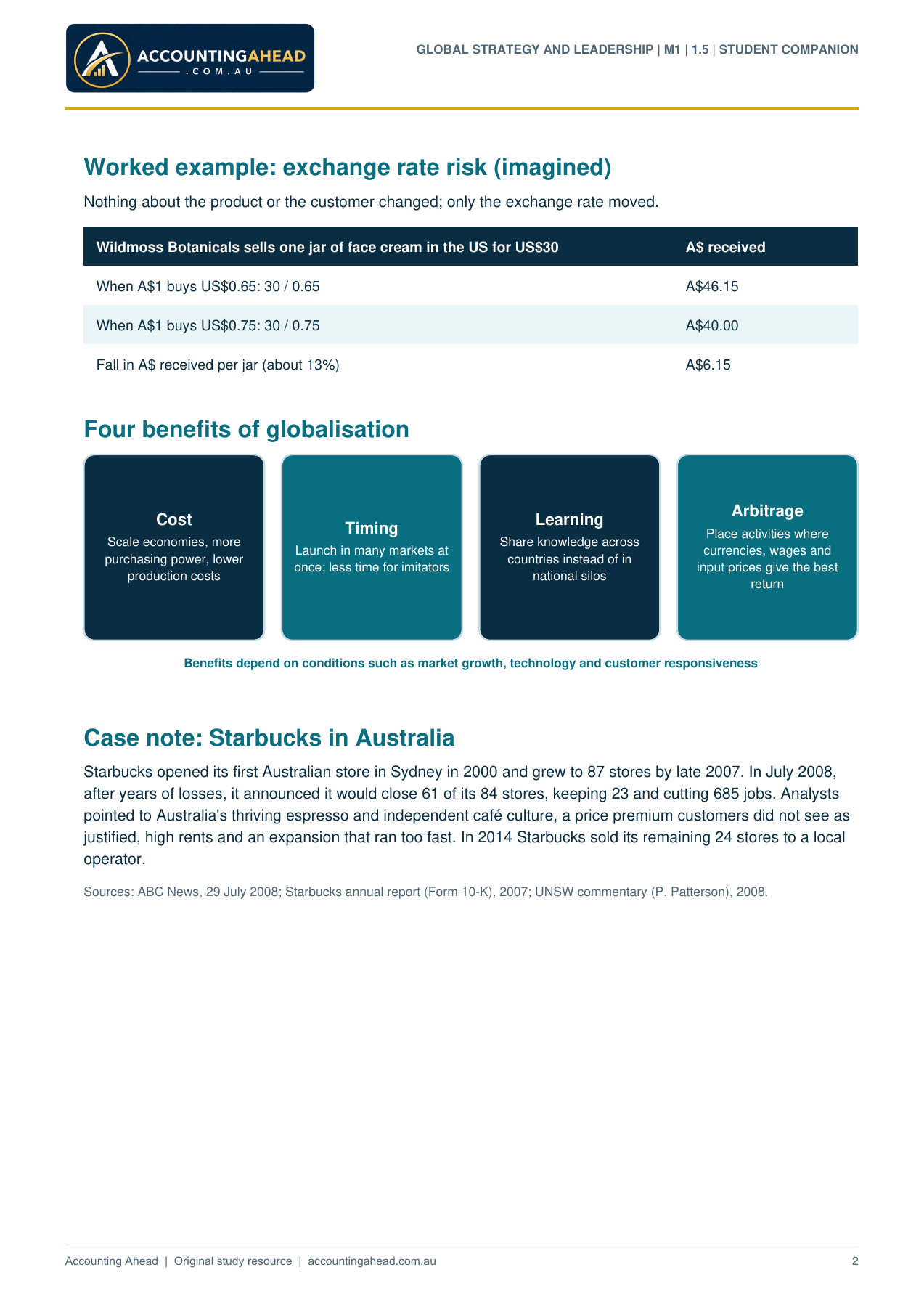
Worked example: exchange rate risk (imagined)
Nothing about the product or the customer changed; only the exchange rate moved.
Wildmoss Botanicals sells one jar of face cream in the US for US$30 A$ received
When A$1 buys US$0.65: 30 / 0.65 A$46.15
When A$1 buys US$0.75: 30 / 0.75 A$40.00
Fall in A$ received per jar (about 13%) A$6.15
Four benefits of globalisation
Cost
Scale economies, more
purchasing power, lower
production costs
Timing
Launch in many markets at
once; less time for imitators
Learning
Share knowledge across
countries instead of in
national silos
Arbitrage
Place activities where
currencies, wages and
input prices give the best
return
Benefits depend on conditions such as market growth, technology and customer responsiveness
Case note: Starbucks in Australia
Starbucks opened its first Australian store in Sydney in 2000 and grew to 87 stores by late 2007. In July 2008,
after years of losses, it announced it would close 61 of its 84 stores, keeping 23 and cutting 685 jobs. Analysts
pointed to Australia's thriving espresso and independent café culture, a price premium customers did not see as
justified, high rents and an expansion that ran too fast. In 2014 Starbucks sold its remaining 24 stores to a local
operator.
Sources: ABC News, 29 July 2008; Starbucks annual report (Form 10-K), 2007; UNSW commentary (P. Patterson), 2008.
GLOBAL STRATEGY AND LEADERSHIP | M1 | 1.5 | STUDENT COMPANION
2
Accounting Ahead | Original study resource | accountingahead.com.au
Practice questions
MODULE 1 | 1.5 | TRY THESE BEFORE THE WORKED ANSWERS
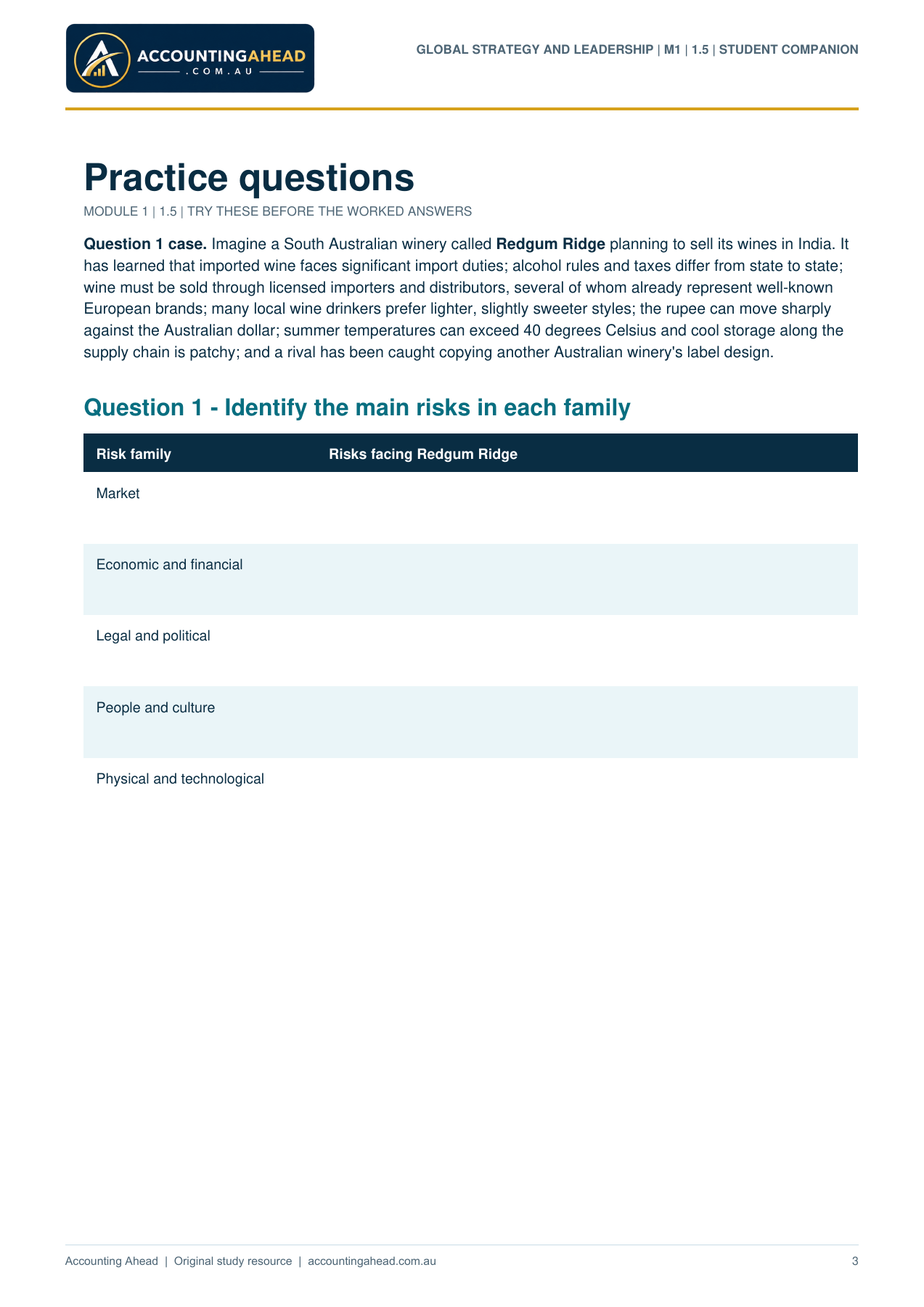
Question 1 case. Imagine a South Australian winery called Redgum Ridge planning to sell its wines in India. It
has learned that imported wine faces significant import duties; alcohol rules and taxes differ from state to state;
wine must be sold through licensed importers and distributors, several of whom already represent well-known
European brands; many local wine drinkers prefer lighter, slightly sweeter styles; the rupee can move sharply
against the Australian dollar; summer temperatures can exceed 40 degrees Celsius and cool storage along the
supply chain is patchy; and a rival has been caught copying another Australian winery's label design.
Question 1 - Identify the main risks in each family
Risk family Risks facing Redgum Ridge
Market
Economic and financial
Legal and political
People and culture
Physical and technological
GLOBAL STRATEGY AND LEADERSHIP | M1 | 1.5 | STUDENT COMPANION
3
Accounting Ahead | Original study resource | accountingahead.com.au
Question 2 - Which benefits apply?
Imagine a payroll software company called Ledgerly with development teams in Brisbane, Manila and Krakow. It
sells one product, translated into several languages, to customers in fifteen countries. It releases every update to
all customers on the same day, keeps a shared library of fixes so a problem solved in one office is solved for
everyone, and decides where to grow each team by comparing salaries and exchange rates in the three cities.
Which of the four benefits of globalisation does Ledgerly enjoy? Explain each one.
GLOBAL STRATEGY AND LEADERSHIP | M1 | 1.5 | STUDENT COMPANION
4
Accounting Ahead | Original study resource | accountingahead.com.au
Question 3 - Standardise or localise?
Imagine an Australian flat-pack furniture retailer called Woodfold, known for a simple Scandinavian-style range
made from plantation timber, planning to open in Japan. Its research shows that city apartments there are often
smaller than Australian homes, many households use futon-style bedding and low tables, customers expect a
very high finish and clear instructions in Japanese, and Woodfold's cost advantage depends on long production
runs of a standard range. Should Woodfold standardise or localise its range? Justify your recommendation.
GLOBAL STRATEGY AND LEADERSHIP | M1 | 1.5 | STUDENT COMPANION
5
Accounting Ahead | Original study resource | accountingahead.com.au
Worked answers
MODULE 1 | 1.5 | WORKED ANSWERS - ATTEMPT THE QUESTIONS FIRST
Question 1 - Redgum Ridge's main risks
Risk family Risks
Market Entrenched European brands with established importer relationships; distribution
only through licensed importers; a choice between adapting wine styles and
labels or keeping the standard range
Economic and financial Import duties raise shelf prices, so affordability depends on disposable income;
rupee movements can erode margins; state taxes add cost
Legal and political Different alcohol rules, licences and taxes in each state; import regulations that
can change
People and culture Preference for lighter, sweeter styles; different drinking customs between regions;
the need to build relationships with distributors
Physical and technological Heat and a patchy cold chain can spoil wine; label copying threatens the brand,
so trademarks should be registered locally
Question 2 - Ledgerly's benefits
Cost: one product sold in fifteen countries spreads development costs over a far larger customer base. Timing:
simultaneous releases are efficient and give imitators less time to copy new features. Learning: the shared fix
library stops each office solving problems another office has already solved. Arbitrage: growing teams where
salaries and exchange rates give the best return lowers the cost of development.
Question 3 - Woodfold: standardise or localise?
Recommendation: a hybrid. Standardise what drives the cost advantage and the brand: core designs,
materials, production runs, supply chain and brand identity. Localise what Japanese customers clearly need:
compact sizes for smaller apartments, a few new lines such as low tables and futon-friendly bases, a higher
finish standard, and instructions and service in Japanese.
Justification: full standardisation risks a range that does not fit Japanese homes, the same trap that hurts
brands entering a market with a strong local culture. Full localisation would destroy the long production runs that
make Woodfold competitive. Starting with a limited adapted range and testing it lets Woodfold learn before
committing.
GLOBAL STRATEGY AND LEADERSHIP | M1 | 1.5 | WORKED ANSWERS
6