
Introduction to leadership
Printable study notes to use alongside Part 1.6.
Read the handout text
Accounting Ahead | Original study resource | accountingahead.com.au
Introduction to leadership
MODULE 1 | 1.6 | STUDENT COMPANION
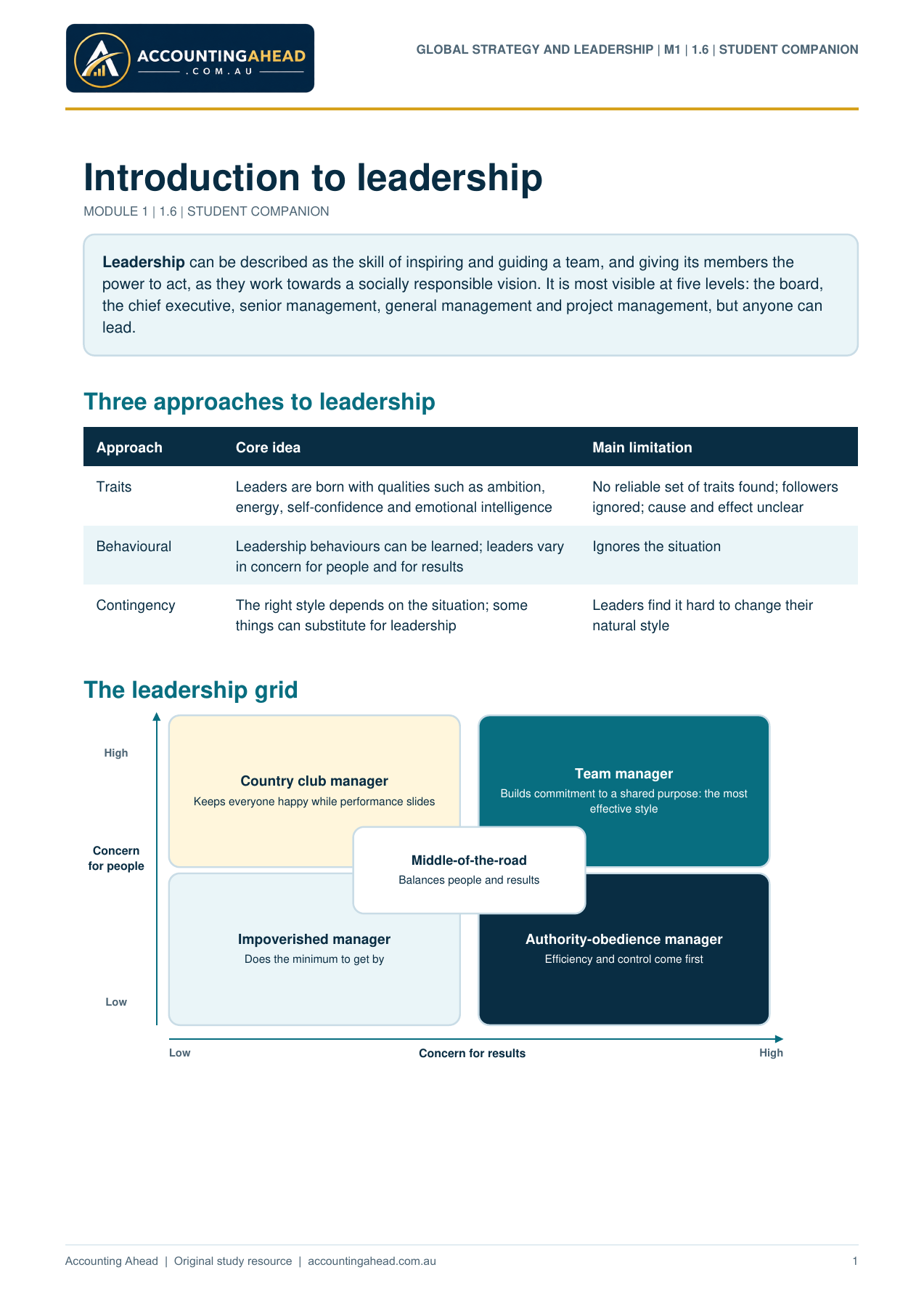
Leadership can be described as the skill of inspiring and guiding a team, and giving its members the
power to act, as they work towards a socially responsible vision. It is most visible at five levels: the board,
the chief executive, senior management, general management and project management, but anyone can
lead.
Three approaches to leadership
Approach Core idea Main limitation
Traits Leaders are born with qualities such as ambition,
energy, self-confidence and emotional intelligence
No reliable set of traits found; followers
ignored; cause and effect unclear
Behavioural Leadership behaviours can be learned; leaders vary
in concern for people and for results
Ignores the situation
Contingency The right style depends on the situation; some
things can substitute for leadership
Leaders find it hard to change their
natural style
The leadership grid
Country club manager
Keeps everyone happy while performance slides
Team manager
Builds commitment to a shared purpose: the most
effective style
Impoverished manager
Does the minimum to get by
Authority-obedience manager
Efficiency and control come first
Middle-of-the-road
Balances people and results
High
Low
Concern
for people
Low HighConcern for results
GLOBAL STRATEGY AND LEADERSHIP | M1 | 1.6 | STUDENT COMPANION
1
Accounting Ahead | Original study resource | accountingahead.com.au
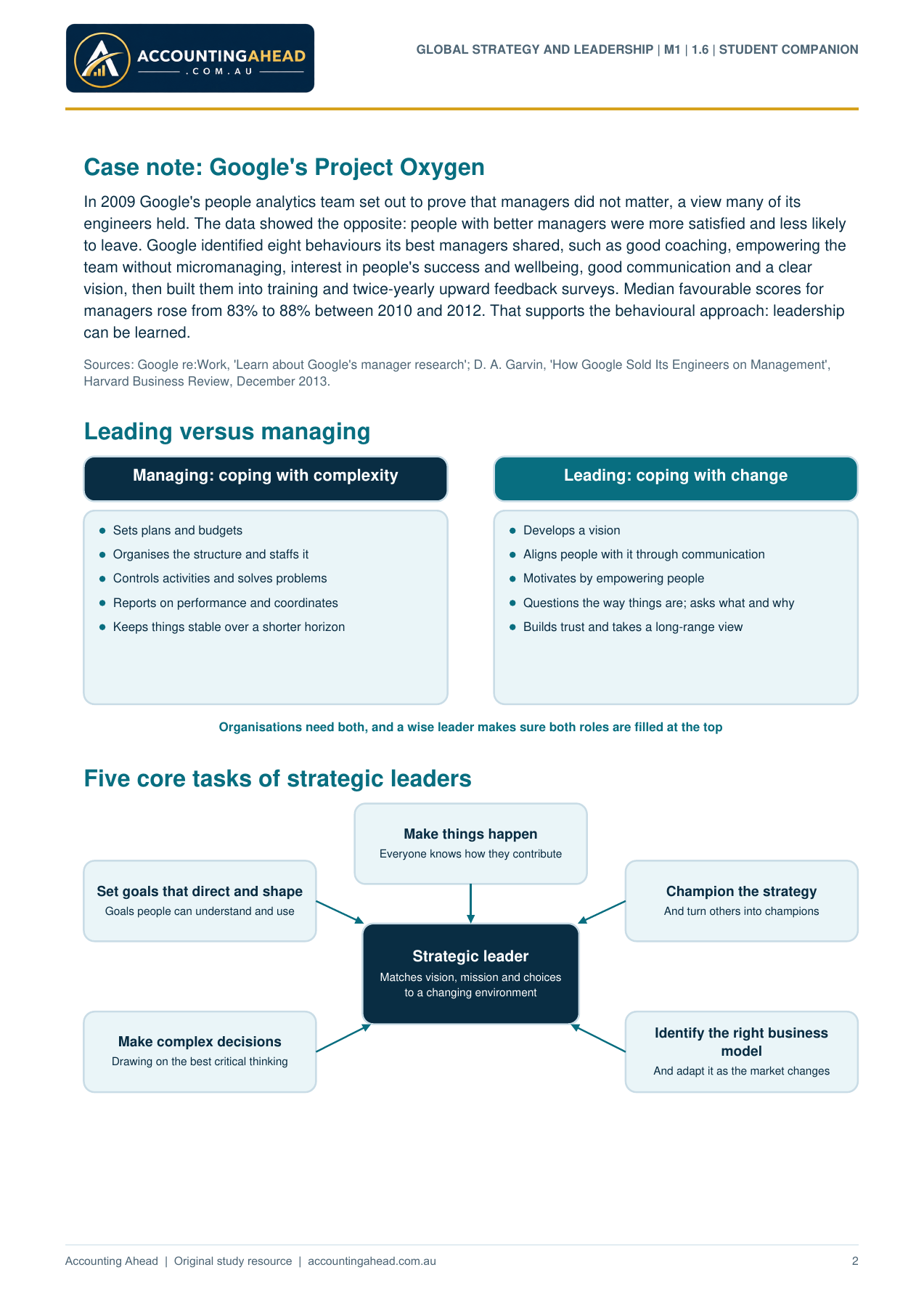
Case note: Google's Project Oxygen
In 2009 Google's people analytics team set out to prove that managers did not matter, a view many of its
engineers held. The data showed the opposite: people with better managers were more satisfied and less likely
to leave. Google identified eight behaviours its best managers shared, such as good coaching, empowering the
team without micromanaging, interest in people's success and wellbeing, good communication and a clear
vision, then built them into training and twice-yearly upward feedback surveys. Median favourable scores for
managers rose from 83% to 88% between 2010 and 2012. That supports the behavioural approach: leadership
can be learned.
Sources: Google re:Work, 'Learn about Google's manager research'; D. A. Garvin, 'How Google Sold Its Engineers on Management',
Harvard Business Review, December 2013.
Leading versus managing
Managing: coping with complexity
Sets plans and budgets
Organises the structure and staffs it
Controls activities and solves problems
Reports on performance and coordinates
Keeps things stable over a shorter horizon
Leading: coping with change
Develops a vision
Aligns people with it through communication
Motivates by empowering people
Questions the way things are; asks what and why
Builds trust and takes a long-range view
Organisations need both, and a wise leader makes sure both roles are filled at the top
Five core tasks of strategic leaders
Strategic leader
Matches vision, mission and choices
to a changing environment
Make things happen
Everyone knows how they contribute
Set goals that direct and shape
Goals people can understand and use
Champion the strategy
And turn others into champions
Make complex decisions
Drawing on the best critical thinking
Identify the right business
model
And adapt it as the market changes
GLOBAL STRATEGY AND LEADERSHIP | M1 | 1.6 | STUDENT COMPANION
2
Accounting Ahead | Original study resource | accountingahead.com.au
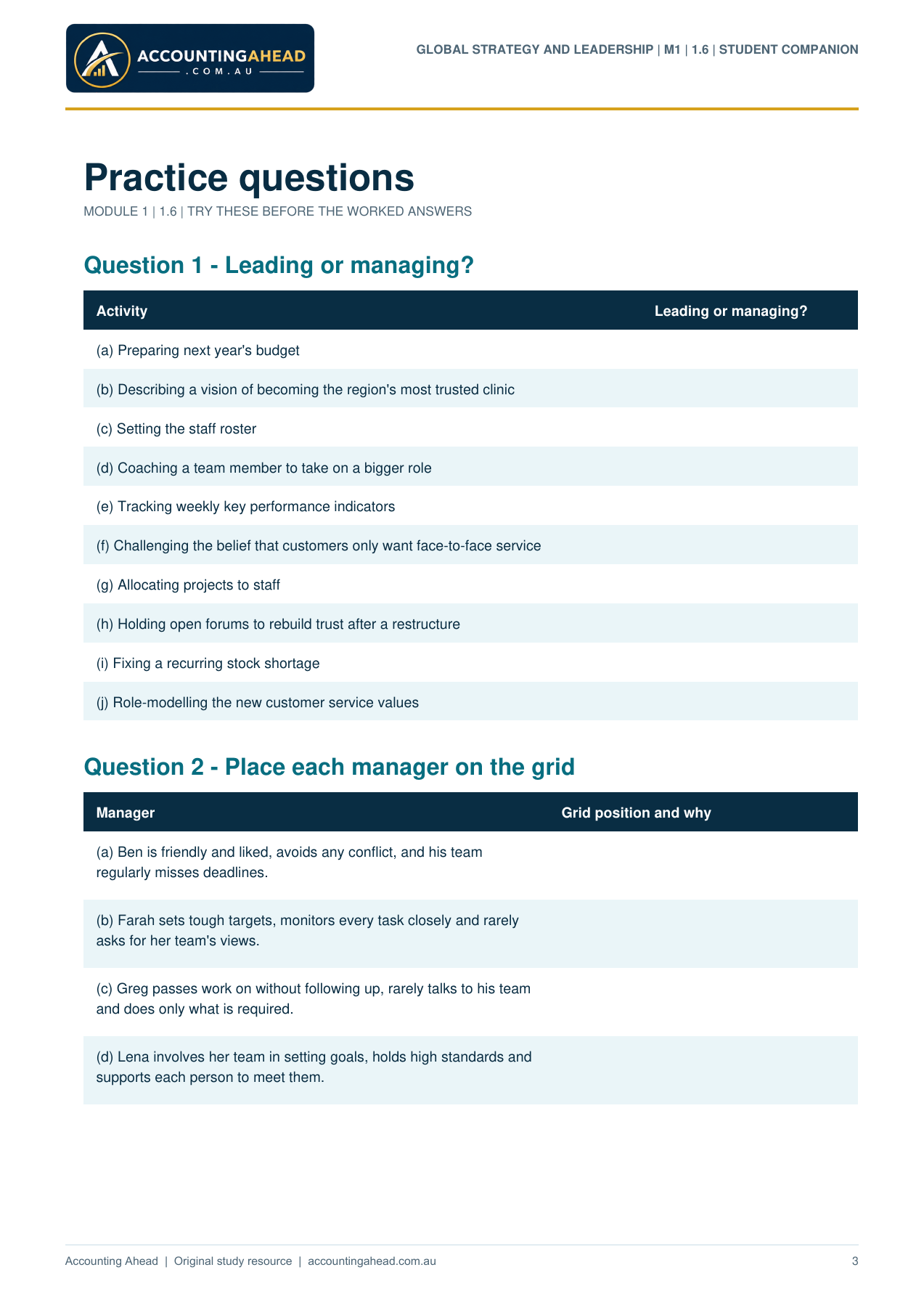
Practice questions
MODULE 1 | 1.6 | TRY THESE BEFORE THE WORKED ANSWERS
Question 1 - Leading or managing?
Activity Leading or managing?
(a) Preparing next year's budget
(b) Describing a vision of becoming the region's most trusted clinic
(c) Setting the staff roster
(d) Coaching a team member to take on a bigger role
(e) Tracking weekly key performance indicators
(f) Challenging the belief that customers only want face-to-face service
(g) Allocating projects to staff
(h) Holding open forums to rebuild trust after a restructure
(i) Fixing a recurring stock shortage
(j) Role-modelling the new customer service values
Question 2 - Place each manager on the grid
Manager Grid position and why
(a) Ben is friendly and liked, avoids any conflict, and his team
regularly misses deadlines.
(b) Farah sets tough targets, monitors every task closely and rarely
asks for her team's views.
(c) Greg passes work on without following up, rarely talks to his team
and does only what is required.
(d) Lena involves her team in setting goals, holds high standards and
supports each person to meet them.
GLOBAL STRATEGY AND LEADERSHIP | M1 | 1.6 | STUDENT COMPANION
3
Accounting Ahead | Original study resource | accountingahead.com.au
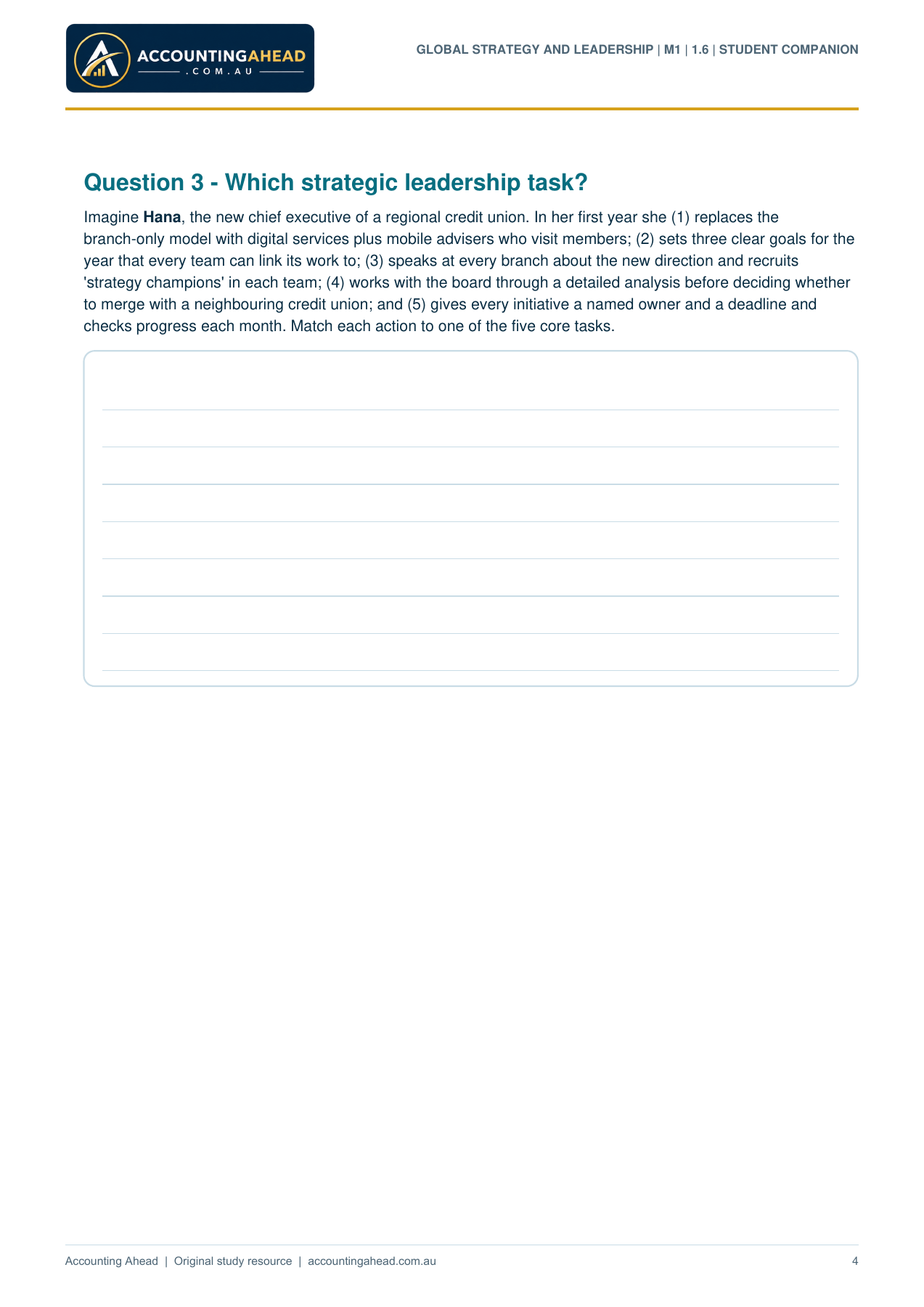
Question 3 - Which strategic leadership task?
Imagine Hana, the new chief executive of a regional credit union. In her first year she (1) replaces the
branch-only model with digital services plus mobile advisers who visit members; (2) sets three clear goals for the
year that every team can link its work to; (3) speaks at every branch about the new direction and recruits
'strategy champions' in each team; (4) works with the board through a detailed analysis before deciding whether
to merge with a neighbouring credit union; and (5) gives every initiative a named owner and a deadline and
checks progress each month. Match each action to one of the five core tasks.
GLOBAL STRATEGY AND LEADERSHIP | M1 | 1.6 | STUDENT COMPANION
4
Accounting Ahead | Original study resource | accountingahead.com.au
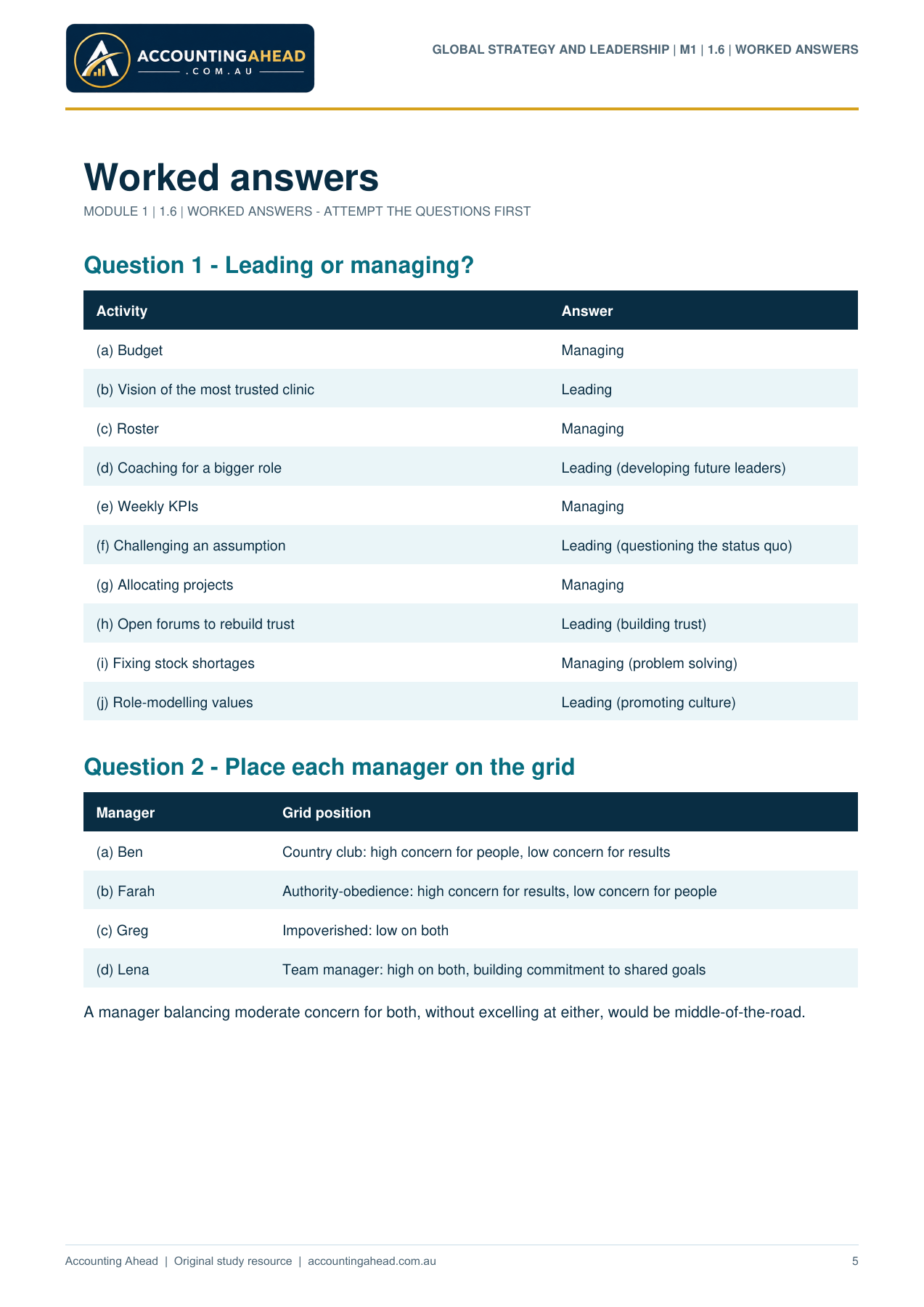
Worked answers
MODULE 1 | 1.6 | WORKED ANSWERS - ATTEMPT THE QUESTIONS FIRST
Question 1 - Leading or managing?
Activity Answer
(a) Budget Managing
(b) Vision of the most trusted clinic Leading
(c) Roster Managing
(d) Coaching for a bigger role Leading (developing future leaders)
(e) Weekly KPIs Managing
(f) Challenging an assumption Leading (questioning the status quo)
(g) Allocating projects Managing
(h) Open forums to rebuild trust Leading (building trust)
(i) Fixing stock shortages Managing (problem solving)
(j) Role-modelling values Leading (promoting culture)
Question 2 - Place each manager on the grid
Manager Grid position
(a) Ben Country club: high concern for people, low concern for results
(b) Farah Authority-obedience: high concern for results, low concern for people
(c) Greg Impoverished: low on both
(d) Lena Team manager: high on both, building commitment to shared goals
A manager balancing moderate concern for both, without excelling at either, would be middle-of-the-road.
GLOBAL STRATEGY AND LEADERSHIP | M1 | 1.6 | WORKED ANSWERS
5
Accounting Ahead | Original study resource | accountingahead.com.au
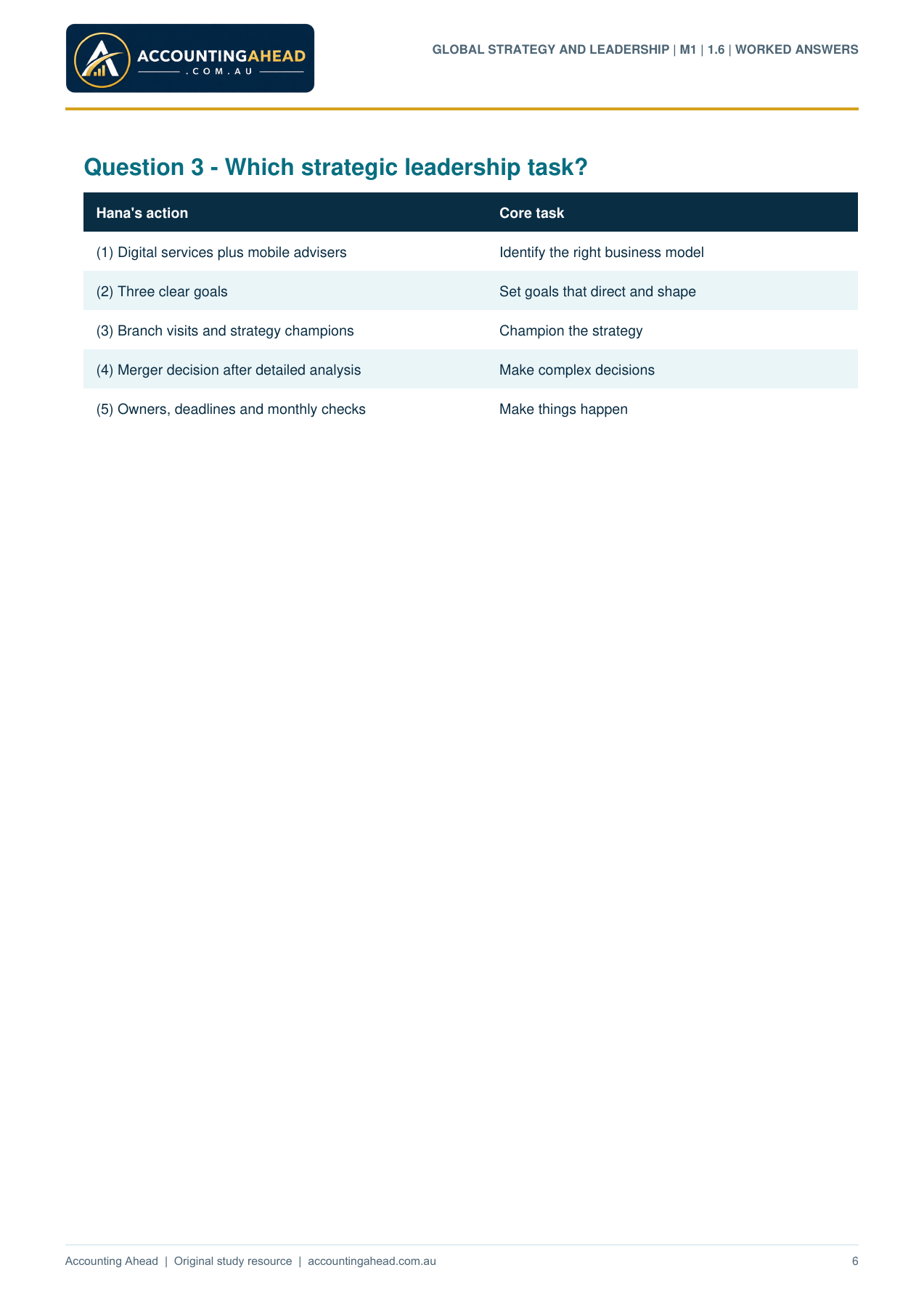
Question 3 - Which strategic leadership task?
Hana's action Core task
(1) Digital services plus mobile advisers Identify the right business model
(2) Three clear goals Set goals that direct and shape
(3) Branch visits and strategy champions Champion the strategy
(4) Merger decision after detailed analysis Make complex decisions
(5) Owners, deadlines and monthly checks Make things happen
GLOBAL STRATEGY AND LEADERSHIP | M1 | 1.6 | WORKED ANSWERS
6