
Matching leadership style to the situation
Printable study notes to use alongside Part 1.7.2.
Read the handout text
Accounting Ahead | Original study resource | accountingahead.com.au
Matching leadership style to the situation
MODULE 1 | 1.7.2 | STUDENT COMPANION
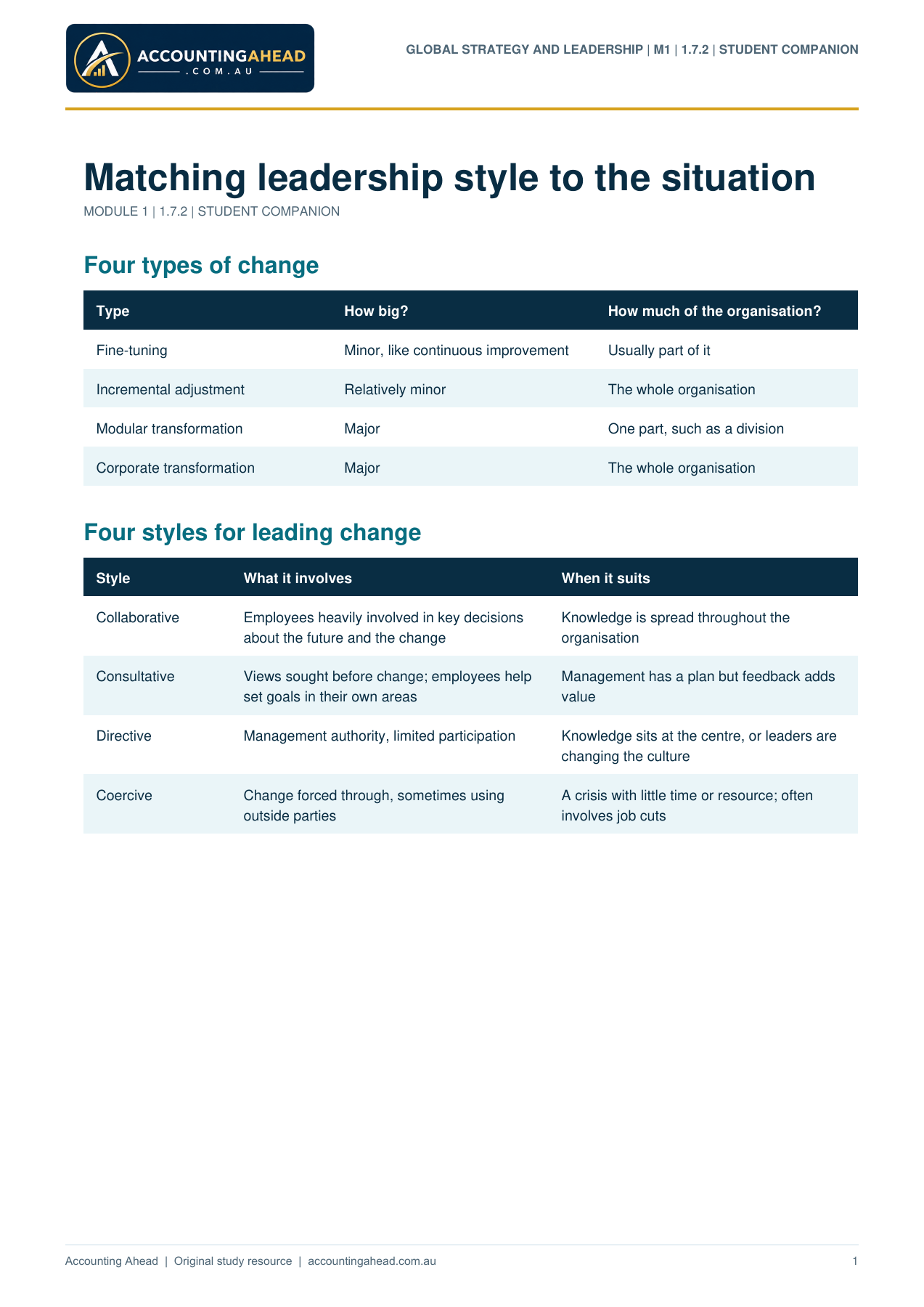
Four types of change
Type How big? How much of the organisation?
Fine-tuning Minor, like continuous improvement Usually part of it
Incremental adjustment Relatively minor The whole organisation
Modular transformation Major One part, such as a division
Corporate transformation Major The whole organisation
Four styles for leading change
Style What it involves When it suits
Collaborative Employees heavily involved in key decisions
about the future and the change
Knowledge is spread throughout the
organisation
Consultative Views sought before change; employees help
set goals in their own areas
Management has a plan but feedback adds
value
Directive Management authority, limited participation Knowledge sits at the centre, or leaders are
changing the culture
Coercive Change forced through, sometimes using
outside parties
A crisis with little time or resource; often
involves job cuts
GLOBAL STRATEGY AND LEADERSHIP | M1 | 1.7.2 | STUDENT COMPANION
1
Accounting Ahead | Original study resource | accountingahead.com.au
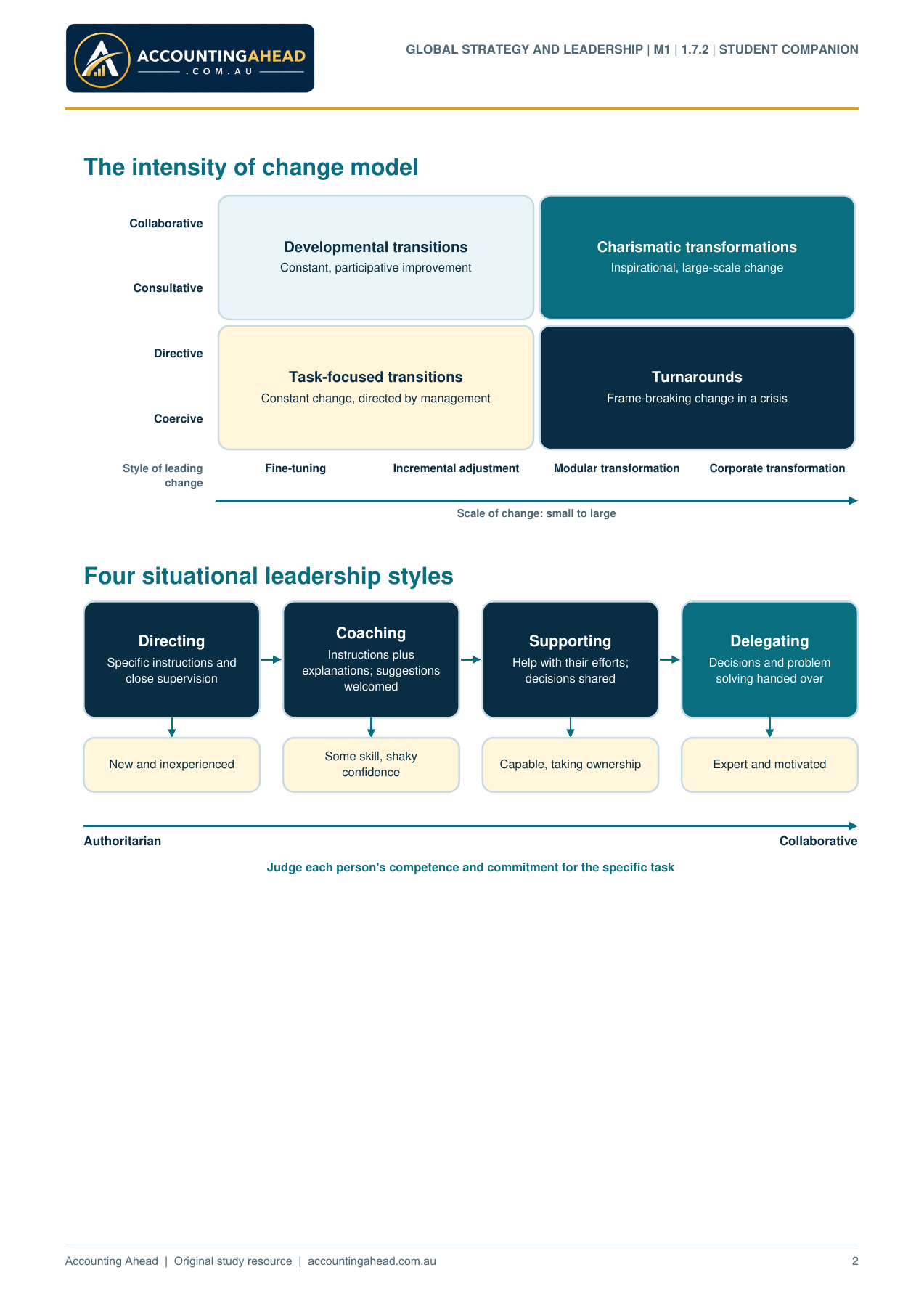
The intensity of change model
Developmental transitions
Constant, participative improvement
Charismatic transformations
Inspirational, large-scale change
Task-focused transitions
Constant change, directed by management
Turnarounds
Frame-breaking change in a crisis
Collaborative
Consultative
Directive
Coercive
Fine-tuning Incremental adjustment Modular transformation Corporate transformation
Scale of change: small to large
Style of leading
change
Four situational leadership styles
Directing
Specific instructions and
close supervision
New and inexperienced
Coaching
Instructions plus
explanations; suggestions
welcomed
Some skill, shaky
confidence
Supporting
Help with their efforts;
decisions shared
Capable, taking ownership
Delegating
Decisions and problem
solving handed over
Expert and motivated
Authoritarian Collaborative
Judge each person's competence and commitment for the specific task
GLOBAL STRATEGY AND LEADERSHIP | M1 | 1.7.2 | STUDENT COMPANION
2
Accounting Ahead | Original study resource | accountingahead.com.au
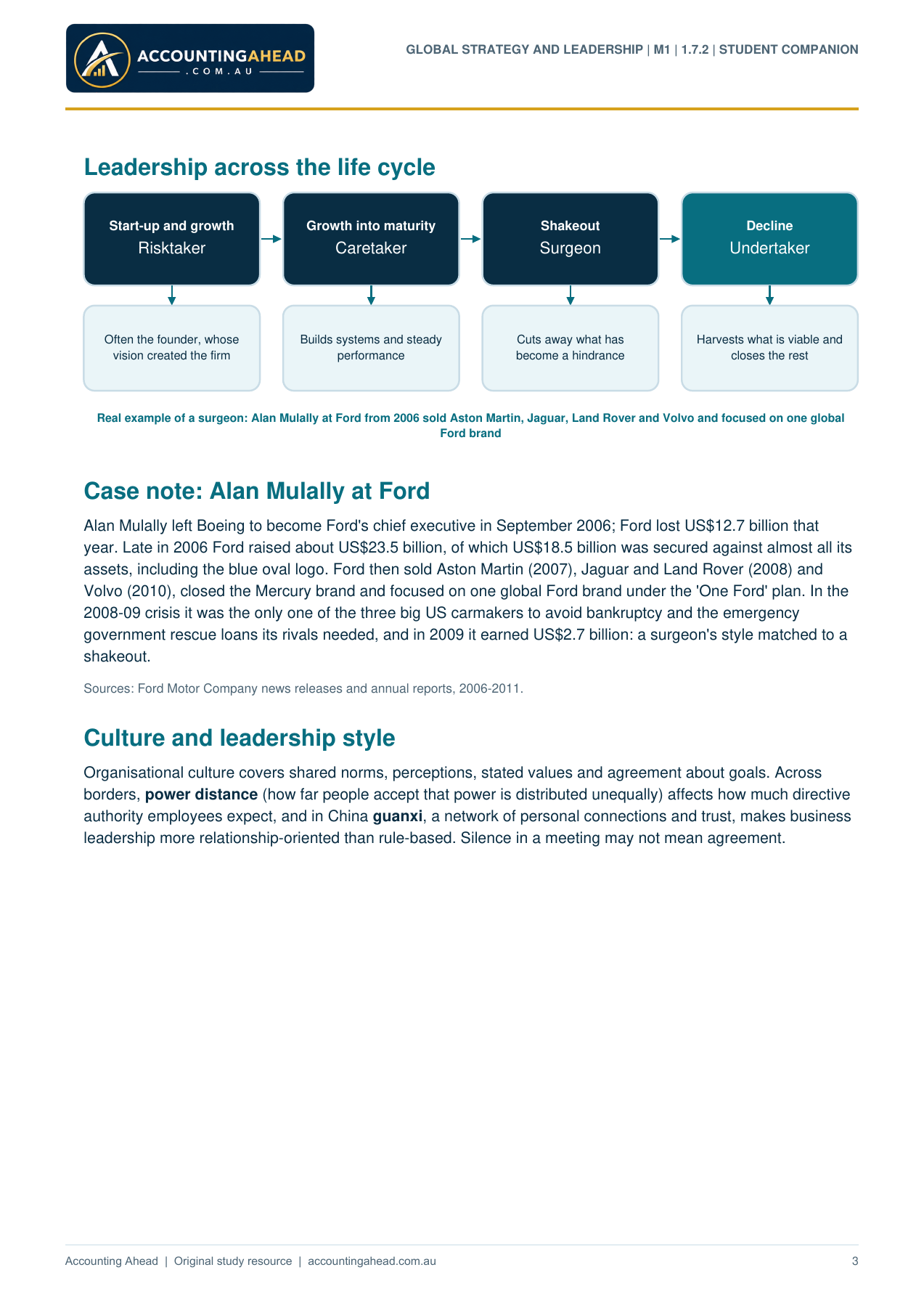
Leadership across the life cycle
Start-up and growth
Risktaker
Often the founder, whose
vision created the firm
Growth into maturity
Caretaker
Builds systems and steady
performance
Shakeout
Surgeon
Cuts away what has
become a hindrance
Decline
Undertaker
Harvests what is viable and
closes the rest
Real example of a surgeon: Alan Mulally at Ford from 2006 sold Aston Martin, Jaguar, Land Rover and Volvo and focused on one global
Ford brand
Case note: Alan Mulally at Ford
Alan Mulally left Boeing to become Ford's chief executive in September 2006; Ford lost US$12.7 billion that
year. Late in 2006 Ford raised about US$23.5 billion, of which US$18.5 billion was secured against almost all its
assets, including the blue oval logo. Ford then sold Aston Martin (2007), Jaguar and Land Rover (2008) and
Volvo (2010), closed the Mercury brand and focused on one global Ford brand under the 'One Ford' plan. In the
2008-09 crisis it was the only one of the three big US carmakers to avoid bankruptcy and the emergency
government rescue loans its rivals needed, and in 2009 it earned US$2.7 billion: a surgeon's style matched to a
shakeout.
Sources: Ford Motor Company news releases and annual reports, 2006-2011.
Culture and leadership style
Organisational culture covers shared norms, perceptions, stated values and agreement about goals. Across
borders, power distance (how far people accept that power is distributed unequally) affects how much directive
authority employees expect, and in China guanxi, a network of personal connections and trust, makes business
leadership more relationship-oriented than rule-based. Silence in a meeting may not mean agreement.
GLOBAL STRATEGY AND LEADERSHIP | M1 | 1.7.2 | STUDENT COMPANION
3
Accounting Ahead | Original study resource | accountingahead.com.au
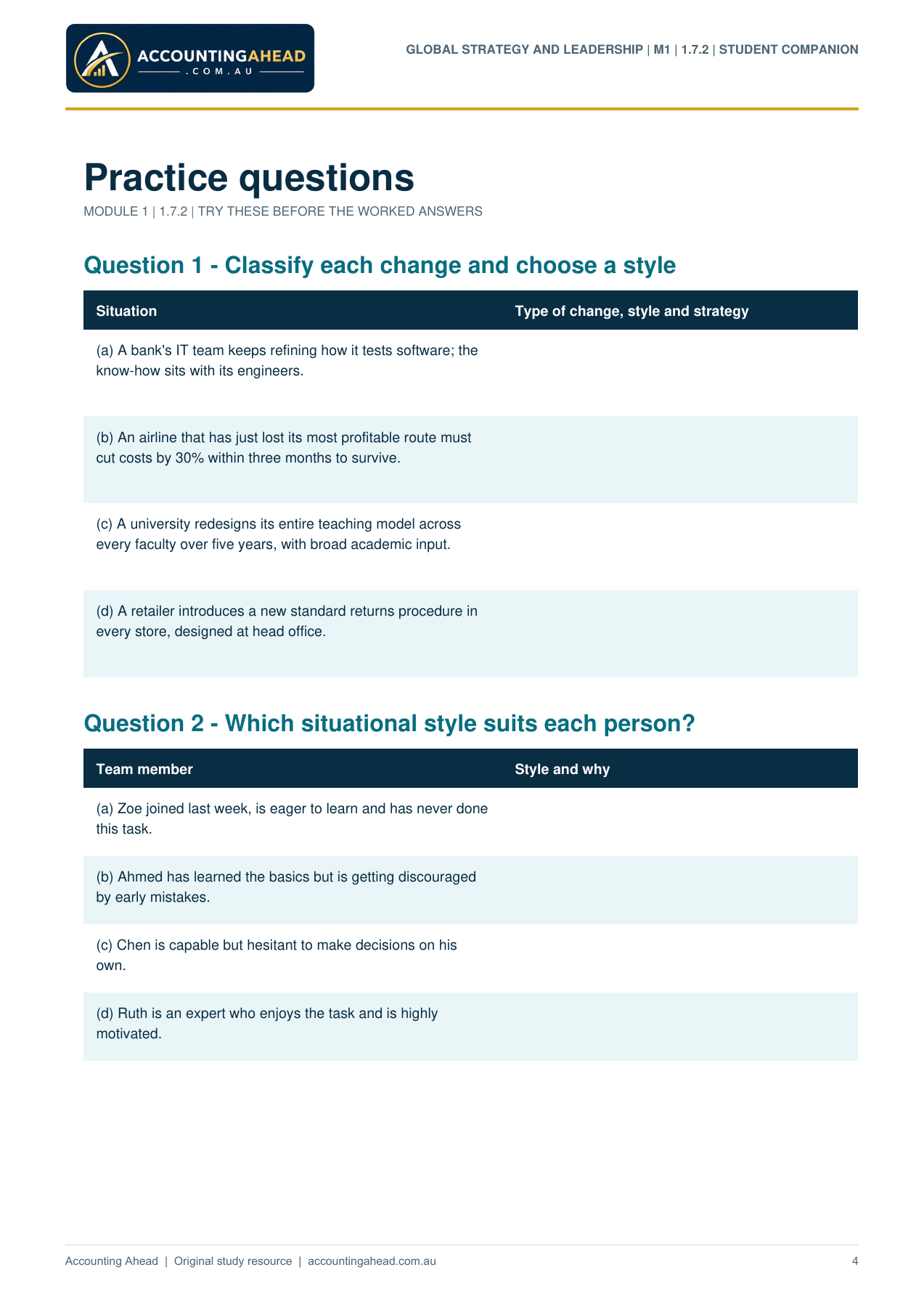
Practice questions
MODULE 1 | 1.7.2 | TRY THESE BEFORE THE WORKED ANSWERS
Question 1 - Classify each change and choose a style
Situation Type of change, style and strategy
(a) A bank's IT team keeps refining how it tests software; the
know-how sits with its engineers.
(b) An airline that has just lost its most profitable route must
cut costs by 30% within three months to survive.
(c) A university redesigns its entire teaching model across
every faculty over five years, with broad academic input.
(d) A retailer introduces a new standard returns procedure in
every store, designed at head office.
Question 2 - Which situational style suits each person?
Team member Style and why
(a) Zoe joined last week, is eager to learn and has never done
this task.
(b) Ahmed has learned the basics but is getting discouraged
by early mistakes.
(c) Chen is capable but hesitant to make decisions on his
own.
(d) Ruth is an expert who enjoys the task and is highly
motivated.
GLOBAL STRATEGY AND LEADERSHIP | M1 | 1.7.2 | STUDENT COMPANION
4
Accounting Ahead | Original study resource | accountingahead.com.au
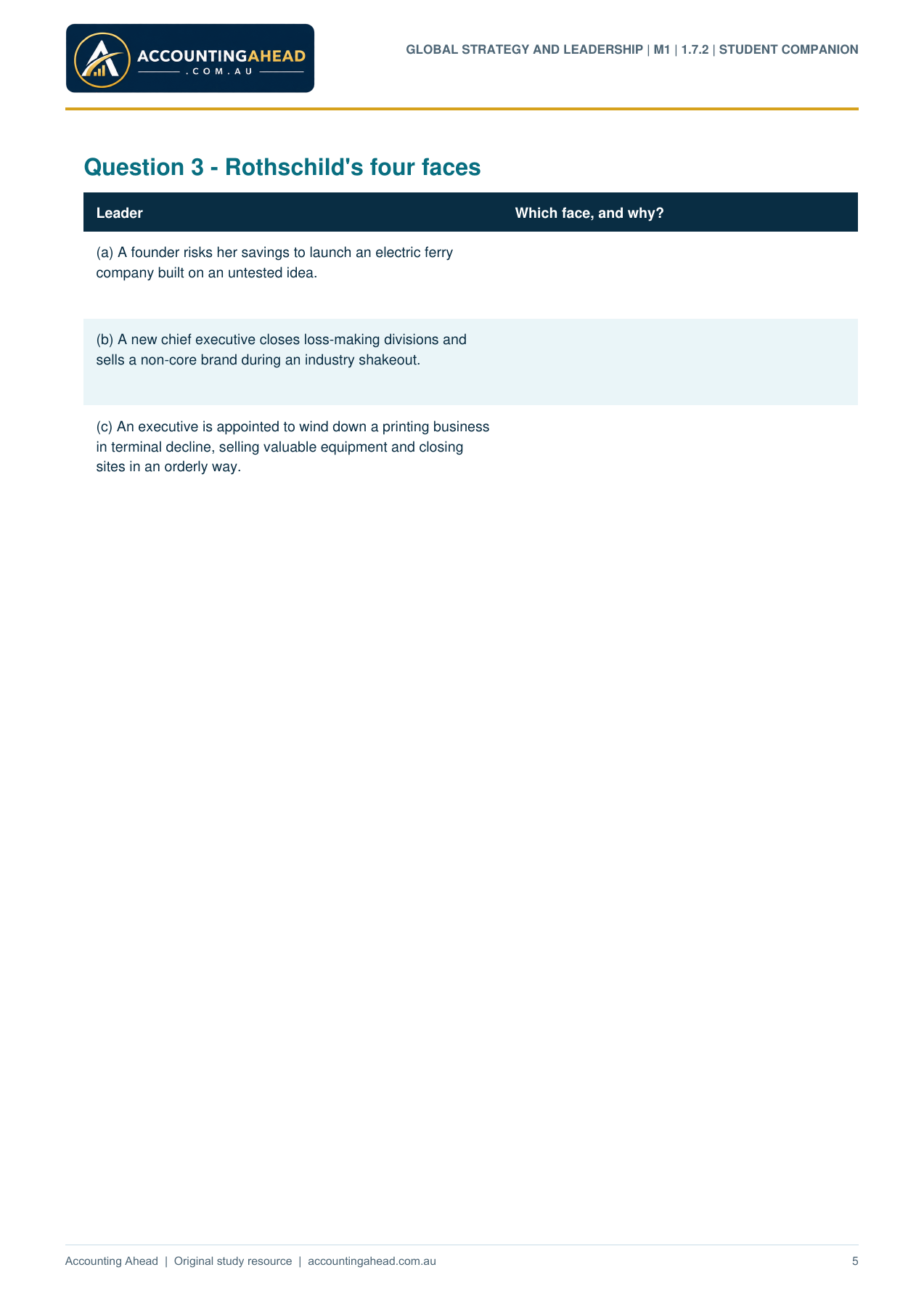
Question 3 - Rothschild's four faces
Leader Which face, and why?
(a) A founder risks her savings to launch an electric ferry
company built on an untested idea.
(b) A new chief executive closes loss-making divisions and
sells a non-core brand during an industry shakeout.
(c) An executive is appointed to wind down a printing business
in terminal decline, selling valuable equipment and closing
sites in an orderly way.
GLOBAL STRATEGY AND LEADERSHIP | M1 | 1.7.2 | STUDENT COMPANION
5
Accounting Ahead | Original study resource | accountingahead.com.au
Worked answers
MODULE 1 | 1.7.2 | WORKED ANSWERS - ATTEMPT THE QUESTIONS FIRST
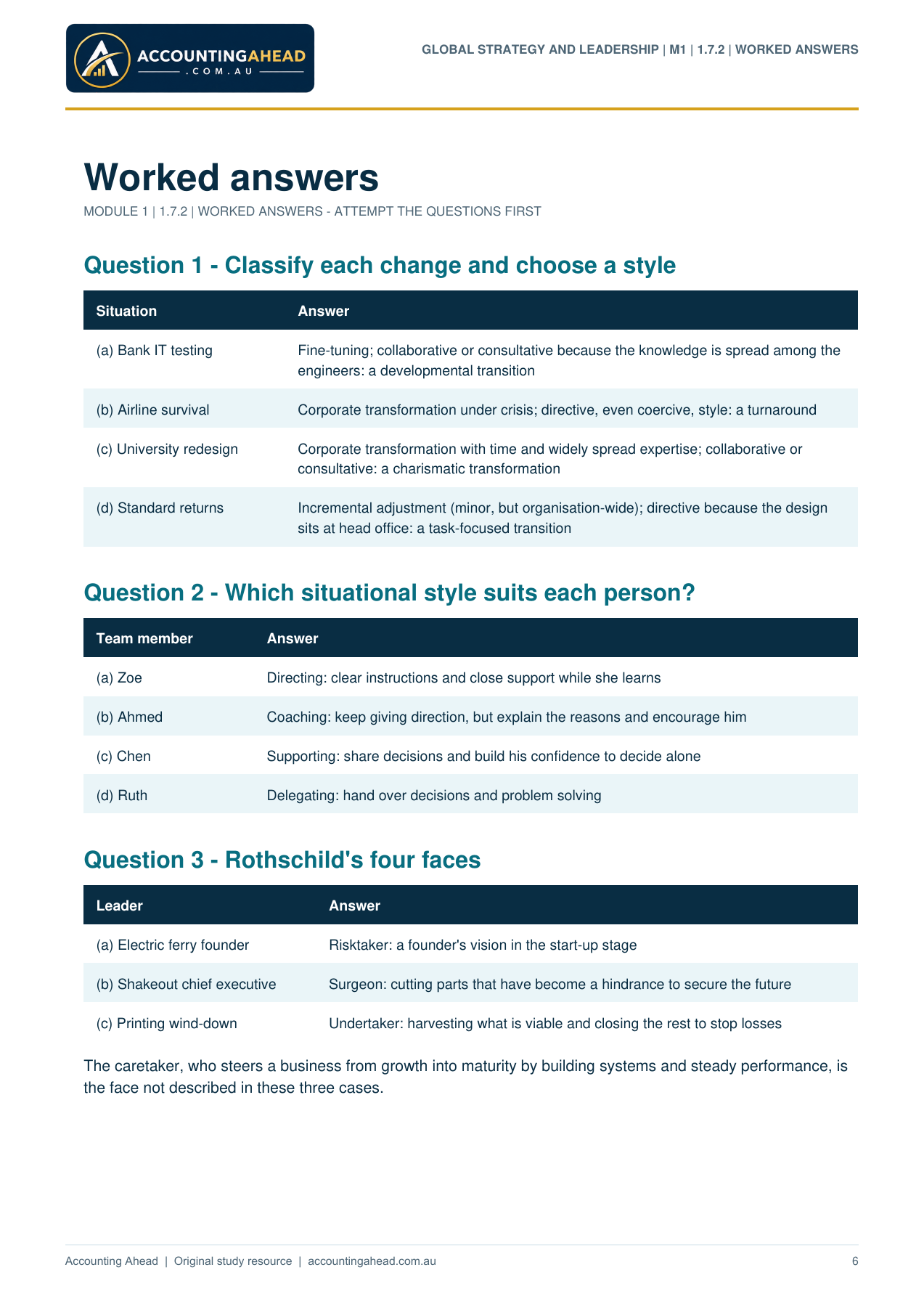
Question 1 - Classify each change and choose a style
Situation Answer
(a) Bank IT testing Fine-tuning; collaborative or consultative because the knowledge is spread among the
engineers: a developmental transition
(b) Airline survival Corporate transformation under crisis; directive, even coercive, style: a turnaround
(c) University redesign Corporate transformation with time and widely spread expertise; collaborative or
consultative: a charismatic transformation
(d) Standard returns Incremental adjustment (minor, but organisation-wide); directive because the design
sits at head office: a task-focused transition
Question 2 - Which situational style suits each person?
Team member Answer
(a) Zoe Directing: clear instructions and close support while she learns
(b) Ahmed Coaching: keep giving direction, but explain the reasons and encourage him
(c) Chen Supporting: share decisions and build his confidence to decide alone
(d) Ruth Delegating: hand over decisions and problem solving
Question 3 - Rothschild's four faces
Leader Answer
(a) Electric ferry founder Risktaker: a founder's vision in the start-up stage
(b) Shakeout chief executive Surgeon: cutting parts that have become a hindrance to secure the future
(c) Printing wind-down Undertaker: harvesting what is viable and closing the rest to stop losses
The caretaker, who steers a business from growth into maturity by building systems and steady performance, is
the face not described in these three cases.
GLOBAL STRATEGY AND LEADERSHIP | M1 | 1.7.2 | WORKED ANSWERS
6