
The role of leaders in strategy
Printable study notes to use alongside Part 1.8.
Read the handout text
Accounting Ahead | Original study resource | accountingahead.com.au
The role of leaders in strategy
MODULE 1 | 1.8 | STUDENT COMPANION
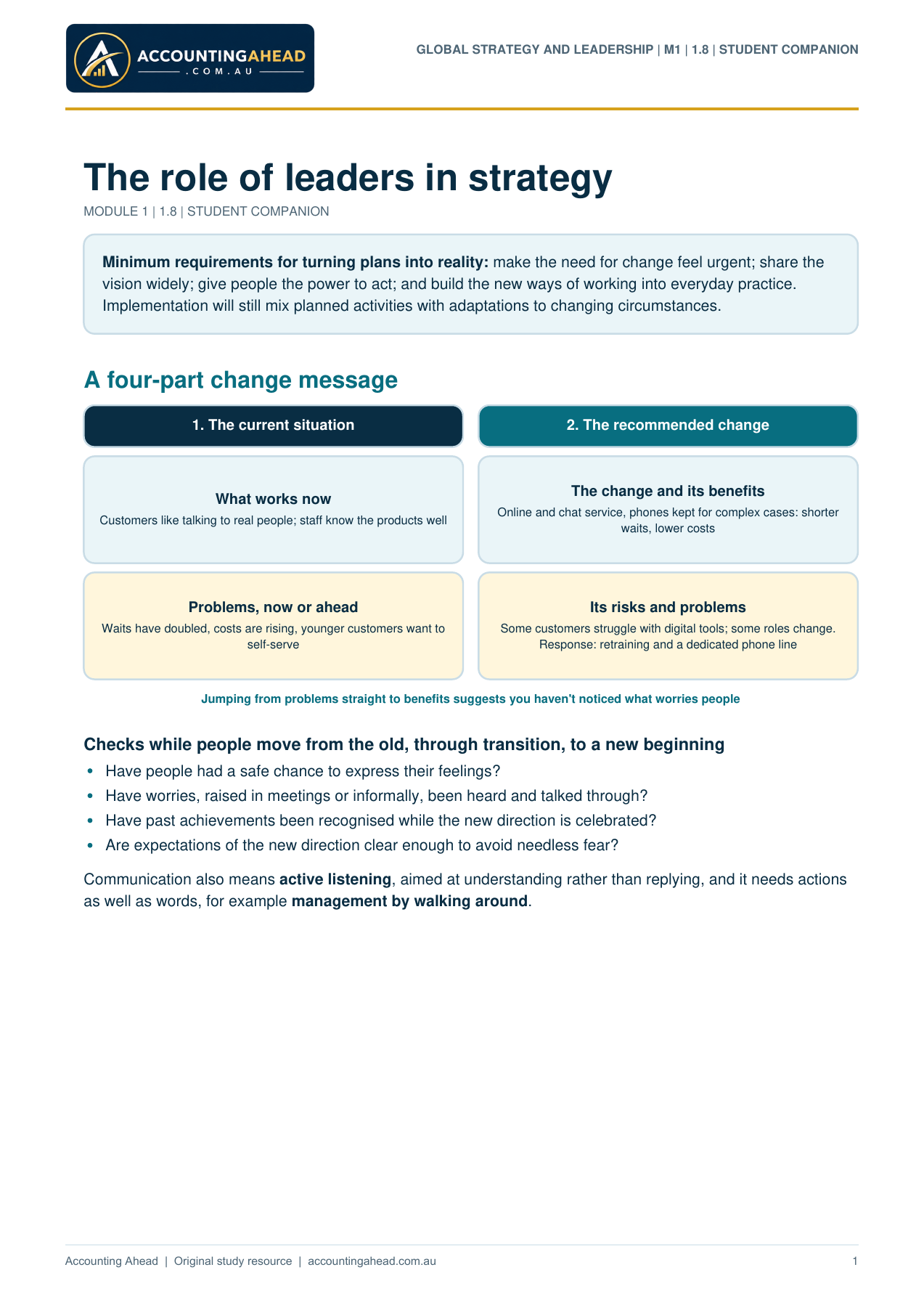
Minimum requirements for turning plans into reality: make the need for change feel urgent; share the
vision widely; give people the power to act; and build the new ways of working into everyday practice.
Implementation will still mix planned activities with adaptations to changing circumstances.
A four-part change message
1. The current situation 2. The recommended change
What works now
Customers like talking to real people; staff know the products well
Problems, now or ahead
Waits have doubled, costs are rising, younger customers want to
self-serve
The change and its benefits
Online and chat service, phones kept for complex cases: shorter
waits, lower costs
Its risks and problems
Some customers struggle with digital tools; some roles change.
Response: retraining and a dedicated phone line
Jumping from problems straight to benefits suggests you haven't noticed what worries people
Checks while people move from the old, through transition, to a new beginning
Have people had a safe chance to express their feelings?
Have worries, raised in meetings or informally, been heard and talked through?
Have past achievements been recognised while the new direction is celebrated?
Are expectations of the new direction clear enough to avoid needless fear?
Communication also means active listening, aimed at understanding rather than replying, and it needs actions
as well as words, for example management by walking around.
GLOBAL STRATEGY AND LEADERSHIP | M1 | 1.8 | STUDENT COMPANION
1
Accounting Ahead | Original study resource | accountingahead.com.au
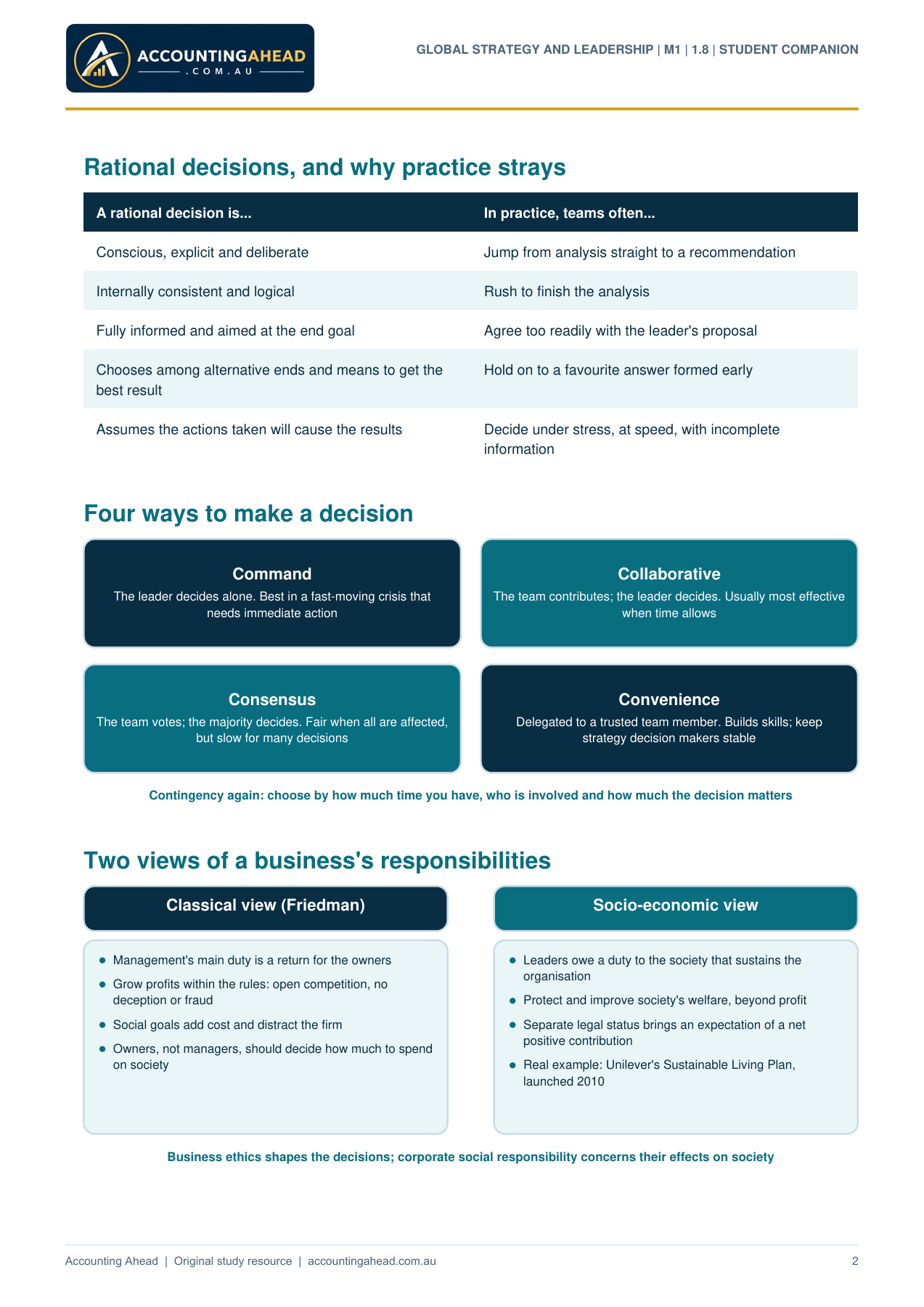
Rational decisions, and why practice strays
A rational decision is... In practice, teams often...
Conscious, explicit and deliberate Jump from analysis straight to a recommendation
Internally consistent and logical Rush to finish the analysis
Fully informed and aimed at the end goal Agree too readily with the leader's proposal
Chooses among alternative ends and means to get the
best result
Hold on to a favourite answer formed early
Assumes the actions taken will cause the results Decide under stress, at speed, with incomplete
information
Four ways to make a decision
Command
The leader decides alone. Best in a fast-moving crisis that
needs immediate action
Collaborative
The team contributes; the leader decides. Usually most effective
when time allows
Consensus
The team votes; the majority decides. Fair when all are affected,
but slow for many decisions
Convenience
Delegated to a trusted team member. Builds skills; keep
strategy decision makers stable
Contingency again: choose by how much time you have, who is involved and how much the decision matters
Two views of a business's responsibilities
Classical view (Friedman)
Management's main duty is a return for the owners
Grow profits within the rules: open competition, no
deception or fraud
Social goals add cost and distract the firm
Owners, not managers, should decide how much to spend
on society
Socio-economic view
Leaders owe a duty to the society that sustains the
organisation
Protect and improve society's welfare, beyond profit
Separate legal status brings an expectation of a net
positive contribution
Real example: Unilever's Sustainable Living Plan,
launched 2010
Business ethics shapes the decisions; corporate social responsibility concerns their effects on society
GLOBAL STRATEGY AND LEADERSHIP | M1 | 1.8 | STUDENT COMPANION
2
Accounting Ahead | Original study resource | accountingahead.com.au
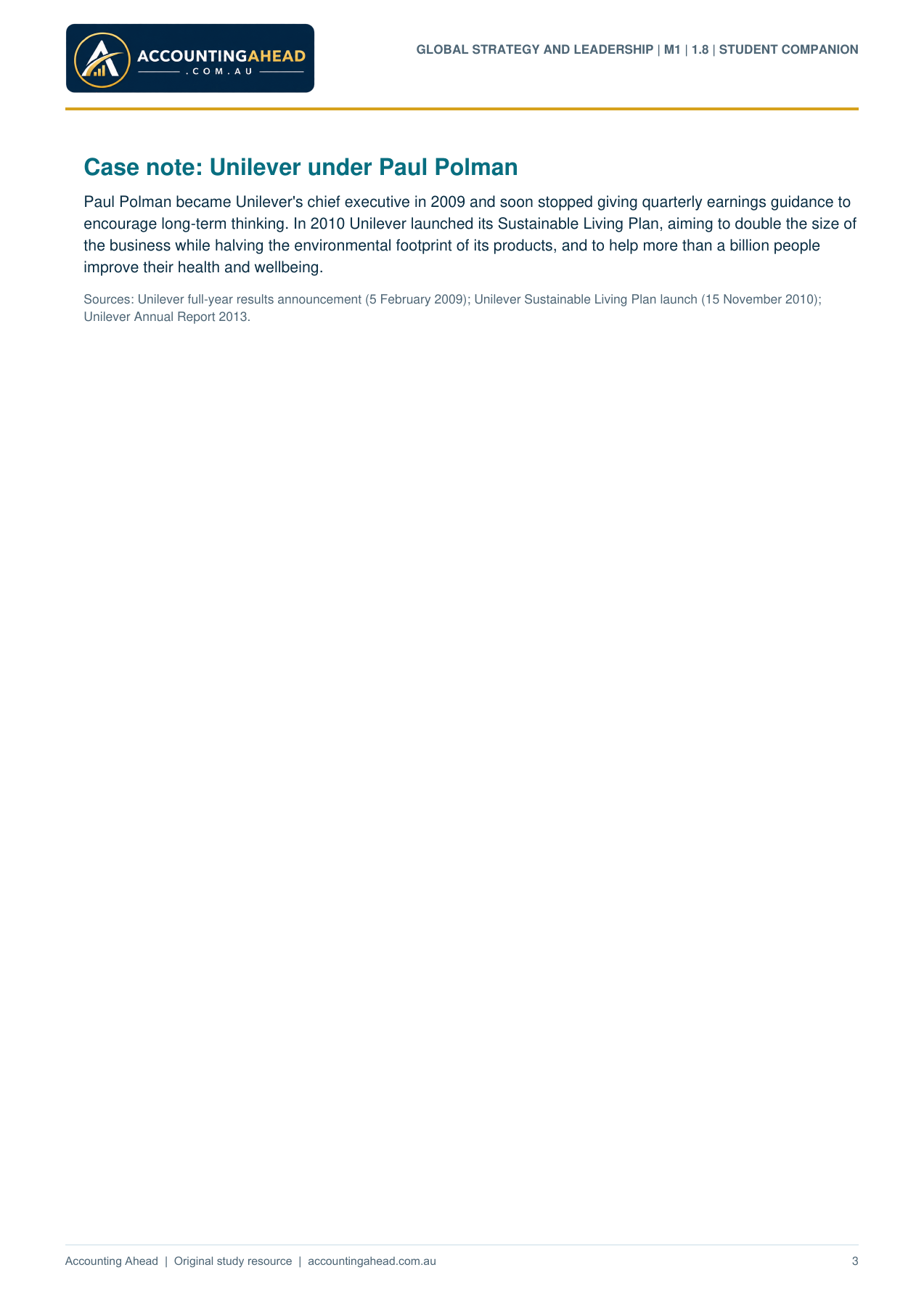
Case note: Unilever under Paul Polman
Paul Polman became Unilever's chief executive in 2009 and soon stopped giving quarterly earnings guidance to
encourage long-term thinking. In 2010 Unilever launched its Sustainable Living Plan, aiming to double the size of
the business while halving the environmental footprint of its products, and to help more than a billion people
improve their health and wellbeing.
Sources: Unilever full-year results announcement (5 February 2009); Unilever Sustainable Living Plan launch (15 November 2010);
Unilever Annual Report 2013.
GLOBAL STRATEGY AND LEADERSHIP | M1 | 1.8 | STUDENT COMPANION
3
Accounting Ahead | Original study resource | accountingahead.com.au
Practice questions
MODULE 1 | 1.8 | TRY THESE BEFORE THE WORKED ANSWERS
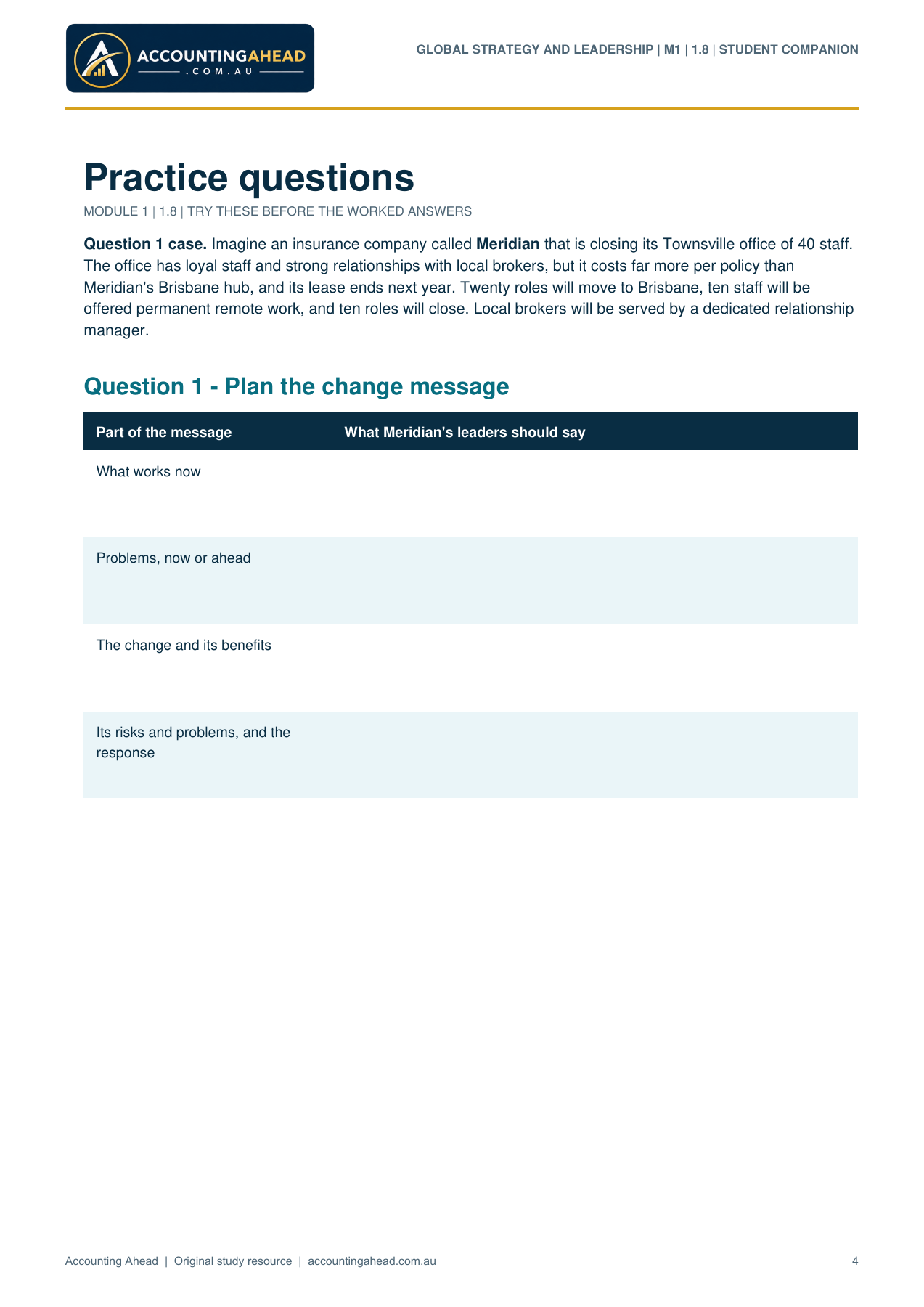
Question 1 case. Imagine an insurance company called Meridian that is closing its Townsville office of 40 staff.
The office has loyal staff and strong relationships with local brokers, but it costs far more per policy than
Meridian's Brisbane hub, and its lease ends next year. Twenty roles will move to Brisbane, ten staff will be
offered permanent remote work, and ten roles will close. Local brokers will be served by a dedicated relationship
manager.
Question 1 - Plan the change message
Part of the message What Meridian's leaders should say
What works now
Problems, now or ahead
The change and its benefits
Its risks and problems, and the
response
GLOBAL STRATEGY AND LEADERSHIP | M1 | 1.8 | STUDENT COMPANION
4
Accounting Ahead | Original study resource | accountingahead.com.au
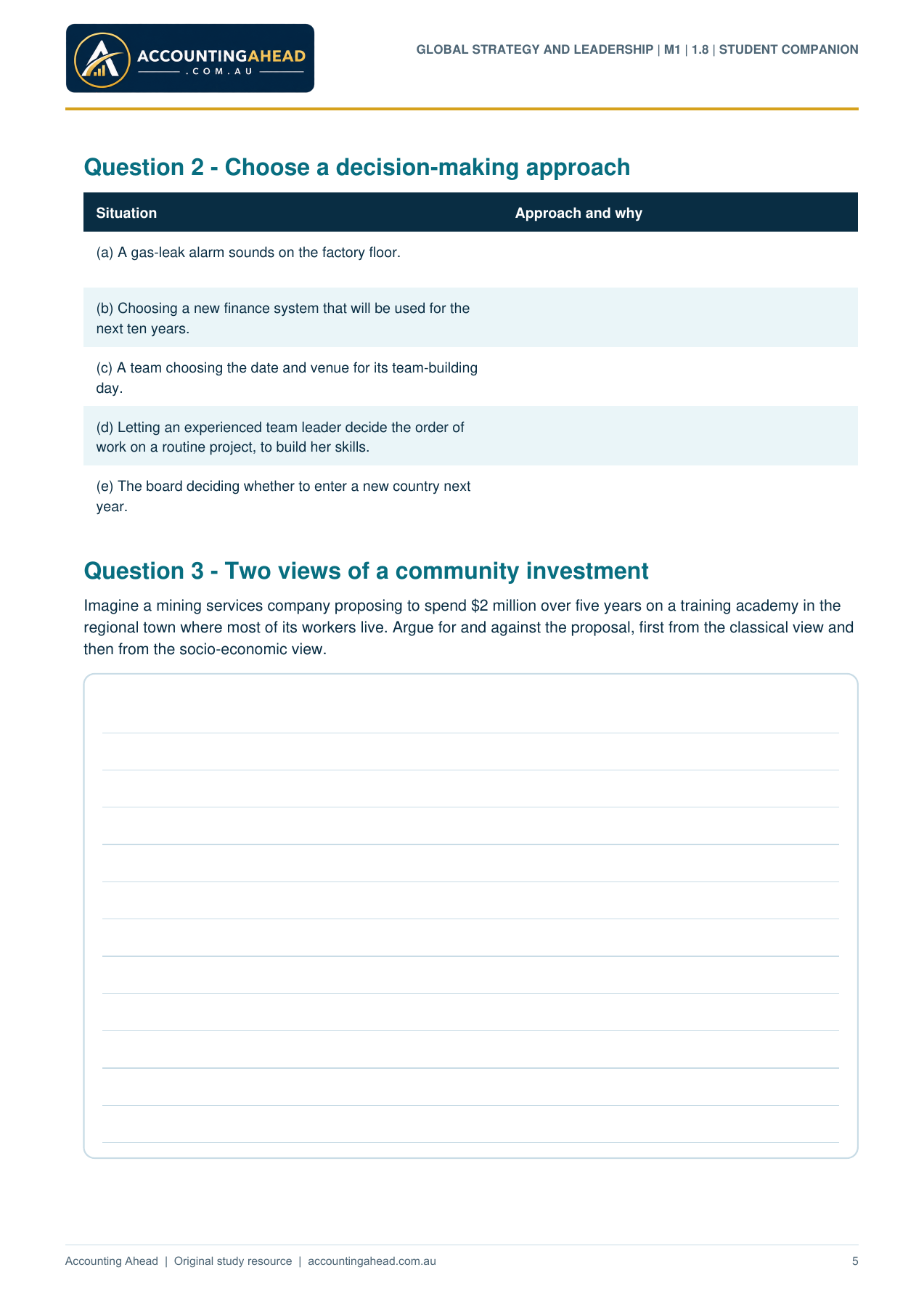
Question 2 - Choose a decision-making approach
Situation Approach and why
(a) A gas-leak alarm sounds on the factory floor.
(b) Choosing a new finance system that will be used for the
next ten years.
(c) A team choosing the date and venue for its team-building
day.
(d) Letting an experienced team leader decide the order of
work on a routine project, to build her skills.
(e) The board deciding whether to enter a new country next
year.
Question 3 - Two views of a community investment
Imagine a mining services company proposing to spend $2 million over five years on a training academy in the
regional town where most of its workers live. Argue for and against the proposal, first from the classical view and
then from the socio-economic view.
GLOBAL STRATEGY AND LEADERSHIP | M1 | 1.8 | STUDENT COMPANION
5
Accounting Ahead | Original study resource | accountingahead.com.au
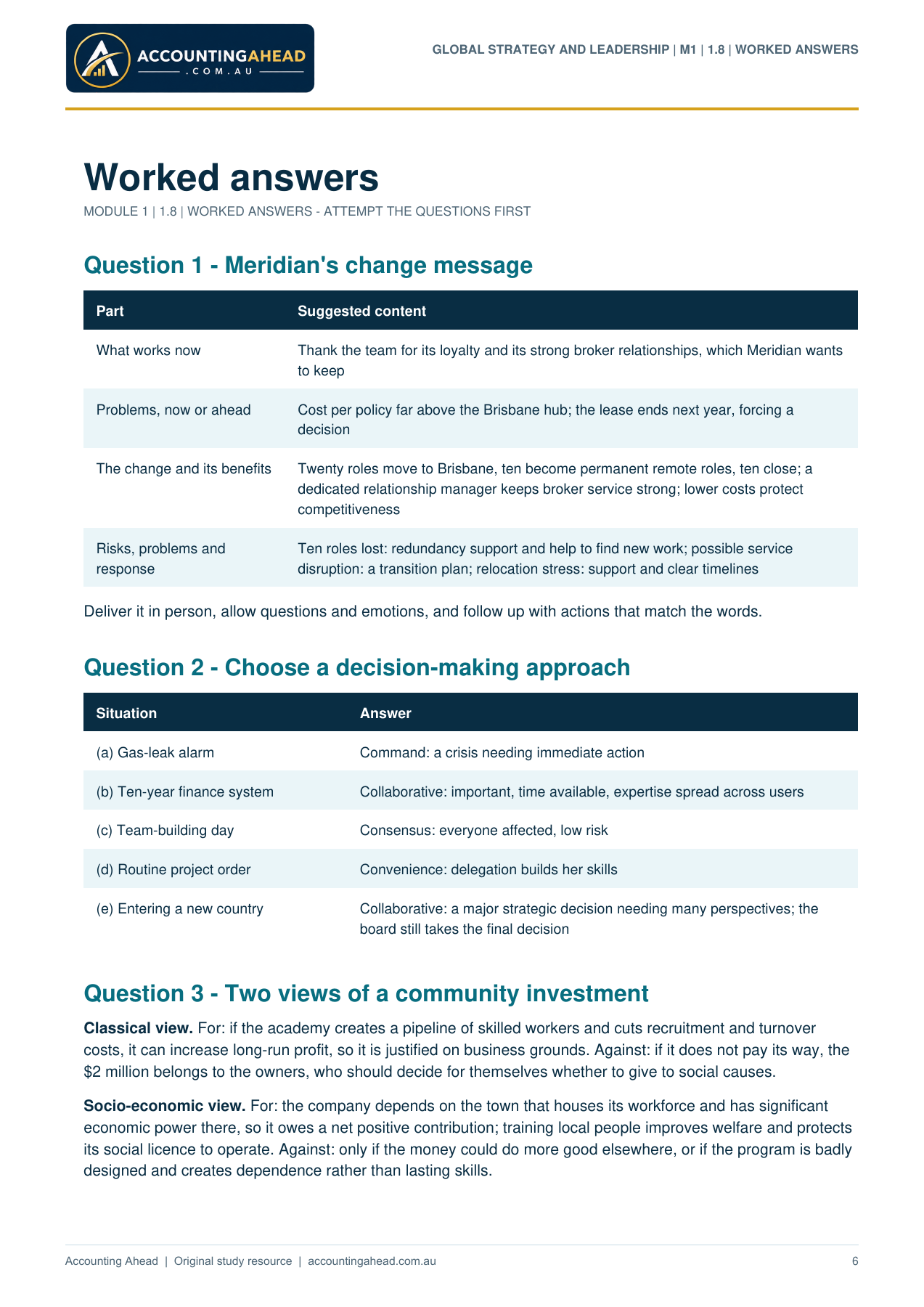
Worked answers
MODULE 1 | 1.8 | WORKED ANSWERS - ATTEMPT THE QUESTIONS FIRST
Question 1 - Meridian's change message
Part Suggested content
What works now Thank the team for its loyalty and its strong broker relationships, which Meridian wants
to keep
Problems, now or ahead Cost per policy far above the Brisbane hub; the lease ends next year, forcing a
decision
The change and its benefits Twenty roles move to Brisbane, ten become permanent remote roles, ten close; a
dedicated relationship manager keeps broker service strong; lower costs protect
competitiveness
Risks, problems and
response
Ten roles lost: redundancy support and help to find new work; possible service
disruption: a transition plan; relocation stress: support and clear timelines
Deliver it in person, allow questions and emotions, and follow up with actions that match the words.
Question 2 - Choose a decision-making approach
Situation Answer
(a) Gas-leak alarm Command: a crisis needing immediate action
(b) Ten-year finance system Collaborative: important, time available, expertise spread across users
(c) Team-building day Consensus: everyone affected, low risk
(d) Routine project order Convenience: delegation builds her skills
(e) Entering a new country Collaborative: a major strategic decision needing many perspectives; the
board still takes the final decision
Question 3 - Two views of a community investment
Classical view. For: if the academy creates a pipeline of skilled workers and cuts recruitment and turnover
costs, it can increase long-run profit, so it is justified on business grounds. Against: if it does not pay its way, the
$2 million belongs to the owners, who should decide for themselves whether to give to social causes.
Socio-economic view. For: the company depends on the town that houses its workforce and has significant
economic power there, so it owes a net positive contribution; training local people improves welfare and protects
its social licence to operate. Against: only if the money could do more good elsewhere, or if the program is badly
designed and creates dependence rather than lasting skills.
GLOBAL STRATEGY AND LEADERSHIP | M1 | 1.8 | WORKED ANSWERS
6