
Understanding customers and markets
Printable study notes to use alongside Part 2.5.
Read the handout text
Accounting Ahead | Original study resource | accountingahead.com.au
Understanding customers and markets
MODULE 2 | 2.5 | STUDENT COMPANION
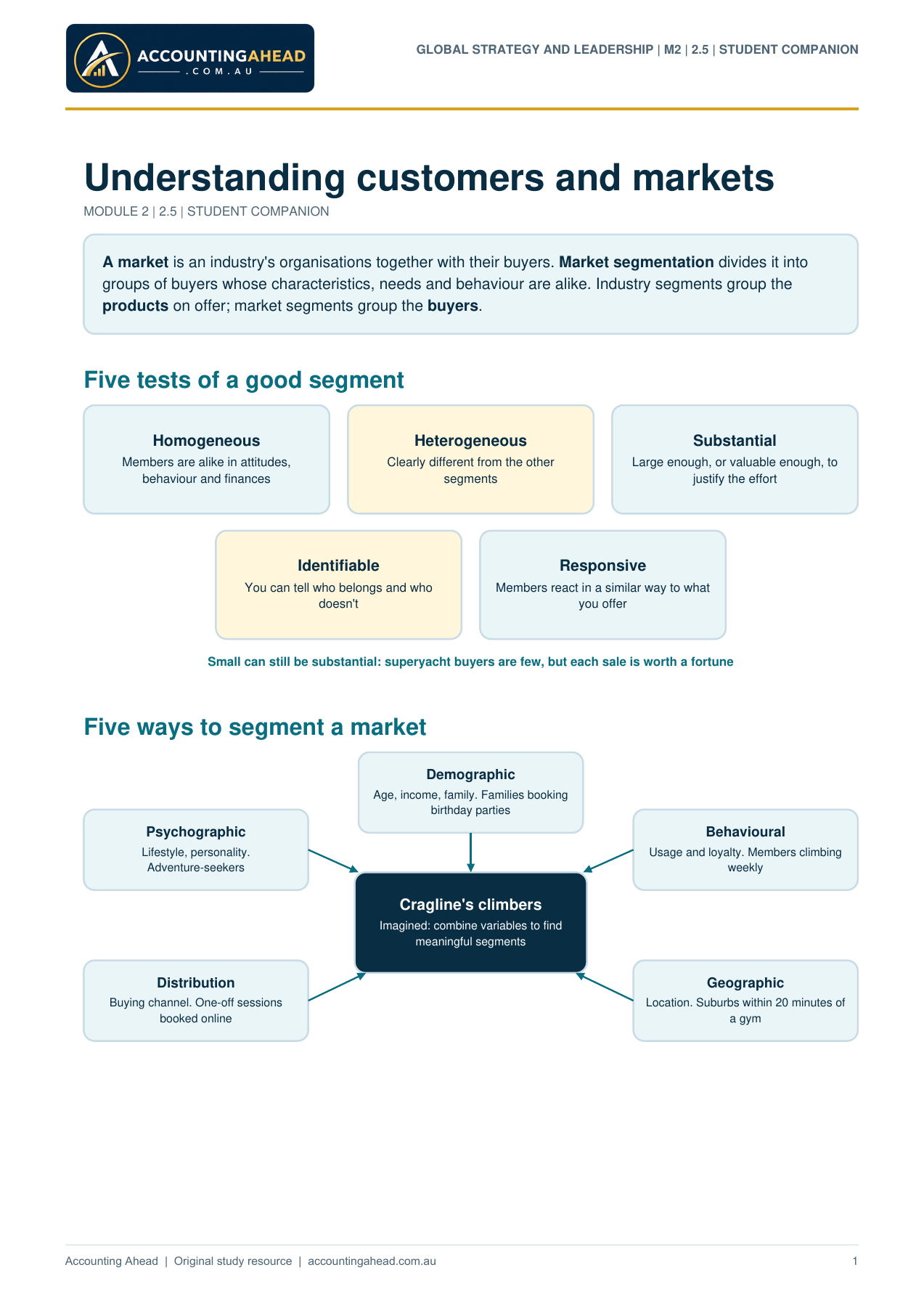
A market is an industry's organisations together with their buyers. Market segmentation divides it into
groups of buyers whose characteristics, needs and behaviour are alike. Industry segments group the
products on offer; market segments group the buyers.
Five tests of a good segment
Homogeneous
Members are alike in attitudes,
behaviour and finances
Heterogeneous
Clearly different from the other
segments
Substantial
Large enough, or valuable enough, to
justify the effort
Identifiable
You can tell who belongs and who
doesn't
Responsive
Members react in a similar way to what
you offer
Small can still be substantial: superyacht buyers are few, but each sale is worth a fortune
Five ways to segment a market
Cragline's climbers
Imagined: combine variables to find
meaningful segments
Demographic
Age, income, family. Families booking
birthday parties
Psychographic
Lifestyle, personality.
Adventure-seekers
Behavioural
Usage and loyalty. Members climbing
weekly
Distribution
Buying channel. One-off sessions
booked online
Geographic
Location. Suburbs within 20 minutes of
a gym
GLOBAL STRATEGY AND LEADERSHIP | M2 | 2.5 | STUDENT COMPANION
1
Accounting Ahead | Original study resource | accountingahead.com.au
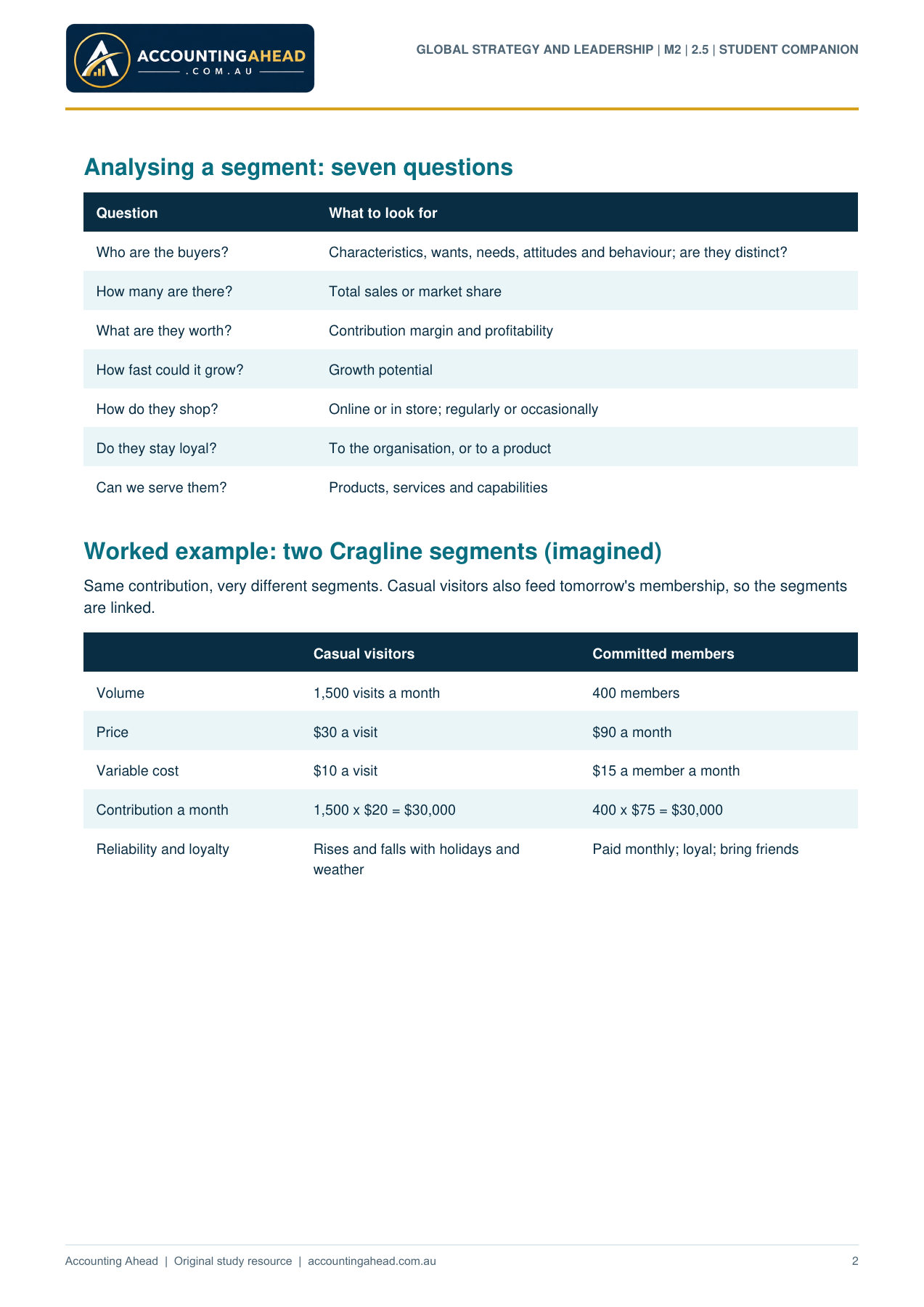
Analysing a segment: seven questions
Question What to look for
Who are the buyers? Characteristics, wants, needs, attitudes and behaviour; are they distinct?
How many are there? Total sales or market share
What are they worth? Contribution margin and profitability
How fast could it grow? Growth potential
How do they shop? Online or in store; regularly or occasionally
Do they stay loyal? To the organisation, or to a product
Can we serve them? Products, services and capabilities
Worked example: two Cragline segments (imagined)
Same contribution, very different segments. Casual visitors also feed tomorrow's membership, so the segments
are linked.
Casual visitors Committed members
Volume 1,500 visits a month 400 members
Price $30 a visit $90 a month
Variable cost $10 a visit $15 a member a month
Contribution a month 1,500 x $20 = $30,000 400 x $75 = $30,000
Reliability and loyalty Rises and falls with holidays and
weather
Paid monthly; loyal; bring friends
GLOBAL STRATEGY AND LEADERSHIP | M2 | 2.5 | STUDENT COMPANION
2
Accounting Ahead | Original study resource | accountingahead.com.au
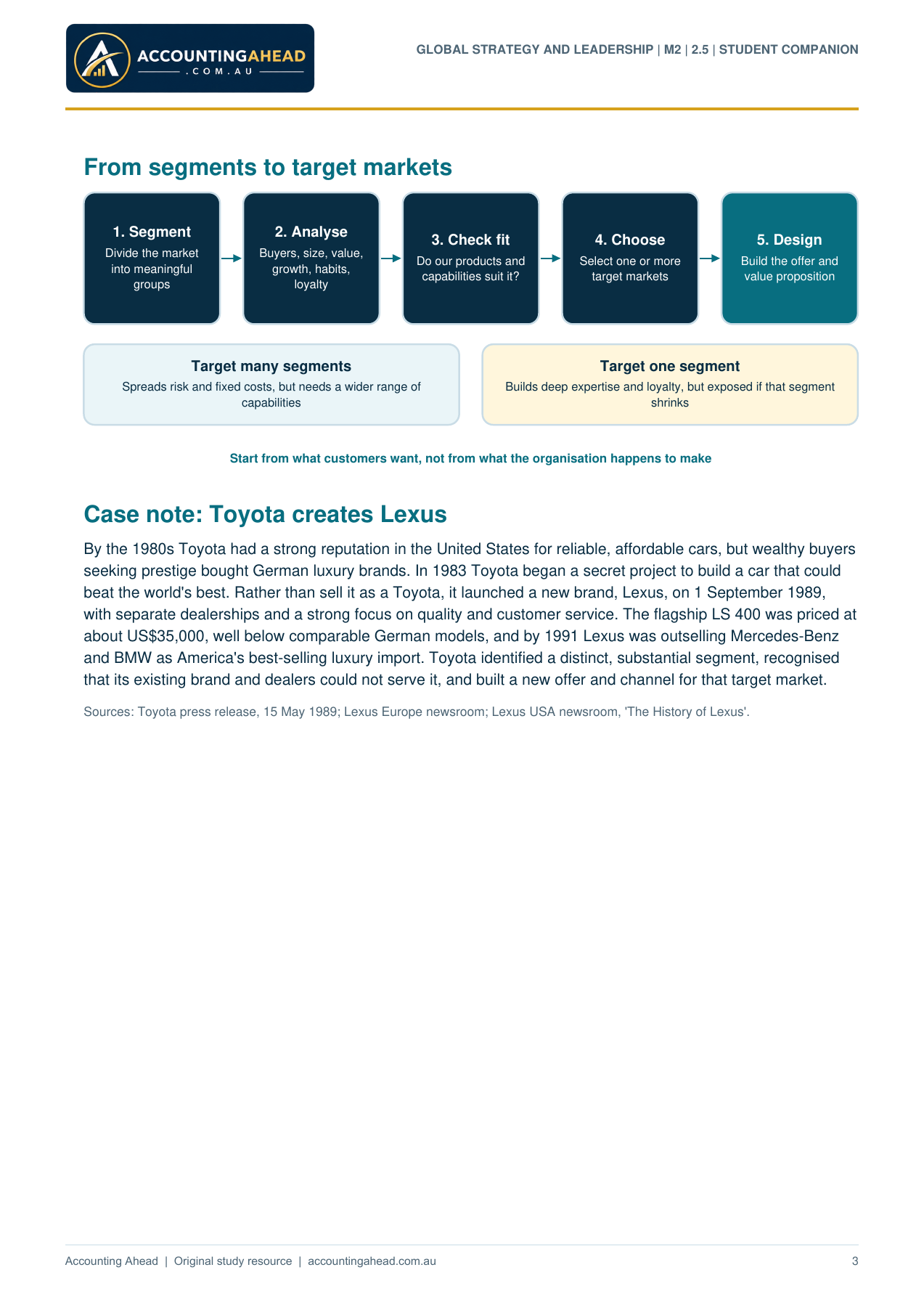
From segments to target markets
1. Segment
Divide the market
into meaningful
groups
2. Analyse
Buyers, size, value,
growth, habits,
loyalty
3. Check fit
Do our products and
capabilities suit it?
4. Choose
Select one or more
target markets
5. Design
Build the offer and
value proposition
Target many segments
Spreads risk and fixed costs, but needs a wider range of
capabilities
Target one segment
Builds deep expertise and loyalty, but exposed if that segment
shrinks
Start from what customers want, not from what the organisation happens to make
Case note: Toyota creates Lexus
By the 1980s Toyota had a strong reputation in the United States for reliable, affordable cars, but wealthy buyers
seeking prestige bought German luxury brands. In 1983 Toyota began a secret project to build a car that could
beat the world's best. Rather than sell it as a Toyota, it launched a new brand, Lexus, on 1 September 1989,
with separate dealerships and a strong focus on quality and customer service. The flagship LS 400 was priced at
about US$35,000, well below comparable German models, and by 1991 Lexus was outselling Mercedes-Benz
and BMW as America's best-selling luxury import. Toyota identified a distinct, substantial segment, recognised
that its existing brand and dealers could not serve it, and built a new offer and channel for that target market.
Sources: Toyota press release, 15 May 1989; Lexus Europe newsroom; Lexus USA newsroom, 'The History of Lexus'.
GLOBAL STRATEGY AND LEADERSHIP | M2 | 2.5 | STUDENT COMPANION
3
Accounting Ahead | Original study resource | accountingahead.com.au
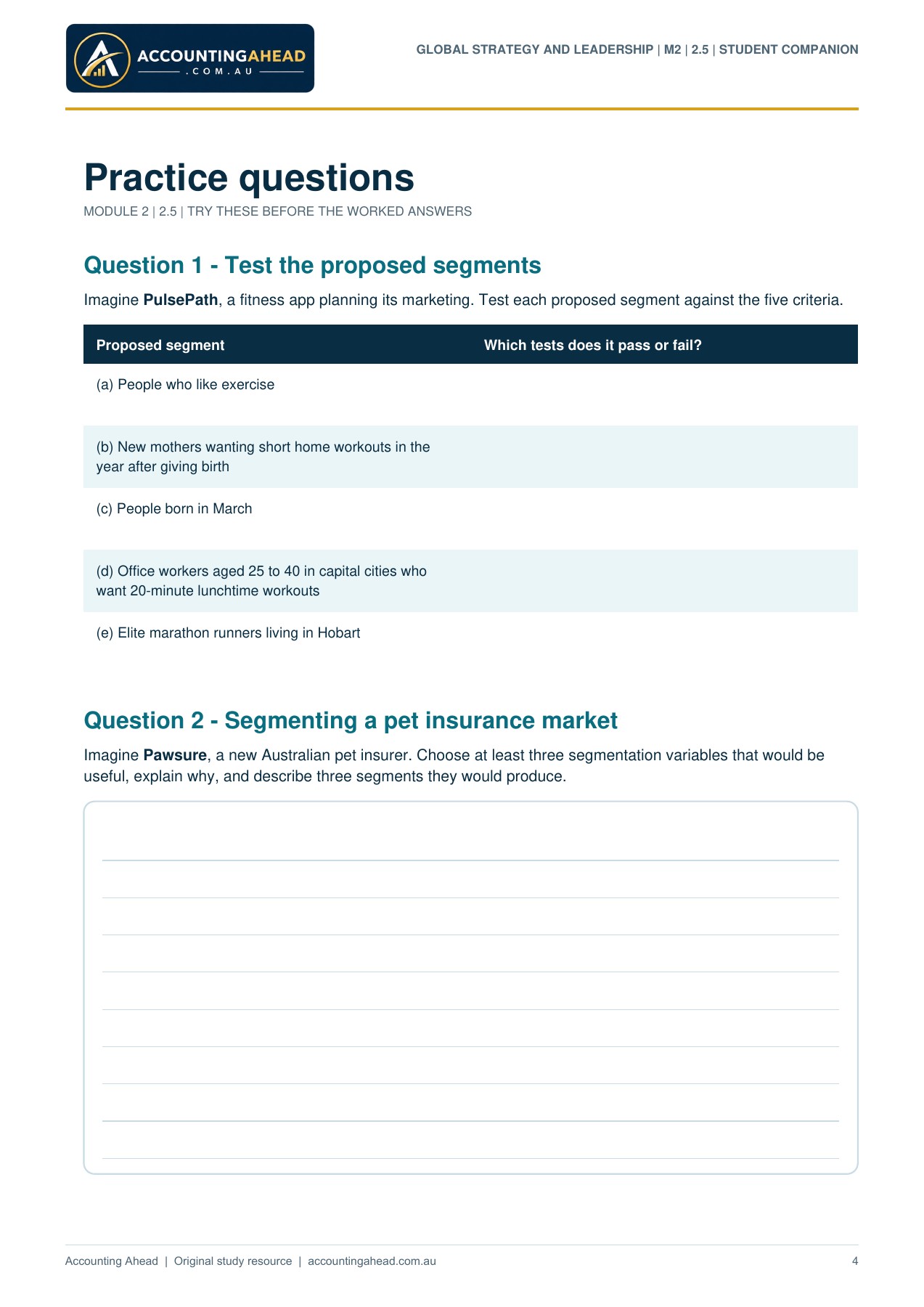
Practice questions
MODULE 2 | 2.5 | TRY THESE BEFORE THE WORKED ANSWERS
Question 1 - Test the proposed segments
Imagine PulsePath, a fitness app planning its marketing. Test each proposed segment against the five criteria.
Proposed segment Which tests does it pass or fail?
(a) People who like exercise
(b) New mothers wanting short home workouts in the
year after giving birth
(c) People born in March
(d) Office workers aged 25 to 40 in capital cities who
want 20-minute lunchtime workouts
(e) Elite marathon runners living in Hobart
Question 2 - Segmenting a pet insurance market
Imagine Pawsure, a new Australian pet insurer. Choose at least three segmentation variables that would be
useful, explain why, and describe three segments they would produce.
GLOBAL STRATEGY AND LEADERSHIP | M2 | 2.5 | STUDENT COMPANION
4
Accounting Ahead | Original study resource | accountingahead.com.au
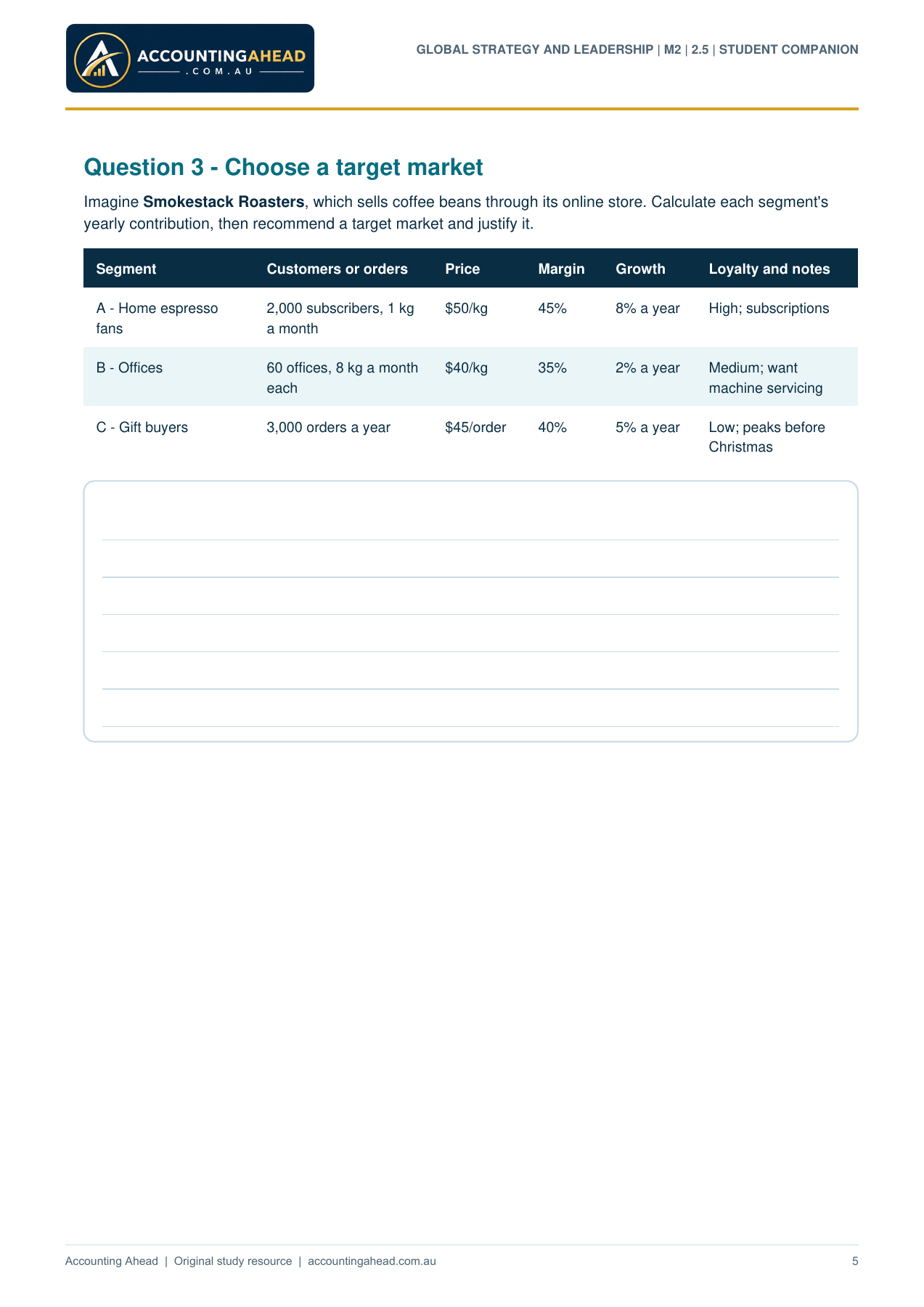
Question 3 - Choose a target market
Imagine Smokestack Roasters, which sells coffee beans through its online store. Calculate each segment's
yearly contribution, then recommend a target market and justify it.
Segment Customers or orders Price Margin Growth Loyalty and notes
A - Home espresso
fans
2,000 subscribers, 1 kg
a month
$50/kg 45% 8% a year High; subscriptions
B - Offices 60 offices, 8 kg a month
each
$40/kg 35% 2% a year Medium; want
machine servicing
C - Gift buyers 3,000 orders a year $45/order 40% 5% a year Low; peaks before
Christmas
GLOBAL STRATEGY AND LEADERSHIP | M2 | 2.5 | STUDENT COMPANION
5
Accounting Ahead | Original study resource | accountingahead.com.au
Worked answers
MODULE 2 | 2.5 | WORKED ANSWERS - ATTEMPT THE QUESTIONS FIRST
Question 1 - PulsePath segments
Segment Assessment
(a) Like exercise Fails homogeneous and identifiable: far too broad to design an offer around
(b) New mothers Passes: alike in needs, distinct, substantial, identifiable, likely to respond to short
home workouts
(c) Born in March Fails responsive and homogeneous: birth month doesn't change what people want
(d) Office workers Passes: clear needs (time), distinct, large and reachable
(e) Hobart marathon runners Fails substantial: too few to justify a dedicated effort, unless very high value
Question 2 - Pawsure
Demographic (owner age and income): young renters versus established families versus retirees differ in
budget and cover needs.
Behavioural (pet type and vet usage): owners of young dogs, older cats or pedigree breeds have very
different claims patterns.
Psychographic (attitude to risk): some owners want comprehensive cover for peace of mind; others want
accident-only cover at the lowest price.
Distribution: online direct buyers versus those who buy at the vet clinic.
Possible segments: budget-conscious young owners of new puppies (accident and illness at low price);
devoted owners of older pets (comprehensive cover, high value); multi-pet families (bundled discounts).
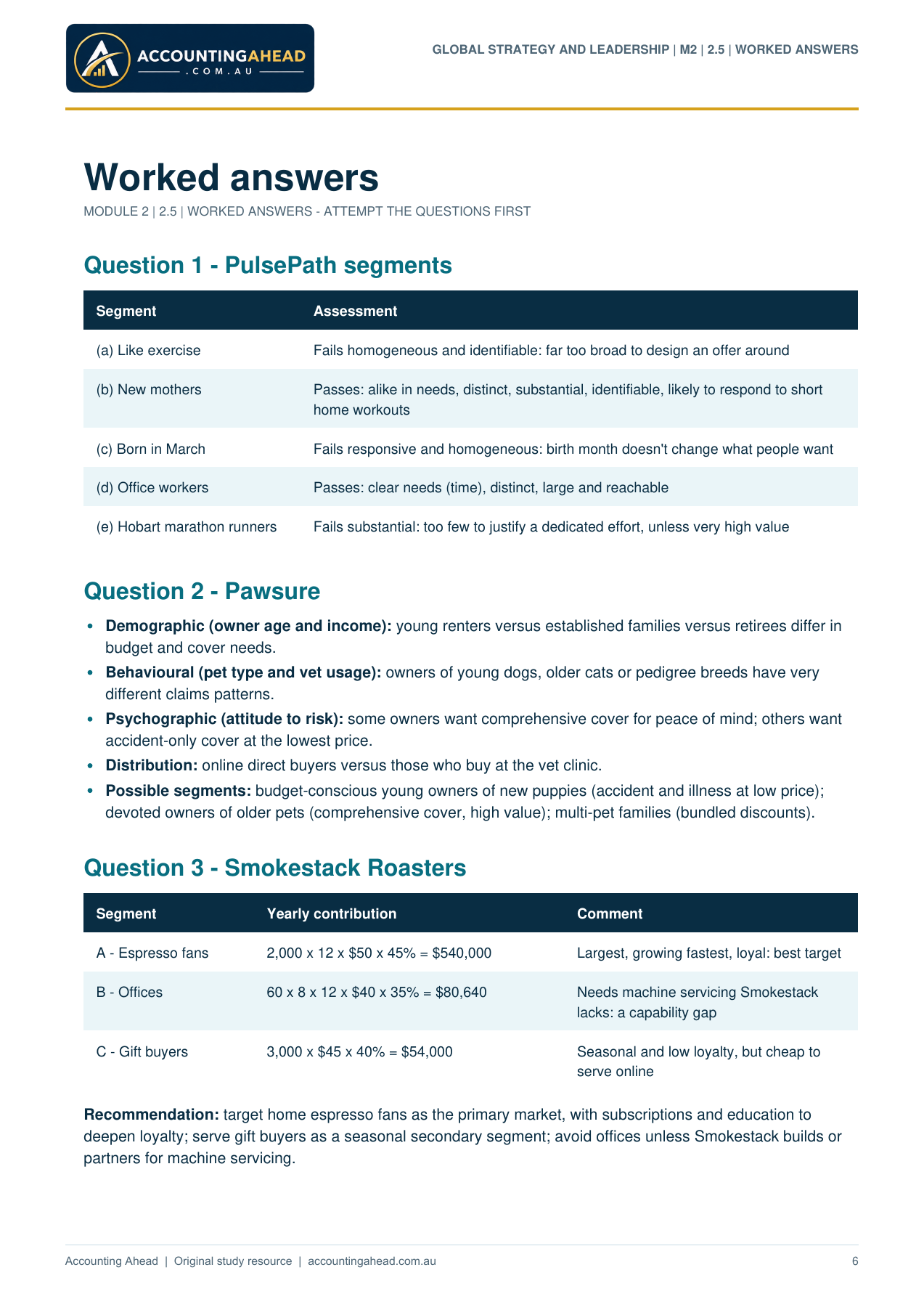
Question 3 - Smokestack Roasters
Segment Yearly contribution Comment
A - Espresso fans 2,000 x 12 x $50 x 45% = $540,000 Largest, growing fastest, loyal: best target
B - Offices 60 x 8 x 12 x $40 x 35% = $80,640 Needs machine servicing Smokestack
lacks: a capability gap
C - Gift buyers 3,000 x $45 x 40% = $54,000 Seasonal and low loyalty, but cheap to
serve online
Recommendation: target home espresso fans as the primary market, with subscriptions and education to
deepen loyalty; serve gift buyers as a seasonal secondary segment; avoid offices unless Smokestack builds or
partners for machine servicing.
GLOBAL STRATEGY AND LEADERSHIP | M2 | 2.5 | WORKED ANSWERS
6