
Implications for leadership and management
Printable study notes to use alongside Part 2.7.
Read the handout text
Accounting Ahead | Original study resource | accountingahead.com.au
Implications for leadership and
management
MODULE 2 | 2.7 | STUDENT COMPANION
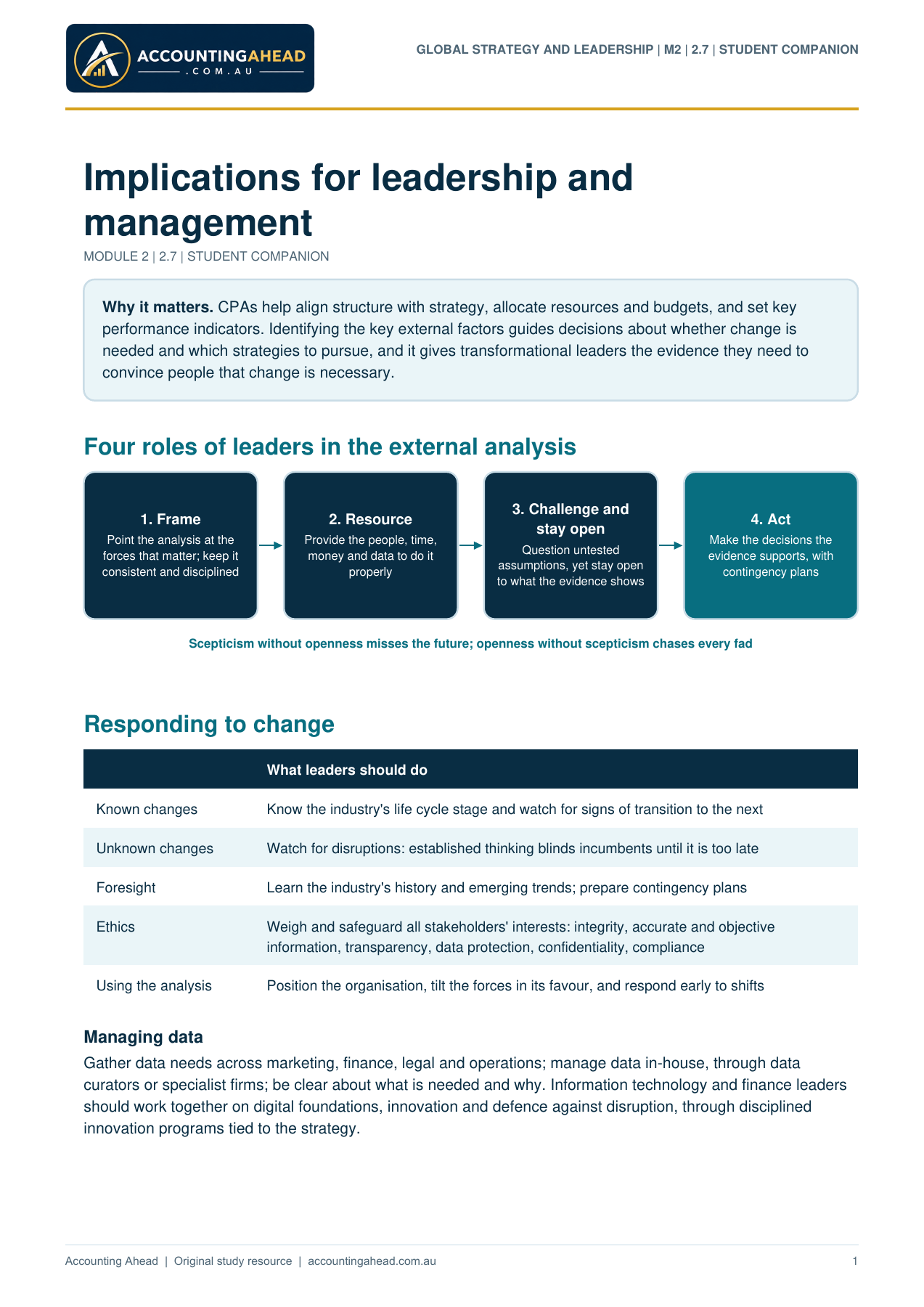
Why it matters. CPAs help align structure with strategy, allocate resources and budgets, and set key
performance indicators. Identifying the key external factors guides decisions about whether change is
needed and which strategies to pursue, and it gives transformational leaders the evidence they need to
convince people that change is necessary.
Four roles of leaders in the external analysis
1. Frame
Point the analysis at the
forces that matter; keep it
consistent and disciplined
2. Resource
Provide the people, time,
money and data to do it
properly
3. Challenge and
stay open
Question untested
assumptions, yet stay open
to what the evidence shows
4. Act
Make the decisions the
evidence supports, with
contingency plans
Scepticism without openness misses the future; openness without scepticism chases every fad
Responding to change
What leaders should do
Known changes Know the industry's life cycle stage and watch for signs of transition to the next
Unknown changes Watch for disruptions: established thinking blinds incumbents until it is too late
Foresight Learn the industry's history and emerging trends; prepare contingency plans
Ethics Weigh and safeguard all stakeholders' interests: integrity, accurate and objective
information, transparency, data protection, confidentiality, compliance
Using the analysis Position the organisation, tilt the forces in its favour, and respond early to shifts
Managing data
Gather data needs across marketing, finance, legal and operations; manage data in-house, through data
curators or specialist firms; be clear about what is needed and why. Information technology and finance leaders
should work together on digital foundations, innovation and defence against disruption, through disciplined
innovation programs tied to the strategy.
GLOBAL STRATEGY AND LEADERSHIP | M2 | 2.7 | STUDENT COMPANION
1
Accounting Ahead | Original study resource | accountingahead.com.au
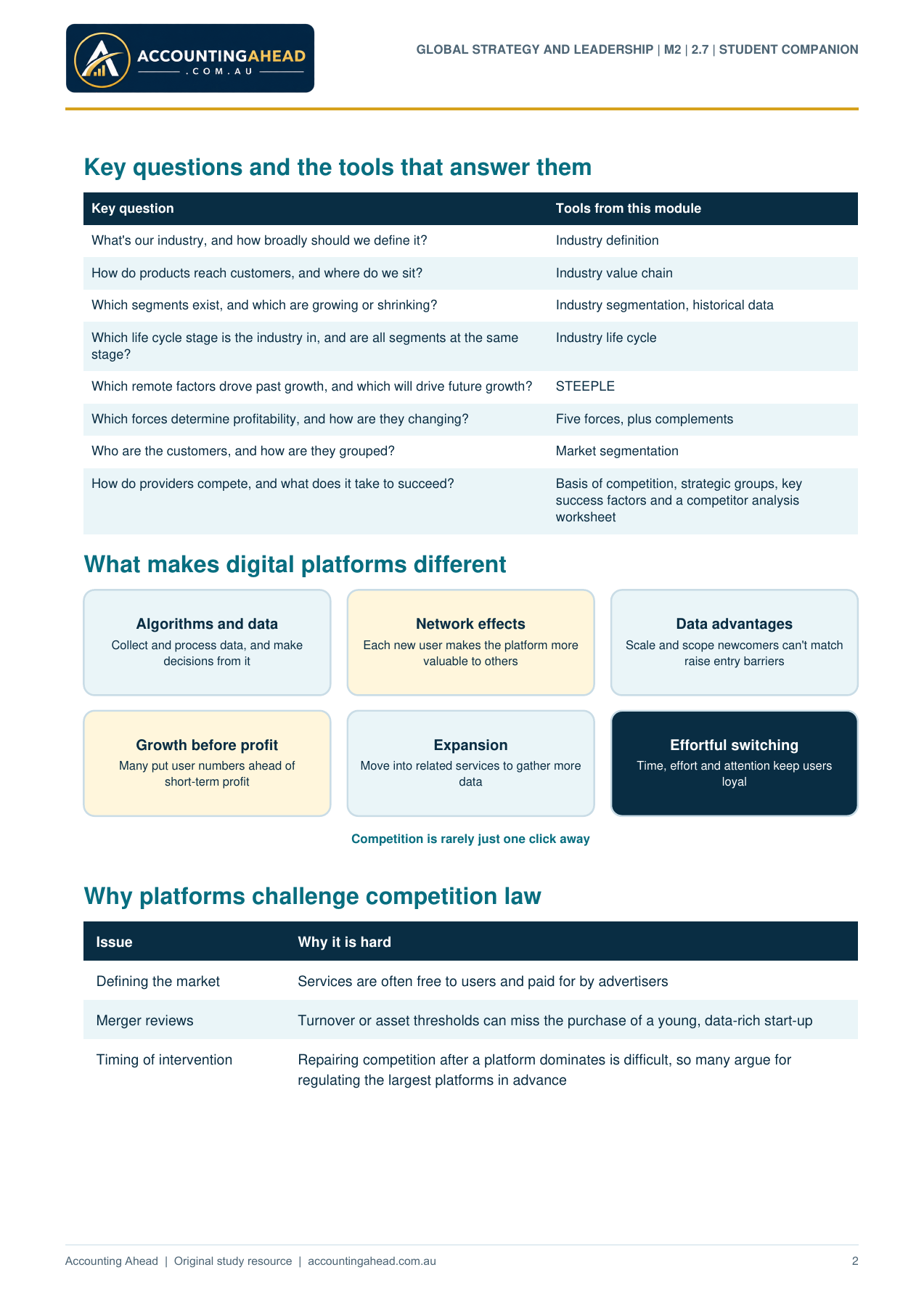
Key questions and the tools that answer them
Key question Tools from this module
What's our industry, and how broadly should we define it? Industry definition
How do products reach customers, and where do we sit? Industry value chain
Which segments exist, and which are growing or shrinking? Industry segmentation, historical data
Which life cycle stage is the industry in, and are all segments at the same
stage?
Industry life cycle
Which remote factors drove past growth, and which will drive future growth? STEEPLE
Which forces determine profitability, and how are they changing? Five forces, plus complements
Who are the customers, and how are they grouped? Market segmentation
How do providers compete, and what does it take to succeed? Basis of competition, strategic groups, key
success factors and a competitor analysis
worksheet
What makes digital platforms different
Algorithms and data
Collect and process data, and make
decisions from it
Network effects
Each new user makes the platform more
valuable to others
Data advantages
Scale and scope newcomers can't match
raise entry barriers
Growth before profit
Many put user numbers ahead of
short-term profit
Expansion
Move into related services to gather more
data
Effortful switching
Time, effort and attention keep users
loyal
Competition is rarely just one click away
Why platforms challenge competition law
Issue Why it is hard
Defining the market Services are often free to users and paid for by advertisers
Merger reviews Turnover or asset thresholds can miss the purchase of a young, data-rich start-up
Timing of intervention Repairing competition after a platform dominates is difficult, so many argue for
regulating the largest platforms in advance
GLOBAL STRATEGY AND LEADERSHIP | M2 | 2.7 | STUDENT COMPANION
2
Accounting Ahead | Original study resource | accountingahead.com.au
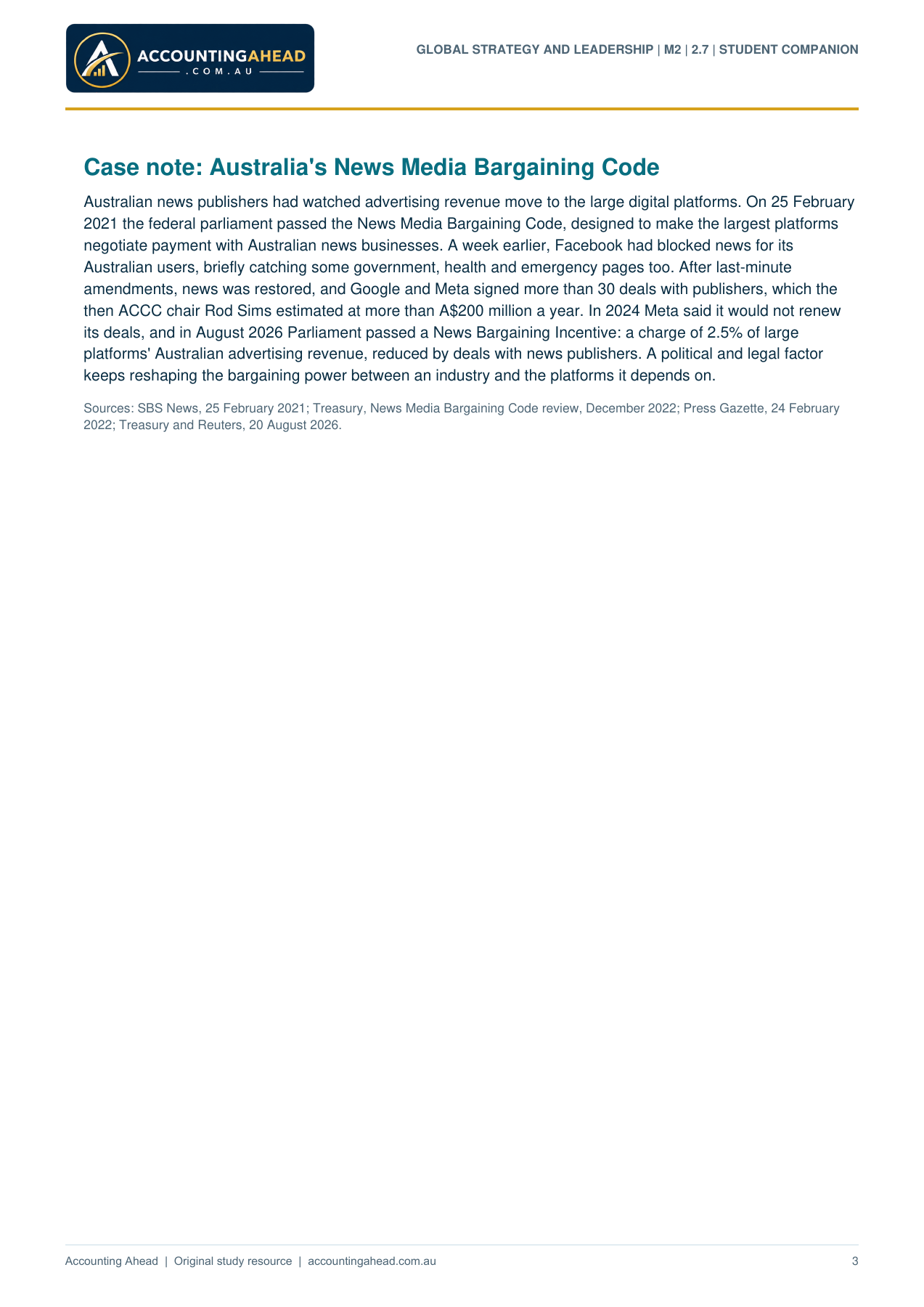
Case note: Australia's News Media Bargaining Code
Australian news publishers had watched advertising revenue move to the large digital platforms. On 25 February
2021 the federal parliament passed the News Media Bargaining Code, designed to make the largest platforms
negotiate payment with Australian news businesses. A week earlier, Facebook had blocked news for its
Australian users, briefly catching some government, health and emergency pages too. After last-minute
amendments, news was restored, and Google and Meta signed more than 30 deals with publishers, which the
then ACCC chair Rod Sims estimated at more than A$200 million a year. In 2024 Meta said it would not renew
its deals, and in August 2026 Parliament passed a News Bargaining Incentive: a charge of 2.5% of large
platforms' Australian advertising revenue, reduced by deals with news publishers. A political and legal factor
keeps reshaping the bargaining power between an industry and the platforms it depends on.
Sources: SBS News, 25 February 2021; Treasury, News Media Bargaining Code review, December 2022; Press Gazette, 24 February
2022; Treasury and Reuters, 20 August 2026.
GLOBAL STRATEGY AND LEADERSHIP | M2 | 2.7 | STUDENT COMPANION
3
Accounting Ahead | Original study resource | accountingahead.com.au
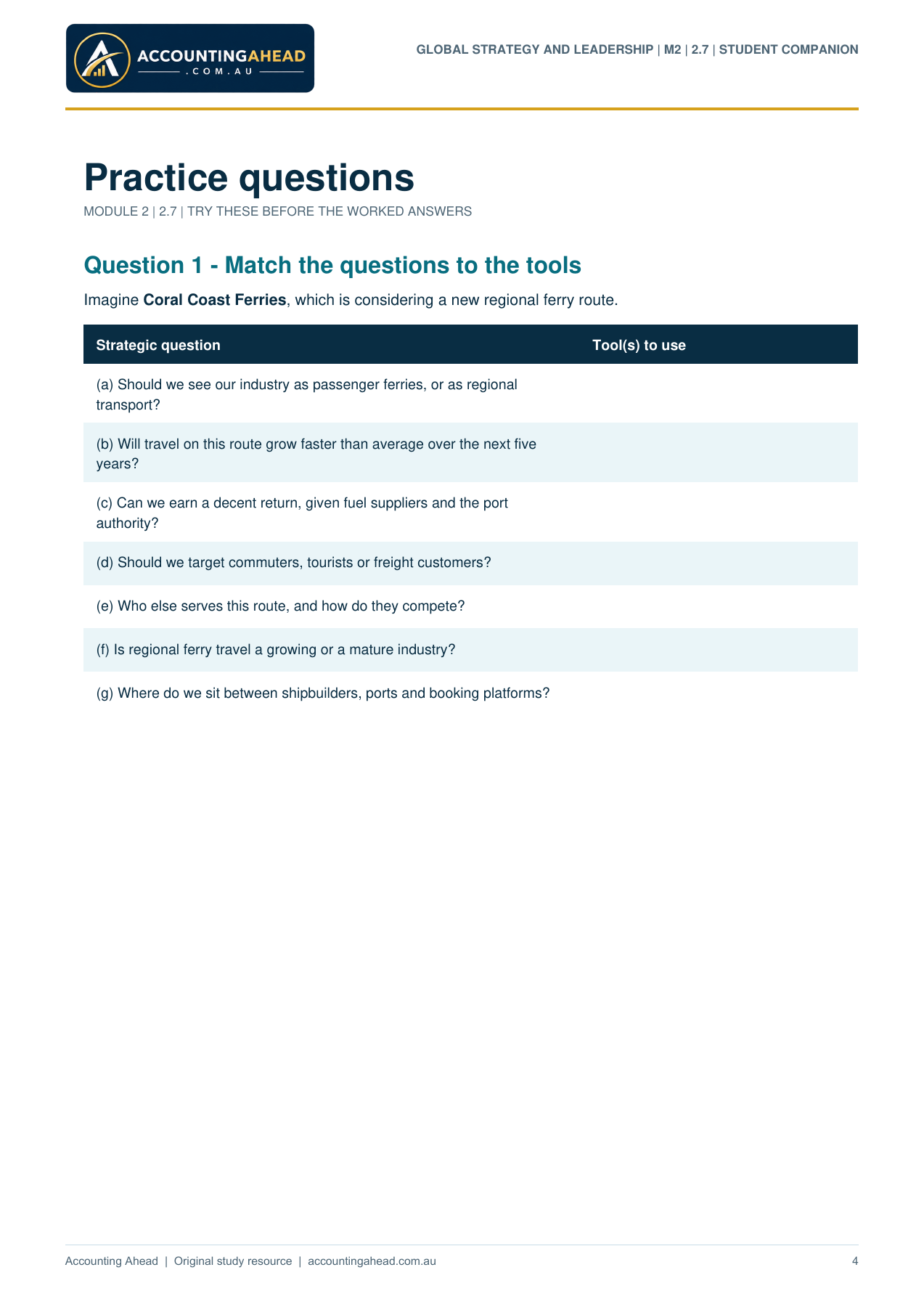
Practice questions
MODULE 2 | 2.7 | TRY THESE BEFORE THE WORKED ANSWERS
Question 1 - Match the questions to the tools
Imagine Coral Coast Ferries, which is considering a new regional ferry route.
Strategic question Tool(s) to use
(a) Should we see our industry as passenger ferries, or as regional
transport?
(b) Will travel on this route grow faster than average over the next five
years?
(c) Can we earn a decent return, given fuel suppliers and the port
authority?
(d) Should we target commuters, tourists or freight customers?
(e) Who else serves this route, and how do they compete?
(f) Is regional ferry travel a growing or a mature industry?
(g) Where do we sit between shipbuilders, ports and booking platforms?
GLOBAL STRATEGY AND LEADERSHIP | M2 | 2.7 | STUDENT COMPANION
4
Accounting Ahead | Original study resource | accountingahead.com.au
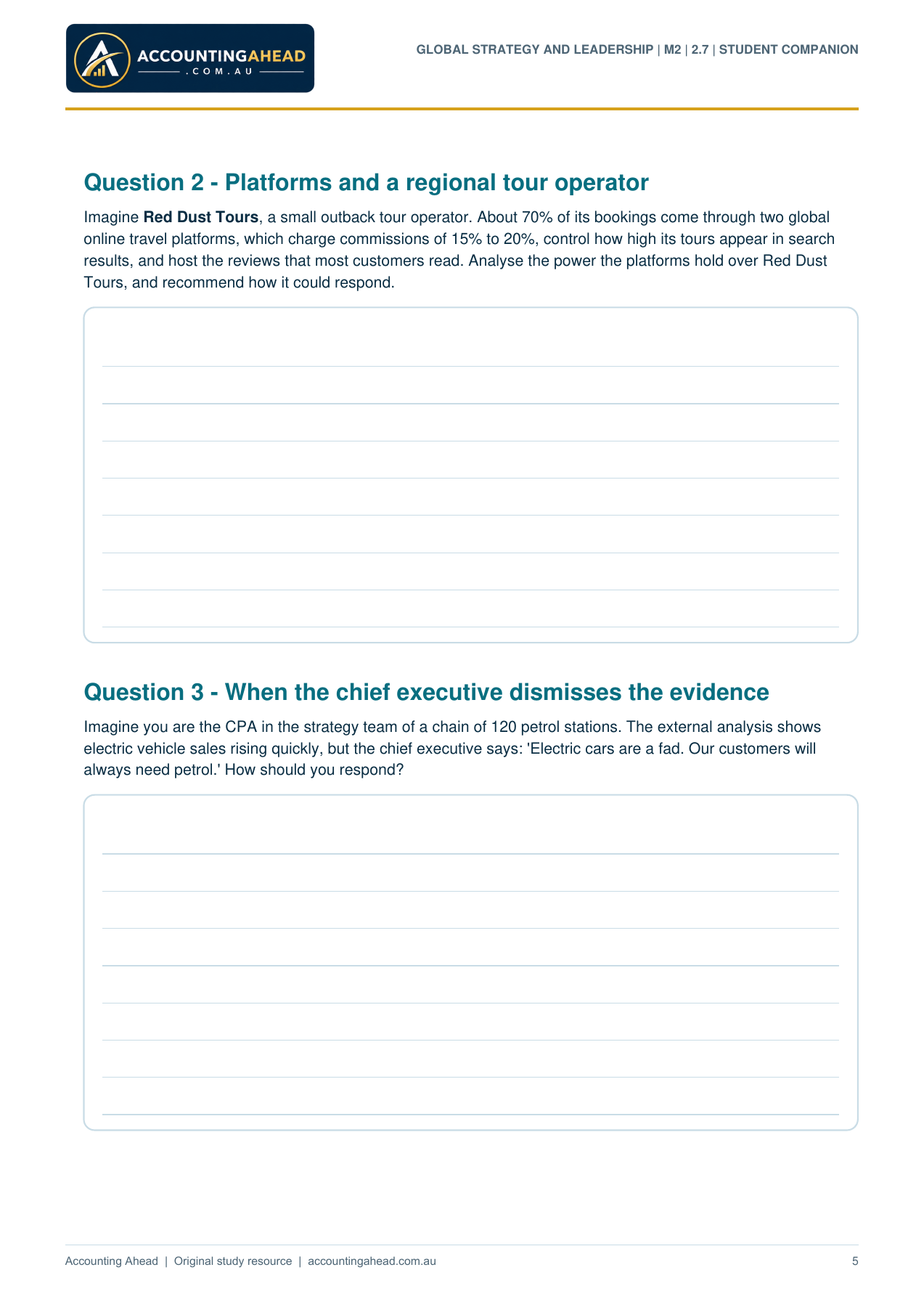
Question 2 - Platforms and a regional tour operator
Imagine Red Dust Tours, a small outback tour operator. About 70% of its bookings come through two global
online travel platforms, which charge commissions of 15% to 20%, control how high its tours appear in search
results, and host the reviews that most customers read. Analyse the power the platforms hold over Red Dust
Tours, and recommend how it could respond.
Question 3 - When the chief executive dismisses the evidence
Imagine you are the CPA in the strategy team of a chain of 120 petrol stations. The external analysis shows
electric vehicle sales rising quickly, but the chief executive says: 'Electric cars are a fad. Our customers will
always need petrol.' How should you respond?
GLOBAL STRATEGY AND LEADERSHIP | M2 | 2.7 | STUDENT COMPANION
5
Accounting Ahead | Original study resource | accountingahead.com.au
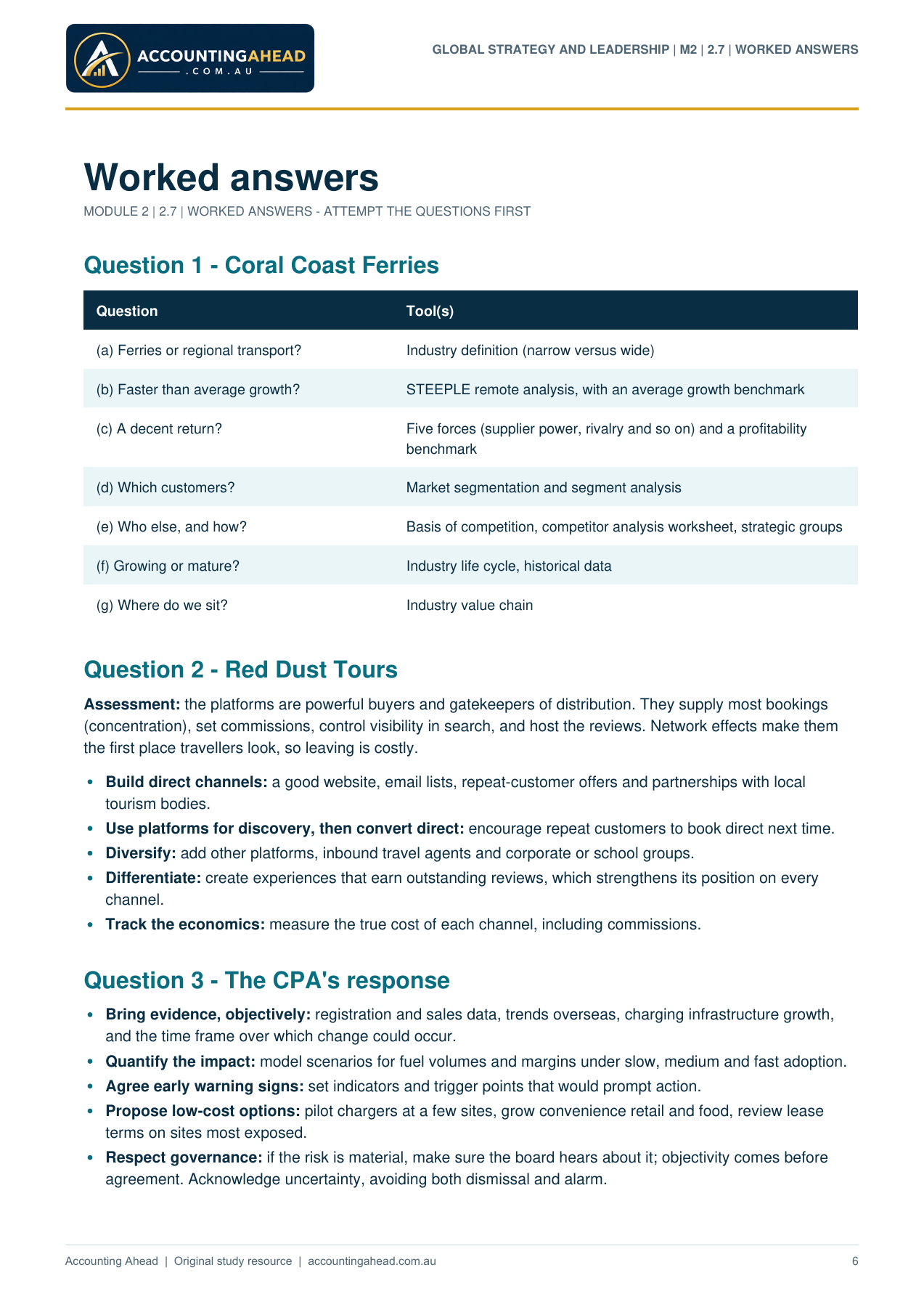
Worked answers
MODULE 2 | 2.7 | WORKED ANSWERS - ATTEMPT THE QUESTIONS FIRST
Question 1 - Coral Coast Ferries
Question Tool(s)
(a) Ferries or regional transport? Industry definition (narrow versus wide)
(b) Faster than average growth? STEEPLE remote analysis, with an average growth benchmark
(c) A decent return? Five forces (supplier power, rivalry and so on) and a profitability
benchmark
(d) Which customers? Market segmentation and segment analysis
(e) Who else, and how? Basis of competition, competitor analysis worksheet, strategic groups
(f) Growing or mature? Industry life cycle, historical data
(g) Where do we sit? Industry value chain
Question 2 - Red Dust Tours
Assessment: the platforms are powerful buyers and gatekeepers of distribution. They supply most bookings
(concentration), set commissions, control visibility in search, and host the reviews. Network effects make them
the first place travellers look, so leaving is costly.
Build direct channels: a good website, email lists, repeat-customer offers and partnerships with local
tourism bodies.
Use platforms for discovery, then convert direct: encourage repeat customers to book direct next time.
Diversify: add other platforms, inbound travel agents and corporate or school groups.
Differentiate: create experiences that earn outstanding reviews, which strengthens its position on every
channel.
Track the economics: measure the true cost of each channel, including commissions.
Question 3 - The CPA's response
Bring evidence, objectively: registration and sales data, trends overseas, charging infrastructure growth,
and the time frame over which change could occur.
Quantify the impact: model scenarios for fuel volumes and margins under slow, medium and fast adoption.
Agree early warning signs: set indicators and trigger points that would prompt action.
Propose low-cost options: pilot chargers at a few sites, grow convenience retail and food, review lease
terms on sites most exposed.
Respect governance: if the risk is material, make sure the board hears about it; objectivity comes before
agreement. Acknowledge uncertainty, avoiding both dismissal and alarm.
GLOBAL STRATEGY AND LEADERSHIP | M2 | 2.7 | WORKED ANSWERS
6