
Understanding key stakeholders
Printable study notes to use alongside Part 3.1.
Read the handout text
Accounting Ahead | Original study resource | accountingahead.com.au
Understanding key stakeholders
MODULE 3 | 3.1 | STUDENT COMPANION
Internal analysis looks at the factors within the organisation's control: stakeholders, current performance
(judged through three groups of drivers), resources and capabilities, and finally SWOT and gap analysis.
The CPA collects, checks and analyses the financial and operational data behind it, and acts as the bridge
between data and business intelligence.
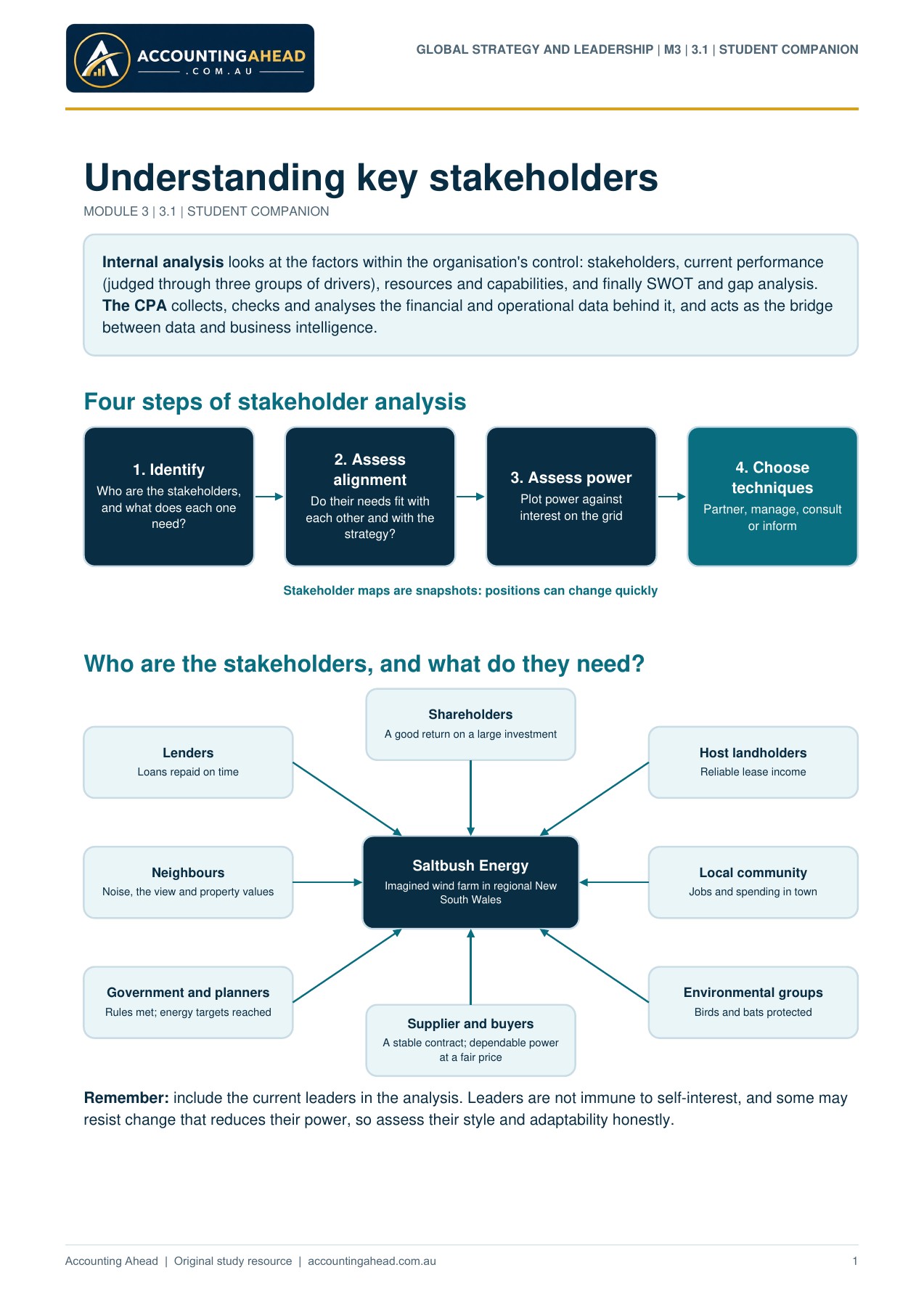
Four steps of stakeholder analysis
1. Identify
Who are the stakeholders,
and what does each one
need?
2. Assess
alignment
Do their needs fit with
each other and with the
strategy?
3. Assess power
Plot power against
interest on the grid
4. Choose
techniques
Partner, manage, consult
or inform
Stakeholder maps are snapshots: positions can change quickly
Who are the stakeholders, and what do they need?
Saltbush Energy
Imagined wind farm in regional New
South Wales
Shareholders
A good return on a large investment
Lenders
Loans repaid on time
Host landholders
Reliable lease income
Neighbours
Noise, the view and property values
Local community
Jobs and spending in town
Government and planners
Rules met; energy targets reached
Environmental groups
Birds and bats protected
Supplier and buyers
A stable contract; dependable power
at a fair price
Remember: include the current leaders in the analysis. Leaders are not immune to self-interest, and some may
resist change that reduces their power, so assess their style and adaptability honestly.
GLOBAL STRATEGY AND LEADERSHIP | M3 | 3.1 | STUDENT COMPANION
1
Accounting Ahead | Original study resource | accountingahead.com.au
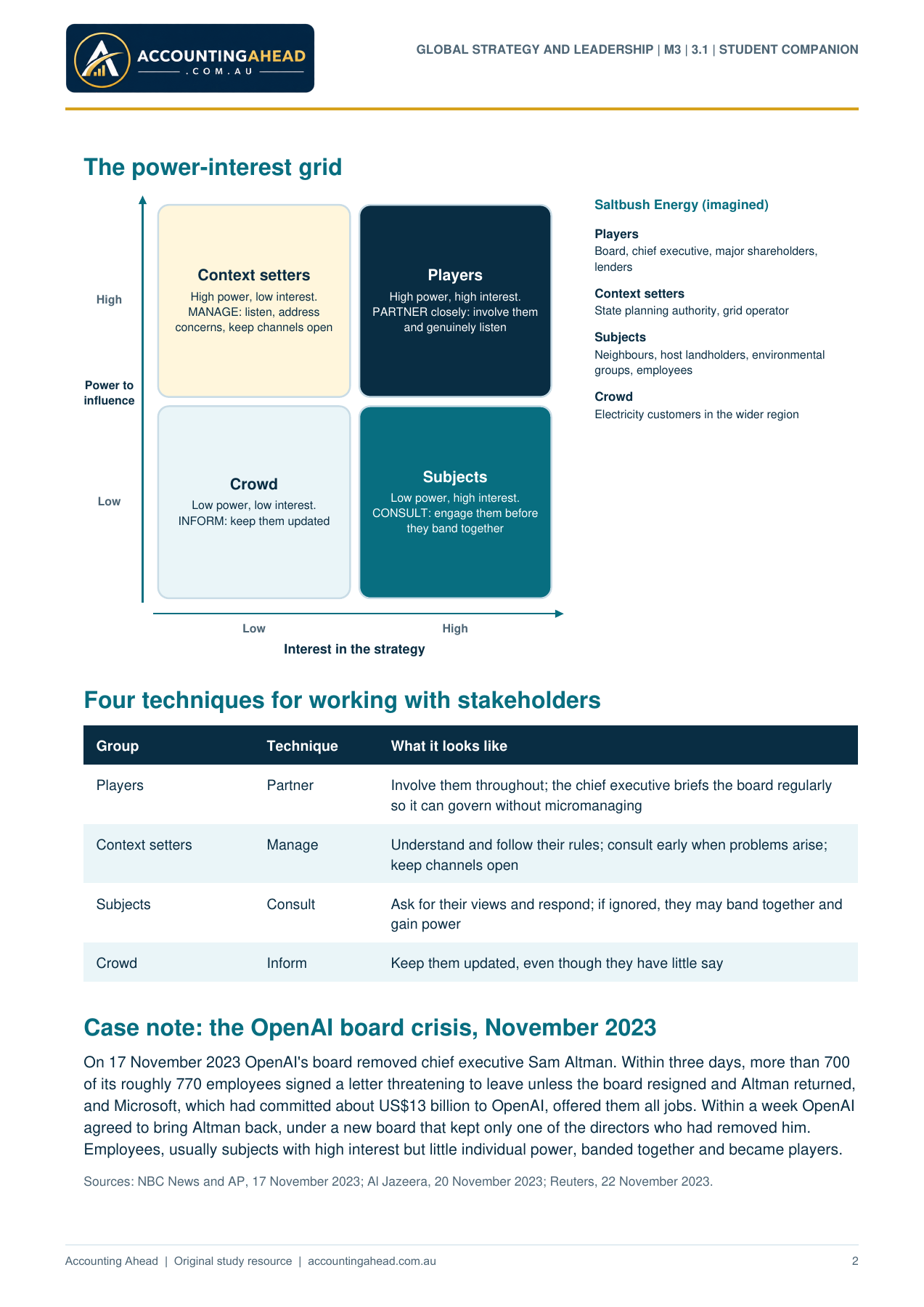
The power-interest grid
Context setters
High power, low interest.
MANAGE: listen, address
concerns, keep channels open
Players
High power, high interest.
PARTNER closely: involve them
and genuinely listen
Crowd
Low power, low interest.
INFORM: keep them updated
Subjects
Low power, high interest.
CONSULT: engage them before
they band together
Low High
Interest in the strategy
High
Low
Power to
influence
Saltbush Energy (imagined)
Players
Board, chief executive, major shareholders,
lenders
Context setters
State planning authority, grid operator
Subjects
Neighbours, host landholders, environmental
groups, employees
Crowd
Electricity customers in the wider region
Four techniques for working with stakeholders
Group Technique What it looks like
Players Partner Involve them throughout; the chief executive briefs the board regularly
so it can govern without micromanaging
Context setters Manage Understand and follow their rules; consult early when problems arise;
keep channels open
Subjects Consult Ask for their views and respond; if ignored, they may band together and
gain power
Crowd Inform Keep them updated, even though they have little say
Case note: the OpenAI board crisis, November 2023
On 17 November 2023 OpenAI's board removed chief executive Sam Altman. Within three days, more than 700
of its roughly 770 employees signed a letter threatening to leave unless the board resigned and Altman returned,
and Microsoft, which had committed about US$13 billion to OpenAI, offered them all jobs. Within a week OpenAI
agreed to bring Altman back, under a new board that kept only one of the directors who had removed him.
Employees, usually subjects with high interest but little individual power, banded together and became players.
Sources: NBC News and AP, 17 November 2023; Al Jazeera, 20 November 2023; Reuters, 22 November 2023.
GLOBAL STRATEGY AND LEADERSHIP | M3 | 3.1 | STUDENT COMPANION
2
Accounting Ahead | Original study resource | accountingahead.com.au
Practice questions
MODULE 3 | 3.1 | TRY THESE BEFORE THE WORKED ANSWERS
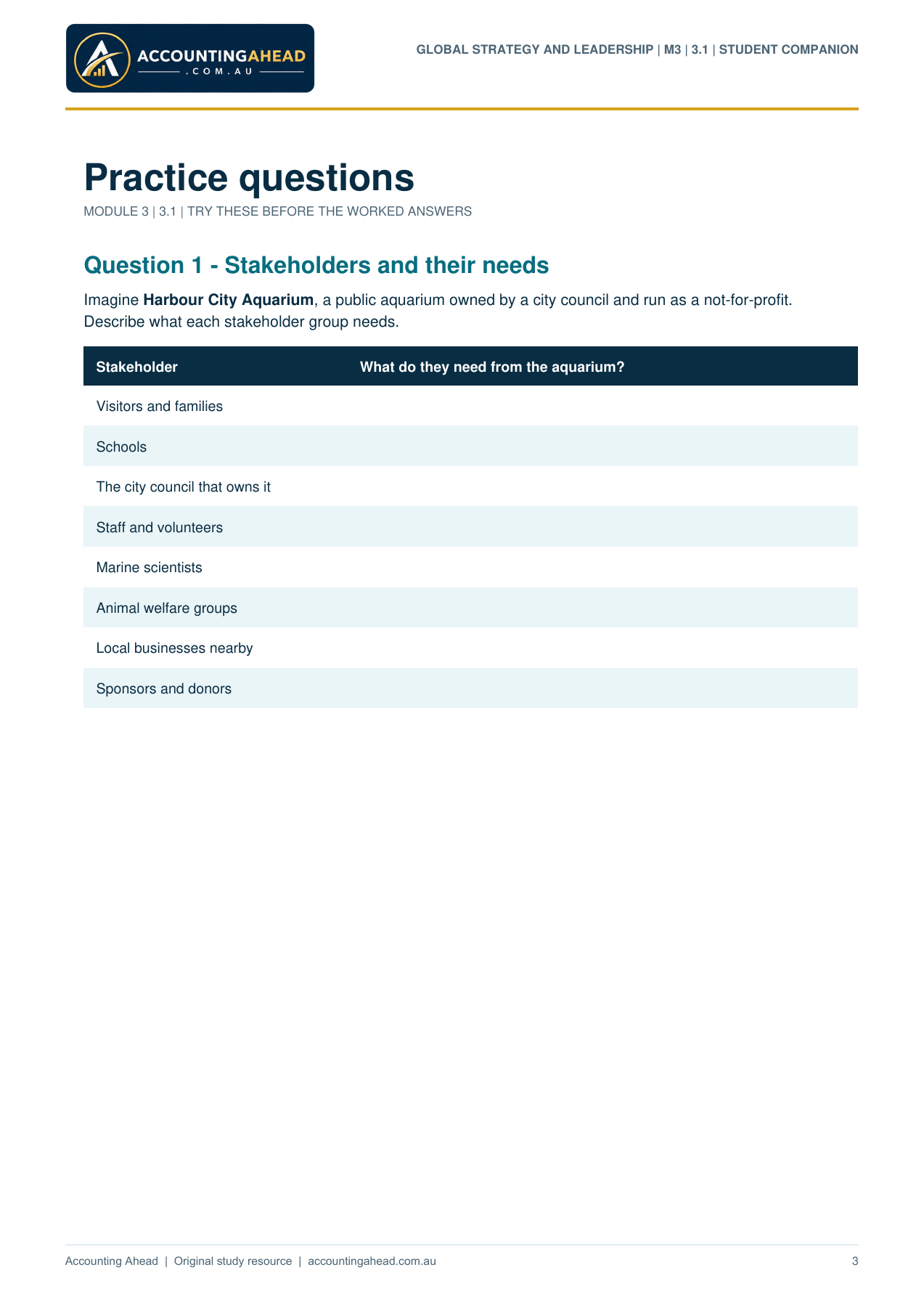
Question 1 - Stakeholders and their needs
Imagine Harbour City Aquarium, a public aquarium owned by a city council and run as a not-for-profit.
Describe what each stakeholder group needs.
Stakeholder What do they need from the aquarium?
Visitors and families
Schools
The city council that owns it
Staff and volunteers
Marine scientists
Animal welfare groups
Local businesses nearby
Sponsors and donors
GLOBAL STRATEGY AND LEADERSHIP | M3 | 3.1 | STUDENT COMPANION
3
Accounting Ahead | Original study resource | accountingahead.com.au
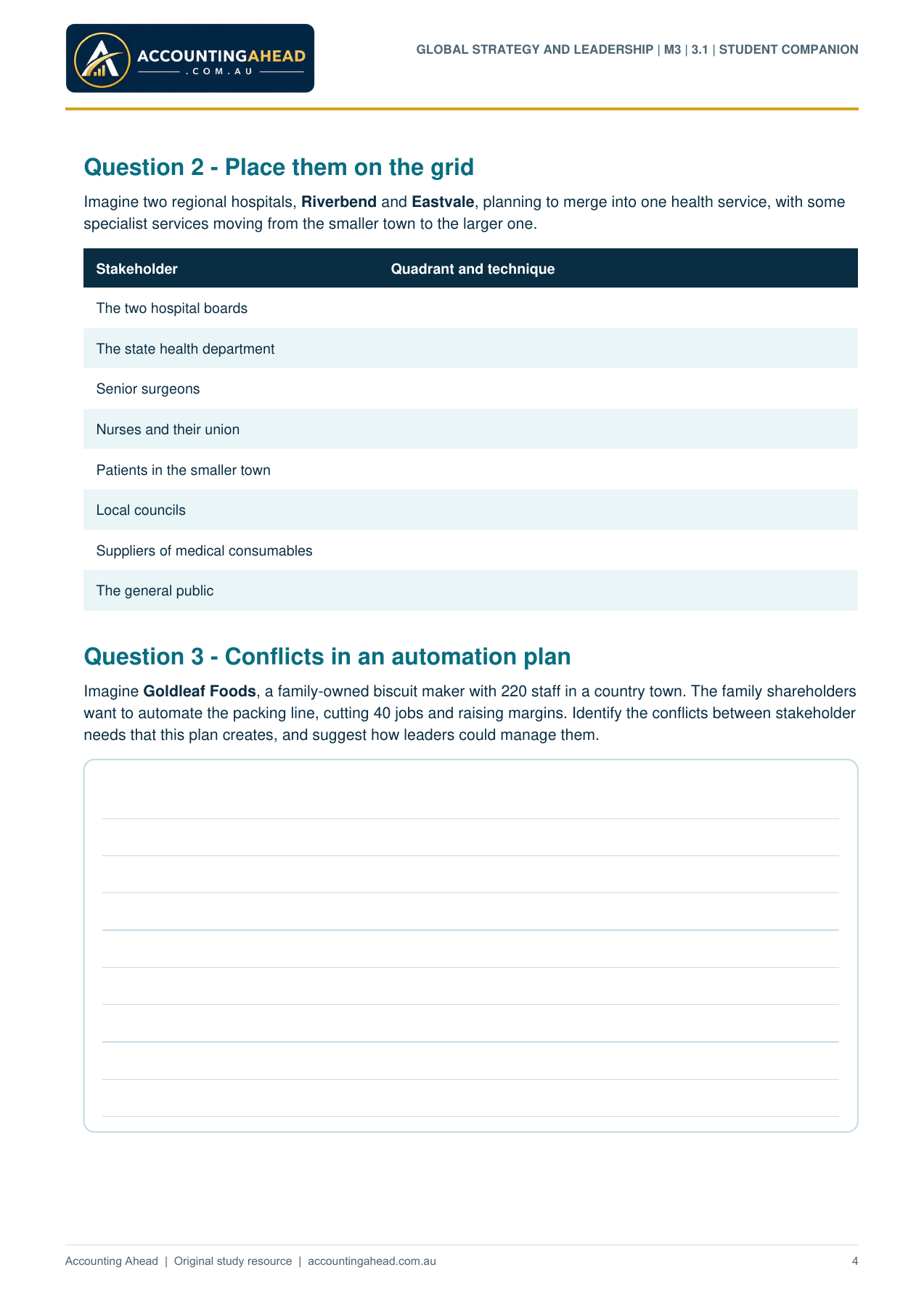
Question 2 - Place them on the grid
Imagine two regional hospitals, Riverbend and Eastvale, planning to merge into one health service, with some
specialist services moving from the smaller town to the larger one.
Stakeholder Quadrant and technique
The two hospital boards
The state health department
Senior surgeons
Nurses and their union
Patients in the smaller town
Local councils
Suppliers of medical consumables
The general public
Question 3 - Conflicts in an automation plan
Imagine Goldleaf Foods, a family-owned biscuit maker with 220 staff in a country town. The family shareholders
want to automate the packing line, cutting 40 jobs and raising margins. Identify the conflicts between stakeholder
needs that this plan creates, and suggest how leaders could manage them.
GLOBAL STRATEGY AND LEADERSHIP | M3 | 3.1 | STUDENT COMPANION
4
Accounting Ahead | Original study resource | accountingahead.com.au
Worked answers
MODULE 3 | 3.1 | WORKED ANSWERS - ATTEMPT THE QUESTIONS FIRST
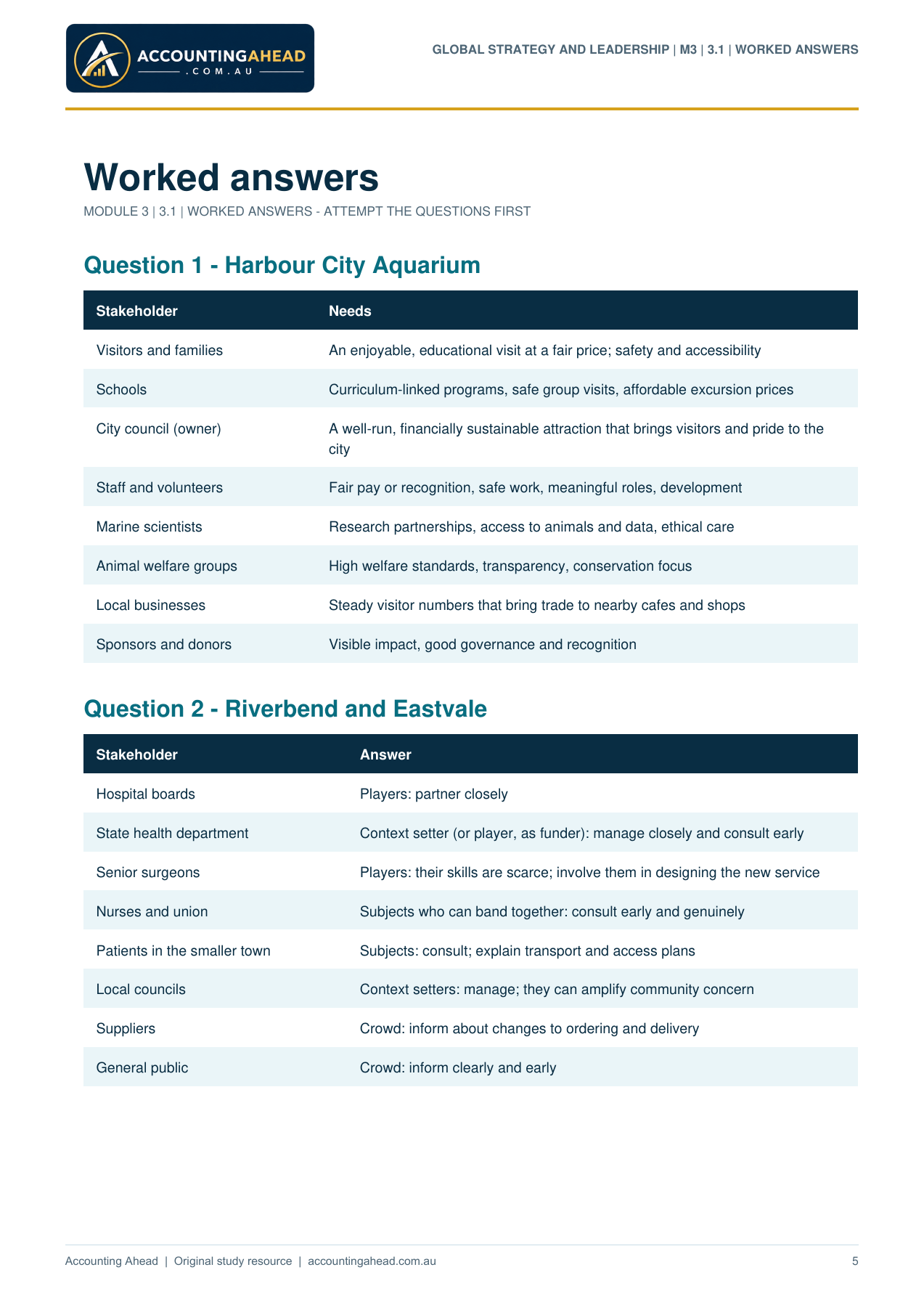
Question 1 - Harbour City Aquarium
Stakeholder Needs
Visitors and families An enjoyable, educational visit at a fair price; safety and accessibility
Schools Curriculum-linked programs, safe group visits, affordable excursion prices
City council (owner) A well-run, financially sustainable attraction that brings visitors and pride to the
city
Staff and volunteers Fair pay or recognition, safe work, meaningful roles, development
Marine scientists Research partnerships, access to animals and data, ethical care
Animal welfare groups High welfare standards, transparency, conservation focus
Local businesses Steady visitor numbers that bring trade to nearby cafes and shops
Sponsors and donors Visible impact, good governance and recognition
Question 2 - Riverbend and Eastvale
Stakeholder Answer
Hospital boards Players: partner closely
State health department Context setter (or player, as funder): manage closely and consult early
Senior surgeons Players: their skills are scarce; involve them in designing the new service
Nurses and union Subjects who can band together: consult early and genuinely
Patients in the smaller town Subjects: consult; explain transport and access plans
Local councils Context setters: manage; they can amplify community concern
Suppliers Crowd: inform about changes to ordering and delivery
General public Crowd: inform clearly and early
GLOBAL STRATEGY AND LEADERSHIP | M3 | 3.1 | WORKED ANSWERS
5
Accounting Ahead | Original study resource | accountingahead.com.au
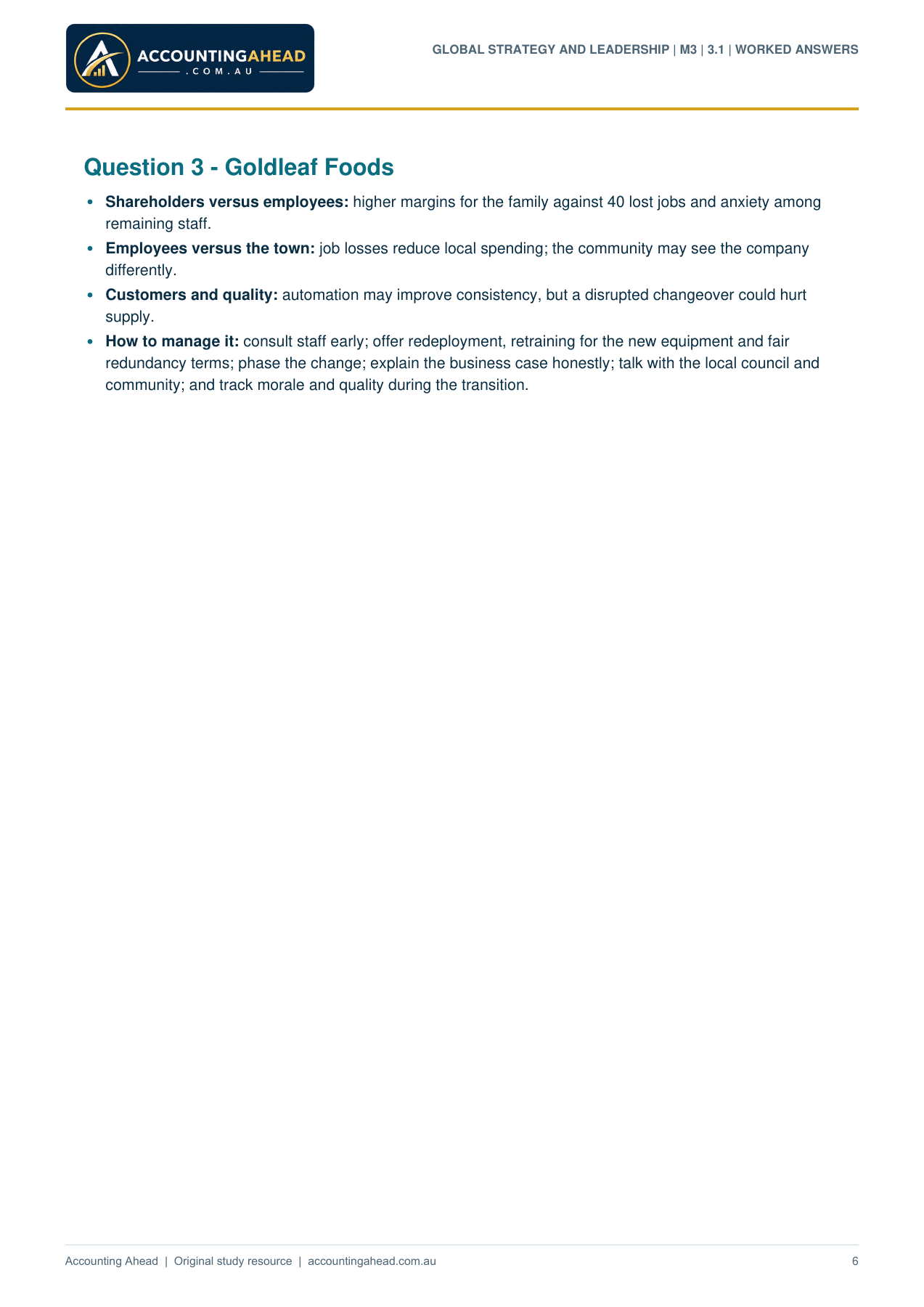
Question 3 - Goldleaf Foods
Shareholders versus employees: higher margins for the family against 40 lost jobs and anxiety among
remaining staff.
Employees versus the town: job losses reduce local spending; the community may see the company
differently.
Customers and quality: automation may improve consistency, but a disrupted changeover could hurt
supply.
How to manage it: consult staff early; offer redeployment, retraining for the new equipment and fair
redundancy terms; phase the change; explain the business case honestly; talk with the local council and
community; and track morale and quality during the transition.
GLOBAL STRATEGY AND LEADERSHIP | M3 | 3.1 | WORKED ANSWERS
6