
Competitive advantage and generic strategies
Printable study notes to use alongside Part 3.3.2.
Read the handout text
Accounting Ahead | Original study resource | accountingahead.com.au
Competitive advantage and generic
strategies
MODULE 3 | 3.3.2 | STUDENT COMPANION
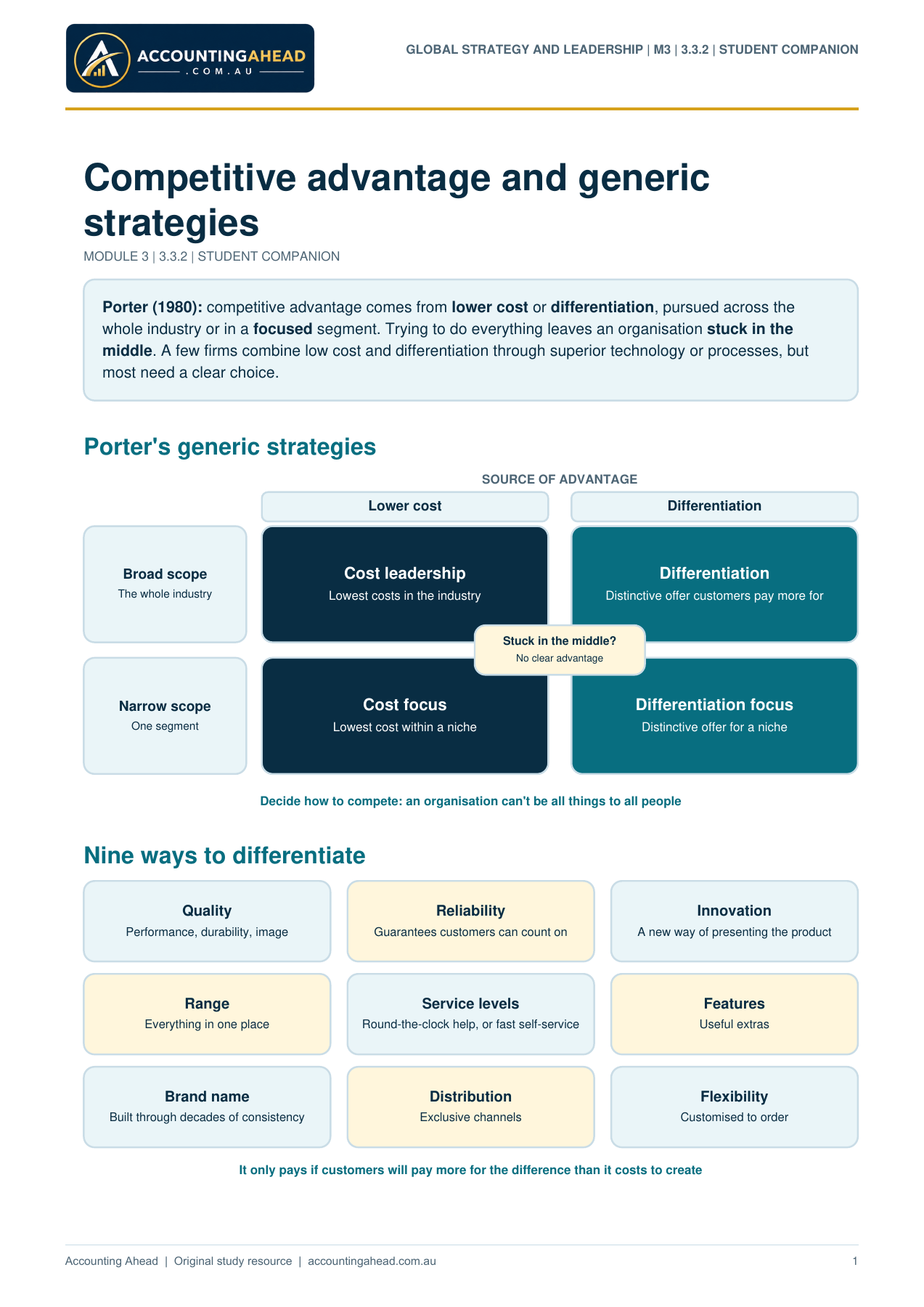
Porter (1980): competitive advantage comes from lower cost or differentiation, pursued across the
whole industry or in a focused segment. Trying to do everything leaves an organisation stuck in the
middle. A few firms combine low cost and differentiation through superior technology or processes, but
most need a clear choice.
Porter's generic strategies
SOURCE OF ADVANTAGE
Lower cost Differentiation
Broad scope
The whole industry
Narrow scope
One segment
Cost leadership
Lowest costs in the industry
Differentiation
Distinctive offer customers pay more for
Cost focus
Lowest cost within a niche
Differentiation focus
Distinctive offer for a niche
Stuck in the middle?
No clear advantage
Decide how to compete: an organisation can't be all things to all people
Nine ways to differentiate
Quality
Performance, durability, image
Reliability
Guarantees customers can count on
Innovation
A new way of presenting the product
Range
Everything in one place
Service levels
Round-the-clock help, or fast self-service
Features
Useful extras
Brand name
Built through decades of consistency
Distribution
Exclusive channels
Flexibility
Customised to order
It only pays if customers will pay more for the difference than it costs to create
GLOBAL STRATEGY AND LEADERSHIP | M3 | 3.3.2 | STUDENT COMPANION
1
Accounting Ahead | Original study resource | accountingahead.com.au
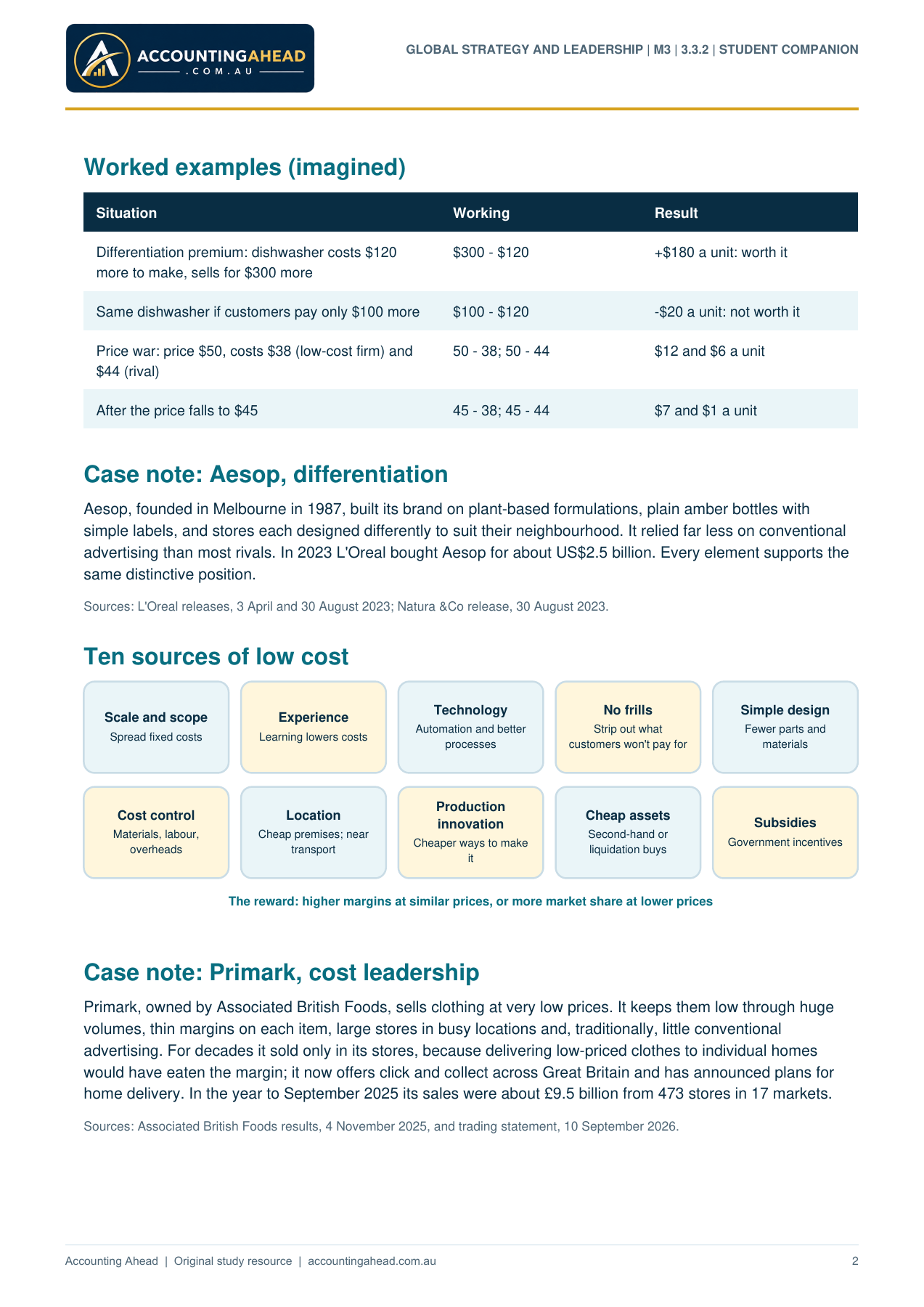
Worked examples (imagined)
Situation Working Result
Differentiation premium: dishwasher costs $120
more to make, sells for $300 more
$300 - $120 +$180 a unit: worth it
Same dishwasher if customers pay only $100 more $100 - $120 -$20 a unit: not worth it
Price war: price $50, costs $38 (low-cost firm) and
$44 (rival)
50 - 38; 50 - 44 $12 and $6 a unit
After the price falls to $45 45 - 38; 45 - 44 $7 and $1 a unit
Case note: Aesop, differentiation
Aesop, founded in Melbourne in 1987, built its brand on plant-based formulations, plain amber bottles with
simple labels, and stores each designed differently to suit their neighbourhood. It relied far less on conventional
advertising than most rivals. In 2023 L'Oreal bought Aesop for about US$2.5 billion. Every element supports the
same distinctive position.
Sources: L'Oreal releases, 3 April and 30 August 2023; Natura &Co release, 30 August 2023.
Ten sources of low cost
Scale and scope
Spread fixed costs
Experience
Learning lowers costs
Technology
Automation and better
processes
No frills
Strip out what
customers won't pay for
Simple design
Fewer parts and
materials
Cost control
Materials, labour,
overheads
Location
Cheap premises; near
transport
Production
innovation
Cheaper ways to make
it
Cheap assets
Second-hand or
liquidation buys
Subsidies
Government incentives
The reward: higher margins at similar prices, or more market share at lower prices
Case note: Primark, cost leadership
Primark, owned by Associated British Foods, sells clothing at very low prices. It keeps them low through huge
volumes, thin margins on each item, large stores in busy locations and, traditionally, little conventional
advertising. For decades it sold only in its stores, because delivering low-priced clothes to individual homes
would have eaten the margin; it now offers click and collect across Great Britain and has announced plans for
home delivery. In the year to September 2025 its sales were about £9.5 billion from 473 stores in 17 markets.
Sources: Associated British Foods results, 4 November 2025, and trading statement, 10 September 2026.
GLOBAL STRATEGY AND LEADERSHIP | M3 | 3.3.2 | STUDENT COMPANION
2
Accounting Ahead | Original study resource | accountingahead.com.au
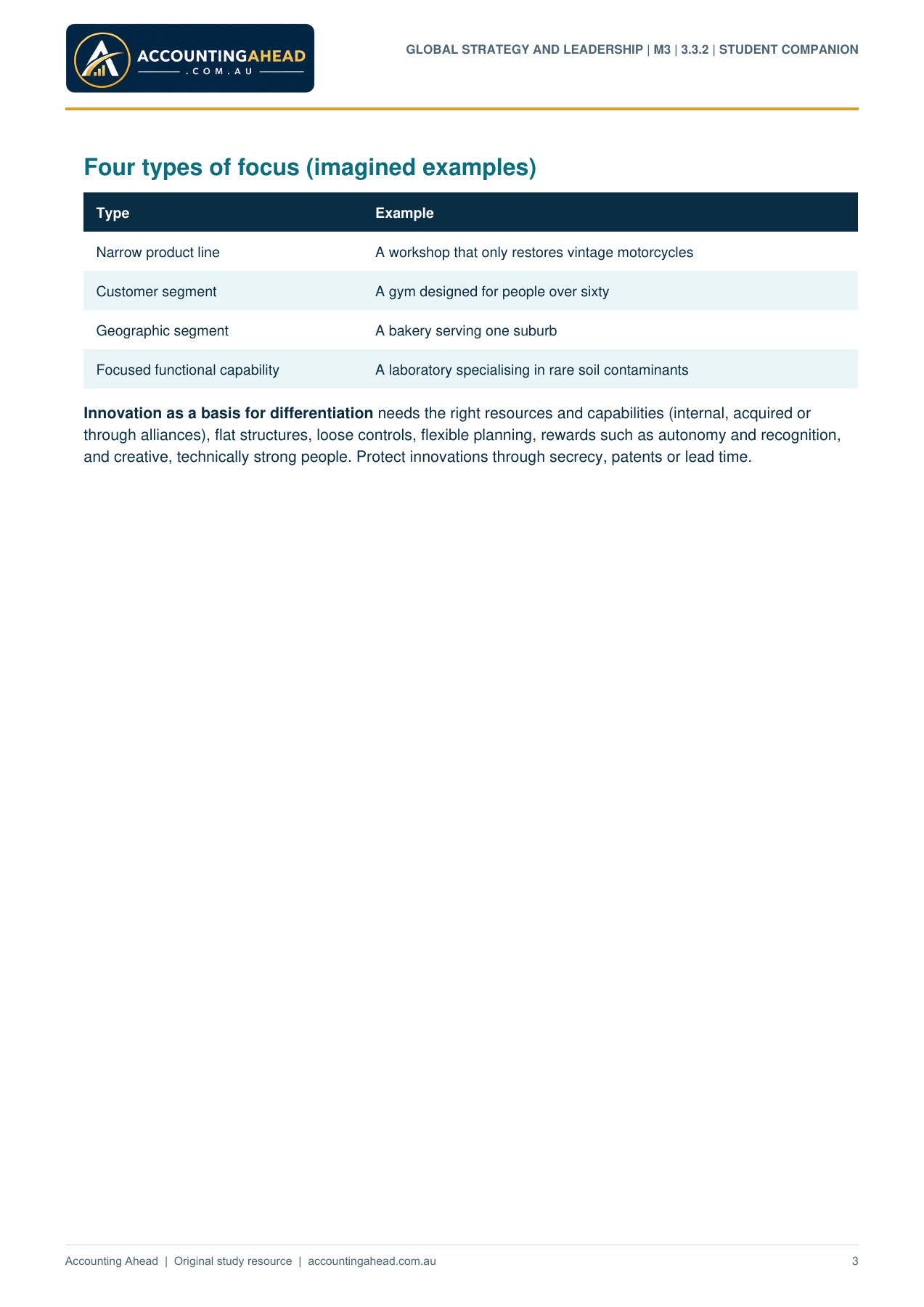
Four types of focus (imagined examples)
Type Example
Narrow product line A workshop that only restores vintage motorcycles
Customer segment A gym designed for people over sixty
Geographic segment A bakery serving one suburb
Focused functional capability A laboratory specialising in rare soil contaminants
Innovation as a basis for differentiation needs the right resources and capabilities (internal, acquired or
through alliances), flat structures, loose controls, flexible planning, rewards such as autonomy and recognition,
and creative, technically strong people. Protect innovations through secrecy, patents or lead time.
GLOBAL STRATEGY AND LEADERSHIP | M3 | 3.3.2 | STUDENT COMPANION
3
Accounting Ahead | Original study resource | accountingahead.com.au
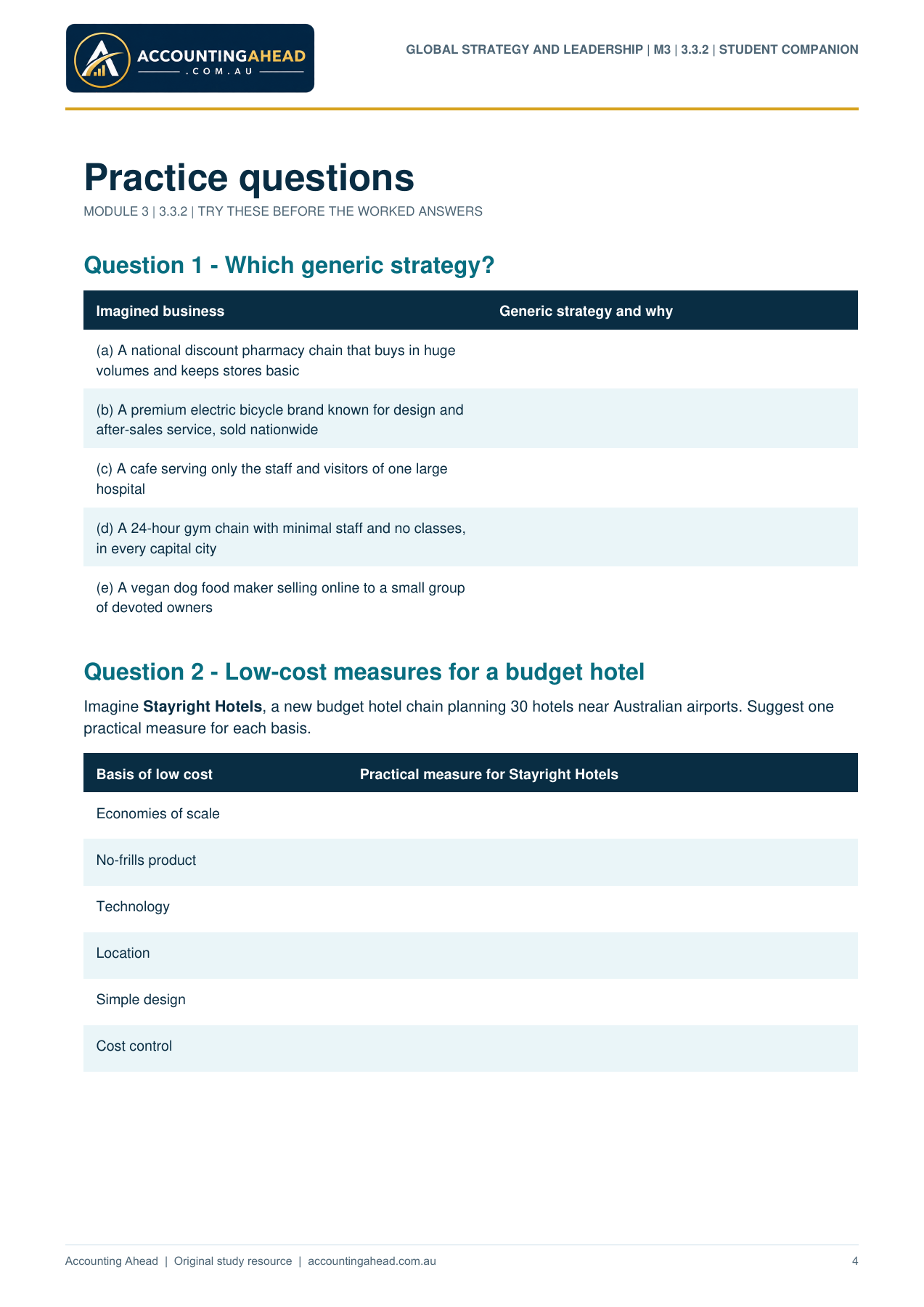
Practice questions
MODULE 3 | 3.3.2 | TRY THESE BEFORE THE WORKED ANSWERS
Question 1 - Which generic strategy?
Imagined business Generic strategy and why
(a) A national discount pharmacy chain that buys in huge
volumes and keeps stores basic
(b) A premium electric bicycle brand known for design and
after-sales service, sold nationwide
(c) A cafe serving only the staff and visitors of one large
hospital
(d) A 24-hour gym chain with minimal staff and no classes,
in every capital city
(e) A vegan dog food maker selling online to a small group
of devoted owners
Question 2 - Low-cost measures for a budget hotel
Imagine Stayright Hotels, a new budget hotel chain planning 30 hotels near Australian airports. Suggest one
practical measure for each basis.
Basis of low cost Practical measure for Stayright Hotels
Economies of scale
No-frills product
Technology
Location
Simple design
Cost control
GLOBAL STRATEGY AND LEADERSHIP | M3 | 3.3.2 | STUDENT COMPANION
4
Accounting Ahead | Original study resource | accountingahead.com.au
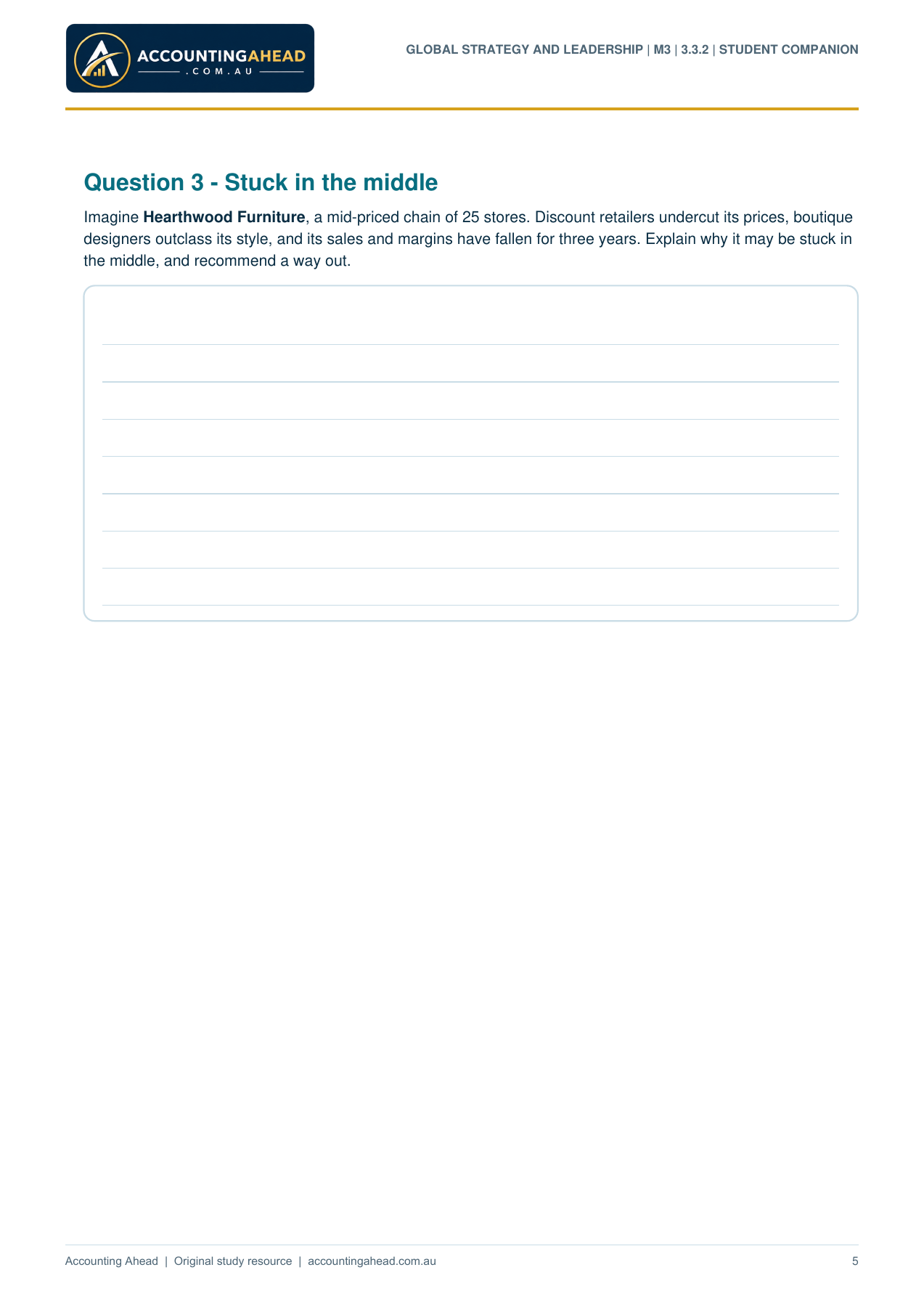
Question 3 - Stuck in the middle
Imagine Hearthwood Furniture, a mid-priced chain of 25 stores. Discount retailers undercut its prices, boutique
designers outclass its style, and its sales and margins have fallen for three years. Explain why it may be stuck in
the middle, and recommend a way out.
GLOBAL STRATEGY AND LEADERSHIP | M3 | 3.3.2 | STUDENT COMPANION
5
Accounting Ahead | Original study resource | accountingahead.com.au
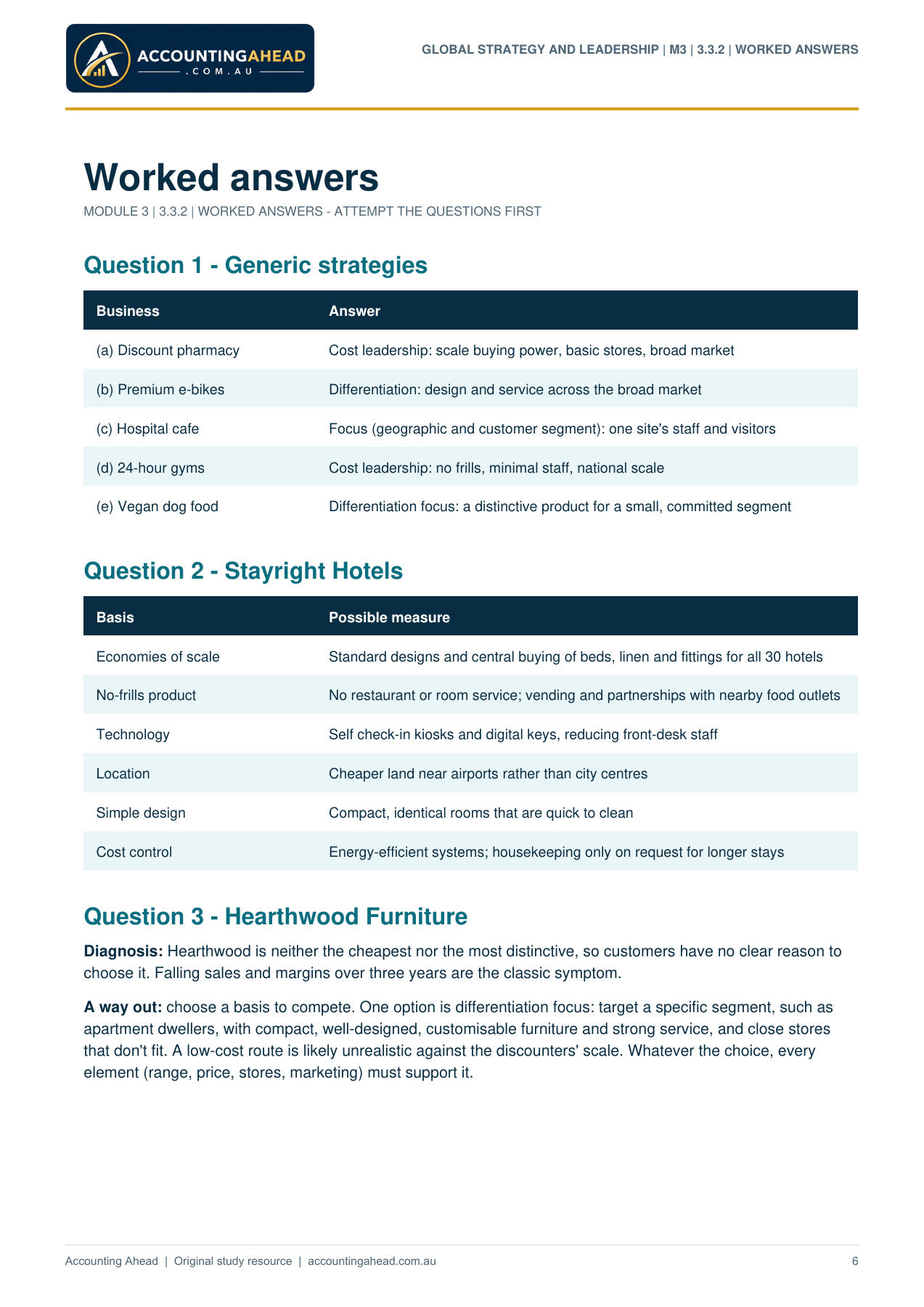
Worked answers
MODULE 3 | 3.3.2 | WORKED ANSWERS - ATTEMPT THE QUESTIONS FIRST
Question 1 - Generic strategies
Business Answer
(a) Discount pharmacy Cost leadership: scale buying power, basic stores, broad market
(b) Premium e-bikes Differentiation: design and service across the broad market
(c) Hospital cafe Focus (geographic and customer segment): one site's staff and visitors
(d) 24-hour gyms Cost leadership: no frills, minimal staff, national scale
(e) Vegan dog food Differentiation focus: a distinctive product for a small, committed segment
Question 2 - Stayright Hotels
Basis Possible measure
Economies of scale Standard designs and central buying of beds, linen and fittings for all 30 hotels
No-frills product No restaurant or room service; vending and partnerships with nearby food outlets
Technology Self check-in kiosks and digital keys, reducing front-desk staff
Location Cheaper land near airports rather than city centres
Simple design Compact, identical rooms that are quick to clean
Cost control Energy-efficient systems; housekeeping only on request for longer stays
Question 3 - Hearthwood Furniture
Diagnosis: Hearthwood is neither the cheapest nor the most distinctive, so customers have no clear reason to
choose it. Falling sales and margins over three years are the classic symptom.
A way out: choose a basis to compete. One option is differentiation focus: target a specific segment, such as
apartment dwellers, with compact, well-designed, customisable furniture and strong service, and close stores
that don't fit. A low-cost route is likely unrealistic against the discounters' scale. Whatever the choice, every
element (range, price, stores, marketing) must support it.
GLOBAL STRATEGY AND LEADERSHIP | M3 | 3.3.2 | WORKED ANSWERS
6