
Resources and capabilities
Printable study notes to use alongside Part 3.6.
Read the handout text
Accounting Ahead | Original study resource | accountingahead.com.au
Resources and capabilities
MODULE 3 | 3.6 | STUDENT COMPANION
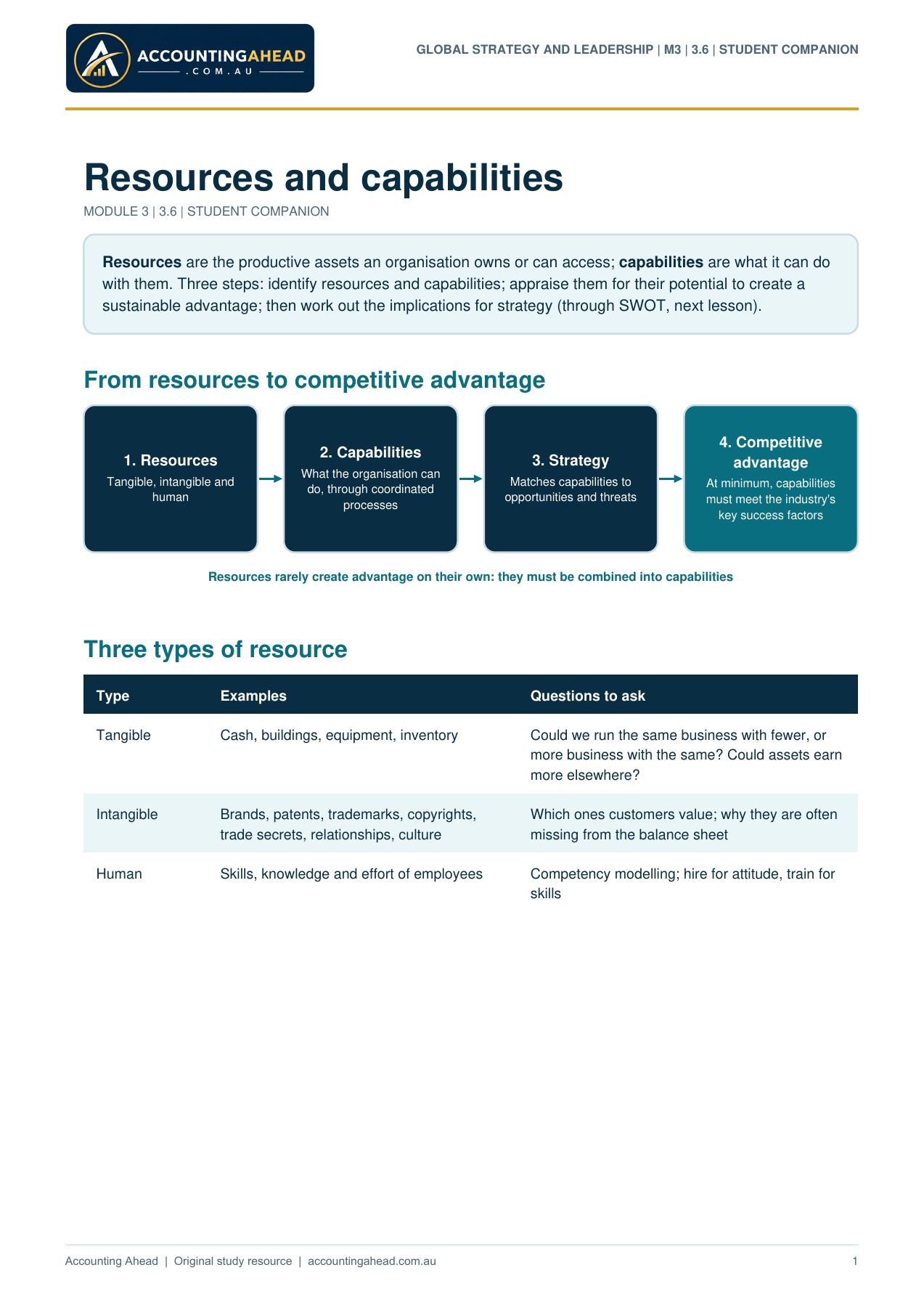
Resources are the productive assets an organisation owns or can access; capabilities are what it can do
with them. Three steps: identify resources and capabilities; appraise them for their potential to create a
sustainable advantage; then work out the implications for strategy (through SWOT, next lesson).
From resources to competitive advantage
1. Resources
Tangible, intangible and
human
2. Capabilities
What the organisation can
do, through coordinated
processes
3. Strategy
Matches capabilities to
opportunities and threats
4. Competitive
advantage
At minimum, capabilities
must meet the industry's
key success factors
Resources rarely create advantage on their own: they must be combined into capabilities
Three types of resource
Type Examples Questions to ask
Tangible Cash, buildings, equipment, inventory Could we run the same business with fewer, or
more business with the same? Could assets earn
more elsewhere?
Intangible Brands, patents, trademarks, copyrights,
trade secrets, relationships, culture
Which ones customers value; why they are often
missing from the balance sheet
Human Skills, knowledge and effort of employees Competency modelling; hire for attitude, train for
skills
GLOBAL STRATEGY AND LEADERSHIP | M3 | 3.6 | STUDENT COMPANION
1
Accounting Ahead | Original study resource | accountingahead.com.au
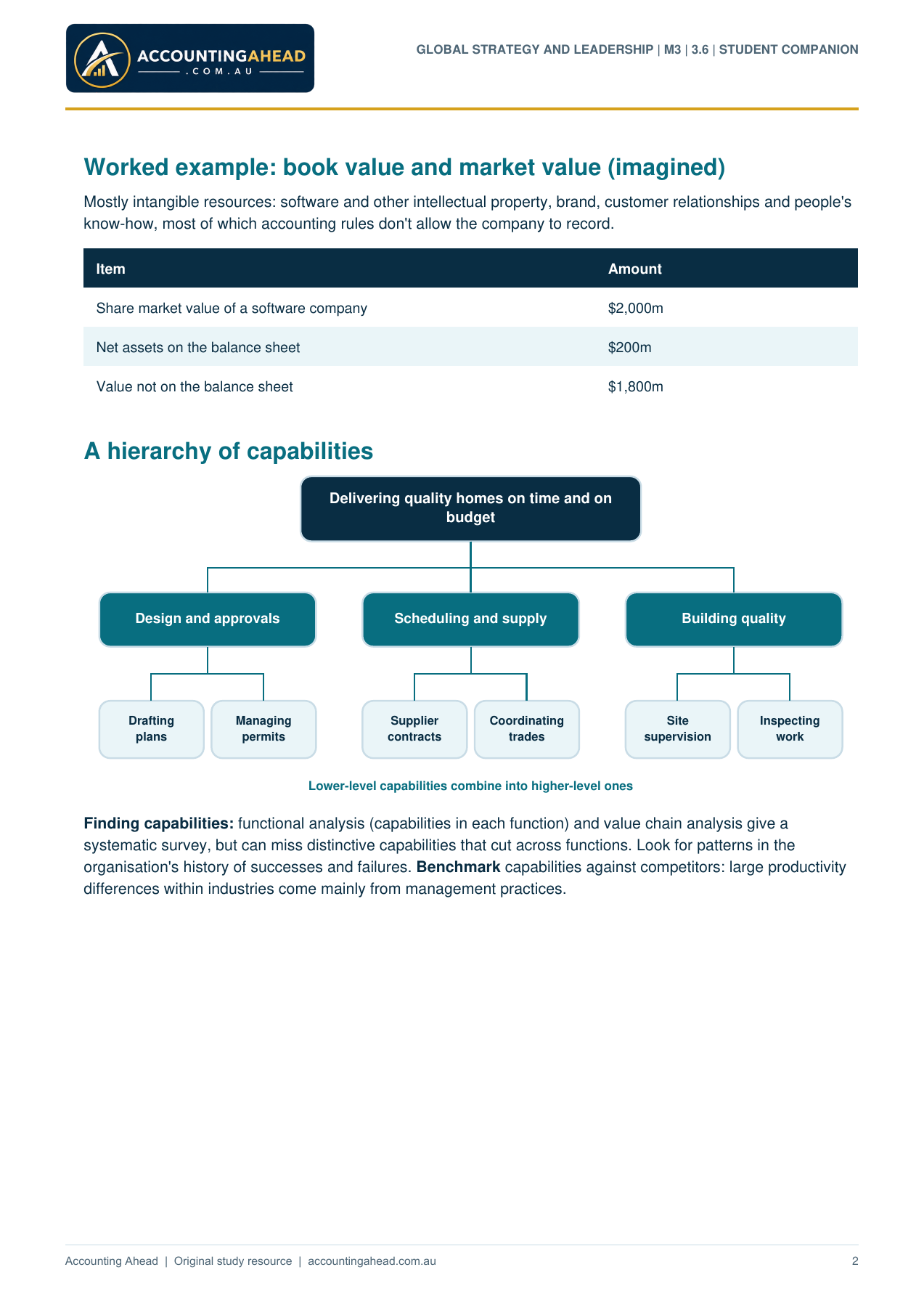
Worked example: book value and market value (imagined)
Mostly intangible resources: software and other intellectual property, brand, customer relationships and people's
know-how, most of which accounting rules don't allow the company to record.
Item Amount
Share market value of a software company $2,000m
Net assets on the balance sheet $200m
Value not on the balance sheet $1,800m
A hierarchy of capabilities
Delivering quality homes on time and on
budget
Design and approvals
Drafting
plans
Managing
permits
Scheduling and supply
Supplier
contracts
Coordinating
trades
Building quality
Site
supervision
Inspecting
work
Lower-level capabilities combine into higher-level ones
Finding capabilities: functional analysis (capabilities in each function) and value chain analysis give a
systematic survey, but can miss distinctive capabilities that cut across functions. Look for patterns in the
organisation's history of successes and failures. Benchmark capabilities against competitors: large productivity
differences within industries come mainly from management practices.
GLOBAL STRATEGY AND LEADERSHIP | M3 | 3.6 | STUDENT COMPANION
2
Accounting Ahead | Original study resource | accountingahead.com.au
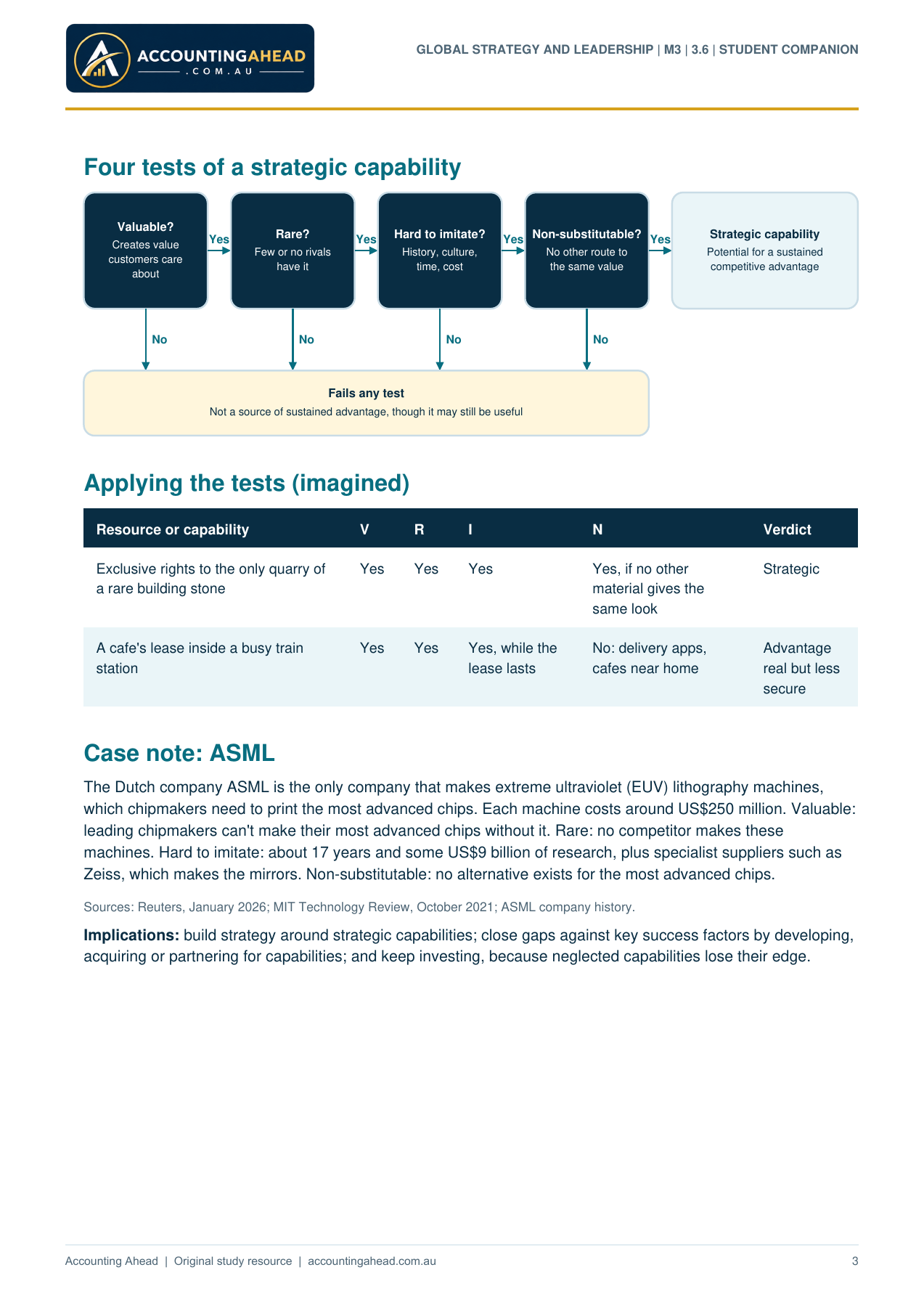
Four tests of a strategic capability
Valuable?
Creates value
customers care
about
Yes
No
Rare?
Few or no rivals
have it
Yes
No
Hard to imitate?
History, culture,
time, cost
Yes
No
Non-substitutable?
No other route to
the same value
Yes
No
Strategic capability
Potential for a sustained
competitive advantage
Fails any test
Not a source of sustained advantage, though it may still be useful
Applying the tests (imagined)
Resource or capability V R I N Verdict
Exclusive rights to the only quarry of
a rare building stone
Yes Yes Yes Yes, if no other
material gives the
same look
Strategic
A cafe's lease inside a busy train
station
Yes Yes Yes, while the
lease lasts
No: delivery apps,
cafes near home
Advantage
real but less
secure
Case note: ASML
The Dutch company ASML is the only company that makes extreme ultraviolet (EUV) lithography machines,
which chipmakers need to print the most advanced chips. Each machine costs around US$250 million. Valuable:
leading chipmakers can't make their most advanced chips without it. Rare: no competitor makes these
machines. Hard to imitate: about 17 years and some US$9 billion of research, plus specialist suppliers such as
Zeiss, which makes the mirrors. Non-substitutable: no alternative exists for the most advanced chips.
Sources: Reuters, January 2026; MIT Technology Review, October 2021; ASML company history.
Implications: build strategy around strategic capabilities; close gaps against key success factors by developing,
acquiring or partnering for capabilities; and keep investing, because neglected capabilities lose their edge.
GLOBAL STRATEGY AND LEADERSHIP | M3 | 3.6 | STUDENT COMPANION
3
Accounting Ahead | Original study resource | accountingahead.com.au
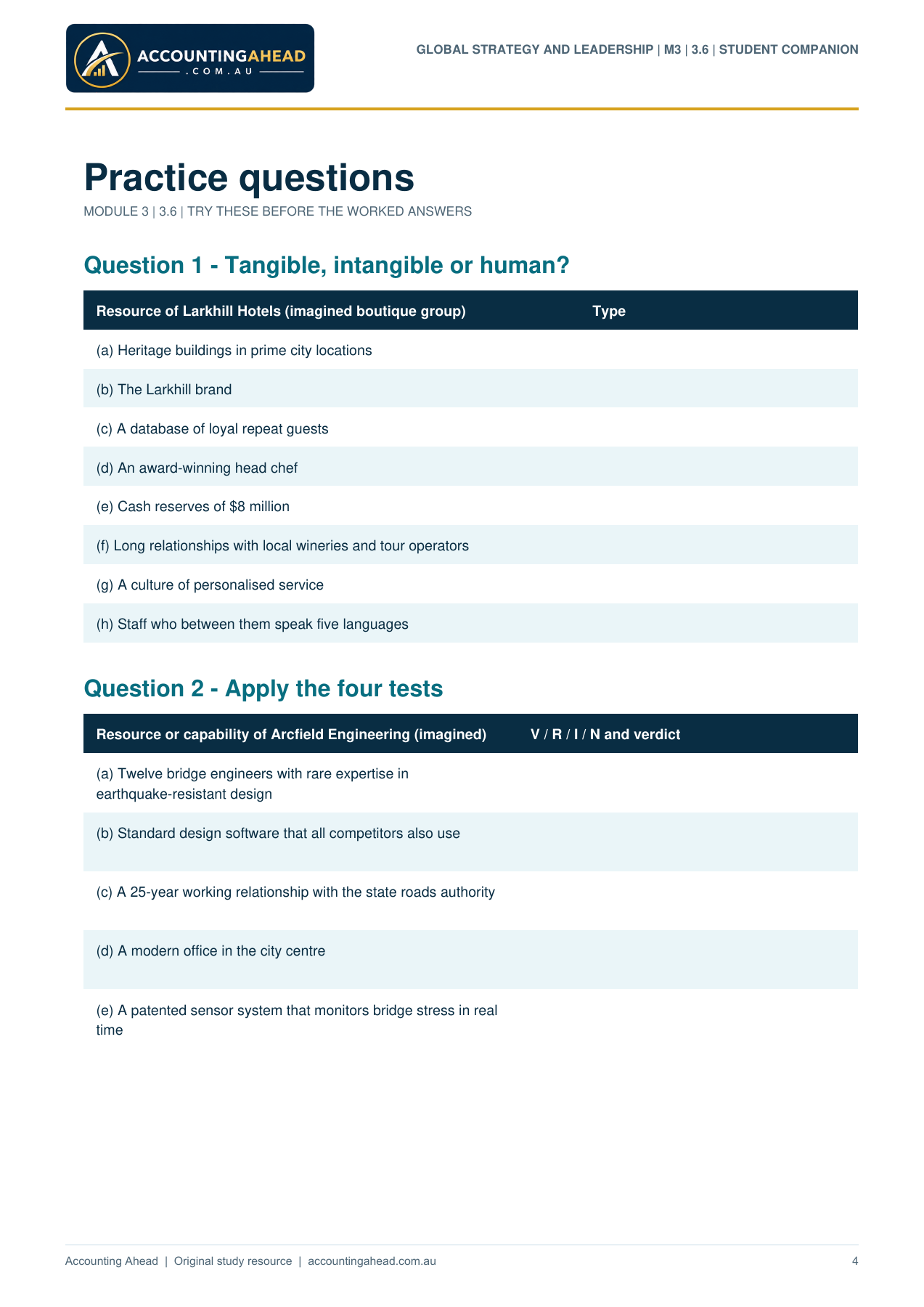
Practice questions
MODULE 3 | 3.6 | TRY THESE BEFORE THE WORKED ANSWERS
Question 1 - Tangible, intangible or human?
Resource of Larkhill Hotels (imagined boutique group) Type
(a) Heritage buildings in prime city locations
(b) The Larkhill brand
(c) A database of loyal repeat guests
(d) An award-winning head chef
(e) Cash reserves of $8 million
(f) Long relationships with local wineries and tour operators
(g) A culture of personalised service
(h) Staff who between them speak five languages
Question 2 - Apply the four tests
Resource or capability of Arcfield Engineering (imagined) V / R / I / N and verdict
(a) Twelve bridge engineers with rare expertise in
earthquake-resistant design
(b) Standard design software that all competitors also use
(c) A 25-year working relationship with the state roads authority
(d) A modern office in the city centre
(e) A patented sensor system that monitors bridge stress in real
time
GLOBAL STRATEGY AND LEADERSHIP | M3 | 3.6 | STUDENT COMPANION
4
Accounting Ahead | Original study resource | accountingahead.com.au
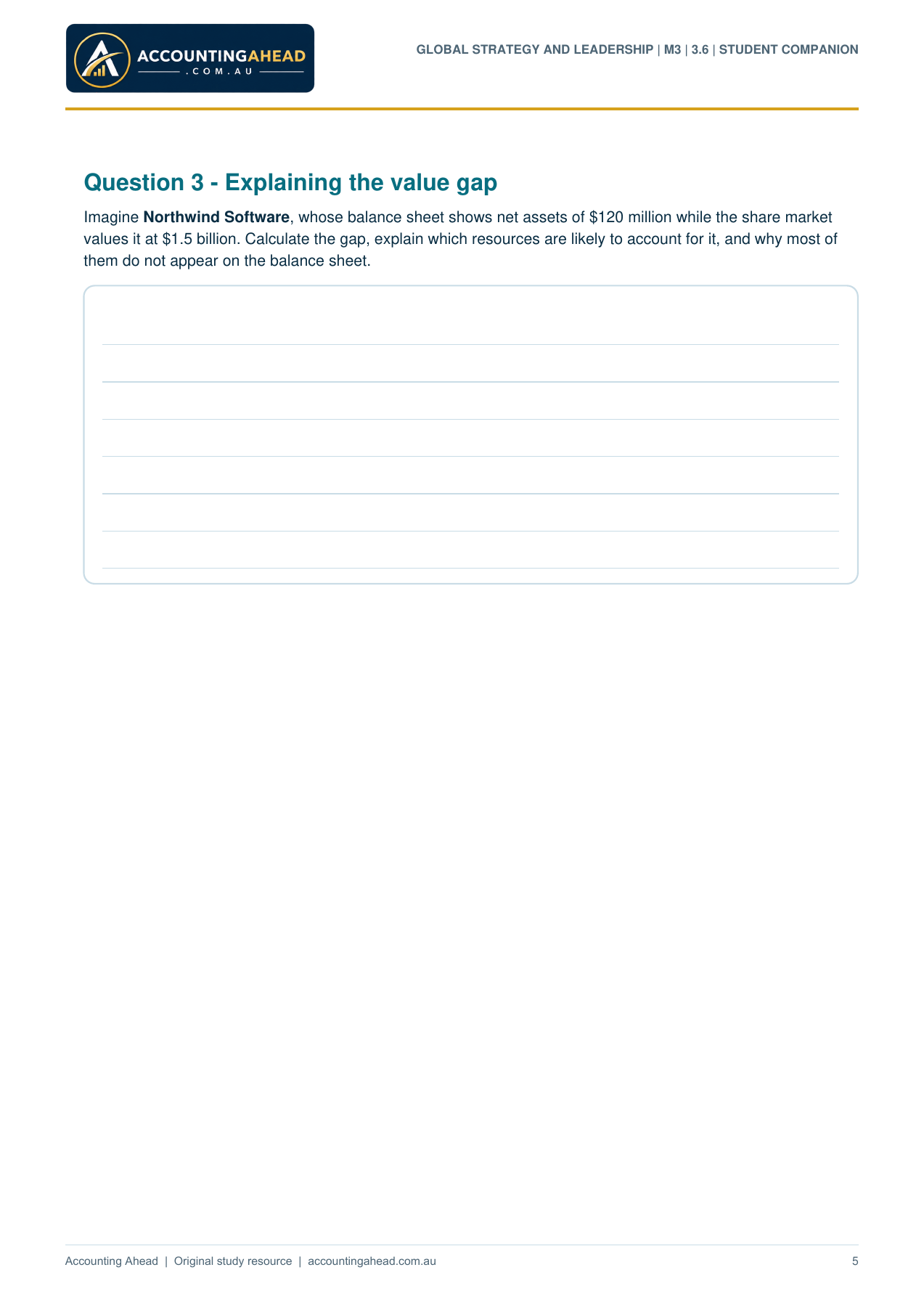
Question 3 - Explaining the value gap
Imagine Northwind Software, whose balance sheet shows net assets of $120 million while the share market
values it at $1.5 billion. Calculate the gap, explain which resources are likely to account for it, and why most of
them do not appear on the balance sheet.
GLOBAL STRATEGY AND LEADERSHIP | M3 | 3.6 | STUDENT COMPANION
5
Accounting Ahead | Original study resource | accountingahead.com.au
Worked answers
MODULE 3 | 3.6 | WORKED ANSWERS - ATTEMPT THE QUESTIONS FIRST
Question 1 - Larkhill Hotels
Resource Type
(a) Heritage buildings Tangible
(b) Brand Intangible
(c) Loyal guest database Intangible (customer relationships and data)
(d) Head chef Human
(e) Cash reserves Tangible (financial)
(f) Winery and tour relationships Intangible (network resources)
(g) Service culture Intangible (culture)
(h) Language skills Human
Question 2 - Arcfield Engineering
Item Assessment
(a) Seismic bridge engineers V yes; R yes; I hard (years to build such a team); N likely: strategic, while
they stay (protect through retention and knowledge capture)
(b) Standard software V yes; R no: not strategic (a necessity, not an advantage)
(c) Roads authority relationship V yes; R yes; I hard (decades of trust); N largely: strategic
(d) City office V limited; R no: not strategic
(e) Patented sensor system V yes; R yes; I protected by patent; N partly (other monitoring methods
exist): a strong advantage while the patent and performance lead last
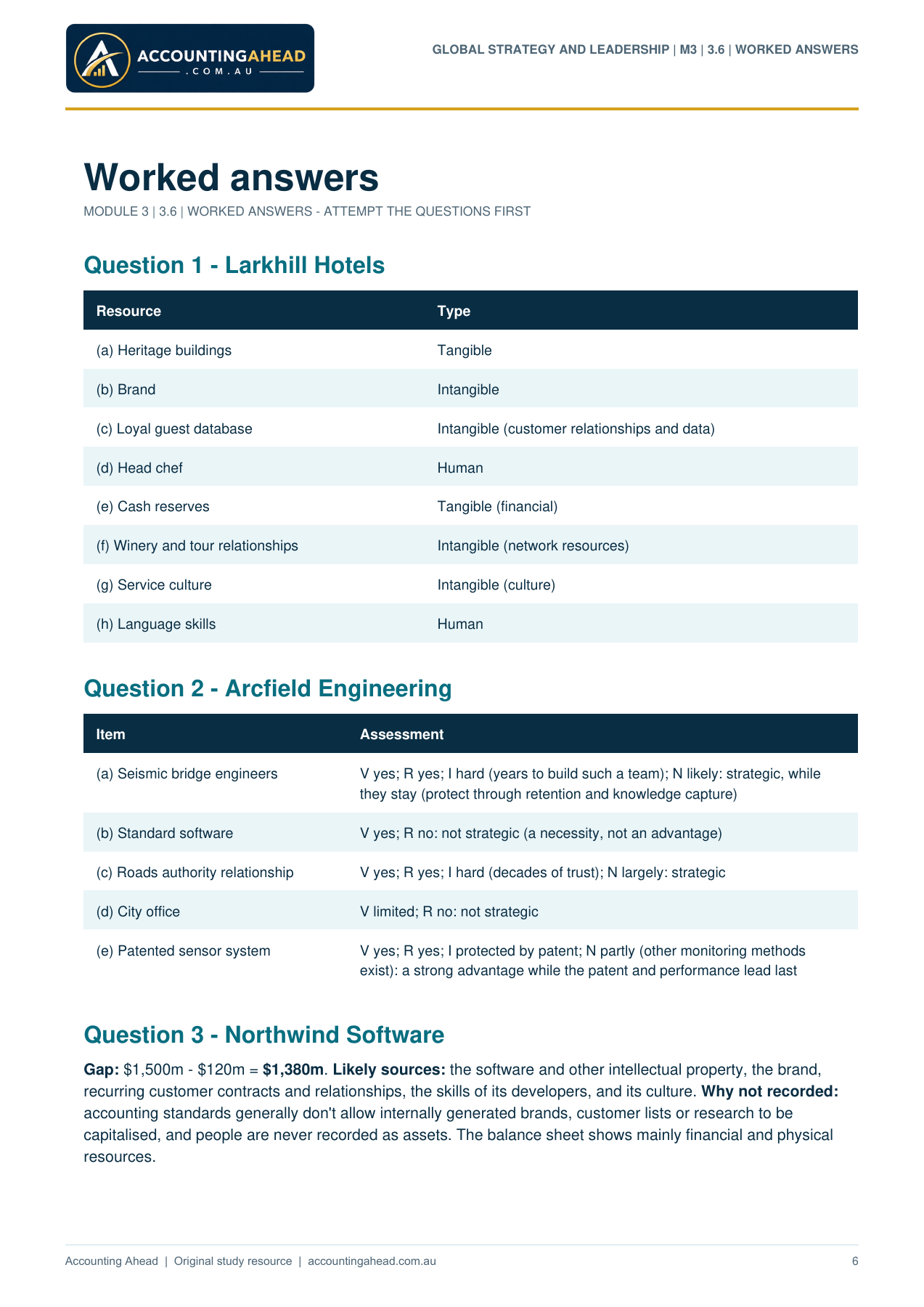
Question 3 - Northwind Software
Gap: $1,500m - $120m = $1,380m. Likely sources: the software and other intellectual property, the brand,
recurring customer contracts and relationships, the skills of its developers, and its culture. Why not recorded:
accounting standards generally don't allow internally generated brands, customer lists or research to be
capitalised, and people are never recorded as assets. The balance sheet shows mainly financial and physical
resources.
GLOBAL STRATEGY AND LEADERSHIP | M3 | 3.6 | WORKED ANSWERS
6