
Design thinking and Blue Ocean Strategy
Printable study notes to use alongside Part 4.5.1.
Read the handout text
Accounting Ahead | Original study resource | accountingahead.com.au
Design thinking and Blue Ocean Strategy
MODULE 4 | 4.5.1 | STUDENT COMPANION
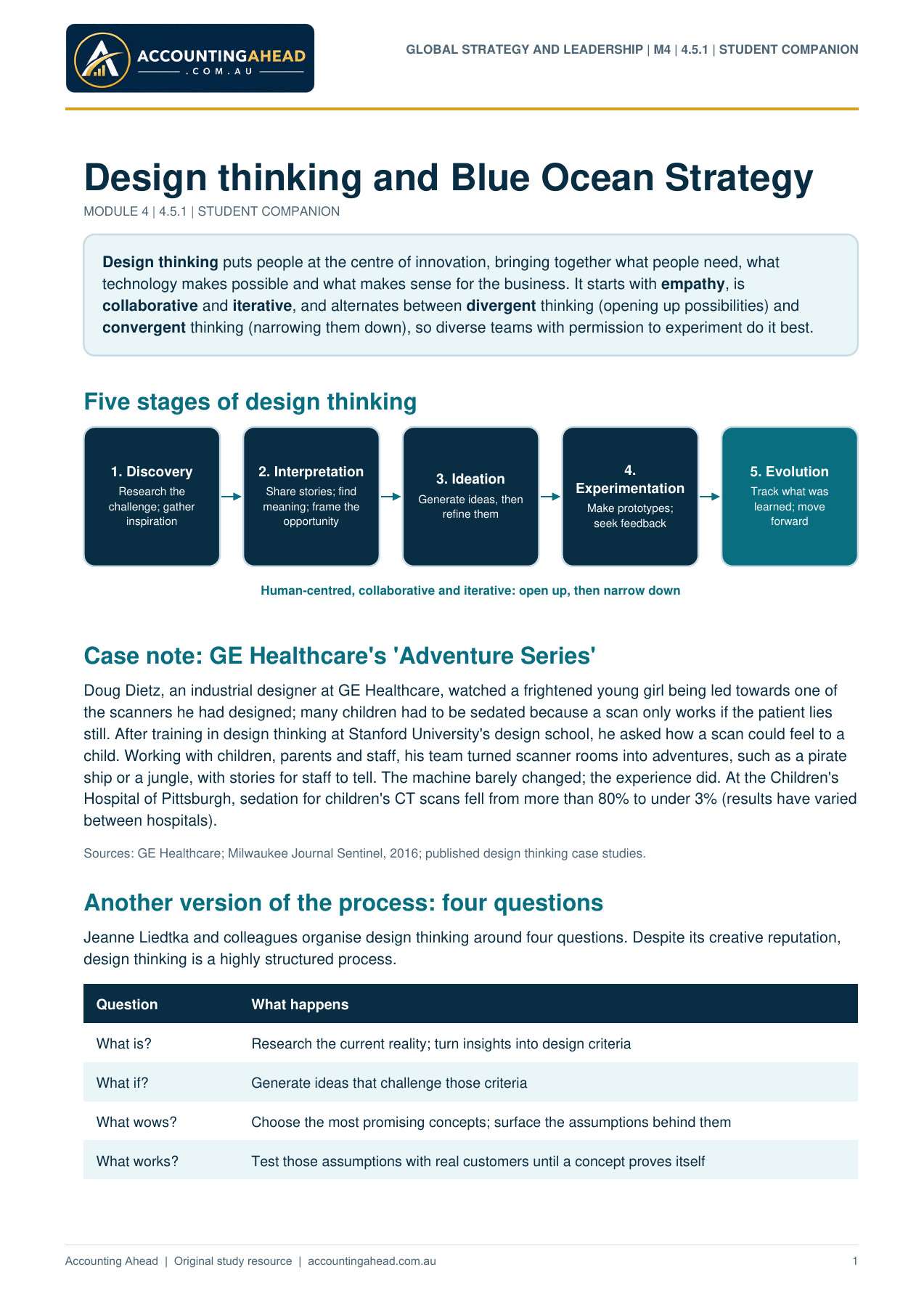
Design thinking puts people at the centre of innovation, bringing together what people need, what
technology makes possible and what makes sense for the business. It starts with empathy, is
collaborative and iterative, and alternates between divergent thinking (opening up possibilities) and
convergent thinking (narrowing them down), so diverse teams with permission to experiment do it best.
Five stages of design thinking
1. Discovery
Research the
challenge; gather
inspiration
2. Interpretation
Share stories; find
meaning; frame the
opportunity
3. Ideation
Generate ideas, then
refine them
4.
Experimentation
Make prototypes;
seek feedback
5. Evolution
Track what was
learned; move
forward
Human-centred, collaborative and iterative: open up, then narrow down
Case note: GE Healthcare's 'Adventure Series'
Doug Dietz, an industrial designer at GE Healthcare, watched a frightened young girl being led towards one of
the scanners he had designed; many children had to be sedated because a scan only works if the patient lies
still. After training in design thinking at Stanford University's design school, he asked how a scan could feel to a
child. Working with children, parents and staff, his team turned scanner rooms into adventures, such as a pirate
ship or a jungle, with stories for staff to tell. The machine barely changed; the experience did. At the Children's
Hospital of Pittsburgh, sedation for children's CT scans fell from more than 80% to under 3% (results have varied
between hospitals).
Sources: GE Healthcare; Milwaukee Journal Sentinel, 2016; published design thinking case studies.
Another version of the process: four questions
Jeanne Liedtka and colleagues organise design thinking around four questions. Despite its creative reputation,
design thinking is a highly structured process.
Question What happens
What is? Research the current reality; turn insights into design criteria
What if? Generate ideas that challenge those criteria
What wows? Choose the most promising concepts; surface the assumptions behind them
What works? Test those assumptions with real customers until a concept proves itself
GLOBAL STRATEGY AND LEADERSHIP | M4 | 4.5.1 | STUDENT COMPANION
1
Accounting Ahead | Original study resource | accountingahead.com.au
Cheap prototypes, staged money: three-dimensional printing can turn a design into a physical prototype in
hours. For CPAs, design thinking means funding a series of small experiments and releasing more money as
each key assumption is confirmed, rather than approving one large budget up front.
Red oceans and blue oceans (Kim and Mauborgne)
Red ocean Blue ocean
Rivals fight for customers in a crowded, familiar market A market space nobody else serves yet
The aim is to outperform competitors The aim is to make rivals irrelevant, for a while
Firms split up the demand that already exists New customers are drawn in who weren't buying before
Choose more value at a higher cost, or less value at a
lower cost
Raise value and cut cost at the same time (value
innovation)
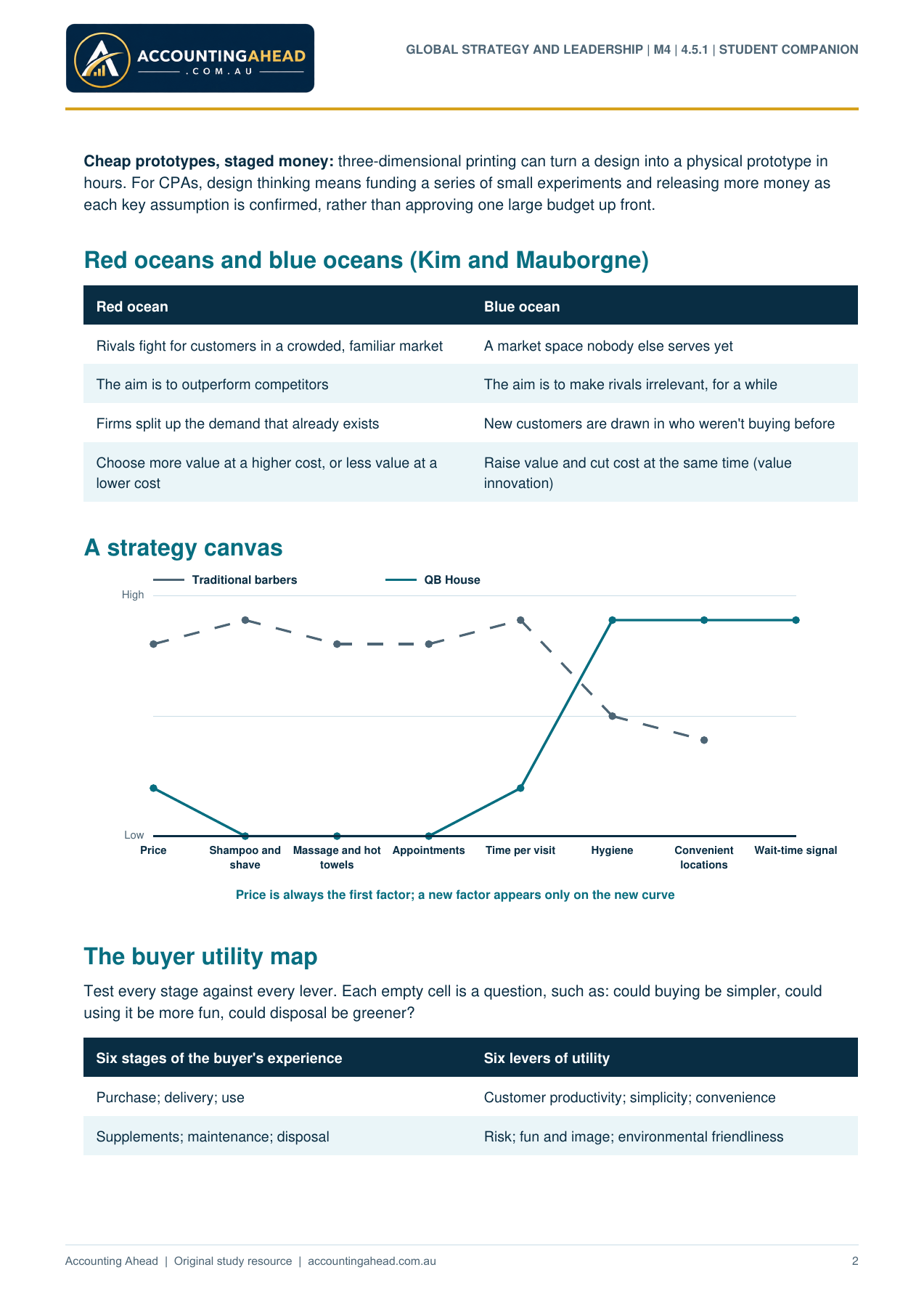
A strategy canvas
Low
High
Price Shampoo and
shave
Massage and hot
towels
Appointments Time per visit Hygiene Convenient
locations
Wait-time signal
Traditional barbers QB House
Price is always the first factor; a new factor appears only on the new curve
The buyer utility map
Test every stage against every lever. Each empty cell is a question, such as: could buying be simpler, could
using it be more fun, could disposal be greener?
Six stages of the buyer's experience Six levers of utility
Purchase; delivery; use Customer productivity; simplicity; convenience
Supplements; maintenance; disposal Risk; fun and image; environmental friendliness
GLOBAL STRATEGY AND LEADERSHIP | M4 | 4.5.1 | STUDENT COMPANION
2
Accounting Ahead | Original study resource | accountingahead.com.au
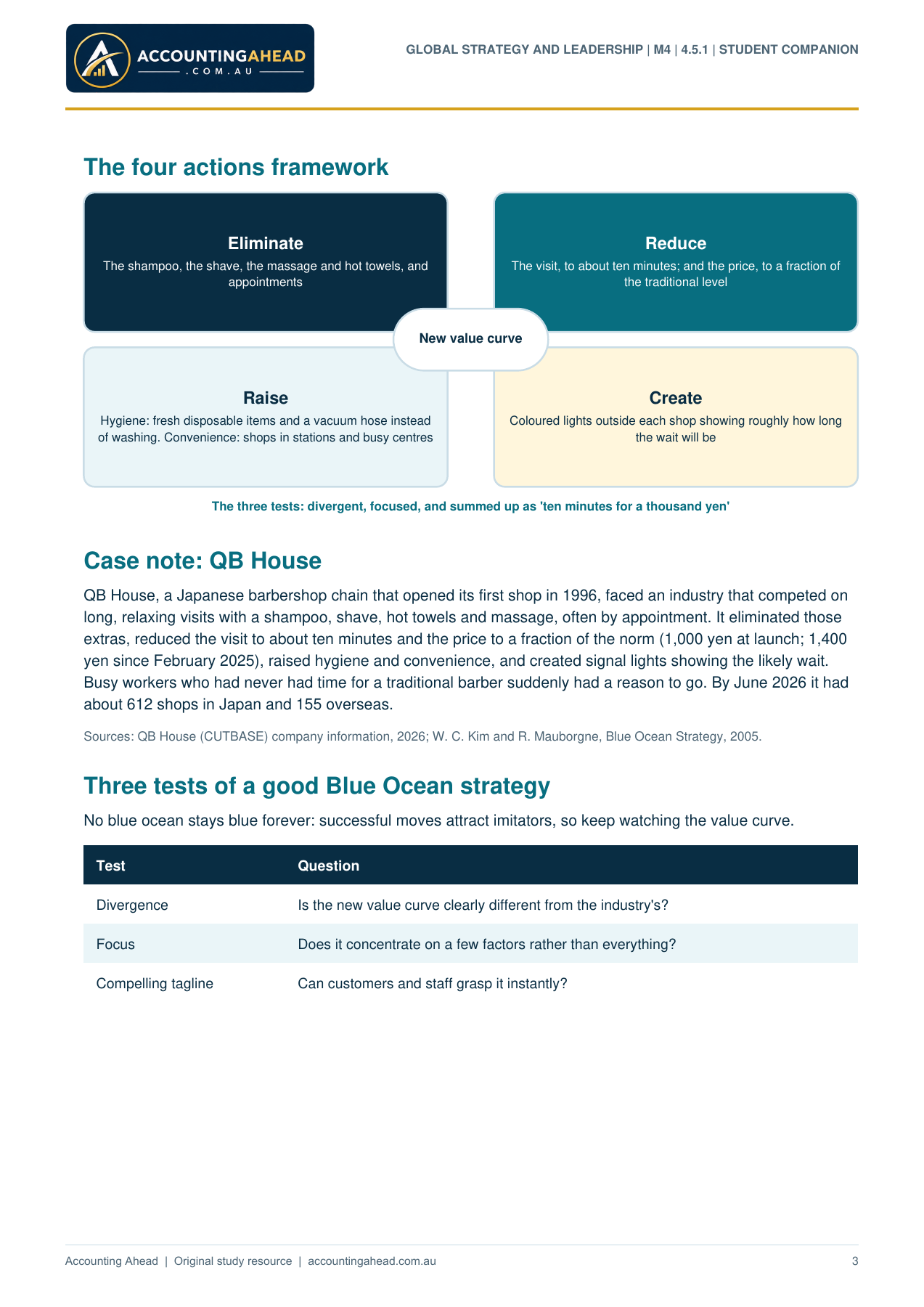
The four actions framework
Eliminate
The shampoo, the shave, the massage and hot towels, and
appointments
Reduce
The visit, to about ten minutes; and the price, to a fraction of
the traditional level
Raise
Hygiene: fresh disposable items and a vacuum hose instead
of washing. Convenience: shops in stations and busy centres
Create
Coloured lights outside each shop showing roughly how long
the wait will be
New value curve
The three tests: divergent, focused, and summed up as 'ten minutes for a thousand yen'
Case note: QB House
QB House, a Japanese barbershop chain that opened its first shop in 1996, faced an industry that competed on
long, relaxing visits with a shampoo, shave, hot towels and massage, often by appointment. It eliminated those
extras, reduced the visit to about ten minutes and the price to a fraction of the norm (1,000 yen at launch; 1,400
yen since February 2025), raised hygiene and convenience, and created signal lights showing the likely wait.
Busy workers who had never had time for a traditional barber suddenly had a reason to go. By June 2026 it had
about 612 shops in Japan and 155 overseas.
Sources: QB House (CUTBASE) company information, 2026; W. C. Kim and R. Mauborgne, Blue Ocean Strategy, 2005.
Three tests of a good Blue Ocean strategy
No blue ocean stays blue forever: successful moves attract imitators, so keep watching the value curve.
Test Question
Divergence Is the new value curve clearly different from the industry's?
Focus Does it concentrate on a few factors rather than everything?
Compelling tagline Can customers and staff grasp it instantly?
GLOBAL STRATEGY AND LEADERSHIP | M4 | 4.5.1 | STUDENT COMPANION
3
Accounting Ahead | Original study resource | accountingahead.com.au
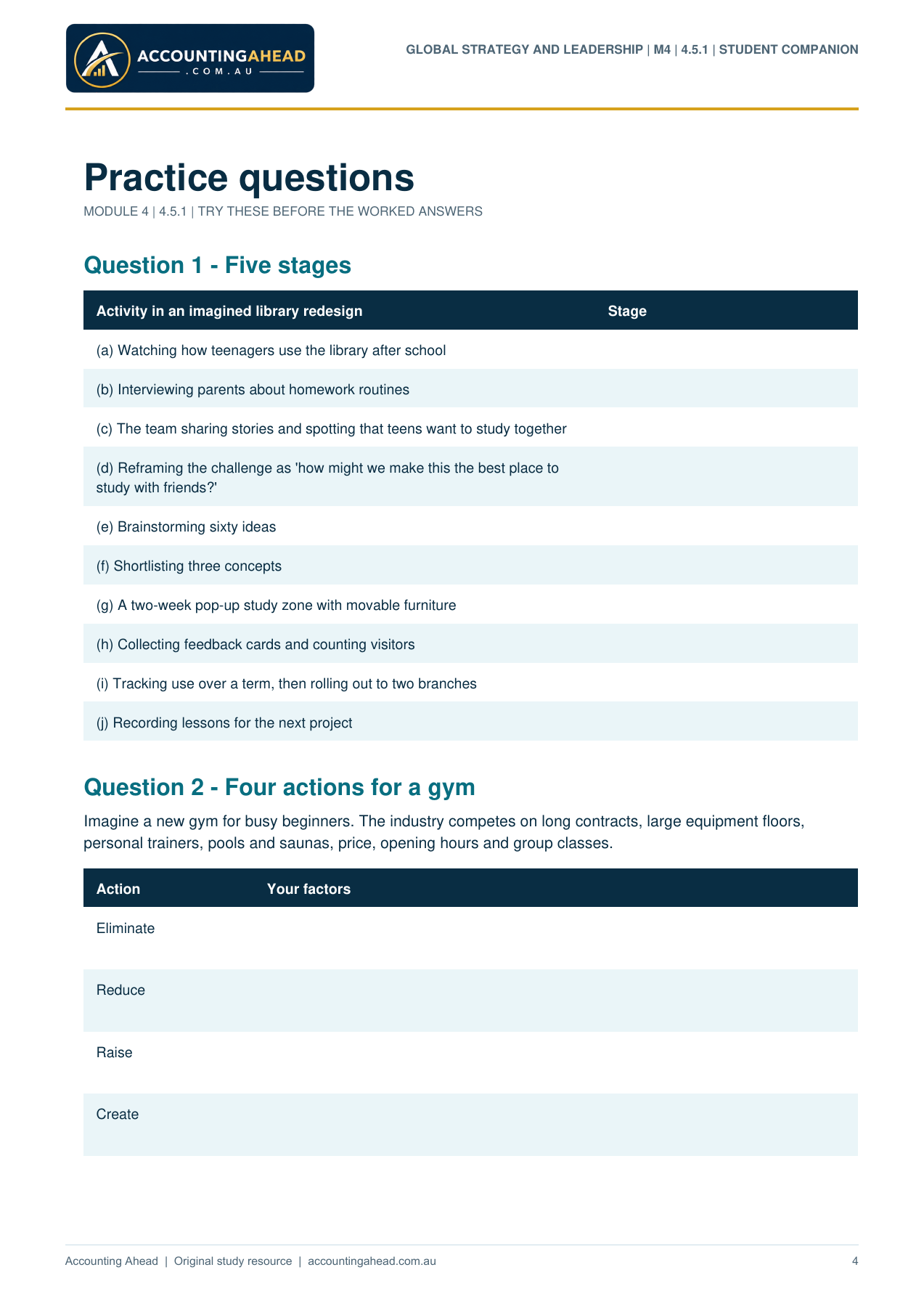
Practice questions
MODULE 4 | 4.5.1 | TRY THESE BEFORE THE WORKED ANSWERS
Question 1 - Five stages
Activity in an imagined library redesign Stage
(a) Watching how teenagers use the library after school
(b) Interviewing parents about homework routines
(c) The team sharing stories and spotting that teens want to study together
(d) Reframing the challenge as 'how might we make this the best place to
study with friends?'
(e) Brainstorming sixty ideas
(f) Shortlisting three concepts
(g) A two-week pop-up study zone with movable furniture
(h) Collecting feedback cards and counting visitors
(i) Tracking use over a term, then rolling out to two branches
(j) Recording lessons for the next project
Question 2 - Four actions for a gym
Imagine a new gym for busy beginners. The industry competes on long contracts, large equipment floors,
personal trainers, pools and saunas, price, opening hours and group classes.
Action Your factors
Eliminate
Reduce
Raise
Create
GLOBAL STRATEGY AND LEADERSHIP | M4 | 4.5.1 | STUDENT COMPANION
4
Accounting Ahead | Original study resource | accountingahead.com.au
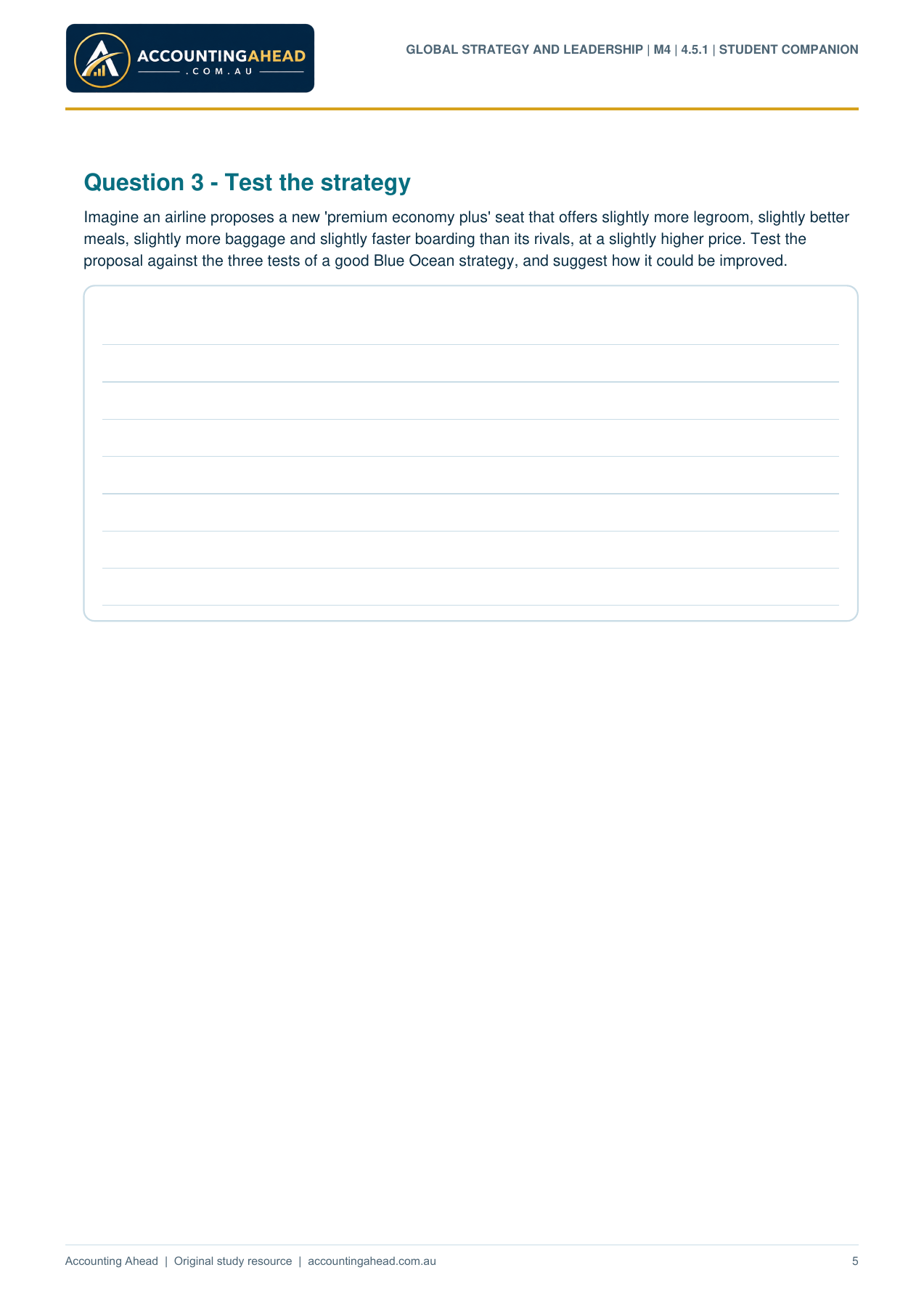
Question 3 - Test the strategy
Imagine an airline proposes a new 'premium economy plus' seat that offers slightly more legroom, slightly better
meals, slightly more baggage and slightly faster boarding than its rivals, at a slightly higher price. Test the
proposal against the three tests of a good Blue Ocean strategy, and suggest how it could be improved.
GLOBAL STRATEGY AND LEADERSHIP | M4 | 4.5.1 | STUDENT COMPANION
5
Accounting Ahead | Original study resource | accountingahead.com.au
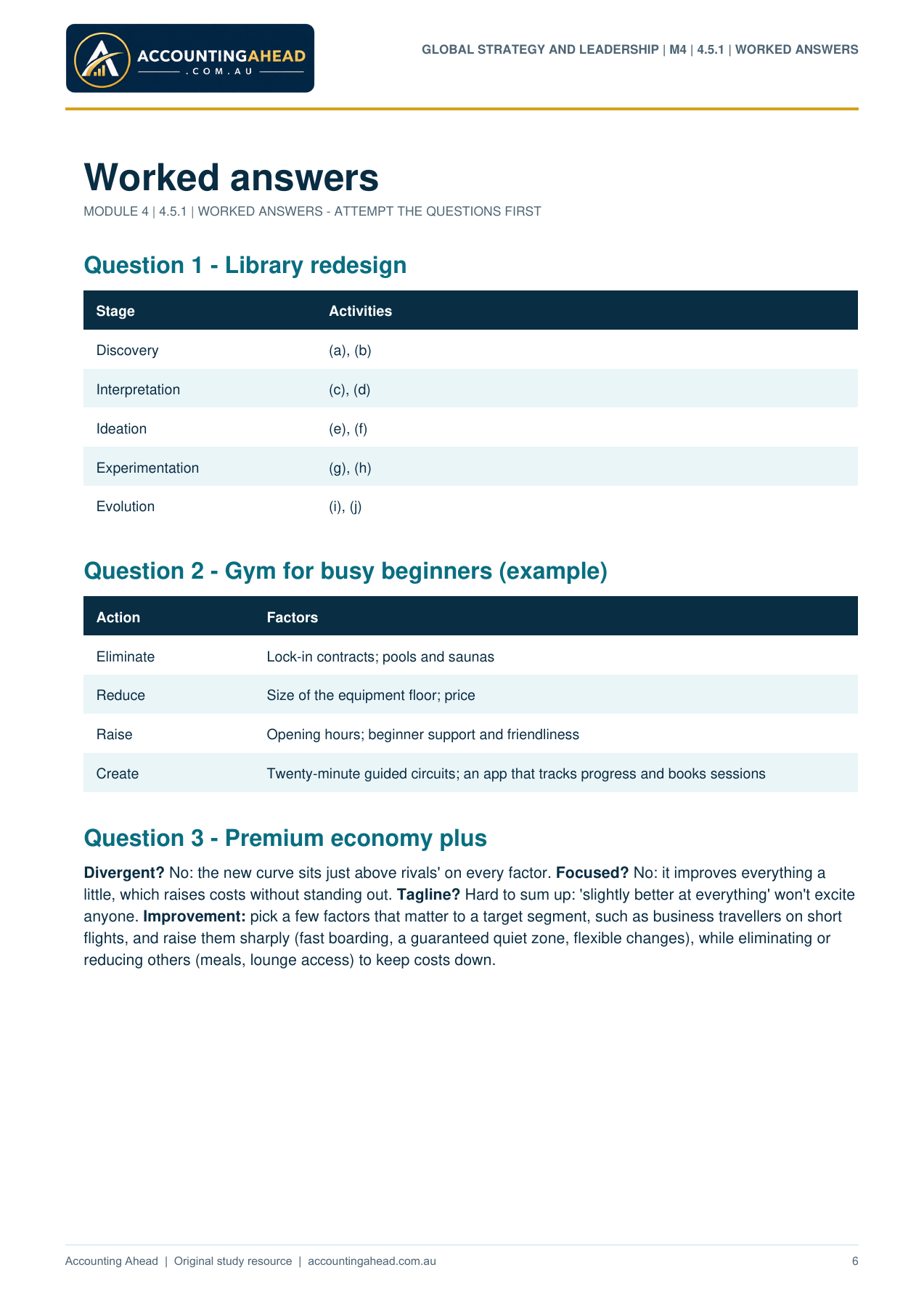
Worked answers
MODULE 4 | 4.5.1 | WORKED ANSWERS - ATTEMPT THE QUESTIONS FIRST
Question 1 - Library redesign
Stage Activities
Discovery (a), (b)
Interpretation (c), (d)
Ideation (e), (f)
Experimentation (g), (h)
Evolution (i), (j)
Question 2 - Gym for busy beginners (example)
Action Factors
Eliminate Lock-in contracts; pools and saunas
Reduce Size of the equipment floor; price
Raise Opening hours; beginner support and friendliness
Create Twenty-minute guided circuits; an app that tracks progress and books sessions
Question 3 - Premium economy plus
Divergent? No: the new curve sits just above rivals' on every factor. Focused? No: it improves everything a
little, which raises costs without standing out. Tagline? Hard to sum up: 'slightly better at everything' won't excite
anyone. Improvement: pick a few factors that matter to a target segment, such as business travellers on short
flights, and raise them sharply (fast boarding, a guaranteed quiet zone, flexible changes), while eliminating or
reducing others (meals, lounge access) to keep costs down.
GLOBAL STRATEGY AND LEADERSHIP | M4 | 4.5.1 | WORKED ANSWERS
6