
Technology, standards and embedded products
Printable study notes to use alongside Part 4.5.2.
Read the handout text
Accounting Ahead | Original study resource | accountingahead.com.au
Technology, standards and embedded
products
MODULE 4 | 4.5.2 | STUDENT COMPANION
Data helps organisations start from customers' pain points rather than from what they can make. Machine
learning finds patterns and segments nobody thought to test, and combining demographic and geographic
data reveals unserved niches. Failure, warranty and service records show where products disappoint;
clicks, searches and social media reveal interest. Data must be collected and used lawfully, ethically and
securely.
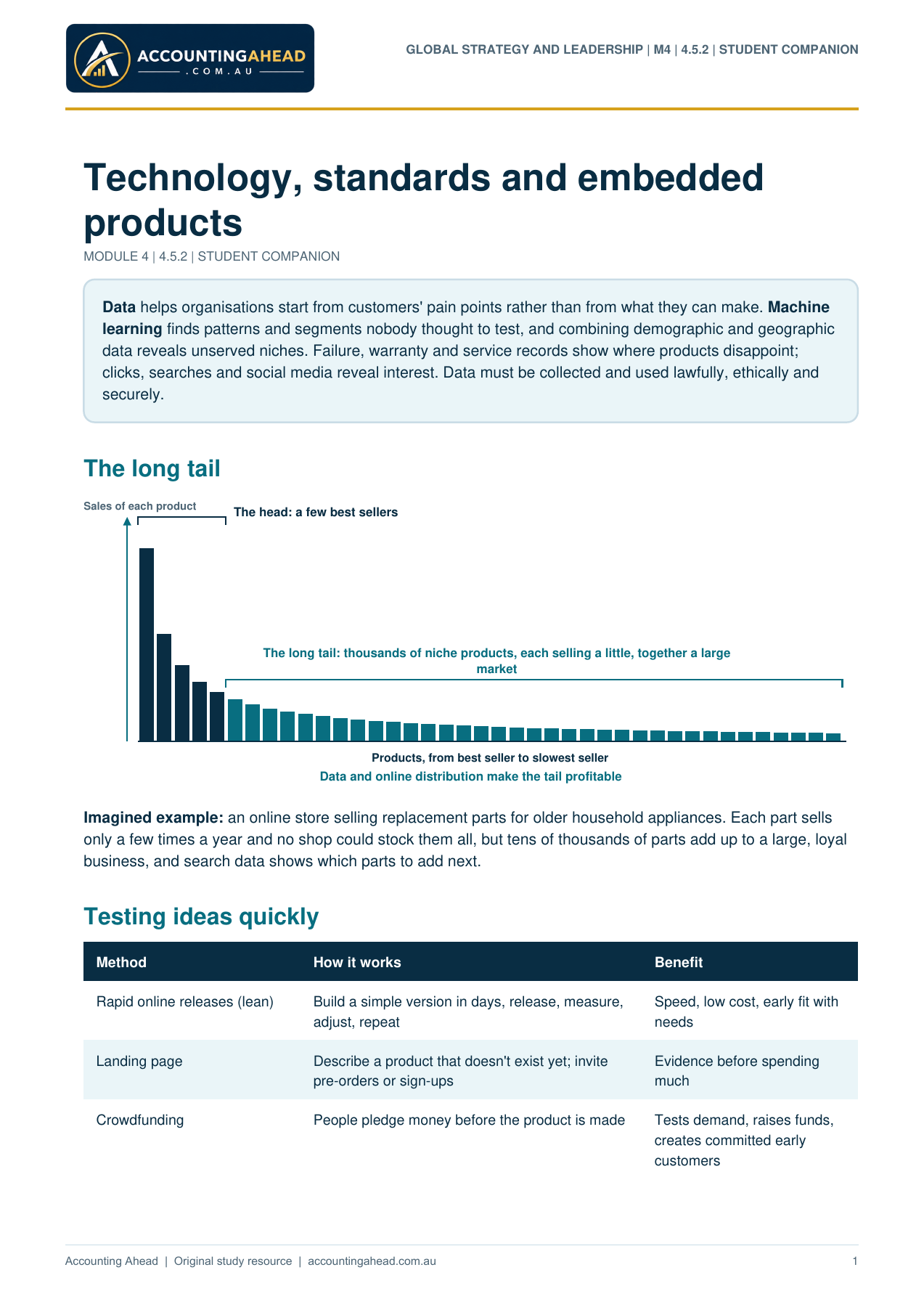
The long tail
Sales of each product
Products, from best seller to slowest seller
The head: a few best sellers
The long tail: thousands of niche products, each selling a little, together a large
market
Data and online distribution make the tail profitable
Imagined example: an online store selling replacement parts for older household appliances. Each part sells
only a few times a year and no shop could stock them all, but tens of thousands of parts add up to a large, loyal
business, and search data shows which parts to add next.
Testing ideas quickly
Method How it works Benefit
Rapid online releases (lean) Build a simple version in days, release, measure,
adjust, repeat
Speed, low cost, early fit with
needs
Landing page Describe a product that doesn't exist yet; invite
pre-orders or sign-ups
Evidence before spending
much
Crowdfunding People pledge money before the product is made Tests demand, raises funds,
creates committed early
customers
GLOBAL STRATEGY AND LEADERSHIP | M4 | 4.5.2 | STUDENT COMPANION
1
Accounting Ahead | Original study resource | accountingahead.com.au
Worked example: a landing-page test (imagined)
A start-up tests an app for booking school-holiday activities before building it.
Item Working Result
Visitors to the page Given 2,000
Sign-ups at $9 a month Given 140
Conversion rate 140 / 2,000 7%
Monthly revenue if all sign-ups subscribe 140 x $9 $1,260
Two kinds of standard
A standard is a format, interface or system that lets products work together, such as chargers, payment cards or
web pages.
De facto standard Public standard
Emerges from competition in the market Agreed by an industry body or required by law
Owner can earn large, lasting returns Open to all, so no single organisation gains an
advantage
Can take years to emerge; investment duplicated;
customers hold back
Avoids uncertainty and speeds up the market
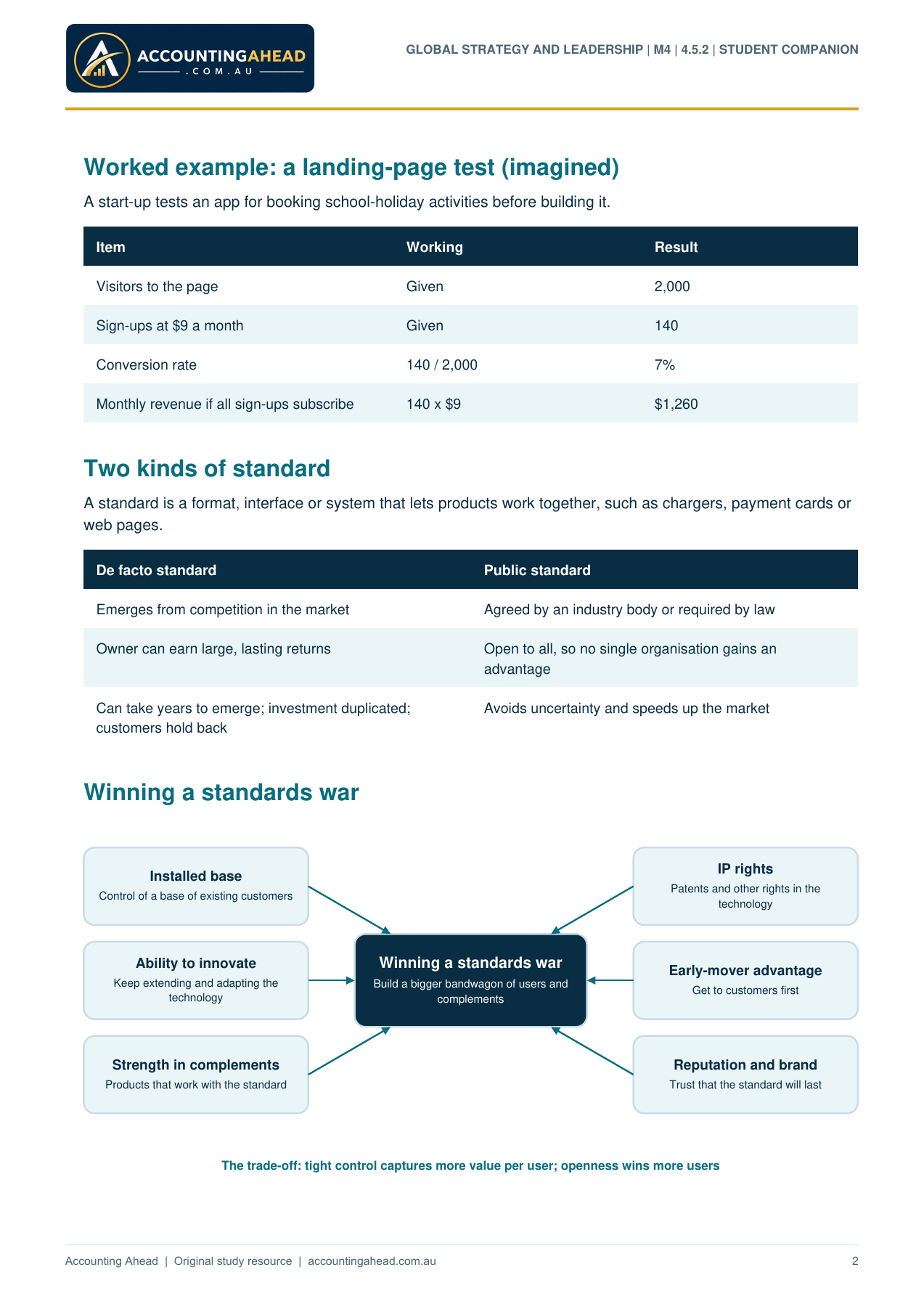
Winning a standards war
Winning a standards war
Build a bigger bandwagon of users and
complements
Installed base
Control of a base of existing customers
IP rights
Patents and other rights in the
technology
Ability to innovate
Keep extending and adapting the
technology
Early-mover advantage
Get to customers first
Strength in complements
Products that work with the standard
Reputation and brand
Trust that the standard will last
The trade-off: tight control captures more value per user; openness wins more users
GLOBAL STRATEGY AND LEADERSHIP | M4 | 4.5.2 | STUDENT COMPANION
2
Accounting Ahead | Original study resource | accountingahead.com.au
The trade-off: imagine a company that has designed a charging connector for electric scooters. Keeping it
closed collects every royalty, but rivals may rally around an alternative; licensing it cheaply may win the market
but earn less per scooter. Customers also buy a whole system, so overall quality matters, and approaches that
still work with what customers already own usually beat ones that make them start again.
Case note: the Qi wireless charging standard
In the early 2010s, rival groups promoted competing ways to charge phones without cables. The Wireless Power
Consortium backed a standard called Qi, while rival groups backed other approaches, two of which later merged.
The Qi group built a large membership and licensed its standard widely, and when Apple adopted Qi for its
iPhones in 2017, the contest was effectively settled. Apple later contributed its magnetic design to the next
version of the standard.
Sources: Wireless Power Consortium announcements; Apple product releases, 2017; technology press coverage.
Case note: Michelin's tyres as a service
Michelin offers truck fleets the use of tyres as a service: the fleet pays according to the distance its trucks travel,
and Michelin manages fitting, checks, maintenance and replacement. Customers get predictable costs and fewer
breakdowns; Michelin gets long-term relationships, steady revenue and a reason to make tyres that last.
Launched around 2000, the service at first grew far more slowly than planned and struggled to make a profit:
pricing and running a service proved much harder than selling tyres.
Sources: Michelin company publications; IMD case study on Michelin Fleet Solutions.
For the CPA: revenue arrives monthly over the contract instead of at the point of sale.
The tyres remain Michelin's assets, on its own books.
Pricing per kilometre needs reliable data on wear, maintenance and repair costs; underpricing locks in losses.
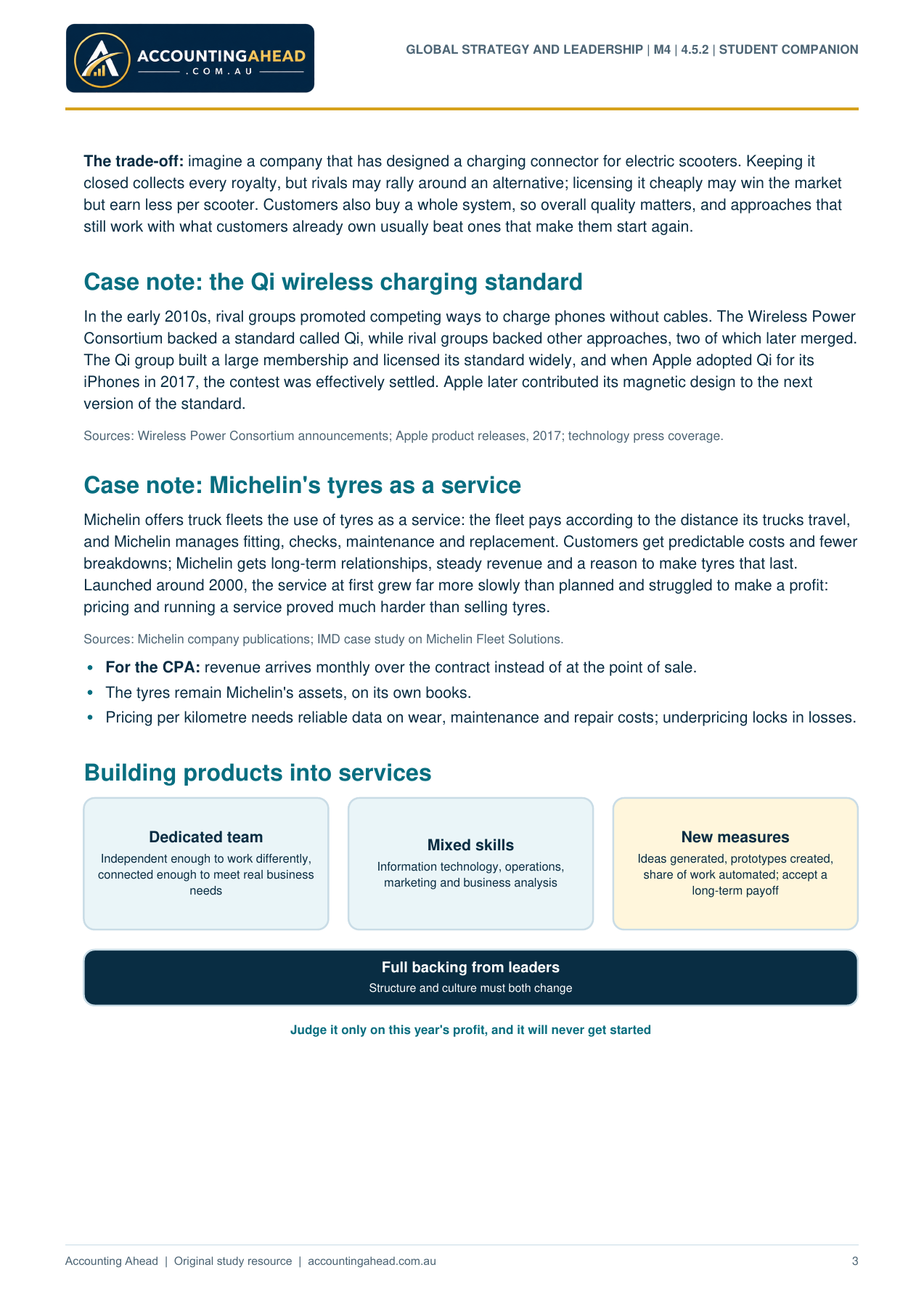
Building products into services
Dedicated team
Independent enough to work differently,
connected enough to meet real business
needs
Mixed skills
Information technology, operations,
marketing and business analysis
New measures
Ideas generated, prototypes created,
share of work automated; accept a
long-term payoff
Full backing from leaders
Structure and culture must both change
Judge it only on this year's profit, and it will never get started
GLOBAL STRATEGY AND LEADERSHIP | M4 | 4.5.2 | STUDENT COMPANION
3
Accounting Ahead | Original study resource | accountingahead.com.au
Practice questions
MODULE 4 | 4.5.2 | TRY THESE BEFORE THE WORKED ANSWERS
Question 1 - Three landing-page tests
The founders will build an idea only if conversion is at least 8% or monthly revenue from the sign-ups is at least
$5,000. Calculate both measures, then decide what to do with each idea.
Idea (imagined) Visitors Sign-ups Monthly price Conversion and monthly
revenue
A. Meal kits for shift workers 3,000 90 $60
B. Dog-walking subscription 1,200 132 $40
C. Language tutoring app 5,000 150 $12
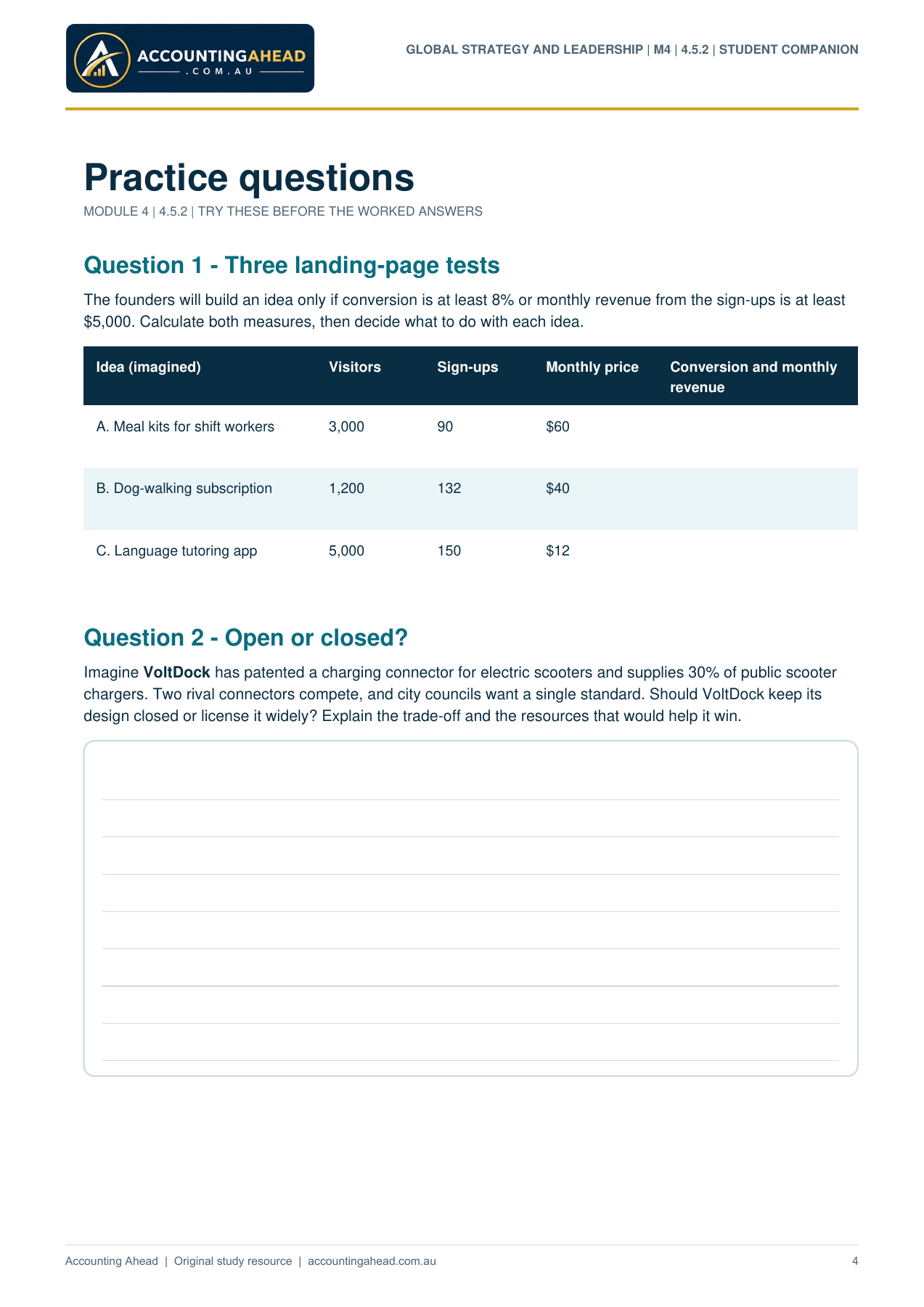
Question 2 - Open or closed?
Imagine VoltDock has patented a charging connector for electric scooters and supplies 30% of public scooter
chargers. Two rival connectors compete, and city councils want a single standard. Should VoltDock keep its
design closed or license it widely? Explain the trade-off and the resources that would help it win.
GLOBAL STRATEGY AND LEADERSHIP | M4 | 4.5.2 | STUDENT COMPANION
4
Accounting Ahead | Original study resource | accountingahead.com.au
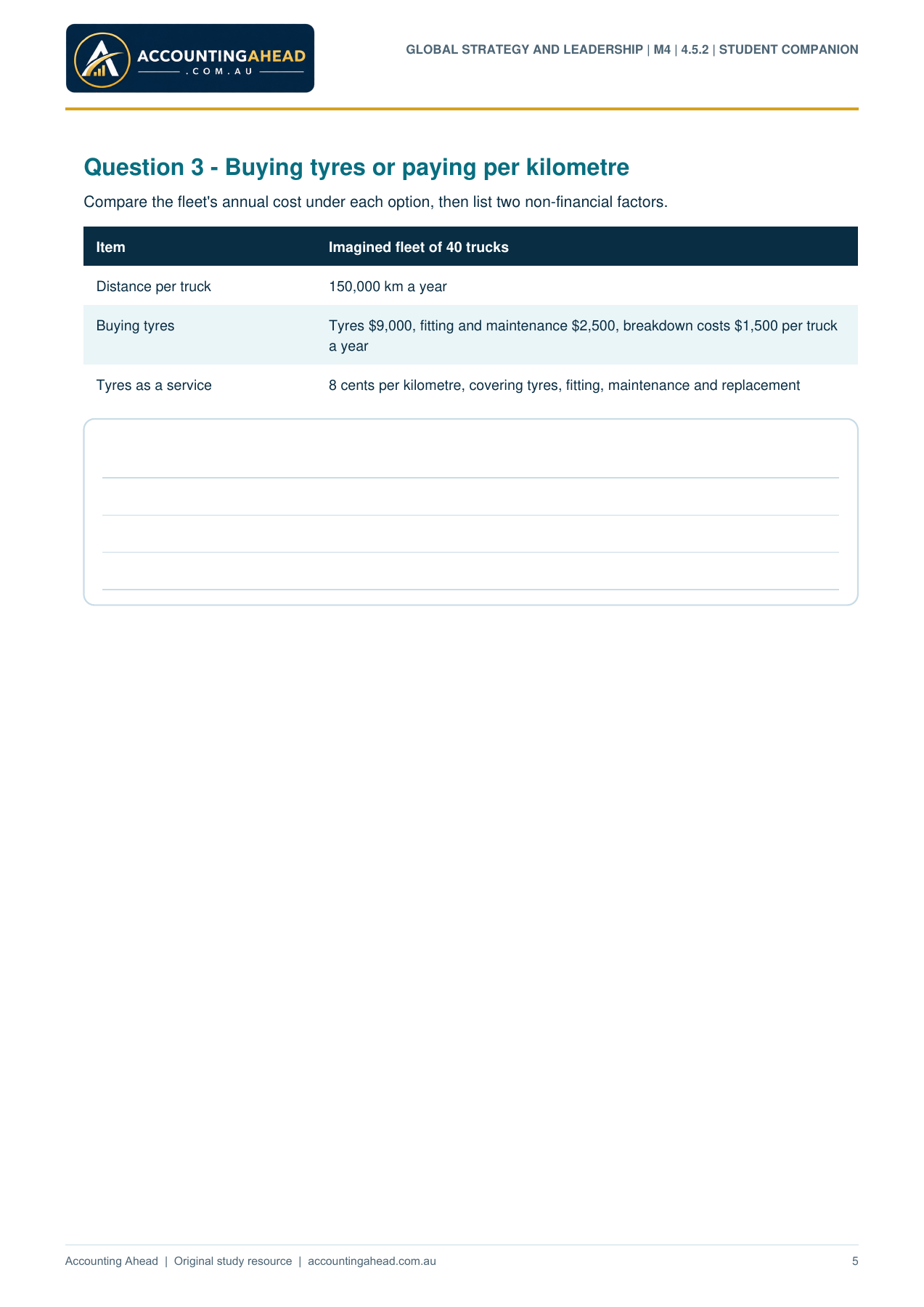
Question 3 - Buying tyres or paying per kilometre
Compare the fleet's annual cost under each option, then list two non-financial factors.
Item Imagined fleet of 40 trucks
Distance per truck 150,000 km a year
Buying tyres Tyres $9,000, fitting and maintenance $2,500, breakdown costs $1,500 per truck
a year
Tyres as a service 8 cents per kilometre, covering tyres, fitting, maintenance and replacement
GLOBAL STRATEGY AND LEADERSHIP | M4 | 4.5.2 | STUDENT COMPANION
5
Accounting Ahead | Original study resource | accountingahead.com.au
Worked answers
MODULE 4 | 4.5.2 | WORKED ANSWERS - ATTEMPT THE QUESTIONS FIRST
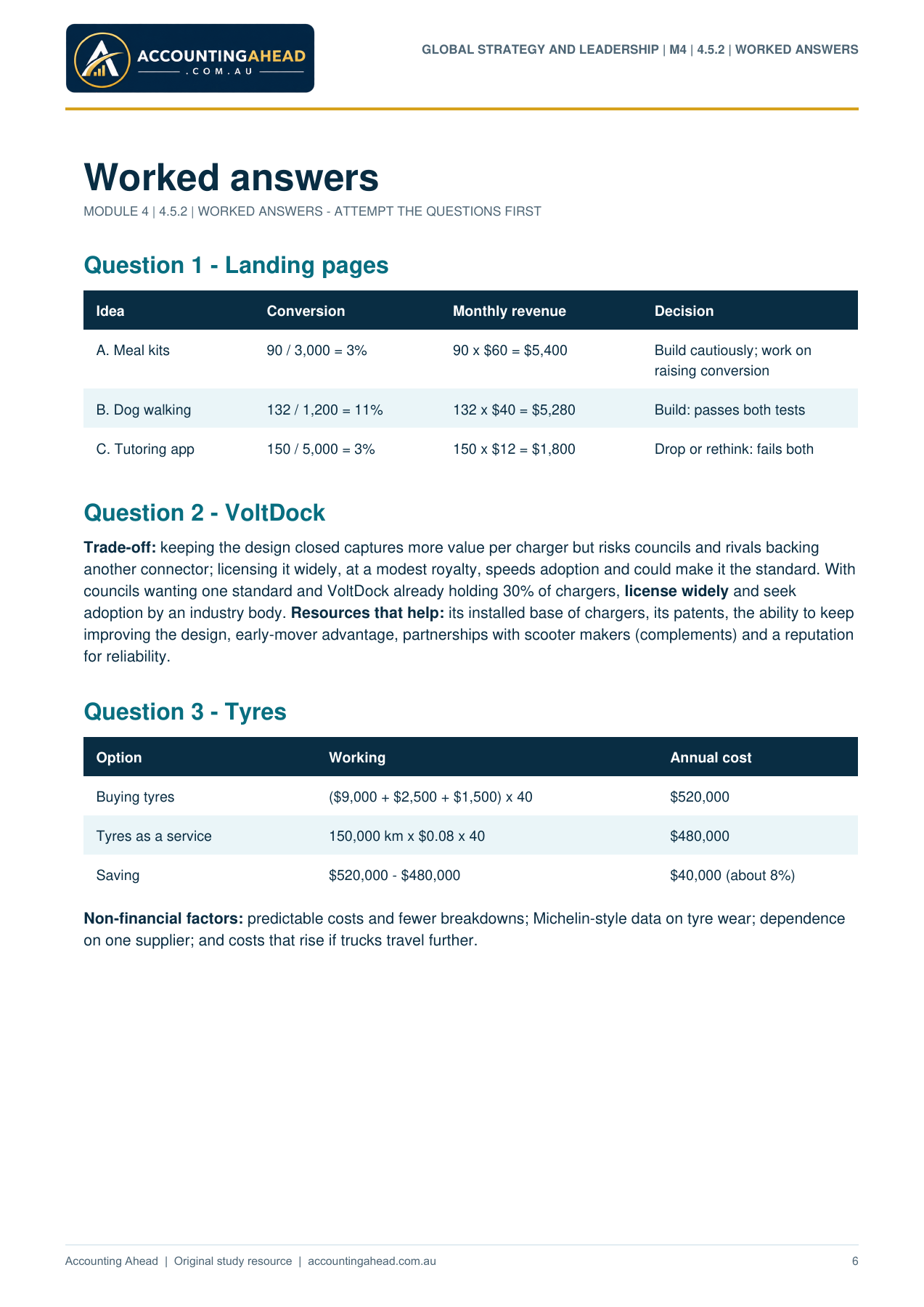
Question 1 - Landing pages
Idea Conversion Monthly revenue Decision
A. Meal kits 90 / 3,000 = 3% 90 x $60 = $5,400 Build cautiously; work on
raising conversion
B. Dog walking 132 / 1,200 = 11% 132 x $40 = $5,280 Build: passes both tests
C. Tutoring app 150 / 5,000 = 3% 150 x $12 = $1,800 Drop or rethink: fails both
Question 2 - VoltDock
Trade-off: keeping the design closed captures more value per charger but risks councils and rivals backing
another connector; licensing it widely, at a modest royalty, speeds adoption and could make it the standard. With
councils wanting one standard and VoltDock already holding 30% of chargers, license widely and seek
adoption by an industry body. Resources that help: its installed base of chargers, its patents, the ability to keep
improving the design, early-mover advantage, partnerships with scooter makers (complements) and a reputation
for reliability.
Question 3 - Tyres
Option Working Annual cost
Buying tyres ($9,000 + $2,500 + $1,500) x 40 $520,000
Tyres as a service 150,000 km x $0.08 x 40 $480,000
Saving $520,000 - $480,000 $40,000 (about 8%)
Non-financial factors: predictable costs and fewer breakdowns; Michelin-style data on tyre wear; dependence
on one supplier; and costs that rise if trucks travel further.
GLOBAL STRATEGY AND LEADERSHIP | M4 | 4.5.2 | WORKED ANSWERS
6