
Modes of entry and acquisitions
Printable study notes to use alongside Part 4.6.2.
Read the handout text
Accounting Ahead | Original study resource | accountingahead.com.au
Modes of entry and acquisitions
MODULE 4 | 4.6.2 | STUDENT COMPANION
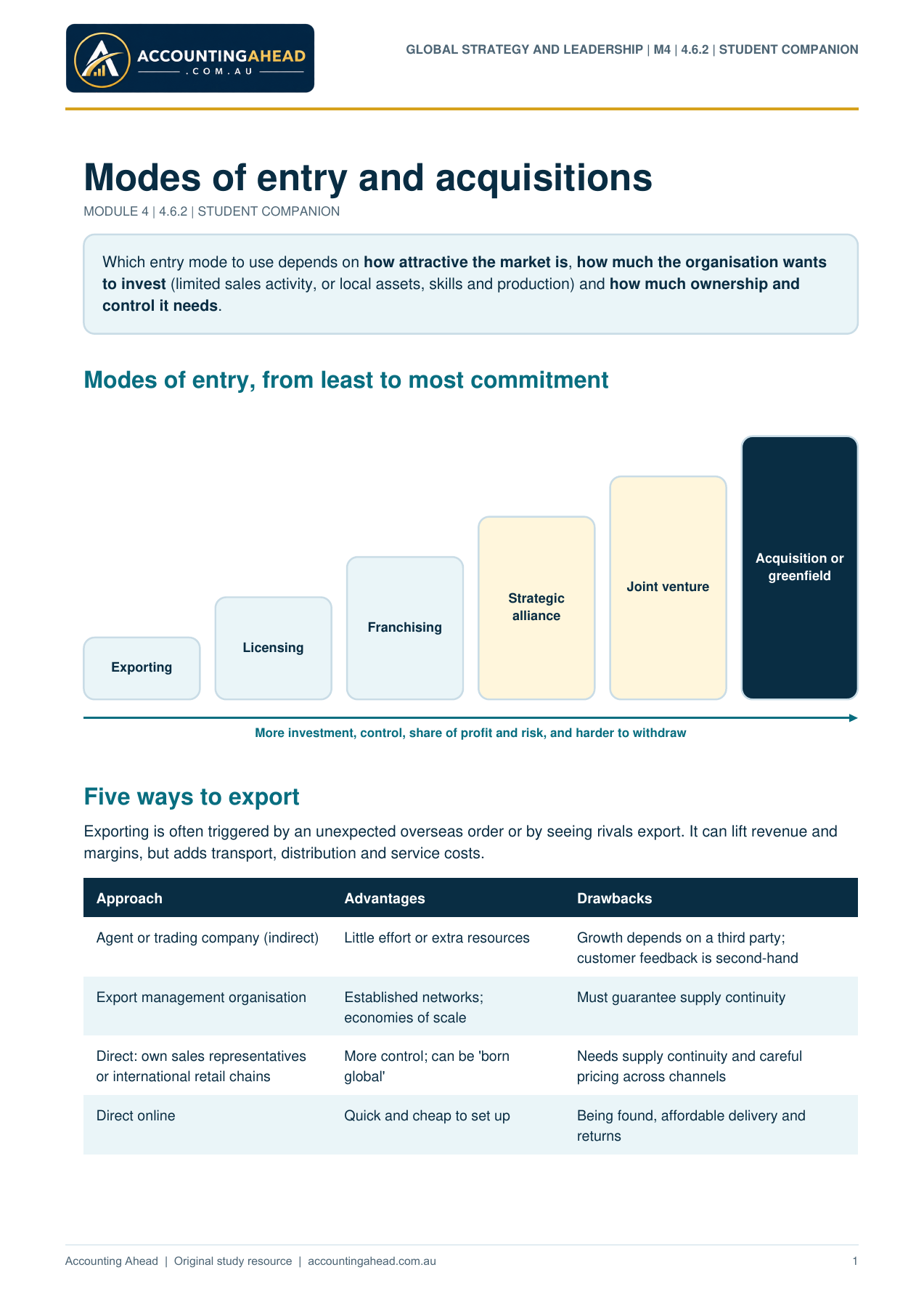
Which entry mode to use depends on how attractive the market is, how much the organisation wants
to invest (limited sales activity, or local assets, skills and production) and how much ownership and
control it needs.
Modes of entry, from least to most commitment
Exporting
Licensing
Franchising
Strategic
alliance
Joint venture
Acquisition or
greenfield
More investment, control, share of profit and risk, and harder to withdraw
Five ways to export
Exporting is often triggered by an unexpected overseas order or by seeing rivals export. It can lift revenue and
margins, but adds transport, distribution and service costs.
Approach Advantages Drawbacks
Agent or trading company (indirect) Little effort or extra resources Growth depends on a third party;
customer feedback is second-hand
Export management organisation Established networks;
economies of scale
Must guarantee supply continuity
Direct: own sales representatives
or international retail chains
More control; can be 'born
global'
Needs supply continuity and careful
pricing across channels
Direct online Quick and cheap to set up Being found, affordable delivery and
returns
GLOBAL STRATEGY AND LEADERSHIP | M4 | 4.6.2 | STUDENT COMPANION
1
Accounting Ahead | Original study resource | accountingahead.com.au
Approach Advantages Drawbacks
Online marketplaces Easy; the operator brings scale
and search
Competing with sellers worldwide; returns
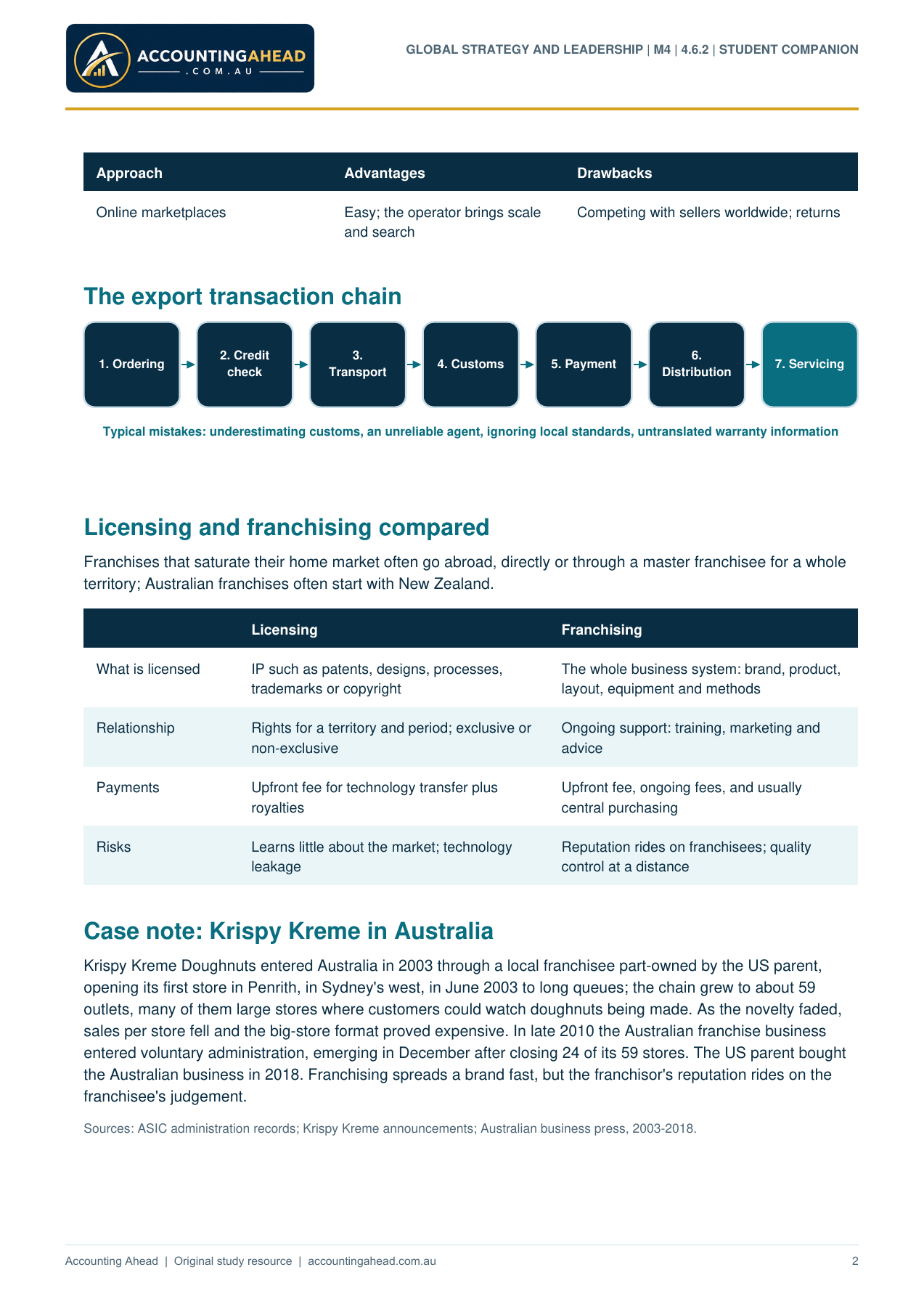
The export transaction chain
1. Ordering 2. Credit
check
3.
Transport 4. Customs 5. Payment 6.
Distribution 7. Servicing
Typical mistakes: underestimating customs, an unreliable agent, ignoring local standards, untranslated warranty information
Licensing and franchising compared
Franchises that saturate their home market often go abroad, directly or through a master franchisee for a whole
territory; Australian franchises often start with New Zealand.
Licensing Franchising
What is licensed IP such as patents, designs, processes,
trademarks or copyright
The whole business system: brand, product,
layout, equipment and methods
Relationship Rights for a territory and period; exclusive or
non-exclusive
Ongoing support: training, marketing and
advice
Payments Upfront fee for technology transfer plus
royalties
Upfront fee, ongoing fees, and usually
central purchasing
Risks Learns little about the market; technology
leakage
Reputation rides on franchisees; quality
control at a distance
Case note: Krispy Kreme in Australia
Krispy Kreme Doughnuts entered Australia in 2003 through a local franchisee part-owned by the US parent,
opening its first store in Penrith, in Sydney's west, in June 2003 to long queues; the chain grew to about 59
outlets, many of them large stores where customers could watch doughnuts being made. As the novelty faded,
sales per store fell and the big-store format proved expensive. In late 2010 the Australian franchise business
entered voluntary administration, emerging in December after closing 24 of its 59 stores. The US parent bought
the Australian business in 2018. Franchising spreads a brand fast, but the franchisor's reputation rides on the
franchisee's judgement.
Sources: ASIC administration records; Krispy Kreme announcements; Australian business press, 2003-2018.
GLOBAL STRATEGY AND LEADERSHIP | M4 | 4.6.2 | STUDENT COMPANION
2
Accounting Ahead | Original study resource | accountingahead.com.au
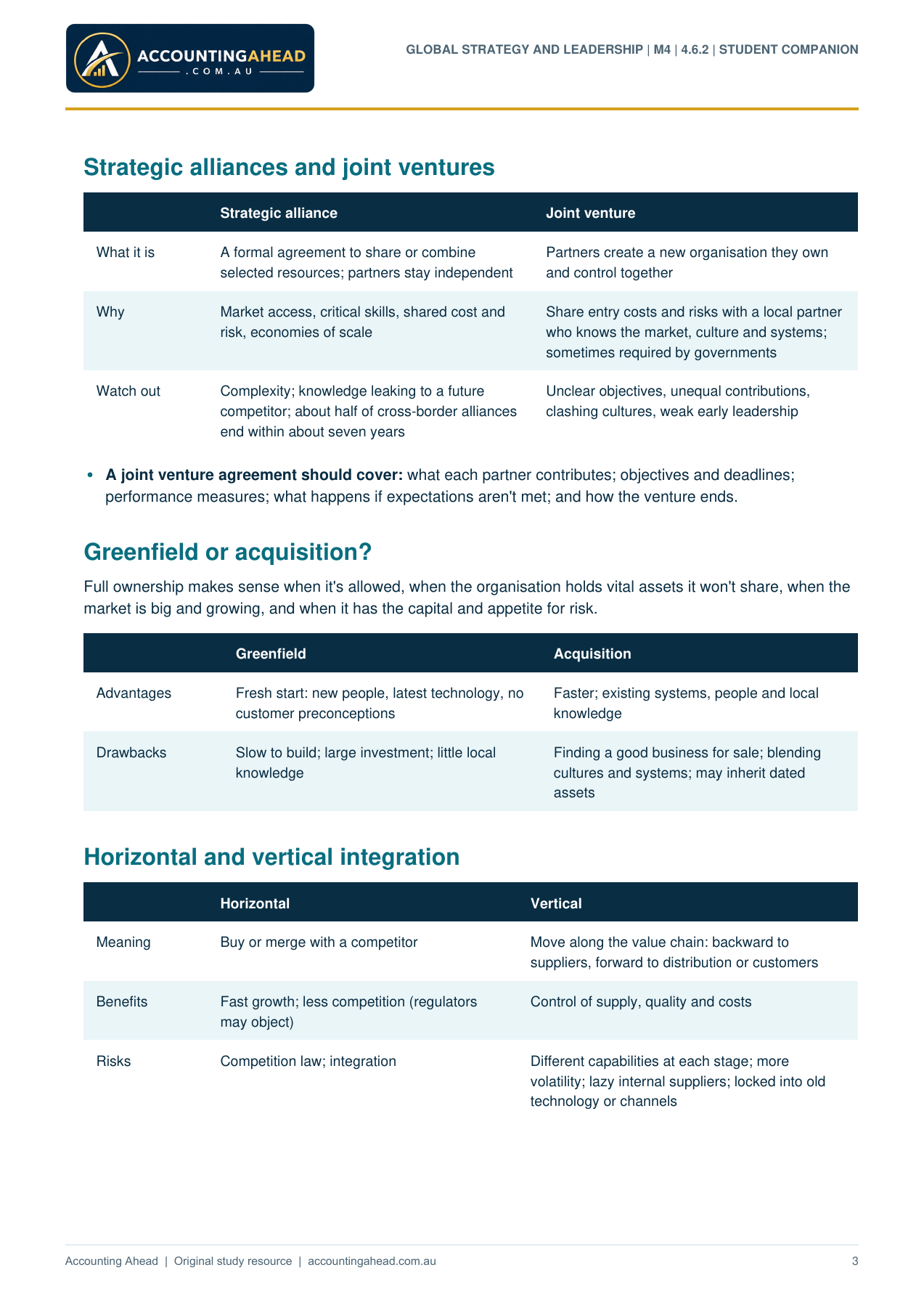
Strategic alliances and joint ventures
Strategic alliance Joint venture
What it is A formal agreement to share or combine
selected resources; partners stay independent
Partners create a new organisation they own
and control together
Why Market access, critical skills, shared cost and
risk, economies of scale
Share entry costs and risks with a local partner
who knows the market, culture and systems;
sometimes required by governments
Watch out Complexity; knowledge leaking to a future
competitor; about half of cross-border alliances
end within about seven years
Unclear objectives, unequal contributions,
clashing cultures, weak early leadership
A joint venture agreement should cover: what each partner contributes; objectives and deadlines;
performance measures; what happens if expectations aren't met; and how the venture ends.
Greenfield or acquisition?
Full ownership makes sense when it's allowed, when the organisation holds vital assets it won't share, when the
market is big and growing, and when it has the capital and appetite for risk.
Greenfield Acquisition
Advantages Fresh start: new people, latest technology, no
customer preconceptions
Faster; existing systems, people and local
knowledge
Drawbacks Slow to build; large investment; little local
knowledge
Finding a good business for sale; blending
cultures and systems; may inherit dated
assets
Horizontal and vertical integration
Horizontal Vertical
Meaning Buy or merge with a competitor Move along the value chain: backward to
suppliers, forward to distribution or customers
Benefits Fast growth; less competition (regulators
may object)
Control of supply, quality and costs
Risks Competition law; integration Different capabilities at each stage; more
volatility; lazy internal suppliers; locked into old
technology or channels
GLOBAL STRATEGY AND LEADERSHIP | M4 | 4.6.2 | STUDENT COMPANION
3
Accounting Ahead | Original study resource | accountingahead.com.au
Five sources of value in mergers and acquisitions (Lasserre)
A deal creates value only if the combined business is worth more than the parts. Short-term, one-off value (tax,
asset sales, quick savings) matters less than lasting competitive advantage.
Source Imagined example
Consolidation Two regional cement makers merge to cut overlapping costs
Global reach An Australian software firm buys a Canadian rival to enter North America
Vertical integration A winery buys the bottling plant it relies on
Diversification A building products company buys a solar installer
Options A bank buys a small fintech to learn a new technology
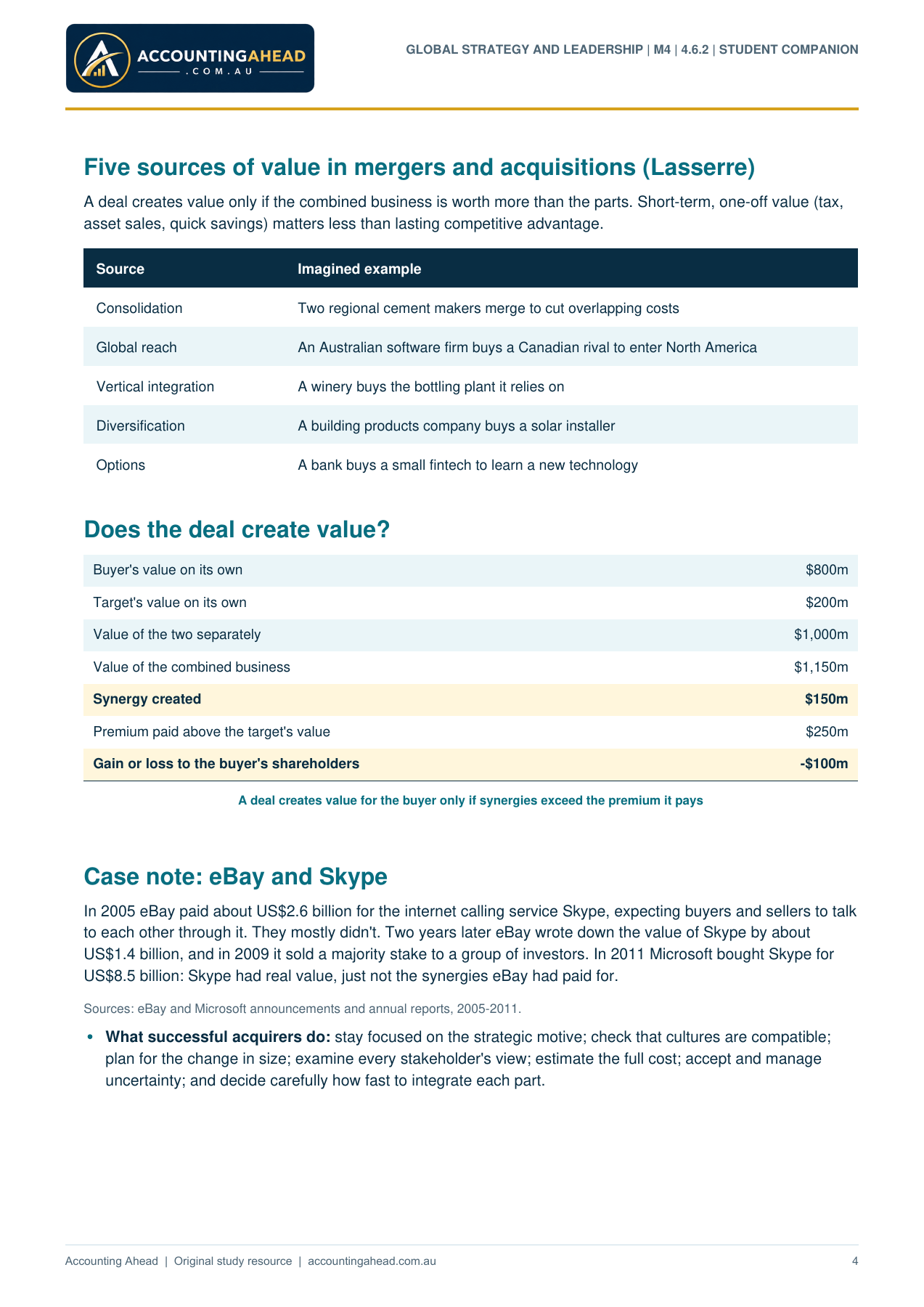
Does the deal create value?
Buyer's value on its own $800m
Target's value on its own $200m
Value of the two separately $1,000m
Value of the combined business $1,150m
Synergy created $150m
Premium paid above the target's value $250m
Gain or loss to the buyer's shareholders -$100m
A deal creates value for the buyer only if synergies exceed the premium it pays
Case note: eBay and Skype
In 2005 eBay paid about US$2.6 billion for the internet calling service Skype, expecting buyers and sellers to talk
to each other through it. They mostly didn't. Two years later eBay wrote down the value of Skype by about
US$1.4 billion, and in 2009 it sold a majority stake to a group of investors. In 2011 Microsoft bought Skype for
US$8.5 billion: Skype had real value, just not the synergies eBay had paid for.
Sources: eBay and Microsoft announcements and annual reports, 2005-2011.
What successful acquirers do: stay focused on the strategic motive; check that cultures are compatible;
plan for the change in size; examine every stakeholder's view; estimate the full cost; accept and manage
uncertainty; and decide carefully how fast to integrate each part.
GLOBAL STRATEGY AND LEADERSHIP | M4 | 4.6.2 | STUDENT COMPANION
4
Accounting Ahead | Original study resource | accountingahead.com.au
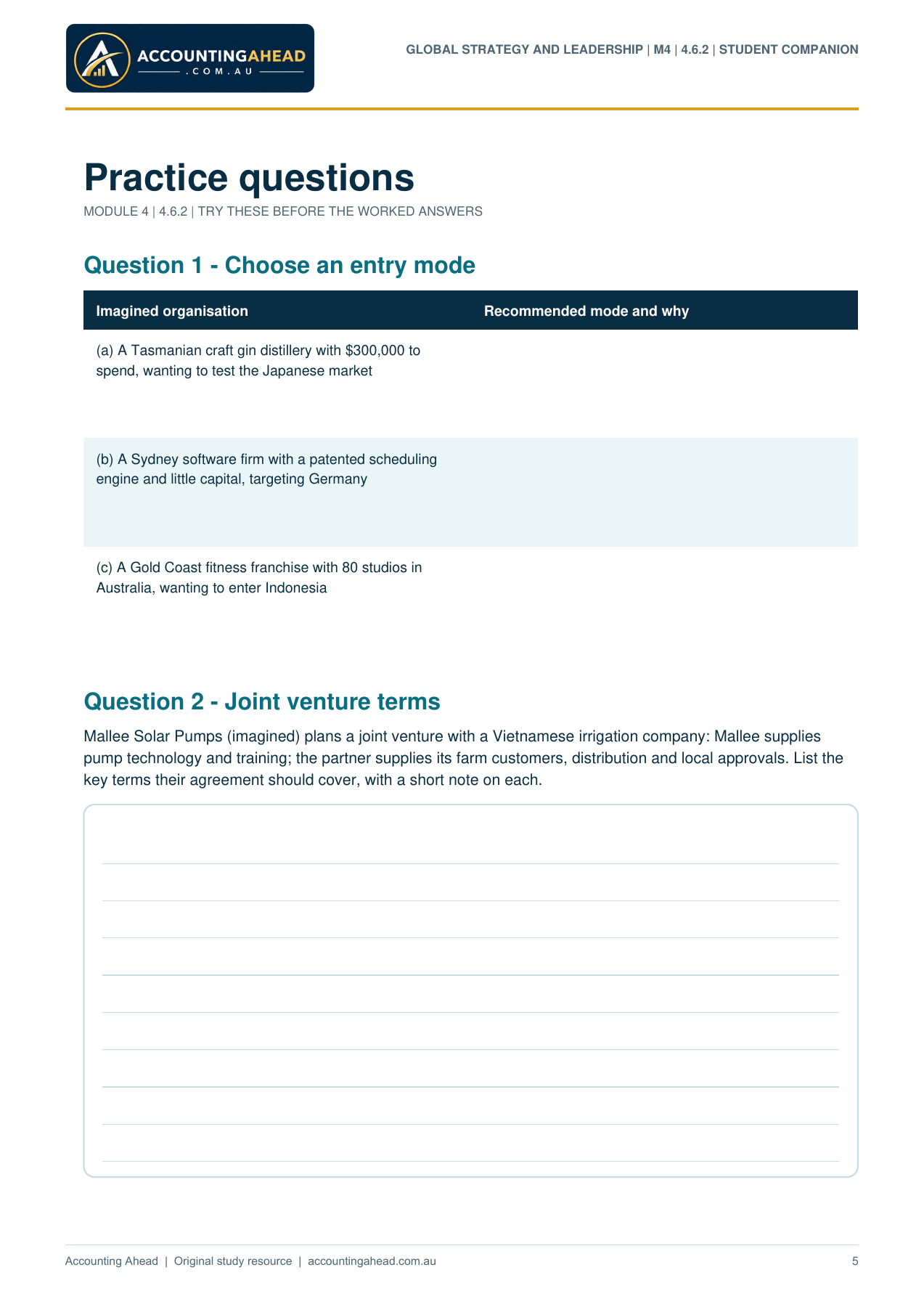
Practice questions
MODULE 4 | 4.6.2 | TRY THESE BEFORE THE WORKED ANSWERS
Question 1 - Choose an entry mode
Imagined organisation Recommended mode and why
(a) A Tasmanian craft gin distillery with $300,000 to
spend, wanting to test the Japanese market
(b) A Sydney software firm with a patented scheduling
engine and little capital, targeting Germany
(c) A Gold Coast fitness franchise with 80 studios in
Australia, wanting to enter Indonesia
Question 2 - Joint venture terms
Mallee Solar Pumps (imagined) plans a joint venture with a Vietnamese irrigation company: Mallee supplies
pump technology and training; the partner supplies its farm customers, distribution and local approvals. List the
key terms their agreement should cover, with a short note on each.
GLOBAL STRATEGY AND LEADERSHIP | M4 | 4.6.2 | STUDENT COMPANION
5
Accounting Ahead | Original study resource | accountingahead.com.au
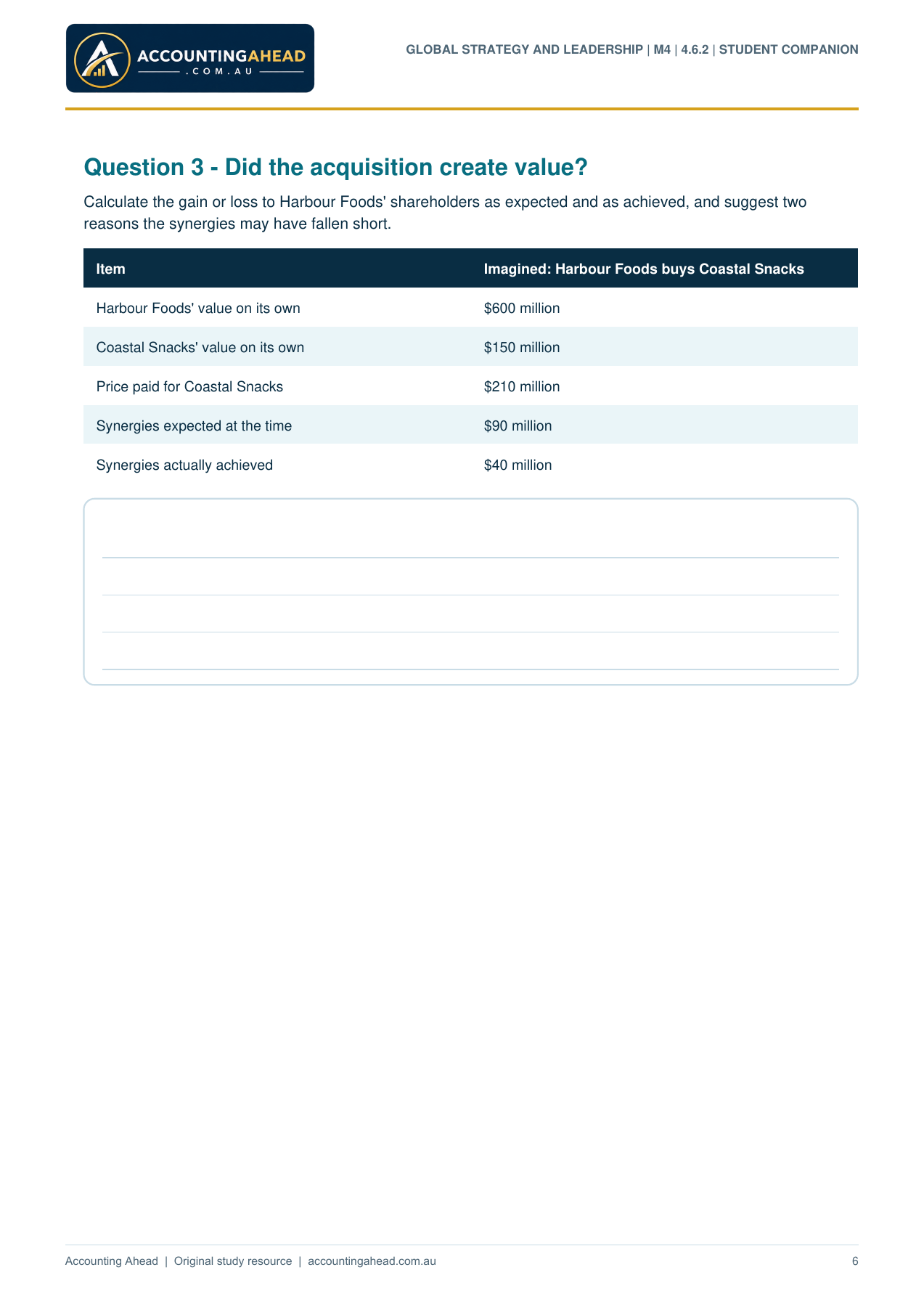
Question 3 - Did the acquisition create value?
Calculate the gain or loss to Harbour Foods' shareholders as expected and as achieved, and suggest two
reasons the synergies may have fallen short.
Item Imagined: Harbour Foods buys Coastal Snacks
Harbour Foods' value on its own $600 million
Coastal Snacks' value on its own $150 million
Price paid for Coastal Snacks $210 million
Synergies expected at the time $90 million
Synergies actually achieved $40 million
GLOBAL STRATEGY AND LEADERSHIP | M4 | 4.6.2 | STUDENT COMPANION
6
Accounting Ahead | Original study resource | accountingahead.com.au
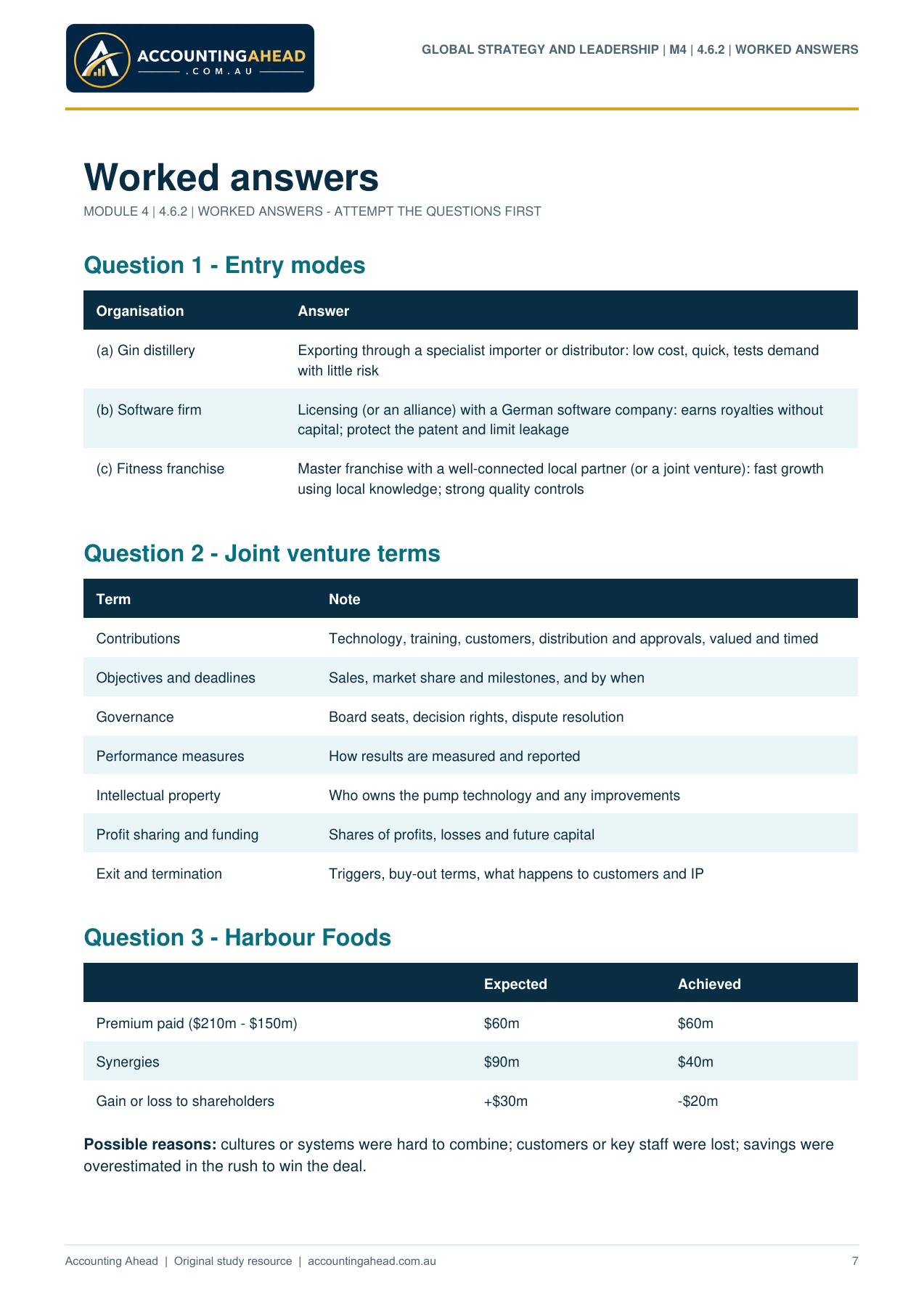
Worked answers
MODULE 4 | 4.6.2 | WORKED ANSWERS - ATTEMPT THE QUESTIONS FIRST
Question 1 - Entry modes
Organisation Answer
(a) Gin distillery Exporting through a specialist importer or distributor: low cost, quick, tests demand
with little risk
(b) Software firm Licensing (or an alliance) with a German software company: earns royalties without
capital; protect the patent and limit leakage
(c) Fitness franchise Master franchise with a well-connected local partner (or a joint venture): fast growth
using local knowledge; strong quality controls
Question 2 - Joint venture terms
Term Note
Contributions Technology, training, customers, distribution and approvals, valued and timed
Objectives and deadlines Sales, market share and milestones, and by when
Governance Board seats, decision rights, dispute resolution
Performance measures How results are measured and reported
Intellectual property Who owns the pump technology and any improvements
Profit sharing and funding Shares of profits, losses and future capital
Exit and termination Triggers, buy-out terms, what happens to customers and IP
Question 3 - Harbour Foods
Expected Achieved
Premium paid ($210m - $150m) $60m $60m
Synergies $90m $40m
Gain or loss to shareholders +$30m -$20m
Possible reasons: cultures or systems were hard to combine; customers or key staff were lost; savings were
overestimated in the rush to win the deal.
GLOBAL STRATEGY AND LEADERSHIP | M4 | 4.6.2 | WORKED ANSWERS
7