
Comparing entry modes and accounting issues
Printable study notes to use alongside Part 4.6.3.
Read the handout text
Accounting Ahead | Original study resource | accountingahead.com.au
Comparing entry modes and accounting
issues
MODULE 4 | 4.6.3 | STUDENT COMPANION
There is no single best entry mode. Organisations usually expand in steps, deciding again at each stage
how many resources to commit, how much risk to accept, how much control they need and how much profit
they could make, often graduating from one mode to the next.
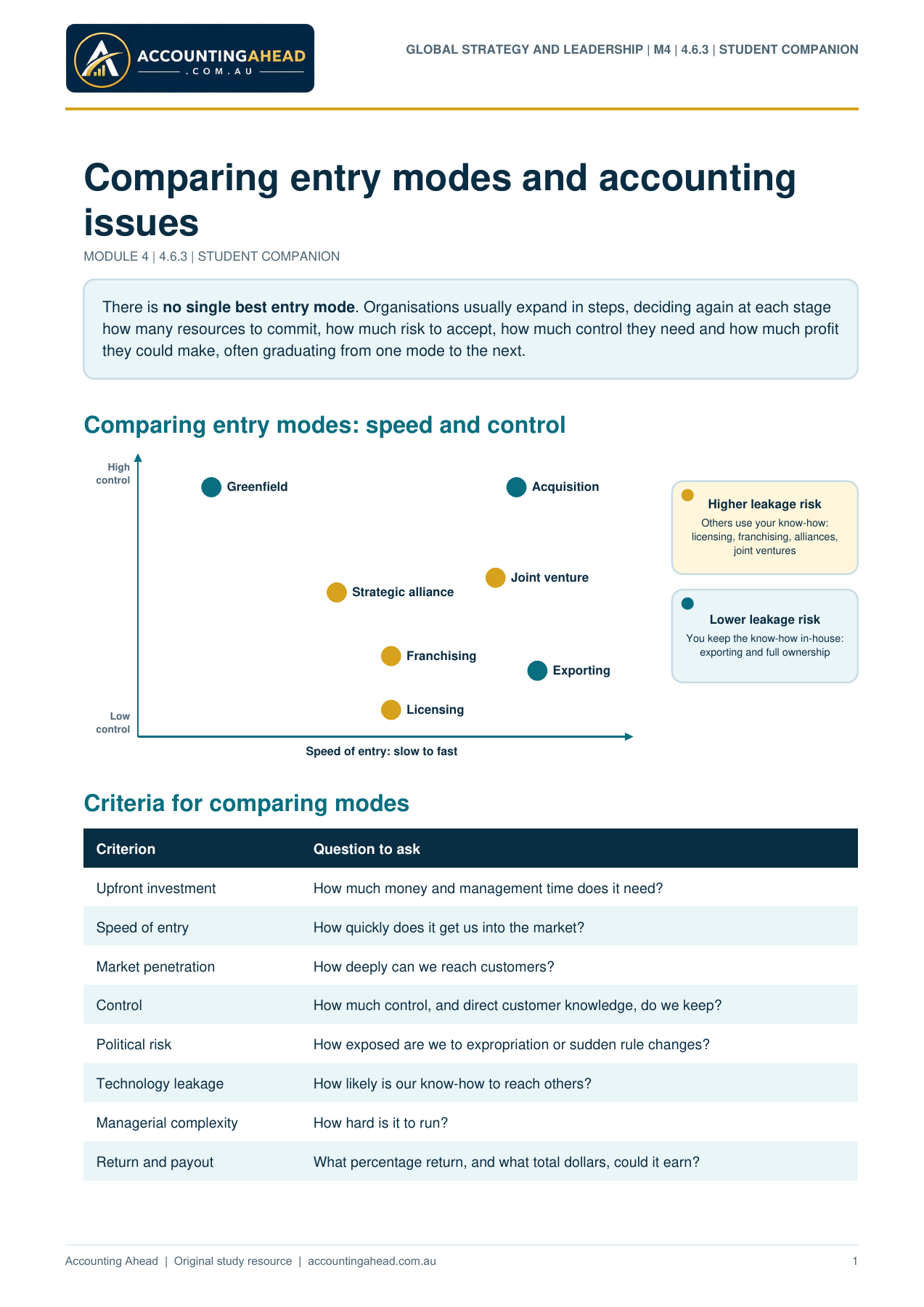
Comparing entry modes: speed and control
Speed of entry: slow to fast
High
control
Low
control
Exporting
Licensing
Franchising
Strategic alliance
Joint venture
AcquisitionGreenfield
Higher leakage risk
Others use your know-how:
licensing, franchising, alliances,
joint ventures
Lower leakage risk
You keep the know-how in-house:
exporting and full ownership
Criteria for comparing modes
Criterion Question to ask
Upfront investment How much money and management time does it need?
Speed of entry How quickly does it get us into the market?
Market penetration How deeply can we reach customers?
Control How much control, and direct customer knowledge, do we keep?
Political risk How exposed are we to expropriation or sudden rule changes?
Technology leakage How likely is our know-how to reach others?
Managerial complexity How hard is it to run?
Return and payout What percentage return, and what total dollars, could it earn?
GLOBAL STRATEGY AND LEADERSHIP | M4 | 4.6.3 | STUDENT COMPANION
1
Accounting Ahead | Original study resource | accountingahead.com.au
Worked example: return versus payout (imagined)
Return is the percentage earned on the money invested; payout is the total dollar amount.
Licence Own subsidiary
Investment $100,000 to set up the licence $5,000,000
Annual income 5% royalty on $4m of sales = $200,000 $1,000,000 profit
Return (percentage) 200% 20%
Payout (dollars) $200,000 $1,000,000 (five times more)
Accounting issues in market expansion
Entering new markets or diversifying brings accounting challenges the organisation hasn't faced before. Their
costs must be anticipated and built into the business case and budget, because they can change whether entry
makes sense at all. Some surface in the external analysis (tax, governance); others in the internal analysis (can
the finance team cope?).
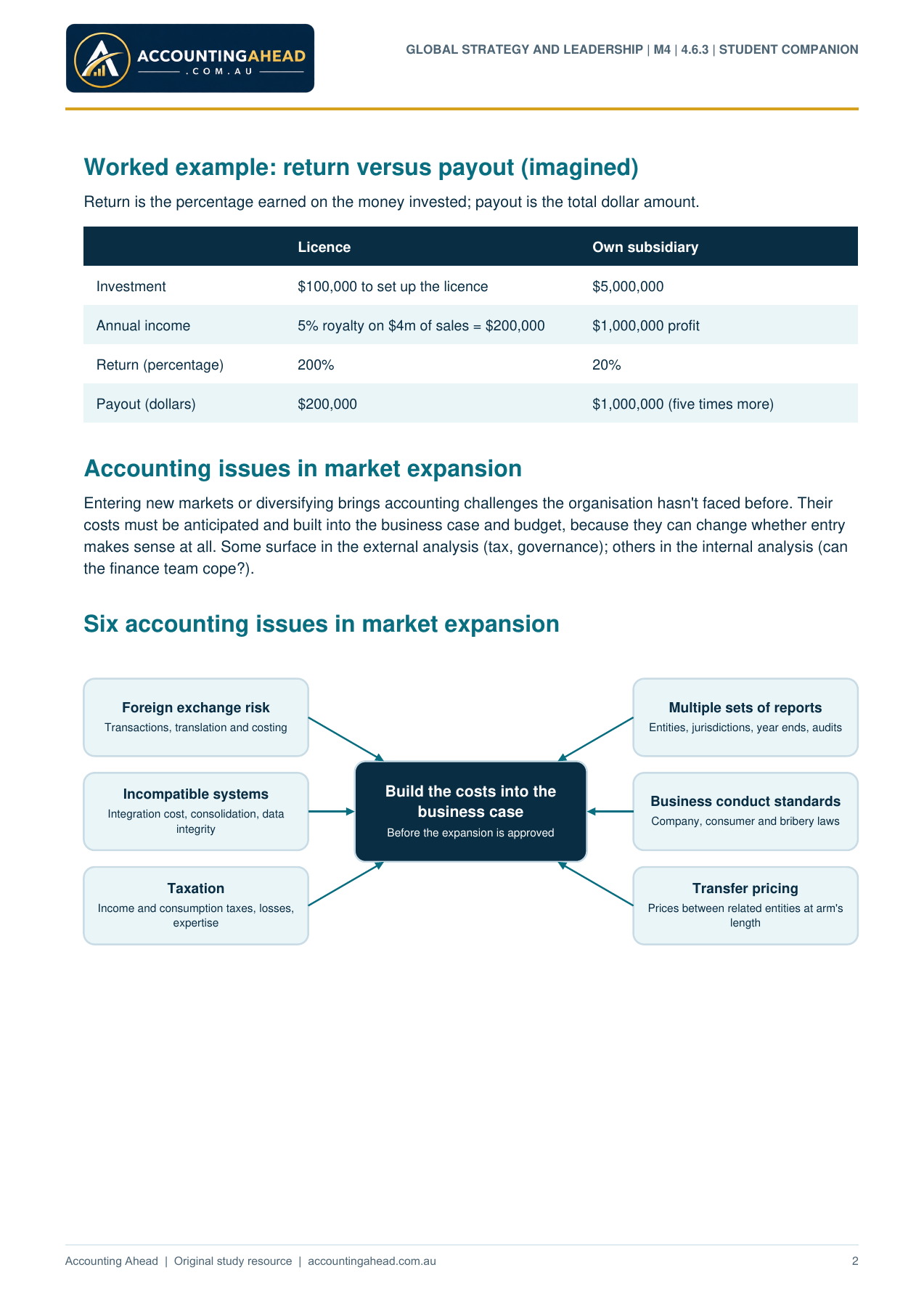
Six accounting issues in market expansion
Build the costs into the
business case
Before the expansion is approved
Foreign exchange risk
Transactions, translation and costing
Multiple sets of reports
Entities, jurisdictions, year ends, audits
Incompatible systems
Integration cost, consolidation, data
integrity
Business conduct standards
Company, consumer and bribery laws
Taxation
Income and consumption taxes, losses,
expertise
Transfer pricing
Prices between related entities at arm's
length
GLOBAL STRATEGY AND LEADERSHIP | M4 | 4.6.3 | STUDENT COMPANION
2
Accounting Ahead | Original study resource | accountingahead.com.au
Where foreign exchange risk comes from
IAS 21 governs the accounting for transactions in foreign currencies and for foreign operations.
Strategy How the risk shows up
Selling or buying abroad, without a
local presence
Gains and losses between the date of a sale or purchase and the date of
payment
A wholly owned business abroad Runs in the local currency; the risk appears when results are translated and
consolidated into the parent's accounts, and in costs such as expatriate
salaries
New products made overseas Uncertain production costs that complicate every costing decision
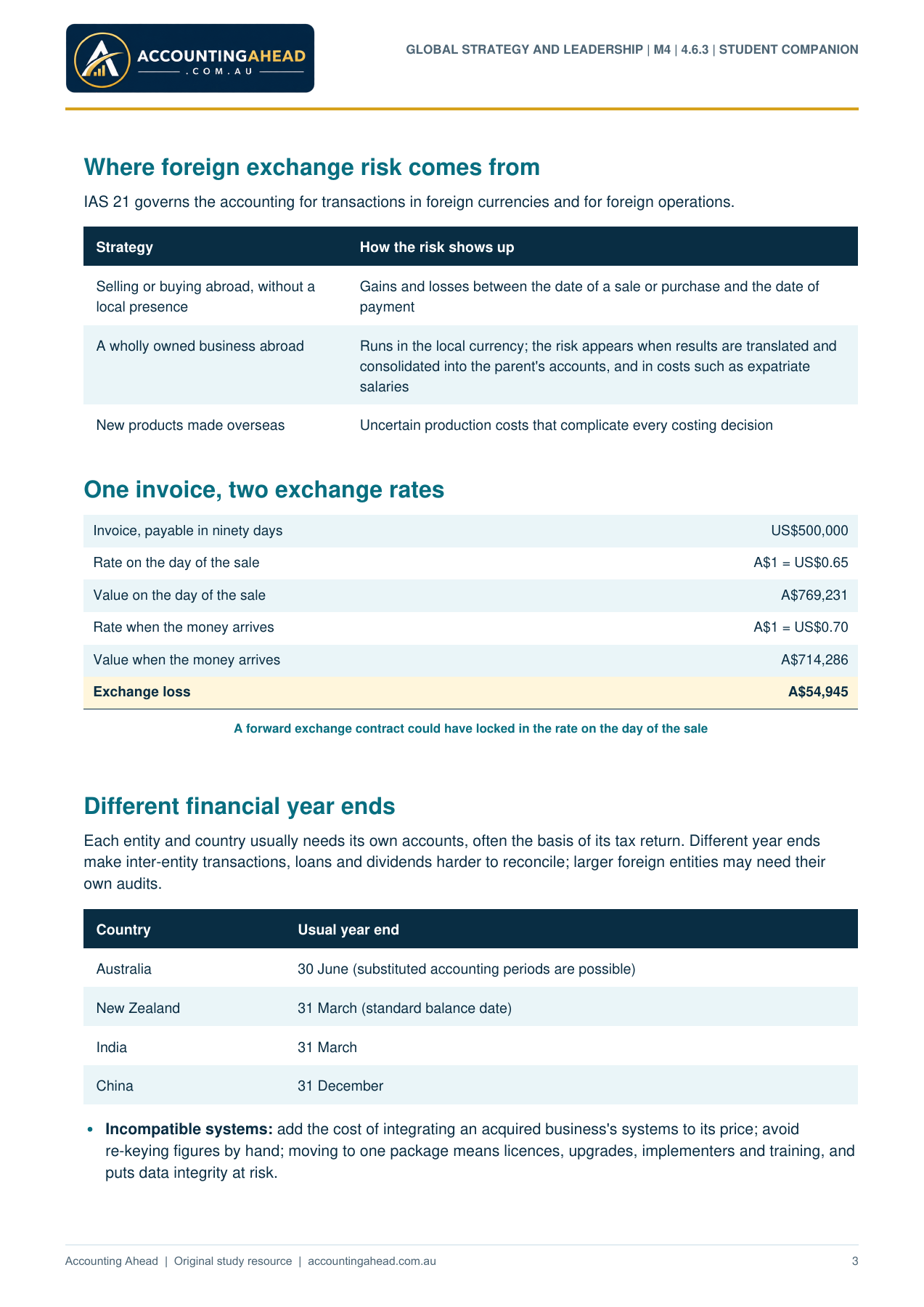
One invoice, two exchange rates
Invoice, payable in ninety days US$500,000
Rate on the day of the sale A$1 = US$0.65
Value on the day of the sale A$769,231
Rate when the money arrives A$1 = US$0.70
Value when the money arrives A$714,286
Exchange loss A$54,945
A forward exchange contract could have locked in the rate on the day of the sale
Different financial year ends
Each entity and country usually needs its own accounts, often the basis of its tax return. Different year ends
make inter-entity transactions, loans and dividends harder to reconcile; larger foreign entities may need their
own audits.
Country Usual year end
Australia 30 June (substituted accounting periods are possible)
New Zealand 31 March (standard balance date)
India 31 March
China 31 December
Incompatible systems: add the cost of integrating an acquired business's systems to its price; avoid
re-keying figures by hand; moving to one package means licences, upgrades, implementers and training, and
puts data integrity at risk.
GLOBAL STRATEGY AND LEADERSHIP | M4 | 4.6.3 | STUDENT COMPANION
3
Accounting Ahead | Original study resource | accountingahead.com.au
Business conduct standards: each country's company and consumer laws apply, with heavy penalties.
Some home laws reach overseas: US foreign bribery law, and Australia's offence (since 2024) of a company
failing to prevent foreign bribery by its associates.
Taxation: income tax rates and rules, and consumption taxes such as GST and VAT (national or state by
state), vary widely. Get expert help; favour countries that let start-up losses be carried forward; align year
ends where possible.
Case note: Chevron Australia and transfer pricing
Transfer prices, charged between related entities in different countries, must reflect what independent parties
would charge. Chevron's Australian business borrowed the Australian-dollar equivalent of US$2.5 billion from a
related US company at around 9% interest, while that company raised the money at little more than 1%. The
Australian Taxation Office argued the rate was far above an arm's length rate, and in 2017 the Full Federal Court
upheld tax assessments of about A$340 million, including penalties and interest, for 2004 to 2008; Chevron then
settled with the Tax Office and withdrew its appeal. Transfer pricing isn't a strategy to pursue; it's a risk to
manage from the start.
Source: Chevron Australia Holdings Pty Ltd v Commissioner of Taxation [2017] FCAFC 62.
GLOBAL STRATEGY AND LEADERSHIP | M4 | 4.6.3 | STUDENT COMPANION
4
Accounting Ahead | Original study resource | accountingahead.com.au
Practice questions
MODULE 4 | 4.6.3 | TRY THESE BEFORE THE WORKED ANSWERS
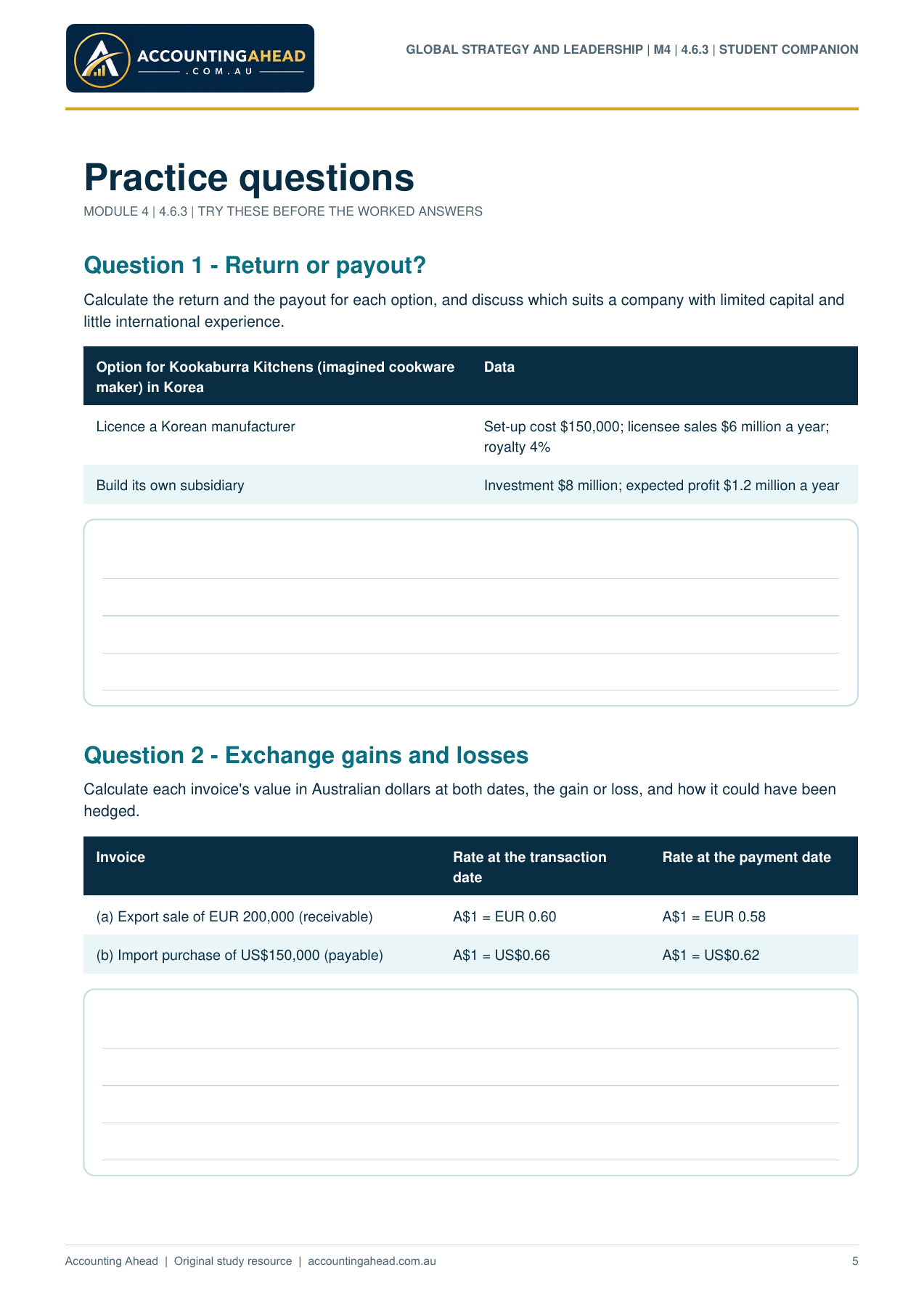
Question 1 - Return or payout?
Calculate the return and the payout for each option, and discuss which suits a company with limited capital and
little international experience.
Option for Kookaburra Kitchens (imagined cookware
maker) in Korea
Data
Licence a Korean manufacturer Set-up cost $150,000; licensee sales $6 million a year;
royalty 4%
Build its own subsidiary Investment $8 million; expected profit $1.2 million a year
Question 2 - Exchange gains and losses
Calculate each invoice's value in Australian dollars at both dates, the gain or loss, and how it could have been
hedged.
Invoice Rate at the transaction
date
Rate at the payment date
(a) Export sale of EUR 200,000 (receivable) A$1 = EUR 0.60 A$1 = EUR 0.58
(b) Import purchase of US$150,000 (payable) A$1 = US$0.66 A$1 = US$0.62
GLOBAL STRATEGY AND LEADERSHIP | M4 | 4.6.3 | STUDENT COMPANION
5
Accounting Ahead | Original study resource | accountingahead.com.au
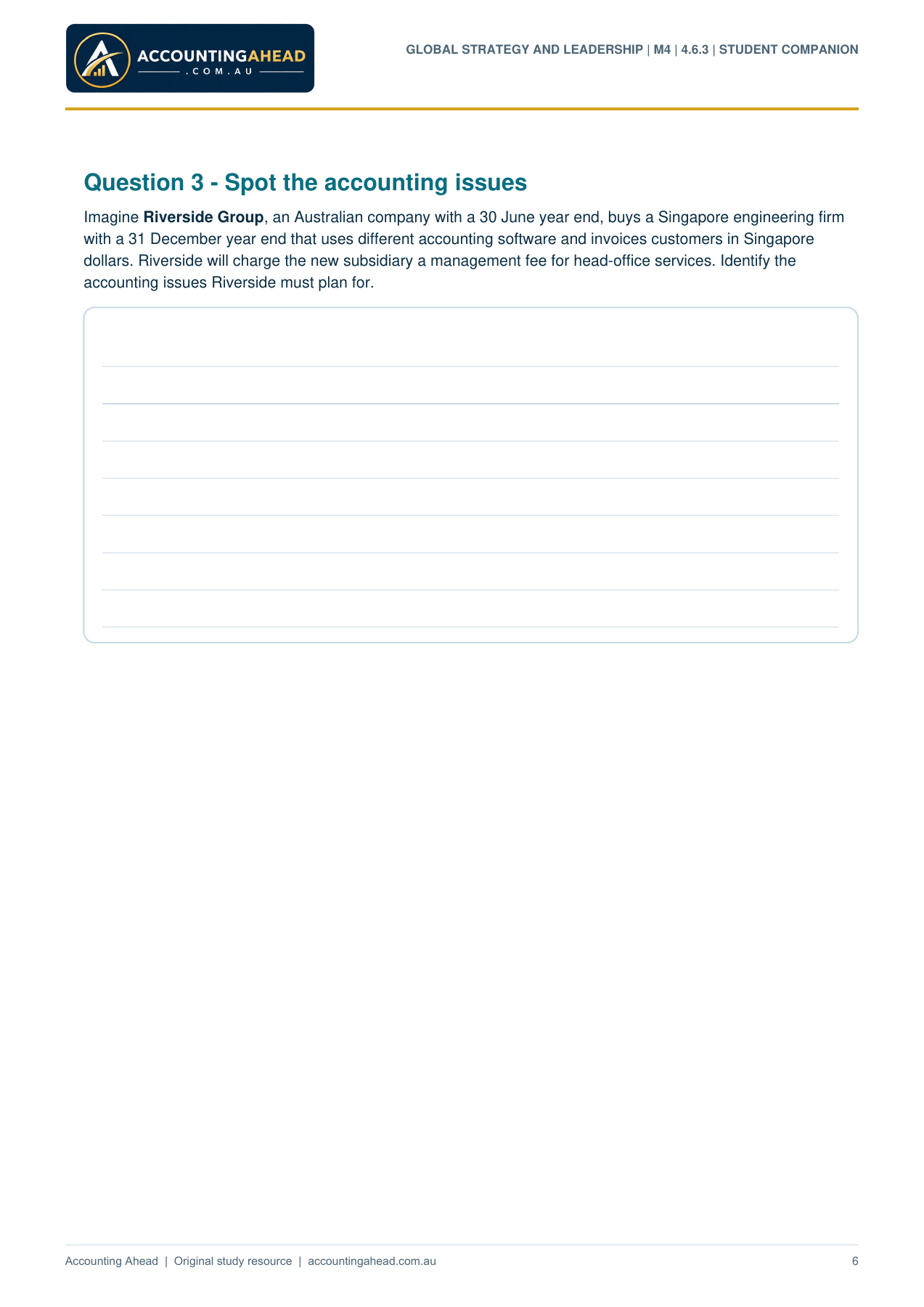
Question 3 - Spot the accounting issues
Imagine Riverside Group, an Australian company with a 30 June year end, buys a Singapore engineering firm
with a 31 December year end that uses different accounting software and invoices customers in Singapore
dollars. Riverside will charge the new subsidiary a management fee for head-office services. Identify the
accounting issues Riverside must plan for.
GLOBAL STRATEGY AND LEADERSHIP | M4 | 4.6.3 | STUDENT COMPANION
6
Accounting Ahead | Original study resource | accountingahead.com.au
Worked answers
MODULE 4 | 4.6.3 | WORKED ANSWERS - ATTEMPT THE QUESTIONS FIRST
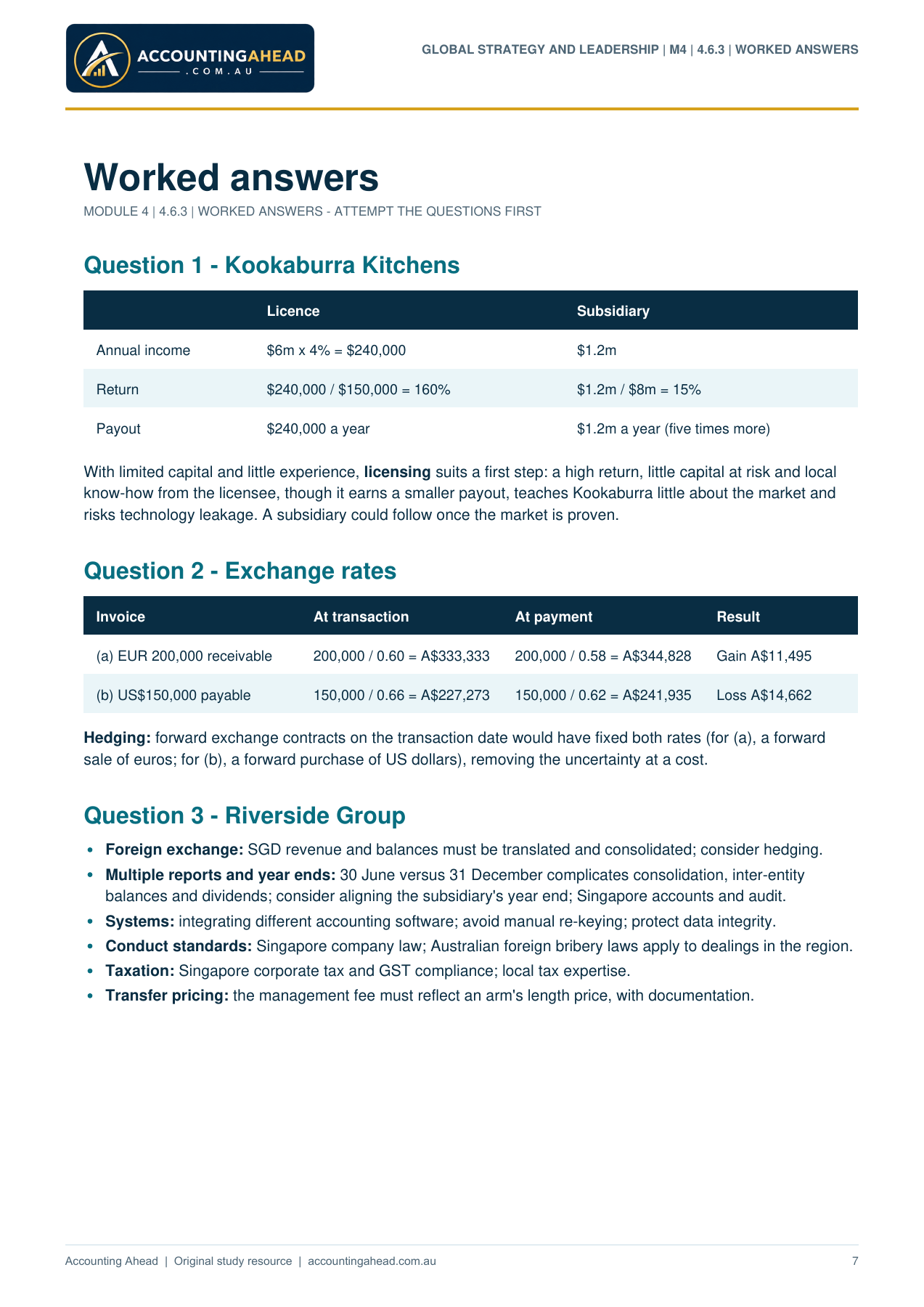
Question 1 - Kookaburra Kitchens
Licence Subsidiary
Annual income $6m x 4% = $240,000 $1.2m
Return $240,000 / $150,000 = 160% $1.2m / $8m = 15%
Payout $240,000 a year $1.2m a year (five times more)
With limited capital and little experience, licensing suits a first step: a high return, little capital at risk and local
know-how from the licensee, though it earns a smaller payout, teaches Kookaburra little about the market and
risks technology leakage. A subsidiary could follow once the market is proven.
Question 2 - Exchange rates
Invoice At transaction At payment Result
(a) EUR 200,000 receivable 200,000 / 0.60 = A$333,333 200,000 / 0.58 = A$344,828 Gain A$11,495
(b) US$150,000 payable 150,000 / 0.66 = A$227,273 150,000 / 0.62 = A$241,935 Loss A$14,662
Hedging: forward exchange contracts on the transaction date would have fixed both rates (for (a), a forward
sale of euros; for (b), a forward purchase of US dollars), removing the uncertainty at a cost.
Question 3 - Riverside Group
Foreign exchange: SGD revenue and balances must be translated and consolidated; consider hedging.
Multiple reports and year ends: 30 June versus 31 December complicates consolidation, inter-entity
balances and dividends; consider aligning the subsidiary's year end; Singapore accounts and audit.
Systems: integrating different accounting software; avoid manual re-keying; protect data integrity.
Conduct standards: Singapore company law; Australian foreign bribery laws apply to dealings in the region.
Taxation: Singapore corporate tax and GST compliance; local tax expertise.
Transfer pricing: the management fee must reflect an arm's length price, with documentation.
GLOBAL STRATEGY AND LEADERSHIP | M4 | 4.6.3 | WORKED ANSWERS
7