
Strategy development: aligning vision, mission, values and goals
Printable study notes to use alongside Part 5.1.
Read the handout text
Accounting Ahead | Original study resource | accountingahead.com.au
Strategy development: aligning vision,
mission, values and goals
MODULE 5 | 5.1 | STUDENT COMPANION
Strategy development weighs up the options generated earlier, decides which to pursue and turns them
into a roadmap the organisation can follow to reach its goals. Putting the roadmap into action is the subject
of Module 6.
What CPAs bring to strategy development
Skill What it involves
Forecasting Gathering business intelligence and data, analysing it and projecting where results are
heading
Market analysis Collecting data and building models to understand how profitable an industry is and
what its participants earn
Financial statement
analysis
Showing the current financial position and what the organisation can afford
Also Benchmarking against rivals, reporting interim results against budget and forecast,
contingency plans, and meaningful non-financial measures (sustainability, brand
value, digital performance)
Imagined example. A not-for-profit's draft four-year plan assumes government grants will grow by 5% a year.
The CPA notes that grants have been flat for three years, models a zero-growth case, and proposes a
contingency: delay one building project if funding falls short.
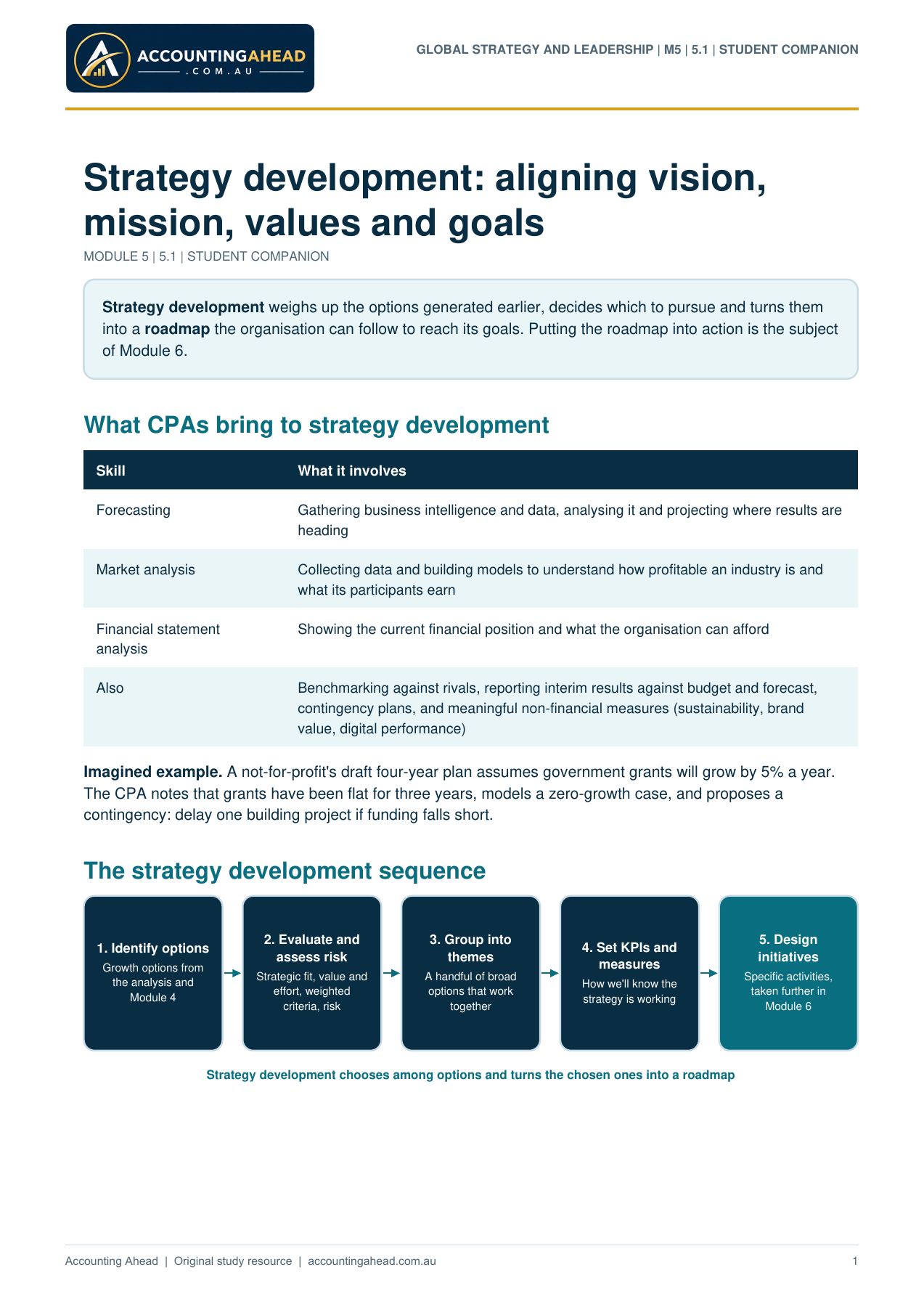
The strategy development sequence
1. Identify options
Growth options from
the analysis and
Module 4
2. Evaluate and
assess risk
Strategic fit, value and
effort, weighted
criteria, risk
3. Group into
themes
A handful of broad
options that work
together
4. Set KPIs and
measures
How we'll know the
strategy is working
5. Design
initiatives
Specific activities,
taken further in
Module 6
Strategy development chooses among options and turns the chosen ones into a roadmap
GLOBAL STRATEGY AND LEADERSHIP | M5 | 5.1 | STUDENT COMPANION
1
Accounting Ahead | Original study resource | accountingahead.com.au
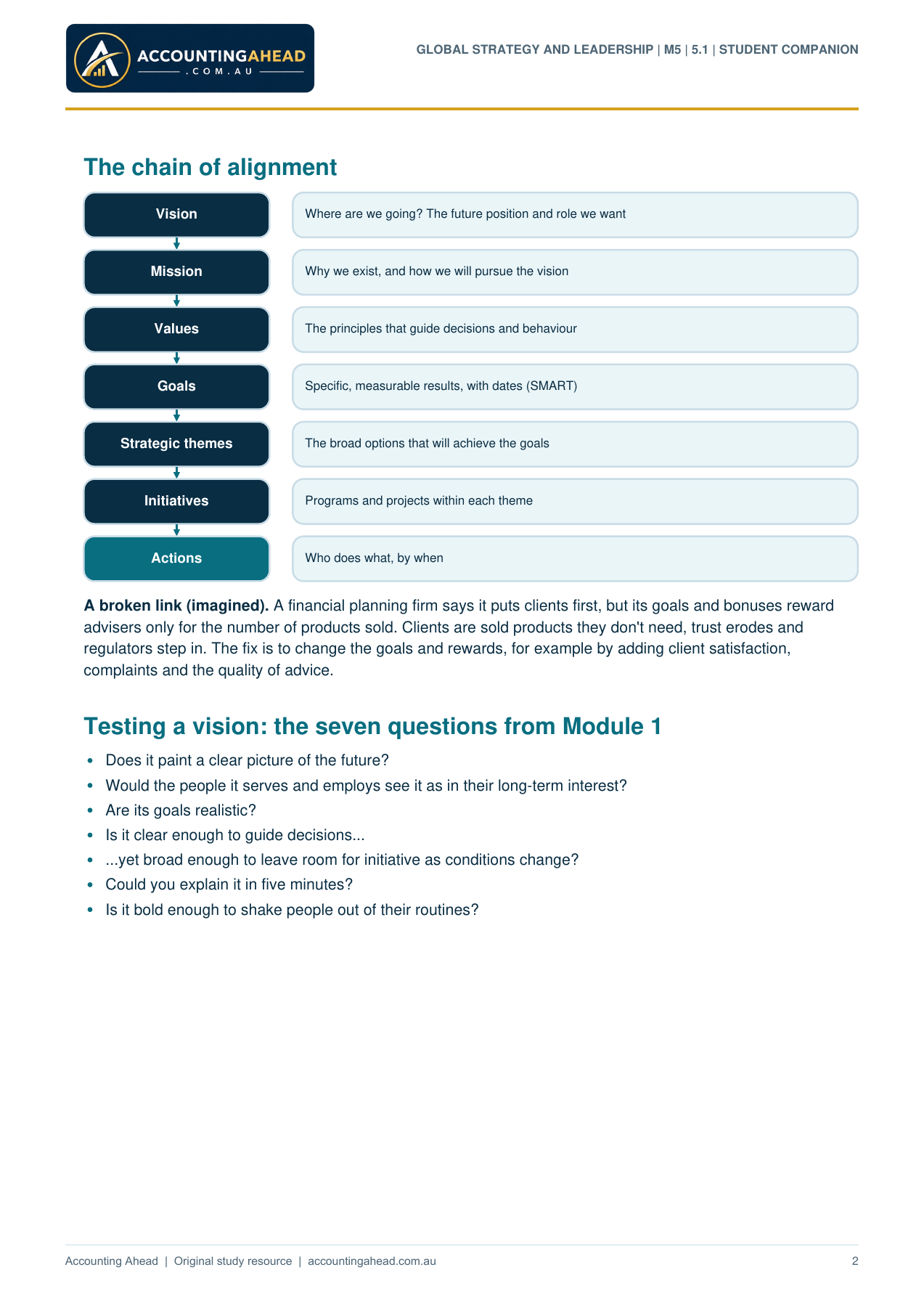
The chain of alignment
Vision Where are we going? The future position and role we want
Mission Why we exist, and how we will pursue the vision
Values The principles that guide decisions and behaviour
Goals Specific, measurable results, with dates (SMART)
Strategic themes The broad options that will achieve the goals
Initiatives Programs and projects within each theme
Actions Who does what, by when
A broken link (imagined). A financial planning firm says it puts clients first, but its goals and bonuses reward
advisers only for the number of products sold. Clients are sold products they don't need, trust erodes and
regulators step in. The fix is to change the goals and rewards, for example by adding client satisfaction,
complaints and the quality of advice.
Testing a vision: the seven questions from Module 1
Does it paint a clear picture of the future?
Would the people it serves and employs see it as in their long-term interest?
Are its goals realistic?
Is it clear enough to guide decisions...
...yet broad enough to leave room for initiative as conditions change?
Could you explain it in five minutes?
Is it bold enough to shake people out of their routines?
GLOBAL STRATEGY AND LEADERSHIP | M5 | 5.1 | STUDENT COMPANION
2
Accounting Ahead | Original study resource | accountingahead.com.au
Ironbark Housing (imagined): from vision to action
Level Ironbark Housing
Vision Everyone in our region has a safe, affordable home
Mission We build, manage and maintain affordable homes, and support our tenants to thrive
Values Respect, fairness, accountability and care (tenants' safety comes before saving money on
repairs)
Goals (SMART) 300 more homes by 2030; tenant satisfaction of 85%; urgent repairs within 48 hours, 9
times in 10
Themes Grow the supply of homes; excellent tenancy services; stay financially sustainable
Initiative A partnership program with private developers
Action Sign agreements with two developers by June
The vision is deliberately ambitious (no single organisation can house a whole region), so the goals must
supply the realism. SMART goals are specific, measurable, achievable, relevant and time-bound. Leaders
reinforce values by honouring them when it costs money, telling stories about staff who displayed them, and
rewarding people who act on them.
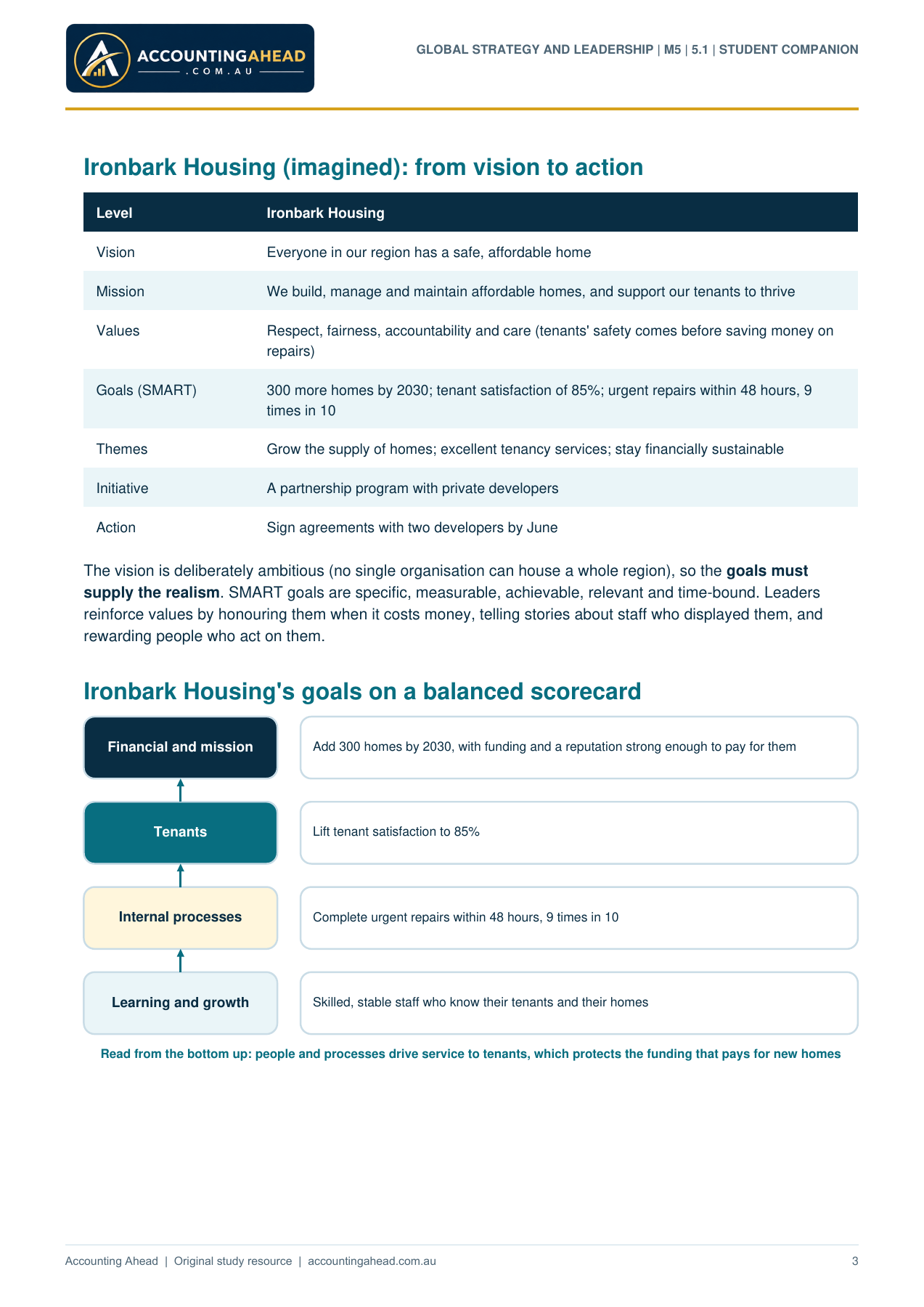
Ironbark Housing's goals on a balanced scorecard
Financial and mission Add 300 homes by 2030, with funding and a reputation strong enough to pay for them
Tenants Lift tenant satisfaction to 85%
Internal processes Complete urgent repairs within 48 hours, 9 times in 10
Learning and growth Skilled, stable staff who know their tenants and their homes
Read from the bottom up: people and processes drive service to tenants, which protects the funding that pays for new homes
GLOBAL STRATEGY AND LEADERSHIP | M5 | 5.1 | STUDENT COMPANION
3
Accounting Ahead | Original study resource | accountingahead.com.au
Case note: Who Gives A Crap
Launched in Melbourne in 2012 by Simon Griffiths, Jehan Ratnatunga and Danny Alexander, Who Gives A Crap
sells toilet paper and other household paper products. To fund its first production run, Griffiths sat on a toilet,
filmed live online, for about 50 hours in July 2012, until a crowdfunding campaign had raised US$50,000 in
pre-orders. The company donates 50% of its profits to water and sanitation charities, makes its paper from
recycled fibres or bamboo, wraps each roll in paper rather than plastic, and has been a certified B Corporation
since 2016. By late 2026 it had donated more than A$20 million. In 2025 it closed a sister brand to concentrate
on the work with the most impact: a clear mission makes it easy to rule out choices that would distract from it.
Sources: Who Gives A Crap 'Our impact' page and company blog (March 2025); TriplePundit, 20 July 2012; CNBC, 7 October 2021.
What leaders and managers need
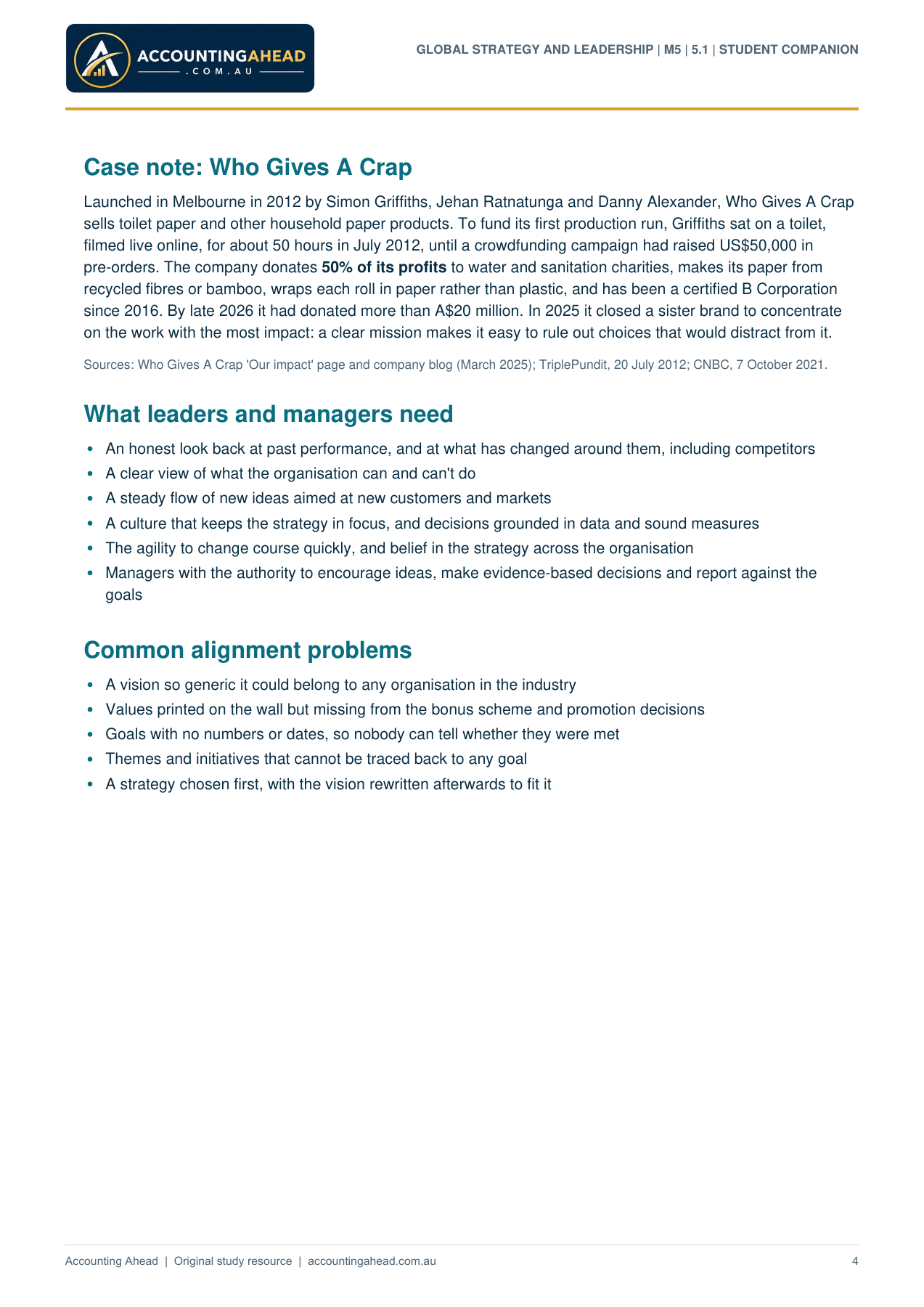
An honest look back at past performance, and at what has changed around them, including competitors
A clear view of what the organisation can and can't do
A steady flow of new ideas aimed at new customers and markets
A culture that keeps the strategy in focus, and decisions grounded in data and sound measures
The agility to change course quickly, and belief in the strategy across the organisation
Managers with the authority to encourage ideas, make evidence-based decisions and report against the
goals
Common alignment problems
A vision so generic it could belong to any organisation in the industry
Values printed on the wall but missing from the bonus scheme and promotion decisions
Goals with no numbers or dates, so nobody can tell whether they were met
Themes and initiatives that cannot be traced back to any goal
A strategy chosen first, with the vision rewritten afterwards to fit it
GLOBAL STRATEGY AND LEADERSHIP | M5 | 5.1 | STUDENT COMPANION
4
Accounting Ahead | Original study resource | accountingahead.com.au
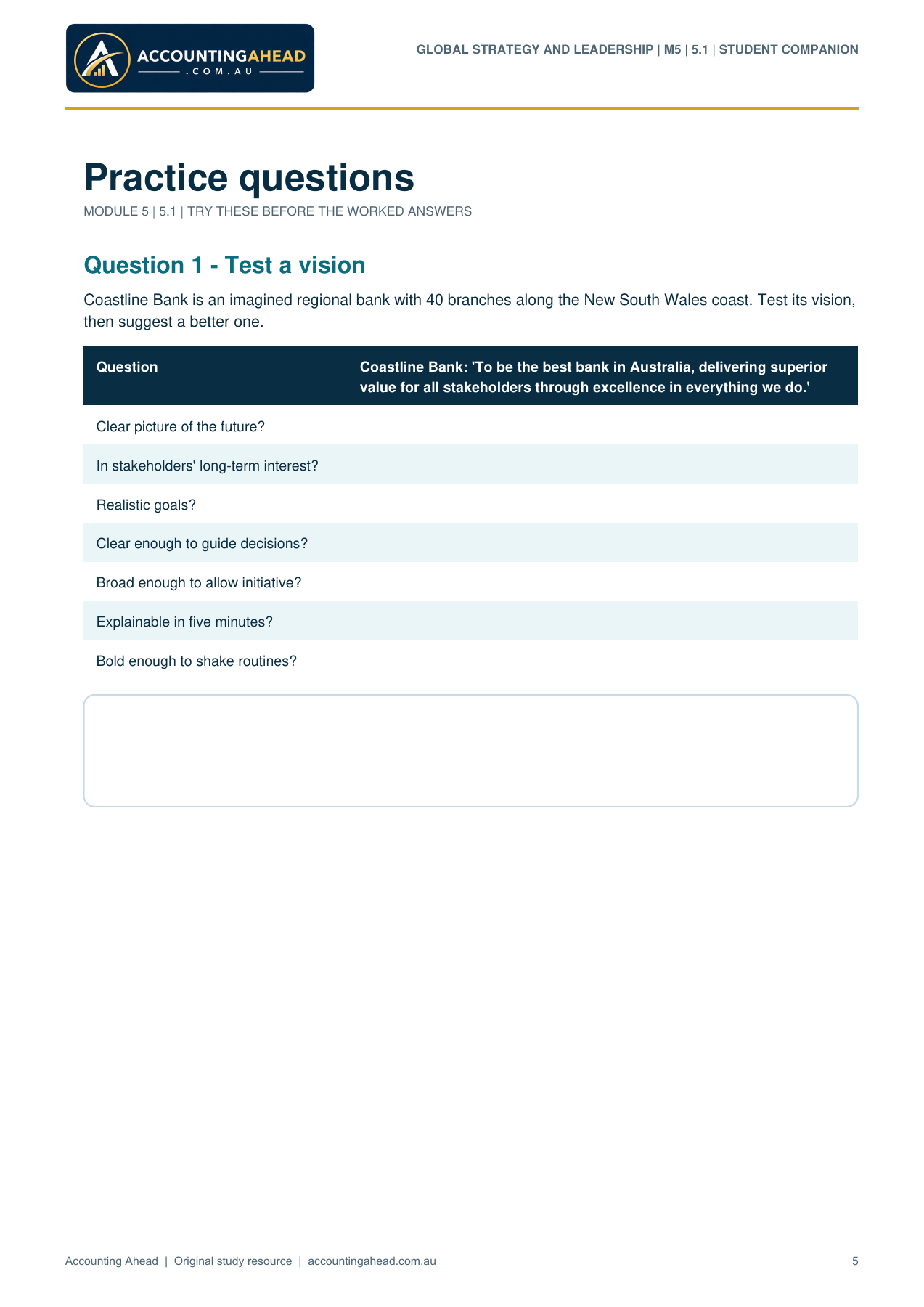
Practice questions
MODULE 5 | 5.1 | TRY THESE BEFORE THE WORKED ANSWERS
Question 1 - Test a vision
Coastline Bank is an imagined regional bank with 40 branches along the New South Wales coast. Test its vision,
then suggest a better one.
Question Coastline Bank: 'To be the best bank in Australia, delivering superior
value for all stakeholders through excellence in everything we do.'
Clear picture of the future?
In stakeholders' long-term interest?
Realistic goals?
Clear enough to guide decisions?
Broad enough to allow initiative?
Explainable in five minutes?
Bold enough to shake routines?
GLOBAL STRATEGY AND LEADERSHIP | M5 | 5.1 | STUDENT COMPANION
5
Accounting Ahead | Original study resource | accountingahead.com.au
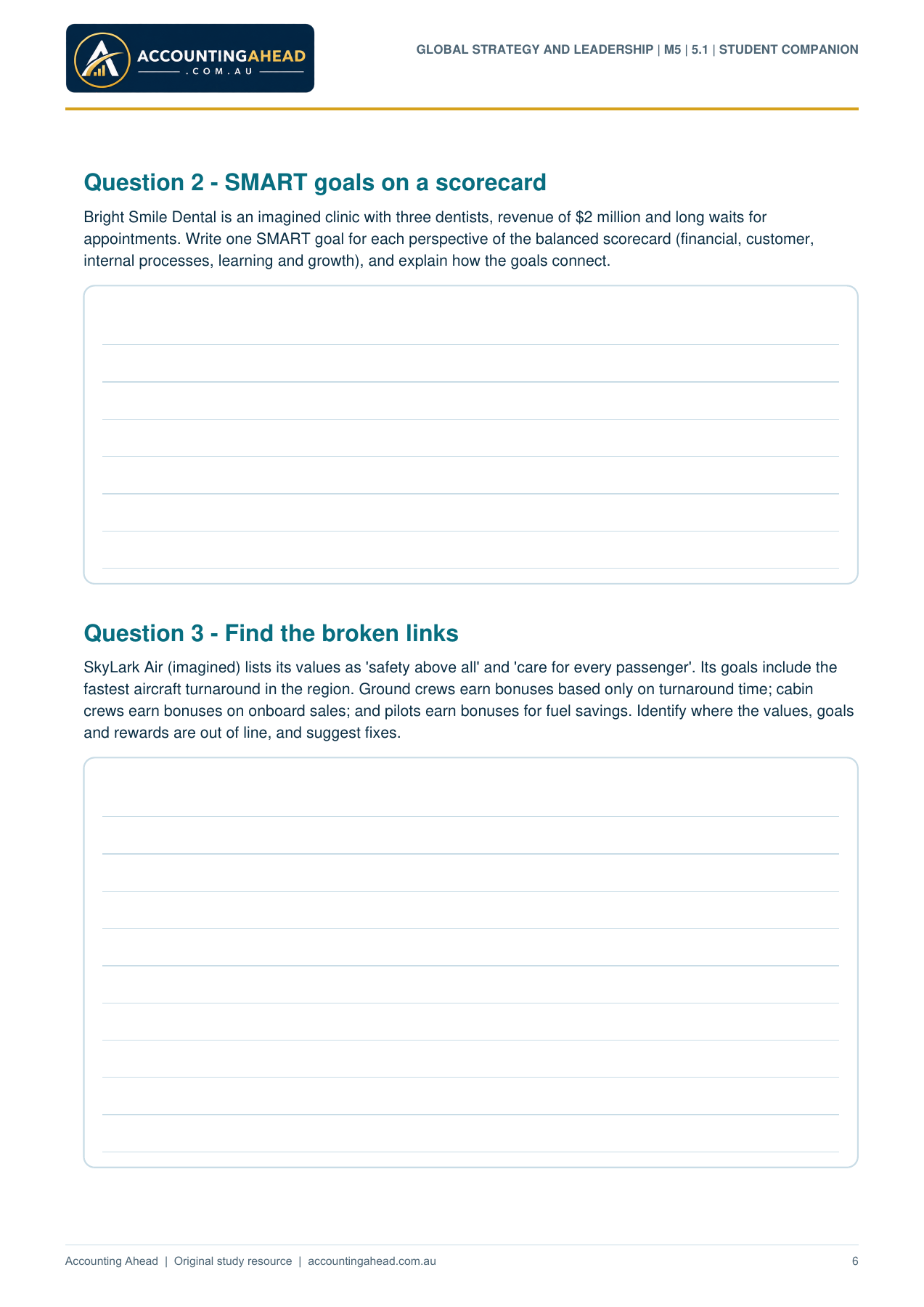
Question 2 - SMART goals on a scorecard
Bright Smile Dental is an imagined clinic with three dentists, revenue of $2 million and long waits for
appointments. Write one SMART goal for each perspective of the balanced scorecard (financial, customer,
internal processes, learning and growth), and explain how the goals connect.
Question 3 - Find the broken links
SkyLark Air (imagined) lists its values as 'safety above all' and 'care for every passenger'. Its goals include the
fastest aircraft turnaround in the region. Ground crews earn bonuses based only on turnaround time; cabin
crews earn bonuses on onboard sales; and pilots earn bonuses for fuel savings. Identify where the values, goals
and rewards are out of line, and suggest fixes.
GLOBAL STRATEGY AND LEADERSHIP | M5 | 5.1 | STUDENT COMPANION
6
Accounting Ahead | Original study resource | accountingahead.com.au
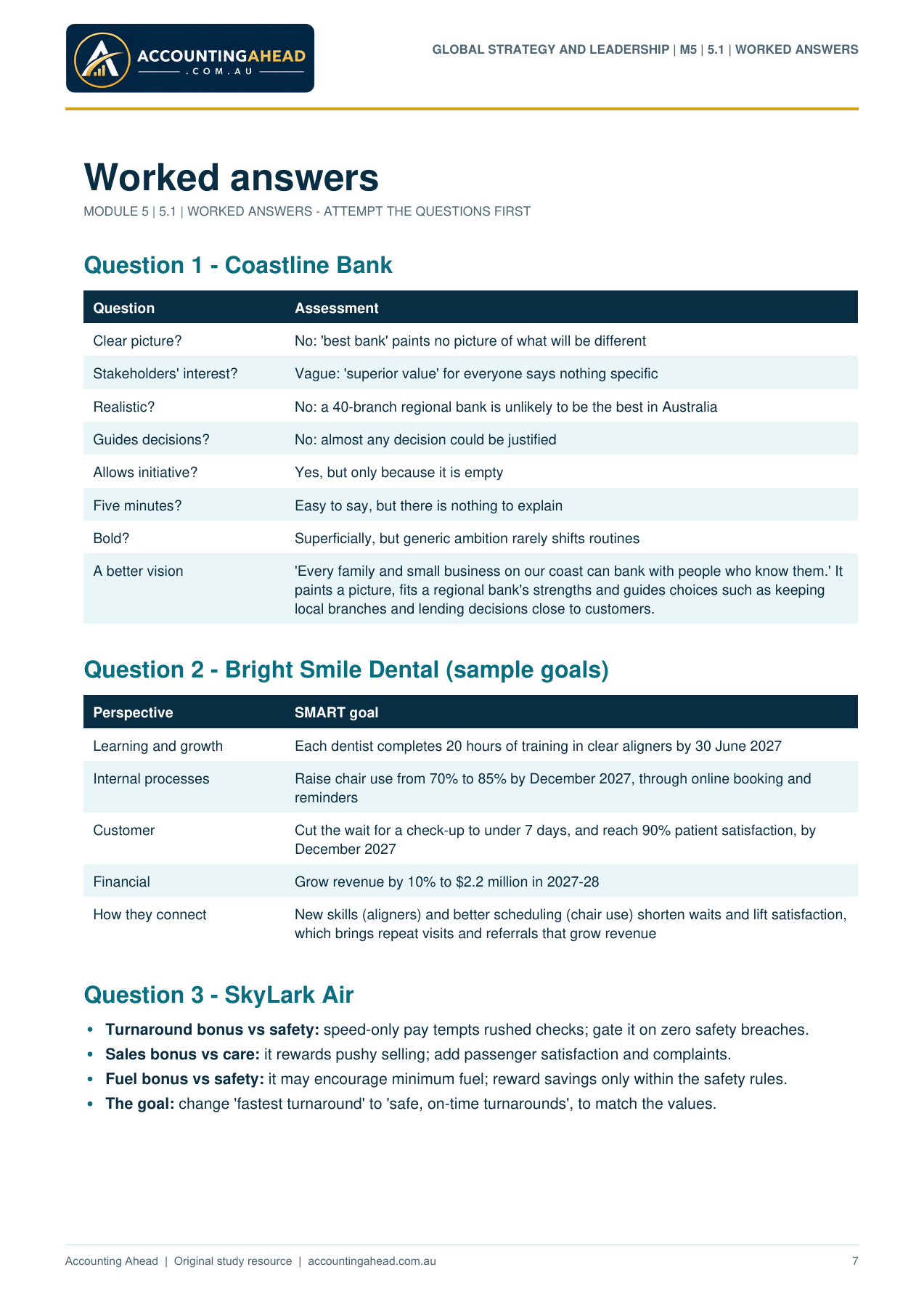
Worked answers
MODULE 5 | 5.1 | WORKED ANSWERS - ATTEMPT THE QUESTIONS FIRST
Question 1 - Coastline Bank
Question Assessment
Clear picture? No: 'best bank' paints no picture of what will be different
Stakeholders' interest? Vague: 'superior value' for everyone says nothing specific
Realistic? No: a 40-branch regional bank is unlikely to be the best in Australia
Guides decisions? No: almost any decision could be justified
Allows initiative? Yes, but only because it is empty
Five minutes? Easy to say, but there is nothing to explain
Bold? Superficially, but generic ambition rarely shifts routines
A better vision 'Every family and small business on our coast can bank with people who know them.' It
paints a picture, fits a regional bank's strengths and guides choices such as keeping
local branches and lending decisions close to customers.
Question 2 - Bright Smile Dental (sample goals)
Perspective SMART goal
Learning and growth Each dentist completes 20 hours of training in clear aligners by 30 June 2027
Internal processes Raise chair use from 70% to 85% by December 2027, through online booking and
reminders
Customer Cut the wait for a check-up to under 7 days, and reach 90% patient satisfaction, by
December 2027
Financial Grow revenue by 10% to $2.2 million in 2027-28
How they connect New skills (aligners) and better scheduling (chair use) shorten waits and lift satisfaction,
which brings repeat visits and referrals that grow revenue
Question 3 - SkyLark Air
Turnaround bonus vs safety: speed-only pay tempts rushed checks; gate it on zero safety breaches.
Sales bonus vs care: it rewards pushy selling; add passenger satisfaction and complaints.
Fuel bonus vs safety: it may encourage minimum fuel; reward savings only within the safety rules.
The goal: change 'fastest turnaround' to 'safe, on-time turnarounds', to match the values.
GLOBAL STRATEGY AND LEADERSHIP | M5 | 5.1 | WORKED ANSWERS
7