
Strategic drivers and operational levers
Printable study notes to use alongside Part 5.2.1.
Read the handout text
Accounting Ahead | Original study resource | accountingahead.com.au
Strategic drivers and operational levers
MODULE 5 | 5.2.1 | STUDENT COMPANION
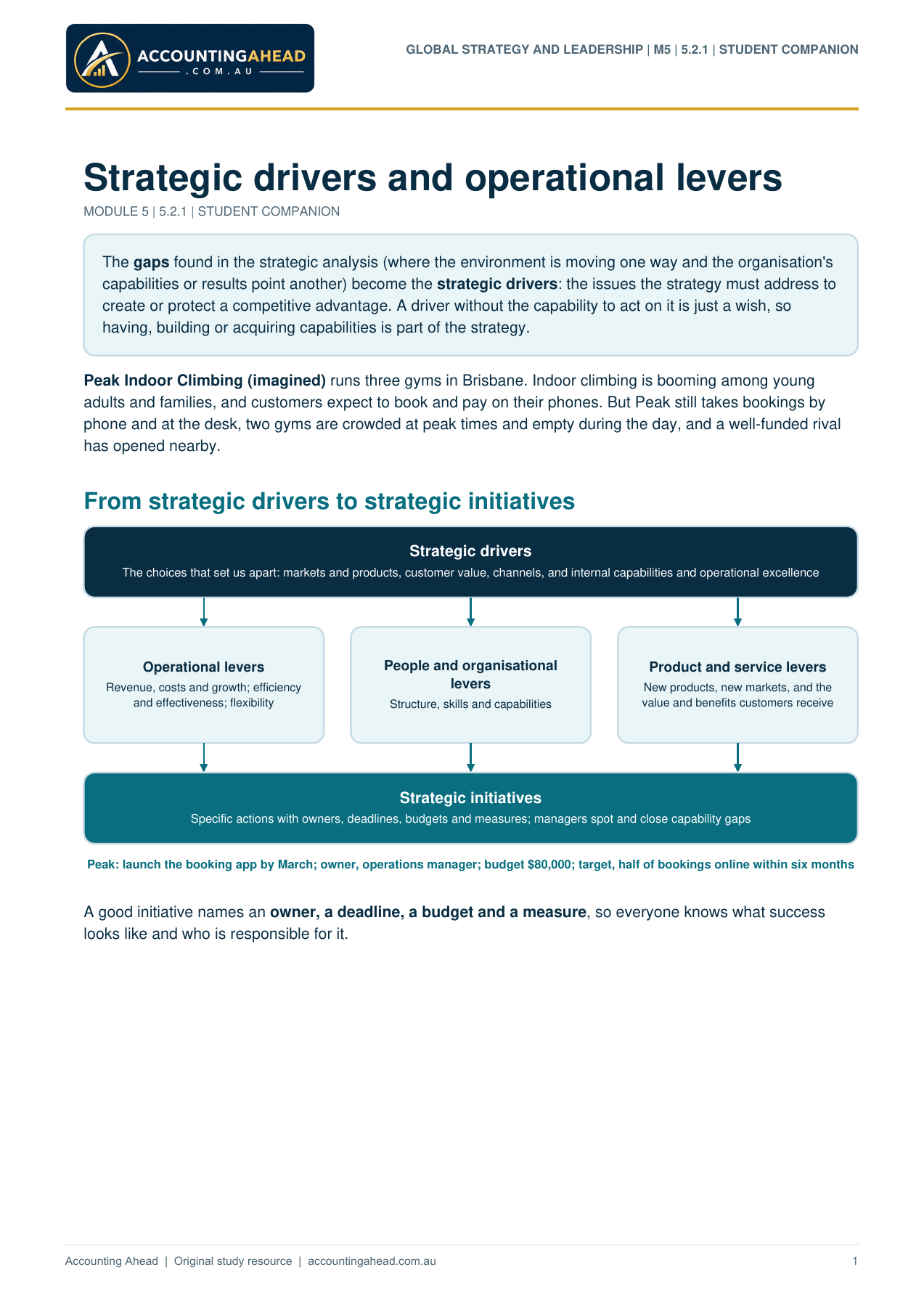
The gaps found in the strategic analysis (where the environment is moving one way and the organisation's
capabilities or results point another) become the strategic drivers: the issues the strategy must address to
create or protect a competitive advantage. A driver without the capability to act on it is just a wish, so
having, building or acquiring capabilities is part of the strategy.
Peak Indoor Climbing (imagined) runs three gyms in Brisbane. Indoor climbing is booming among young
adults and families, and customers expect to book and pay on their phones. But Peak still takes bookings by
phone and at the desk, two gyms are crowded at peak times and empty during the day, and a well-funded rival
has opened nearby.
From strategic drivers to strategic initiatives
Strategic drivers
The choices that set us apart: markets and products, customer value, channels, and internal capabilities and operational excellence
Operational levers
Revenue, costs and growth; efficiency
and effectiveness; flexibility
People and organisational
levers
Structure, skills and capabilities
Product and service levers
New products, new markets, and the
value and benefits customers receive
Strategic initiatives
Specific actions with owners, deadlines, budgets and measures; managers spot and close capability gaps
Peak: launch the booking app by March; owner, operations manager; budget $80,000; target, half of bookings online within six months
A good initiative names an owner, a deadline, a budget and a measure, so everyone knows what success
looks like and who is responsible for it.
GLOBAL STRATEGY AND LEADERSHIP | M5 | 5.2.1 | STUDENT COMPANION
1
Accounting Ahead | Original study resource | accountingahead.com.au
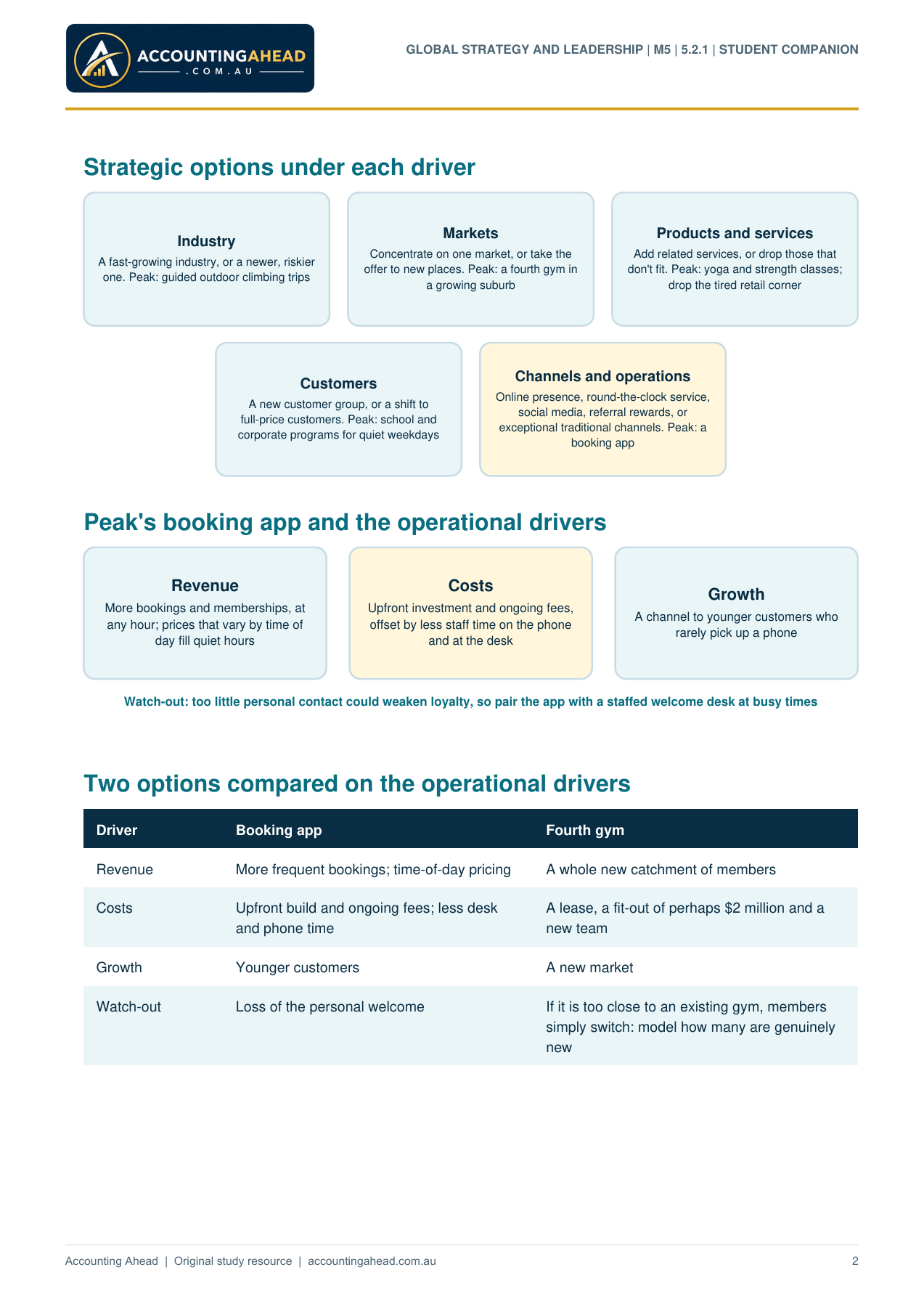
Strategic options under each driver
Industry
A fast-growing industry, or a newer, riskier
one. Peak: guided outdoor climbing trips
Markets
Concentrate on one market, or take the
offer to new places. Peak: a fourth gym in
a growing suburb
Products and services
Add related services, or drop those that
don't fit. Peak: yoga and strength classes;
drop the tired retail corner
Customers
A new customer group, or a shift to
full-price customers. Peak: school and
corporate programs for quiet weekdays
Channels and operations
Online presence, round-the-clock service,
social media, referral rewards, or
exceptional traditional channels. Peak: a
booking app
Peak's booking app and the operational drivers
Revenue
More bookings and memberships, at
any hour; prices that vary by time of
day fill quiet hours
Costs
Upfront investment and ongoing fees,
offset by less staff time on the phone
and at the desk
Growth
A channel to younger customers who
rarely pick up a phone
Watch-out: too little personal contact could weaken loyalty, so pair the app with a staffed welcome desk at busy times
Two options compared on the operational drivers
Driver Booking app Fourth gym
Revenue More frequent bookings; time-of-day pricing A whole new catchment of members
Costs Upfront build and ongoing fees; less desk
and phone time
A lease, a fit-out of perhaps $2 million and a
new team
Growth Younger customers A new market
Watch-out Loss of the personal welcome If it is too close to an existing gym, members
simply switch: model how many are genuinely
new
GLOBAL STRATEGY AND LEADERSHIP | M5 | 5.2.1 | STUDENT COMPANION
2
Accounting Ahead | Original study resource | accountingahead.com.au
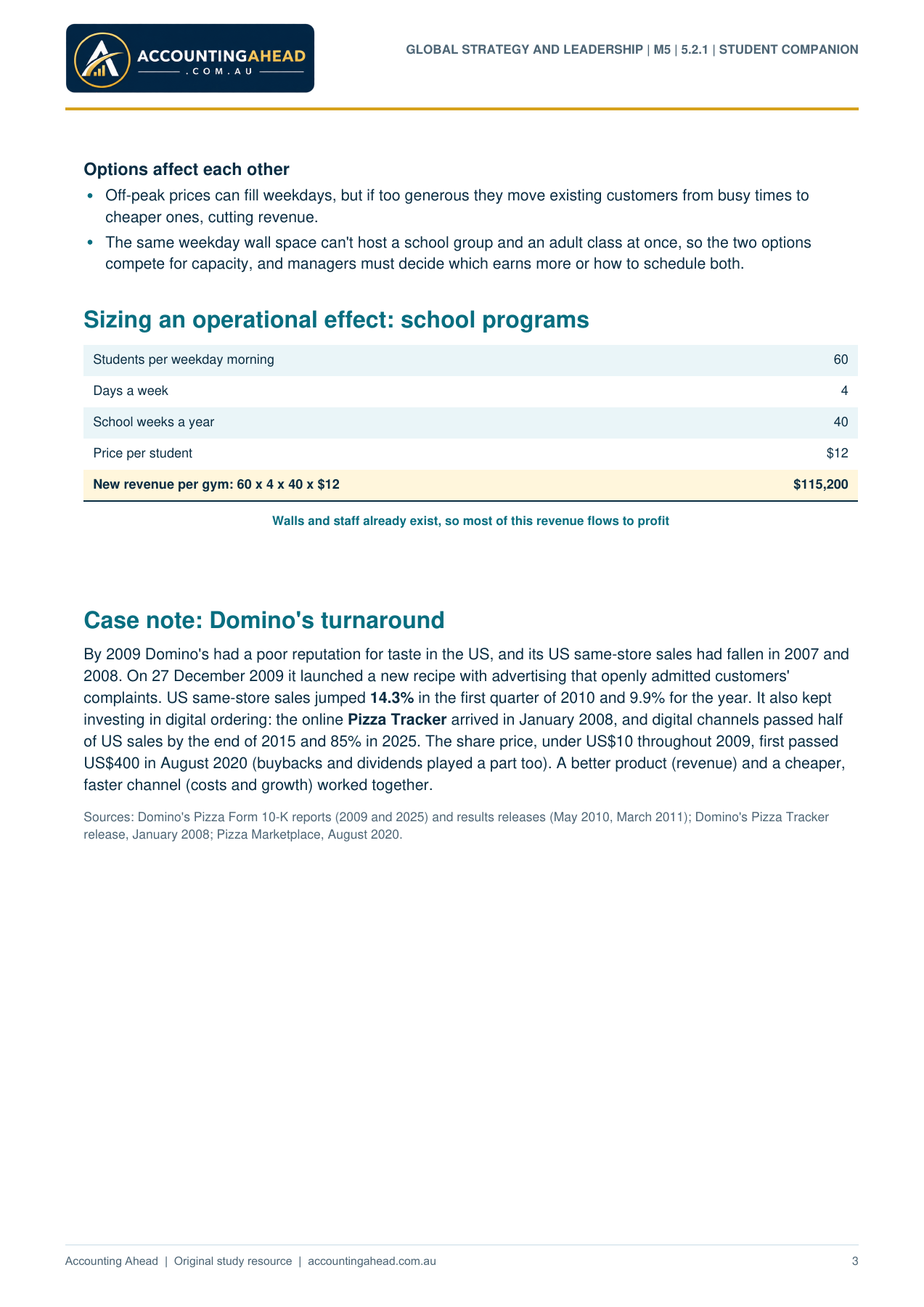
Options affect each other
Off-peak prices can fill weekdays, but if too generous they move existing customers from busy times to
cheaper ones, cutting revenue.
The same weekday wall space can't host a school group and an adult class at once, so the two options
compete for capacity, and managers must decide which earns more or how to schedule both.
Sizing an operational effect: school programs
Students per weekday morning 60
Days a week 4
School weeks a year 40
Price per student $12
New revenue per gym: 60 x 4 x 40 x $12 $115,200
Walls and staff already exist, so most of this revenue flows to profit
Case note: Domino's turnaround
By 2009 Domino's had a poor reputation for taste in the US, and its US same-store sales had fallen in 2007 and
2008. On 27 December 2009 it launched a new recipe with advertising that openly admitted customers'
complaints. US same-store sales jumped 14.3% in the first quarter of 2010 and 9.9% for the year. It also kept
investing in digital ordering: the online Pizza Tracker arrived in January 2008, and digital channels passed half
of US sales by the end of 2015 and 85% in 2025. The share price, under US$10 throughout 2009, first passed
US$400 in August 2020 (buybacks and dividends played a part too). A better product (revenue) and a cheaper,
faster channel (costs and growth) worked together.
Sources: Domino's Pizza Form 10-K reports (2009 and 2025) and results releases (May 2010, March 2011); Domino's Pizza Tracker
release, January 2008; Pizza Marketplace, August 2020.
GLOBAL STRATEGY AND LEADERSHIP | M5 | 5.2.1 | STUDENT COMPANION
3
Accounting Ahead | Original study resource | accountingahead.com.au
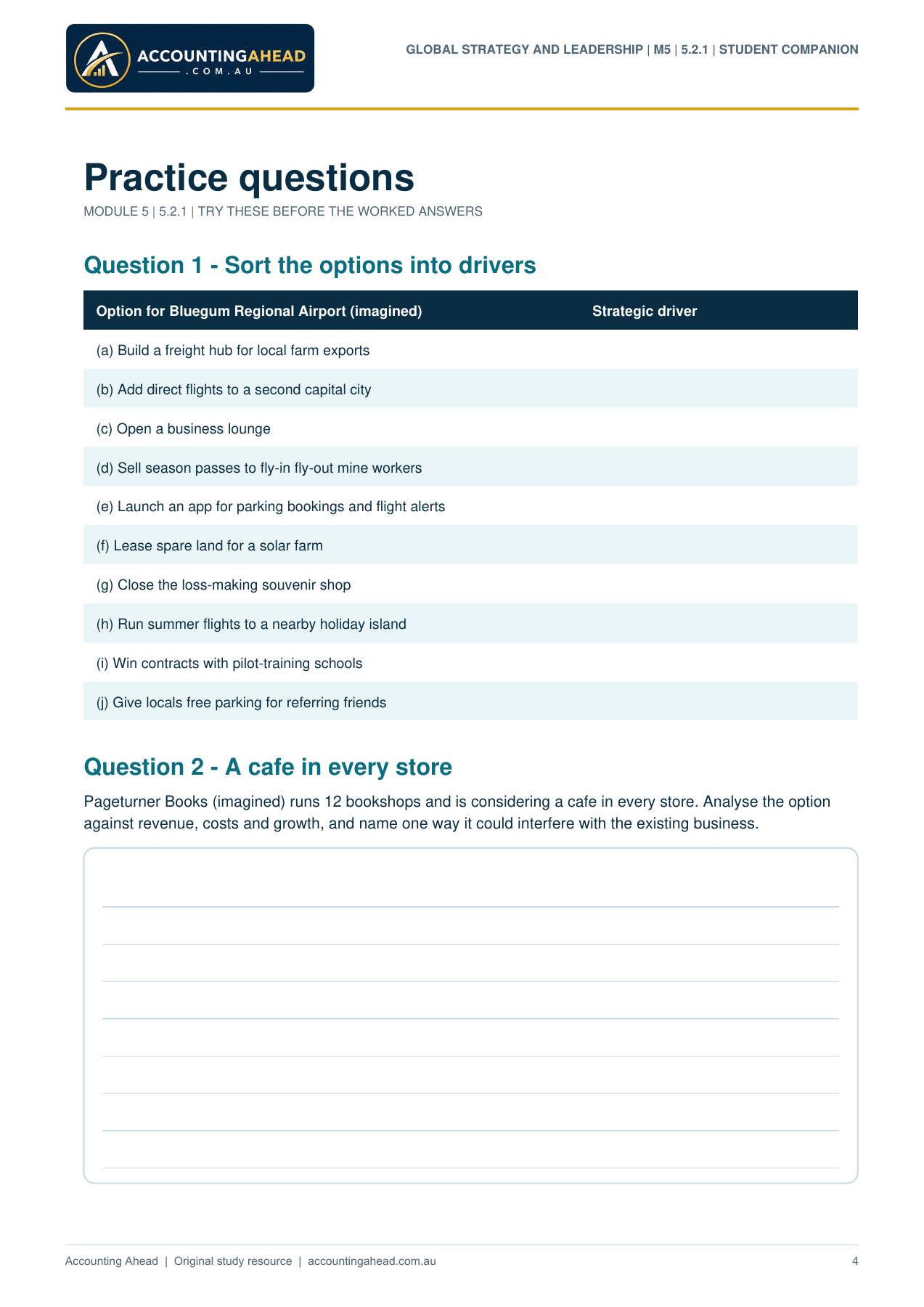
Practice questions
MODULE 5 | 5.2.1 | TRY THESE BEFORE THE WORKED ANSWERS
Question 1 - Sort the options into drivers
Option for Bluegum Regional Airport (imagined) Strategic driver
(a) Build a freight hub for local farm exports
(b) Add direct flights to a second capital city
(c) Open a business lounge
(d) Sell season passes to fly-in fly-out mine workers
(e) Launch an app for parking bookings and flight alerts
(f) Lease spare land for a solar farm
(g) Close the loss-making souvenir shop
(h) Run summer flights to a nearby holiday island
(i) Win contracts with pilot-training schools
(j) Give locals free parking for referring friends
Question 2 - A cafe in every store
Pageturner Books (imagined) runs 12 bookshops and is considering a cafe in every store. Analyse the option
against revenue, costs and growth, and name one way it could interfere with the existing business.
GLOBAL STRATEGY AND LEADERSHIP | M5 | 5.2.1 | STUDENT COMPANION
4
Accounting Ahead | Original study resource | accountingahead.com.au
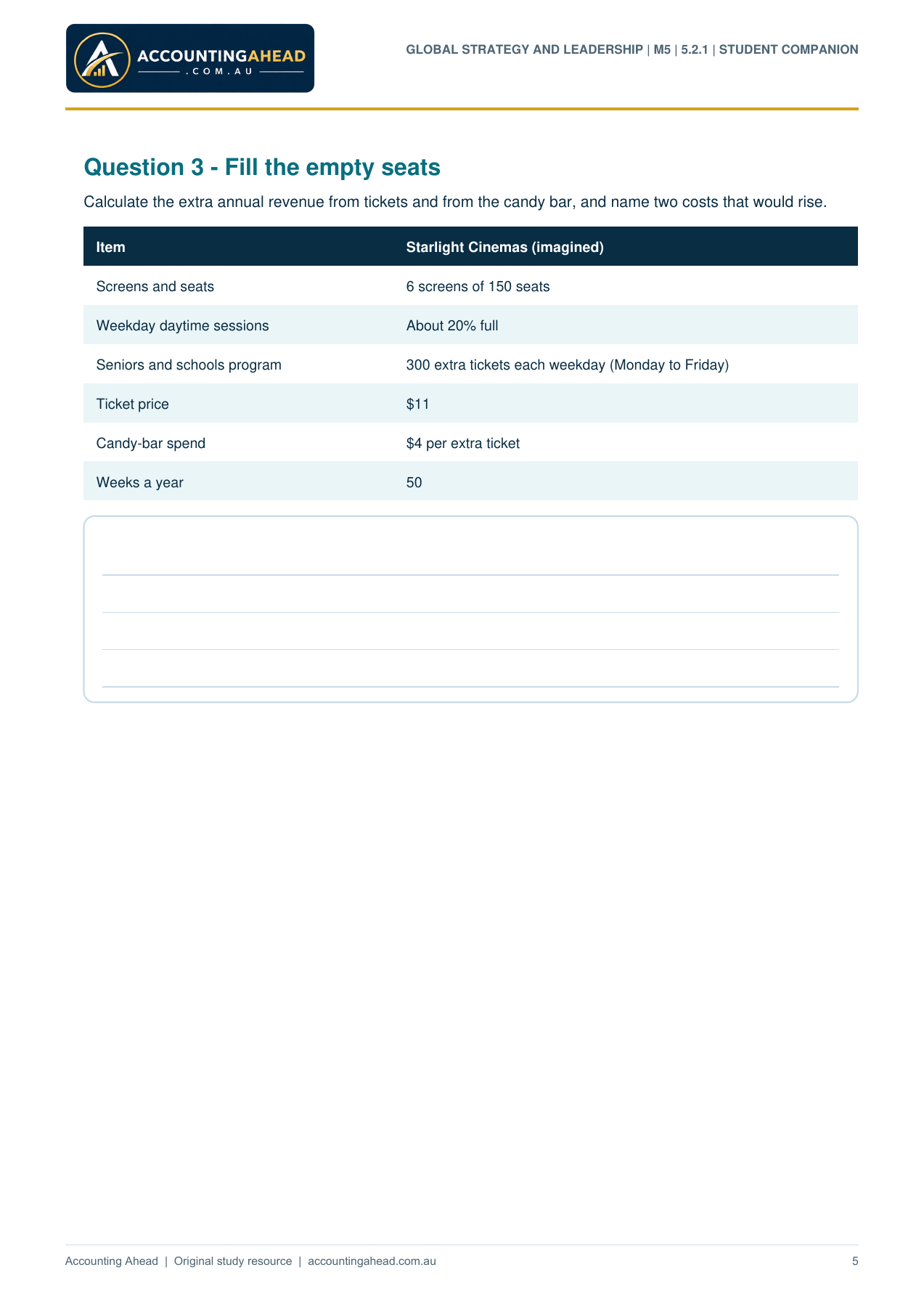
Question 3 - Fill the empty seats
Calculate the extra annual revenue from tickets and from the candy bar, and name two costs that would rise.
Item Starlight Cinemas (imagined)
Screens and seats 6 screens of 150 seats
Weekday daytime sessions About 20% full
Seniors and schools program 300 extra tickets each weekday (Monday to Friday)
Ticket price $11
Candy-bar spend $4 per extra ticket
Weeks a year 50
GLOBAL STRATEGY AND LEADERSHIP | M5 | 5.2.1 | STUDENT COMPANION
5
Accounting Ahead | Original study resource | accountingahead.com.au
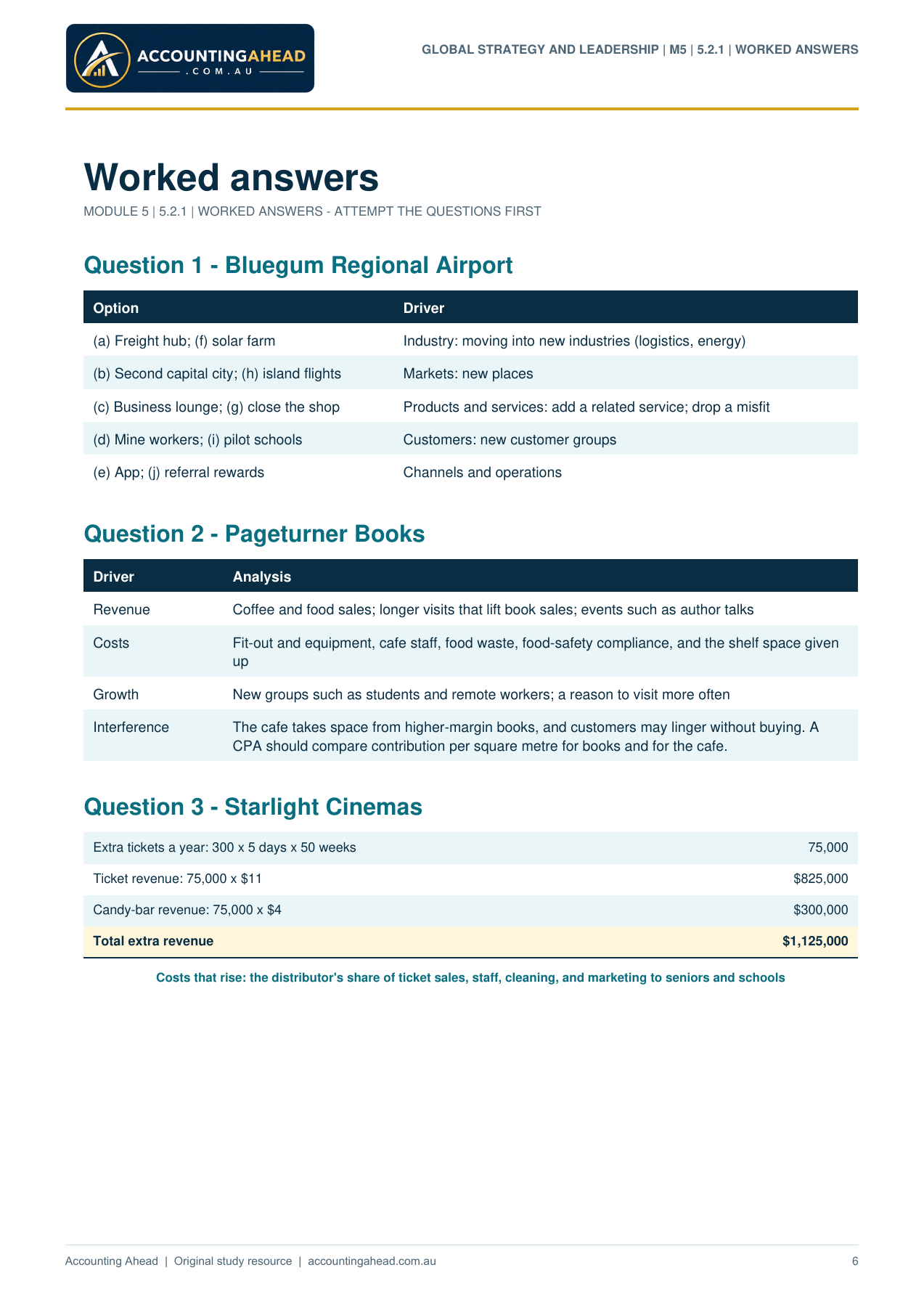
Worked answers
MODULE 5 | 5.2.1 | WORKED ANSWERS - ATTEMPT THE QUESTIONS FIRST
Question 1 - Bluegum Regional Airport
Option Driver
(a) Freight hub; (f) solar farm Industry: moving into new industries (logistics, energy)
(b) Second capital city; (h) island flights Markets: new places
(c) Business lounge; (g) close the shop Products and services: add a related service; drop a misfit
(d) Mine workers; (i) pilot schools Customers: new customer groups
(e) App; (j) referral rewards Channels and operations
Question 2 - Pageturner Books
Driver Analysis
Revenue Coffee and food sales; longer visits that lift book sales; events such as author talks
Costs Fit-out and equipment, cafe staff, food waste, food-safety compliance, and the shelf space given
up
Growth New groups such as students and remote workers; a reason to visit more often
Interference The cafe takes space from higher-margin books, and customers may linger without buying. A
CPA should compare contribution per square metre for books and for the cafe.
Question 3 - Starlight Cinemas
Extra tickets a year: 300 x 5 days x 50 weeks 75,000
Ticket revenue: 75,000 x $11 $825,000
Candy-bar revenue: 75,000 x $4 $300,000
Total extra revenue $1,125,000
Costs that rise: the distributor's share of ticket sales, staff, cleaning, and marketing to seniors and schools
GLOBAL STRATEGY AND LEADERSHIP | M5 | 5.2.1 | WORKED ANSWERS
6