
Evaluating options with business analytics
Printable study notes to use alongside Part 5.3.2.
Read the handout text
Accounting Ahead | Original study resource | accountingahead.com.au
Evaluating options with business analytics
MODULE 5 | 5.3.2 | STUDENT COMPANION
Business analytics finds patterns in data and communicates what they mean. Data comes from inside
and outside the organisation: sales records, customer and staff surveys, research on rivals and the
industry, economic statistics and financial results. Statistical models reveal patterns and estimate the
probability of outcomes, testing qualitative judgements against hard numbers.
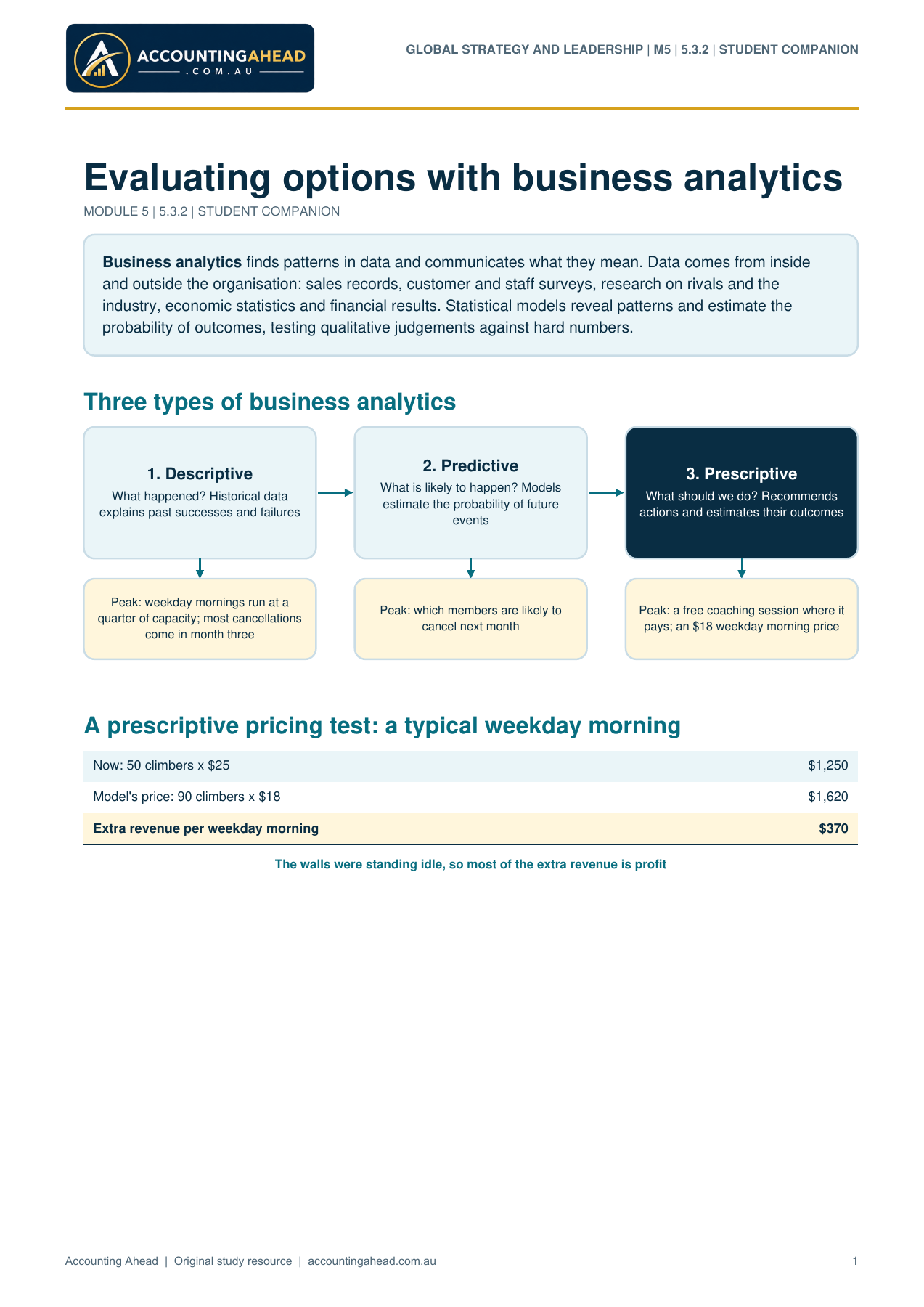
Three types of business analytics
1. Descriptive
What happened? Historical data
explains past successes and failures
Peak: weekday mornings run at a
quarter of capacity; most cancellations
come in month three
2. Predictive
What is likely to happen? Models
estimate the probability of future
events
Peak: which members are likely to
cancel next month
3. Prescriptive
What should we do? Recommends
actions and estimates their outcomes
Peak: a free coaching session where it
pays; an $18 weekday morning price
A prescriptive pricing test: a typical weekday morning
Now: 50 climbers x $25 $1,250
Model's price: 90 climbers x $18 $1,620
Extra revenue per weekday morning $370
The walls were standing idle, so most of the extra revenue is profit
GLOBAL STRATEGY AND LEADERSHIP | M5 | 5.3.2 | STUDENT COMPANION
1
Accounting Ahead | Original study resource | accountingahead.com.au
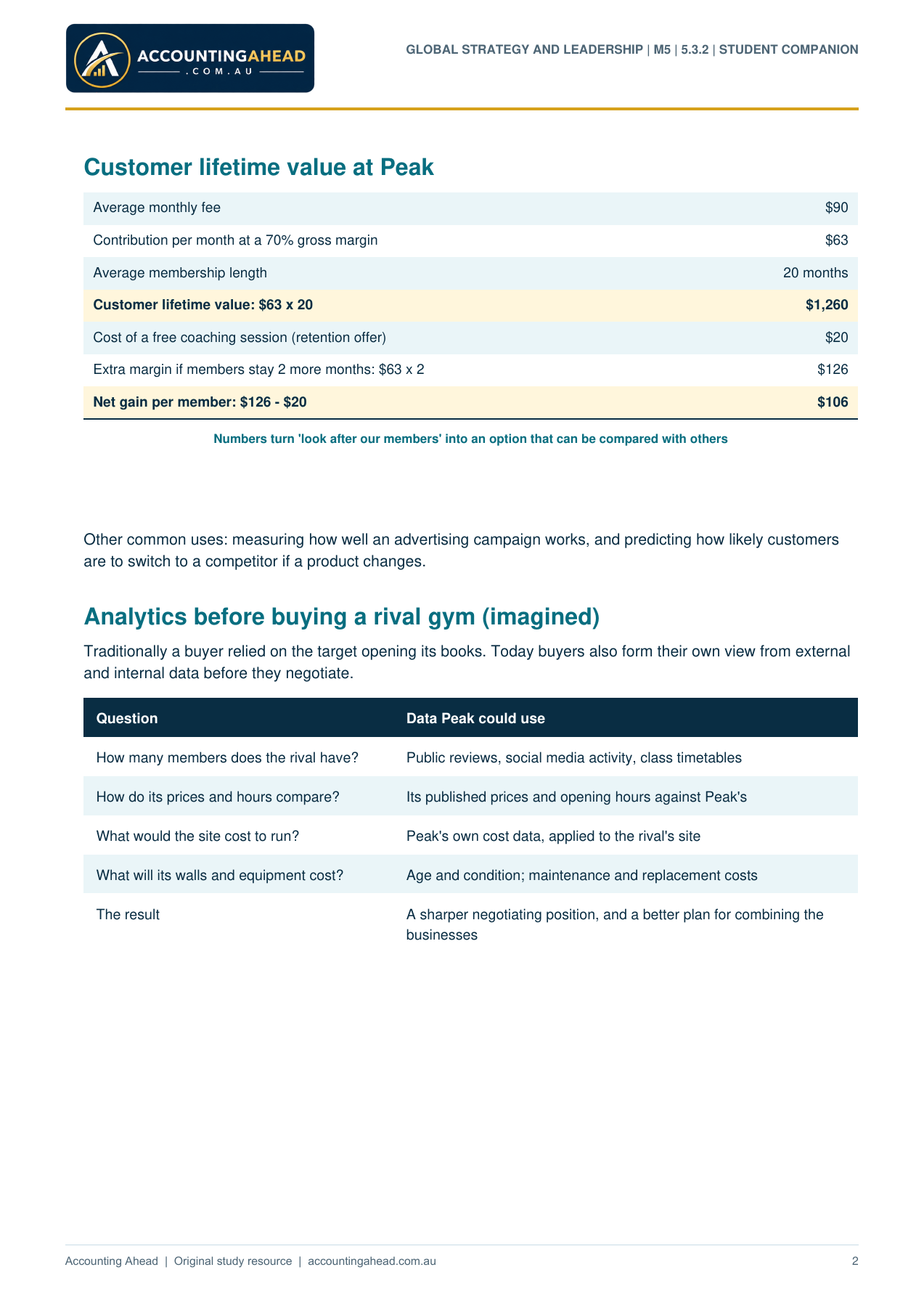
Customer lifetime value at Peak
Average monthly fee $90
Contribution per month at a 70% gross margin $63
Average membership length 20 months
Customer lifetime value: $63 x 20 $1,260
Cost of a free coaching session (retention offer) $20
Extra margin if members stay 2 more months: $63 x 2 $126
Net gain per member: $126 - $20 $106
Numbers turn 'look after our members' into an option that can be compared with others
Other common uses: measuring how well an advertising campaign works, and predicting how likely customers
are to switch to a competitor if a product changes.
Analytics before buying a rival gym (imagined)
Traditionally a buyer relied on the target opening its books. Today buyers also form their own view from external
and internal data before they negotiate.
Question Data Peak could use
How many members does the rival have? Public reviews, social media activity, class timetables
How do its prices and hours compare? Its published prices and opening hours against Peak's
What would the site cost to run? Peak's own cost data, applied to the rival's site
What will its walls and equipment cost? Age and condition; maintenance and replacement costs
The result A sharper negotiating position, and a better plan for combining the
businesses
GLOBAL STRATEGY AND LEADERSHIP | M5 | 5.3.2 | STUDENT COMPANION
2
Accounting Ahead | Original study resource | accountingahead.com.au
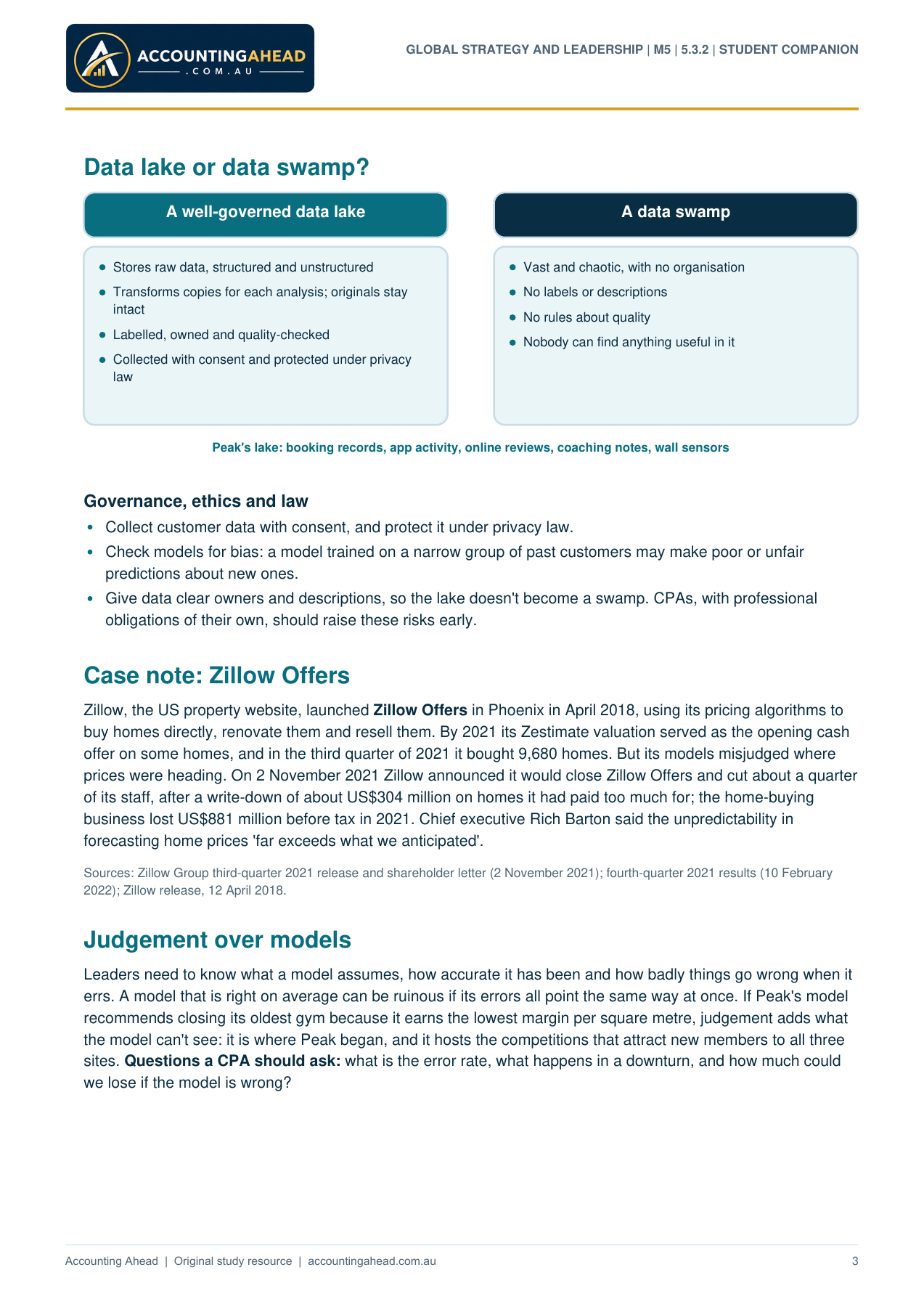
Data lake or data swamp?
A well-governed data lake
Stores raw data, structured and unstructured
Transforms copies for each analysis; originals stay
intact
Labelled, owned and quality-checked
Collected with consent and protected under privacy
law
A data swamp
Vast and chaotic, with no organisation
No labels or descriptions
No rules about quality
Nobody can find anything useful in it
Peak's lake: booking records, app activity, online reviews, coaching notes, wall sensors
Governance, ethics and law
Collect customer data with consent, and protect it under privacy law.
Check models for bias: a model trained on a narrow group of past customers may make poor or unfair
predictions about new ones.
Give data clear owners and descriptions, so the lake doesn't become a swamp. CPAs, with professional
obligations of their own, should raise these risks early.
Case note: Zillow Offers
Zillow, the US property website, launched Zillow Offers in Phoenix in April 2018, using its pricing algorithms to
buy homes directly, renovate them and resell them. By 2021 its Zestimate valuation served as the opening cash
offer on some homes, and in the third quarter of 2021 it bought 9,680 homes. But its models misjudged where
prices were heading. On 2 November 2021 Zillow announced it would close Zillow Offers and cut about a quarter
of its staff, after a write-down of about US$304 million on homes it had paid too much for; the home-buying
business lost US$881 million before tax in 2021. Chief executive Rich Barton said the unpredictability in
forecasting home prices 'far exceeds what we anticipated'.
Sources: Zillow Group third-quarter 2021 release and shareholder letter (2 November 2021); fourth-quarter 2021 results (10 February
2022); Zillow release, 12 April 2018.
Judgement over models
Leaders need to know what a model assumes, how accurate it has been and how badly things go wrong when it
errs. A model that is right on average can be ruinous if its errors all point the same way at once. If Peak's model
recommends closing its oldest gym because it earns the lowest margin per square metre, judgement adds what
the model can't see: it is where Peak began, and it hosts the competitions that attract new members to all three
sites. Questions a CPA should ask: what is the error rate, what happens in a downturn, and how much could
we lose if the model is wrong?
GLOBAL STRATEGY AND LEADERSHIP | M5 | 5.3.2 | STUDENT COMPANION
3
Accounting Ahead | Original study resource | accountingahead.com.au
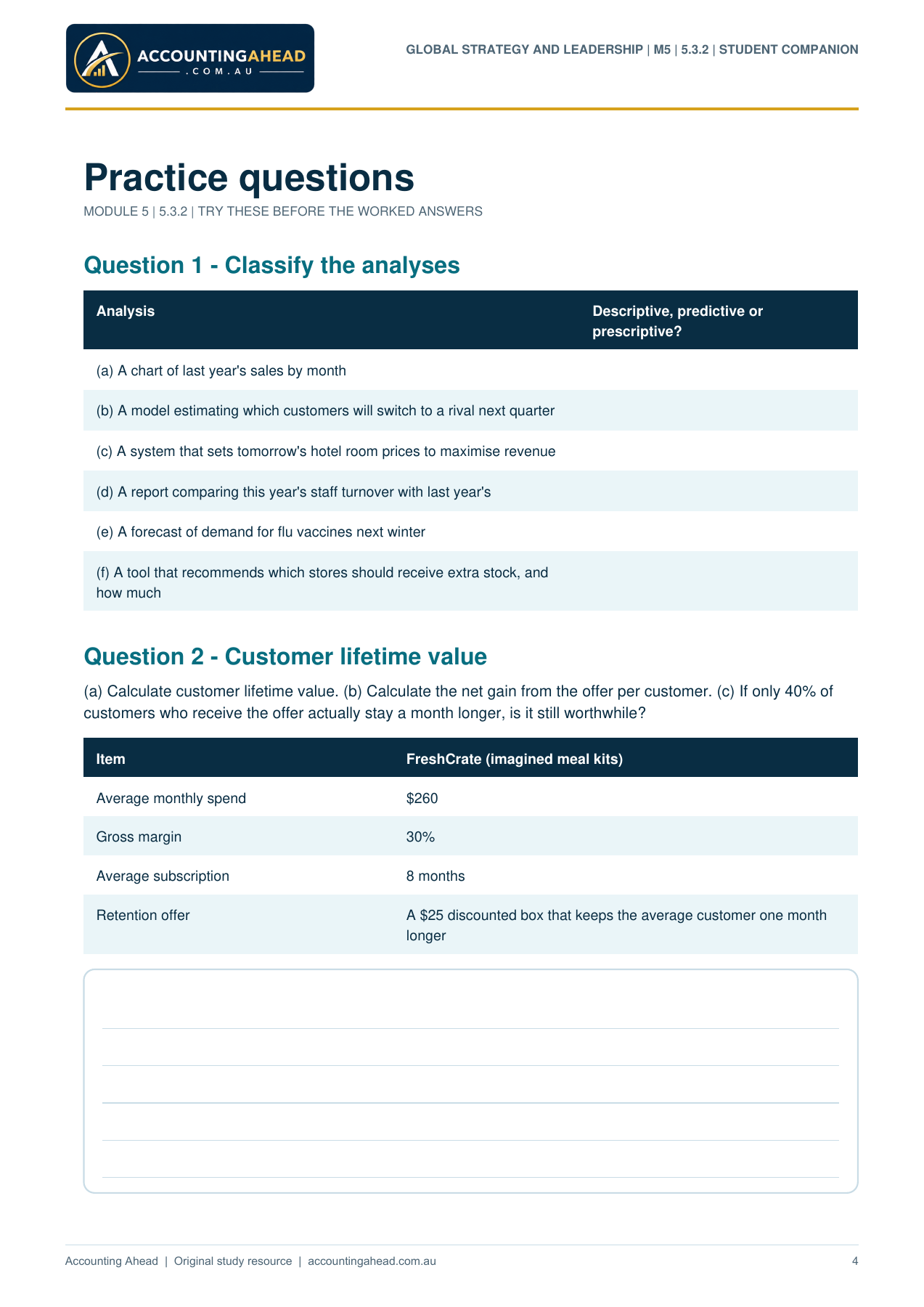
Practice questions
MODULE 5 | 5.3.2 | TRY THESE BEFORE THE WORKED ANSWERS
Question 1 - Classify the analyses
Analysis Descriptive, predictive or
prescriptive?
(a) A chart of last year's sales by month
(b) A model estimating which customers will switch to a rival next quarter
(c) A system that sets tomorrow's hotel room prices to maximise revenue
(d) A report comparing this year's staff turnover with last year's
(e) A forecast of demand for flu vaccines next winter
(f) A tool that recommends which stores should receive extra stock, and
how much
Question 2 - Customer lifetime value
(a) Calculate customer lifetime value. (b) Calculate the net gain from the offer per customer. (c) If only 40% of
customers who receive the offer actually stay a month longer, is it still worthwhile?
Item FreshCrate (imagined meal kits)
Average monthly spend $260
Gross margin 30%
Average subscription 8 months
Retention offer A $25 discounted box that keeps the average customer one month
longer
GLOBAL STRATEGY AND LEADERSHIP | M5 | 5.3.2 | STUDENT COMPANION
4
Accounting Ahead | Original study resource | accountingahead.com.au
Question 3 - When the model says 'buy'
A model at an imagined hardware chain recommends buying a rival chain for $40 million, predicting $6 million a
year in extra profit. How should the board respond?
GLOBAL STRATEGY AND LEADERSHIP | M5 | 5.3.2 | STUDENT COMPANION
5
Accounting Ahead | Original study resource | accountingahead.com.au
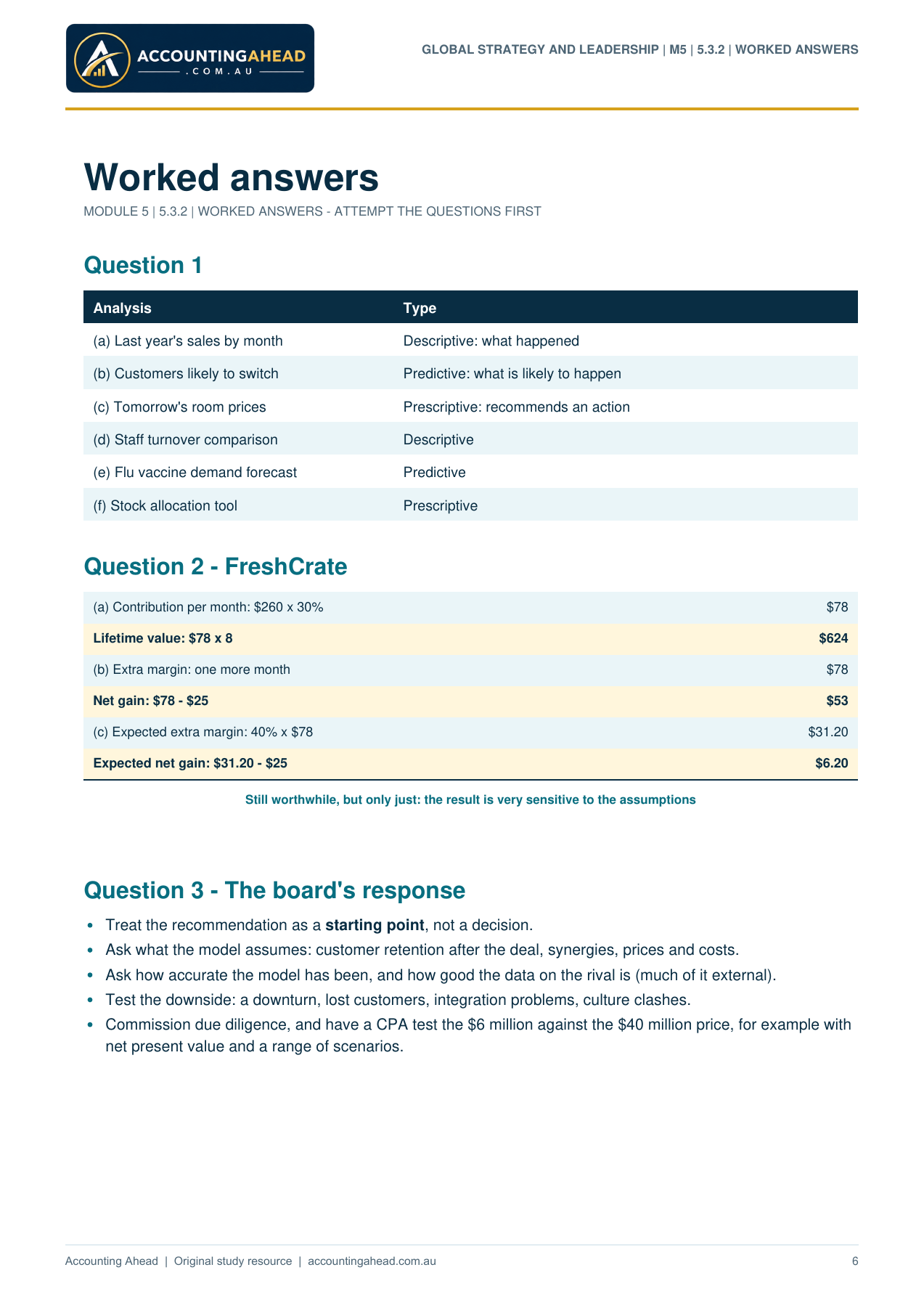
Worked answers
MODULE 5 | 5.3.2 | WORKED ANSWERS - ATTEMPT THE QUESTIONS FIRST
Question 1
Analysis Type
(a) Last year's sales by month Descriptive: what happened
(b) Customers likely to switch Predictive: what is likely to happen
(c) Tomorrow's room prices Prescriptive: recommends an action
(d) Staff turnover comparison Descriptive
(e) Flu vaccine demand forecast Predictive
(f) Stock allocation tool Prescriptive
Question 2 - FreshCrate
(a) Contribution per month: $260 x 30% $78
Lifetime value: $78 x 8 $624
(b) Extra margin: one more month $78
Net gain: $78 - $25 $53
(c) Expected extra margin: 40% x $78 $31.20
Expected net gain: $31.20 - $25 $6.20
Still worthwhile, but only just: the result is very sensitive to the assumptions
Question 3 - The board's response
Treat the recommendation as a starting point, not a decision.
Ask what the model assumes: customer retention after the deal, synergies, prices and costs.
Ask how accurate the model has been, and how good the data on the rival is (much of it external).
Test the downside: a downturn, lost customers, integration problems, culture clashes.
Commission due diligence, and have a CPA test the $6 million against the $40 million price, for example with
net present value and a range of scenarios.
GLOBAL STRATEGY AND LEADERSHIP | M5 | 5.3.2 | WORKED ANSWERS
6