
Treating, quantifying and timing risk
Printable study notes to use alongside Part 5.4.2.
Read the handout text
Accounting Ahead | Original study resource | accountingahead.com.au
Treating, quantifying and timing risk
MODULE 5 | 5.4.2 | STUDENT COMPANION
After the five-step assessment, managers understand each option's risks and how they could affect its
goals and the organisation as a whole. The next task is to choose a cost-effective treatment for each risk.
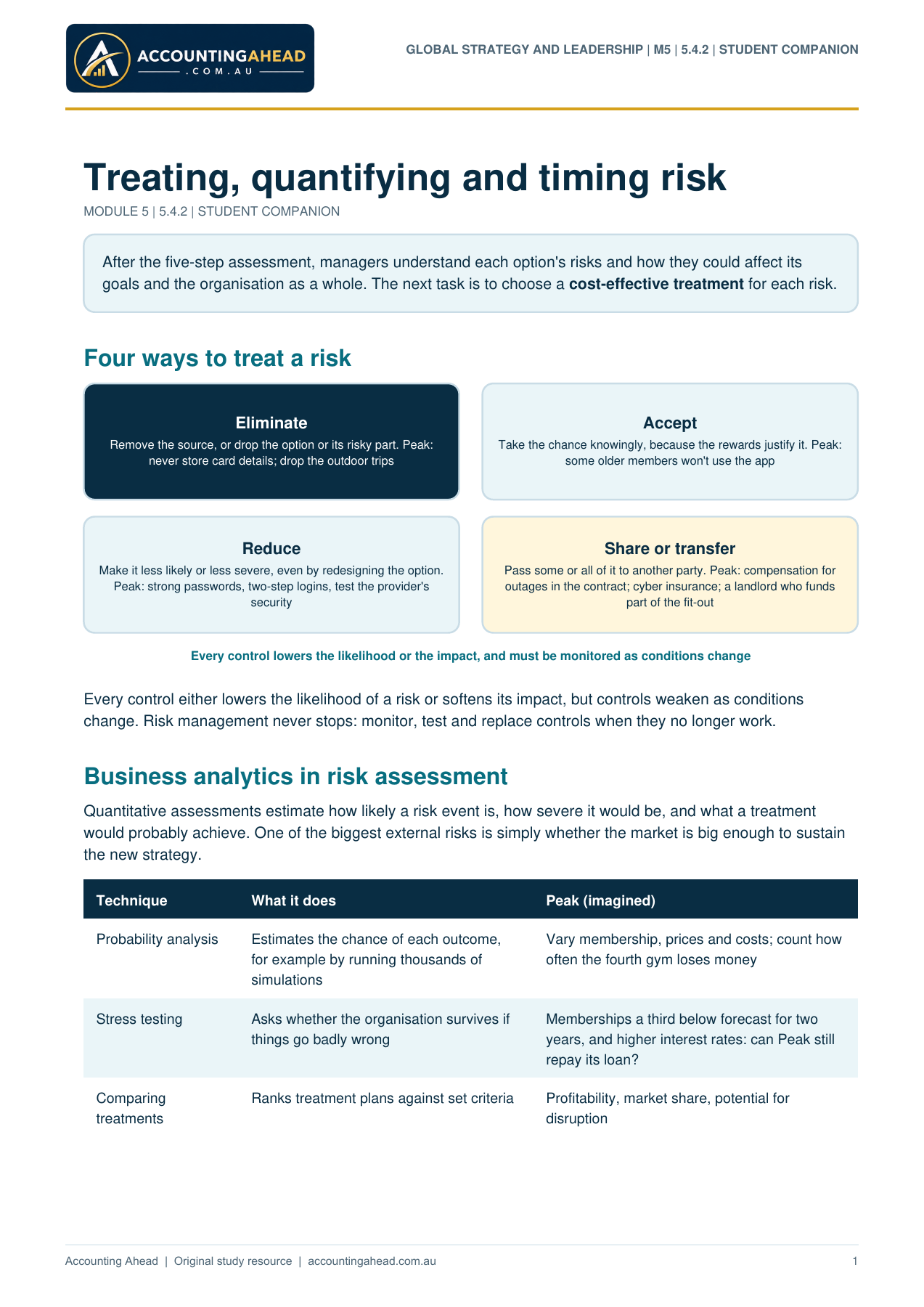
Four ways to treat a risk
Eliminate
Remove the source, or drop the option or its risky part. Peak:
never store card details; drop the outdoor trips
Accept
Take the chance knowingly, because the rewards justify it. Peak:
some older members won't use the app
Reduce
Make it less likely or less severe, even by redesigning the option.
Peak: strong passwords, two-step logins, test the provider's
security
Share or transfer
Pass some or all of it to another party. Peak: compensation for
outages in the contract; cyber insurance; a landlord who funds
part of the fit-out
Every control lowers the likelihood or the impact, and must be monitored as conditions change
Every control either lowers the likelihood of a risk or softens its impact, but controls weaken as conditions
change. Risk management never stops: monitor, test and replace controls when they no longer work.
Business analytics in risk assessment
Quantitative assessments estimate how likely a risk event is, how severe it would be, and what a treatment
would probably achieve. One of the biggest external risks is simply whether the market is big enough to sustain
the new strategy.
Technique What it does Peak (imagined)
Probability analysis Estimates the chance of each outcome,
for example by running thousands of
simulations
Vary membership, prices and costs; count how
often the fourth gym loses money
Stress testing Asks whether the organisation survives if
things go badly wrong
Memberships a third below forecast for two
years, and higher interest rates: can Peak still
repay its loan?
Comparing
treatments
Ranks treatment plans against set criteria Profitability, market share, potential for
disruption
GLOBAL STRATEGY AND LEADERSHIP | M5 | 5.4.2 | STUDENT COMPANION
1
Accounting Ahead | Original study resource | accountingahead.com.au
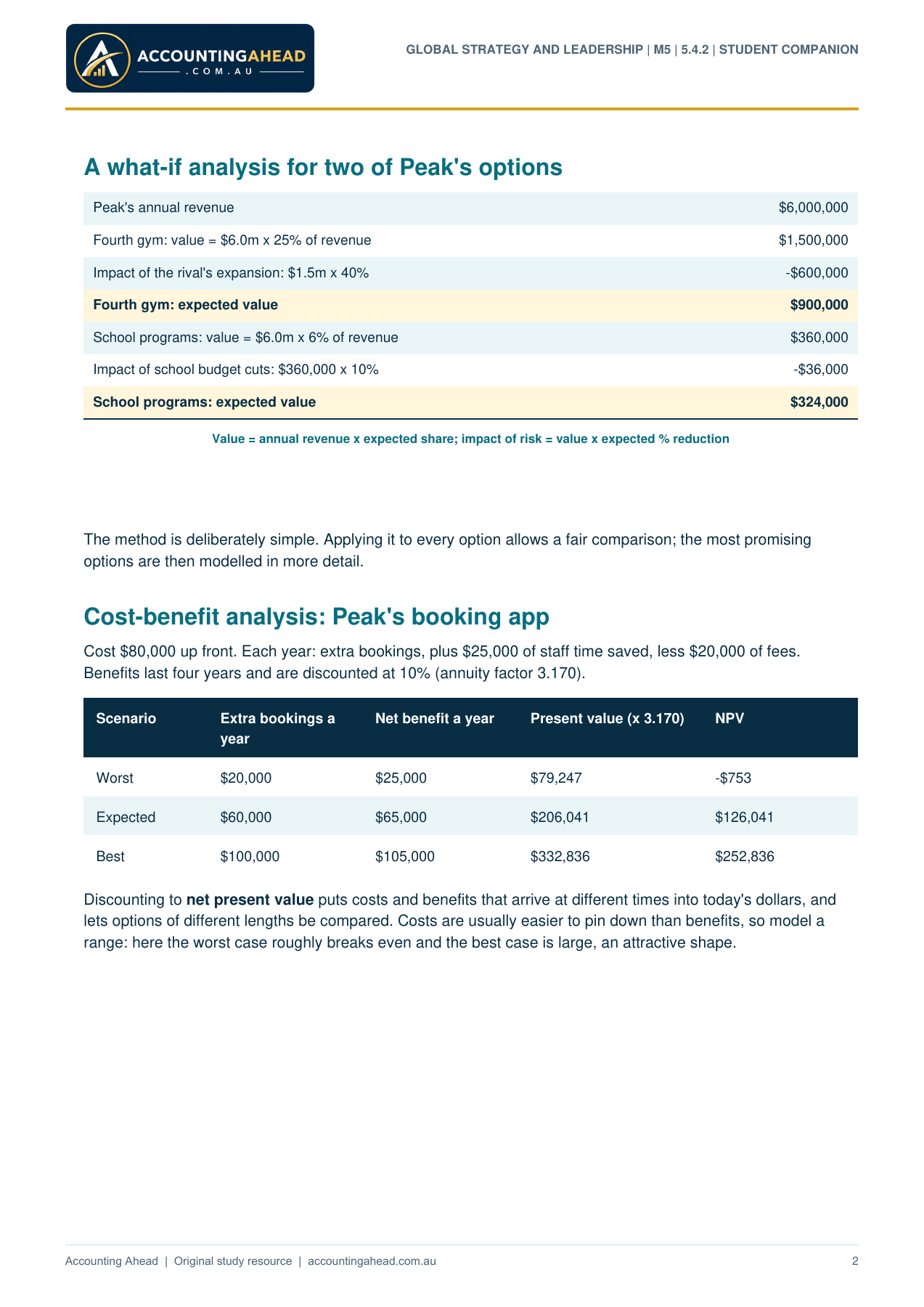
A what-if analysis for two of Peak's options
Peak's annual revenue $6,000,000
Fourth gym: value = $6.0m x 25% of revenue $1,500,000
Impact of the rival's expansion: $1.5m x 40% -$600,000
Fourth gym: expected value $900,000
School programs: value = $6.0m x 6% of revenue $360,000
Impact of school budget cuts: $360,000 x 10% -$36,000
School programs: expected value $324,000
Value = annual revenue x expected share; impact of risk = value x expected % reduction
The method is deliberately simple. Applying it to every option allows a fair comparison; the most promising
options are then modelled in more detail.
Cost-benefit analysis: Peak's booking app
Cost $80,000 up front. Each year: extra bookings, plus $25,000 of staff time saved, less $20,000 of fees.
Benefits last four years and are discounted at 10% (annuity factor 3.170).
Scenario Extra bookings a
year
Net benefit a year Present value (x 3.170) NPV
Worst $20,000 $25,000 $79,247 -$753
Expected $60,000 $65,000 $206,041 $126,041
Best $100,000 $105,000 $332,836 $252,836
Discounting to net present value puts costs and benefits that arrive at different times into today's dollars, and
lets options of different lengths be compared. Costs are usually easier to pin down than benefits, so model a
range: here the worst case roughly breaks even and the best case is large, an attractive shape.
GLOBAL STRATEGY AND LEADERSHIP | M5 | 5.4.2 | STUDENT COMPANION
2
Accounting Ahead | Original study resource | accountingahead.com.au
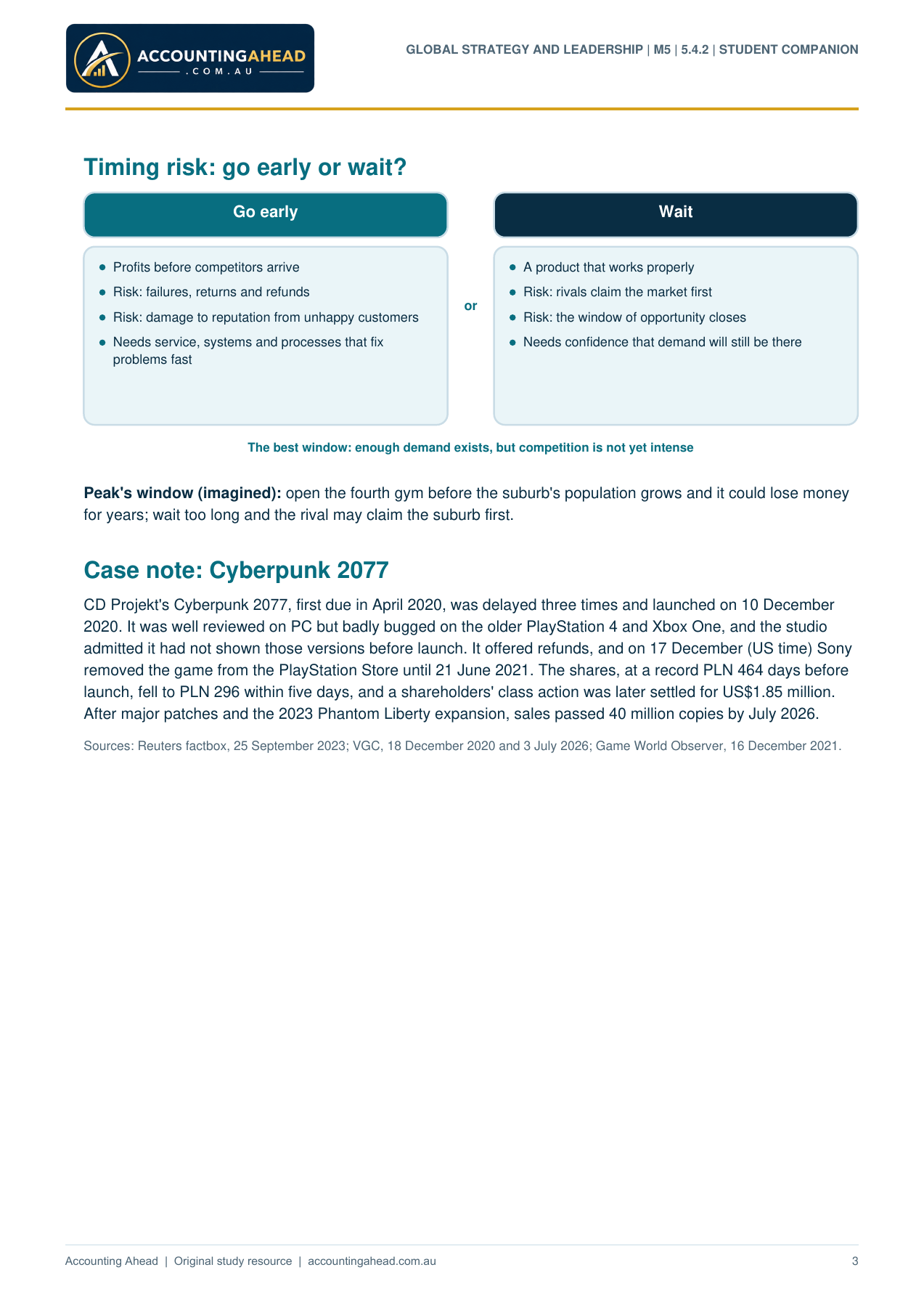
Timing risk: go early or wait?
Go early
Profits before competitors arrive
Risk: failures, returns and refunds
Risk: damage to reputation from unhappy customers
Needs service, systems and processes that fix
problems fast
Wait
A product that works properly
Risk: rivals claim the market first
Risk: the window of opportunity closes
Needs confidence that demand will still be there
or
The best window: enough demand exists, but competition is not yet intense
Peak's window (imagined): open the fourth gym before the suburb's population grows and it could lose money
for years; wait too long and the rival may claim the suburb first.
Case note: Cyberpunk 2077
CD Projekt's Cyberpunk 2077, first due in April 2020, was delayed three times and launched on 10 December
2020. It was well reviewed on PC but badly bugged on the older PlayStation 4 and Xbox One, and the studio
admitted it had not shown those versions before launch. It offered refunds, and on 17 December (US time) Sony
removed the game from the PlayStation Store until 21 June 2021. The shares, at a record PLN 464 days before
launch, fell to PLN 296 within five days, and a shareholders' class action was later settled for US$1.85 million.
After major patches and the 2023 Phantom Liberty expansion, sales passed 40 million copies by July 2026.
Sources: Reuters factbox, 25 September 2023; VGC, 18 December 2020 and 3 July 2026; Game World Observer, 16 December 2021.
GLOBAL STRATEGY AND LEADERSHIP | M5 | 5.4.2 | STUDENT COMPANION
3
Accounting Ahead | Original study resource | accountingahead.com.au
Practice questions
MODULE 5 | 5.4.2 | TRY THESE BEFORE THE WORKED ANSWERS
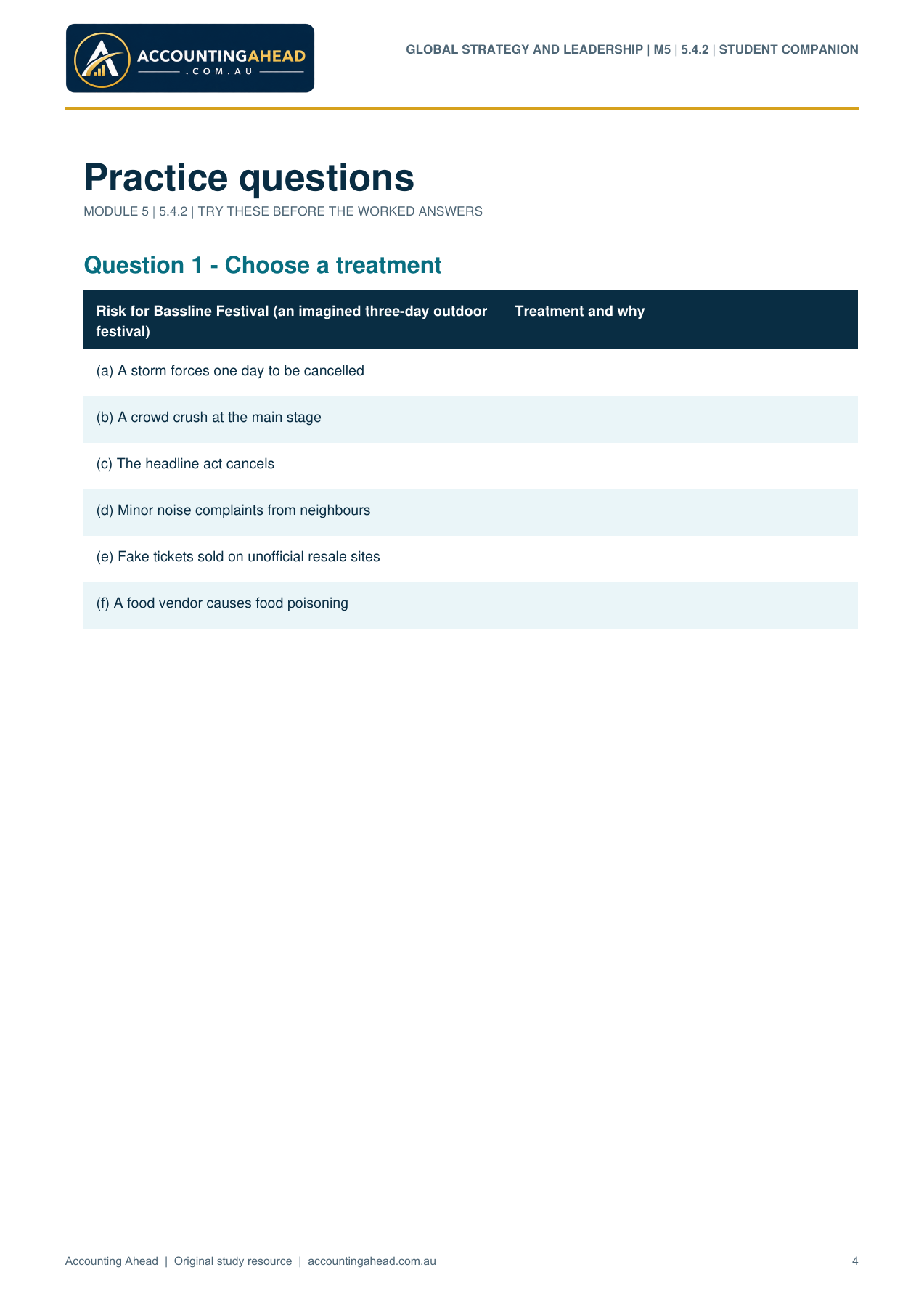
Question 1 - Choose a treatment
Risk for Bassline Festival (an imagined three-day outdoor
festival)
Treatment and why
(a) A storm forces one day to be cancelled
(b) A crowd crush at the main stage
(c) The headline act cancels
(d) Minor noise complaints from neighbours
(e) Fake tickets sold on unofficial resale sites
(f) A food vendor causes food poisoning
GLOBAL STRATEGY AND LEADERSHIP | M5 | 5.4.2 | STUDENT COMPANION
4
Accounting Ahead | Original study resource | accountingahead.com.au
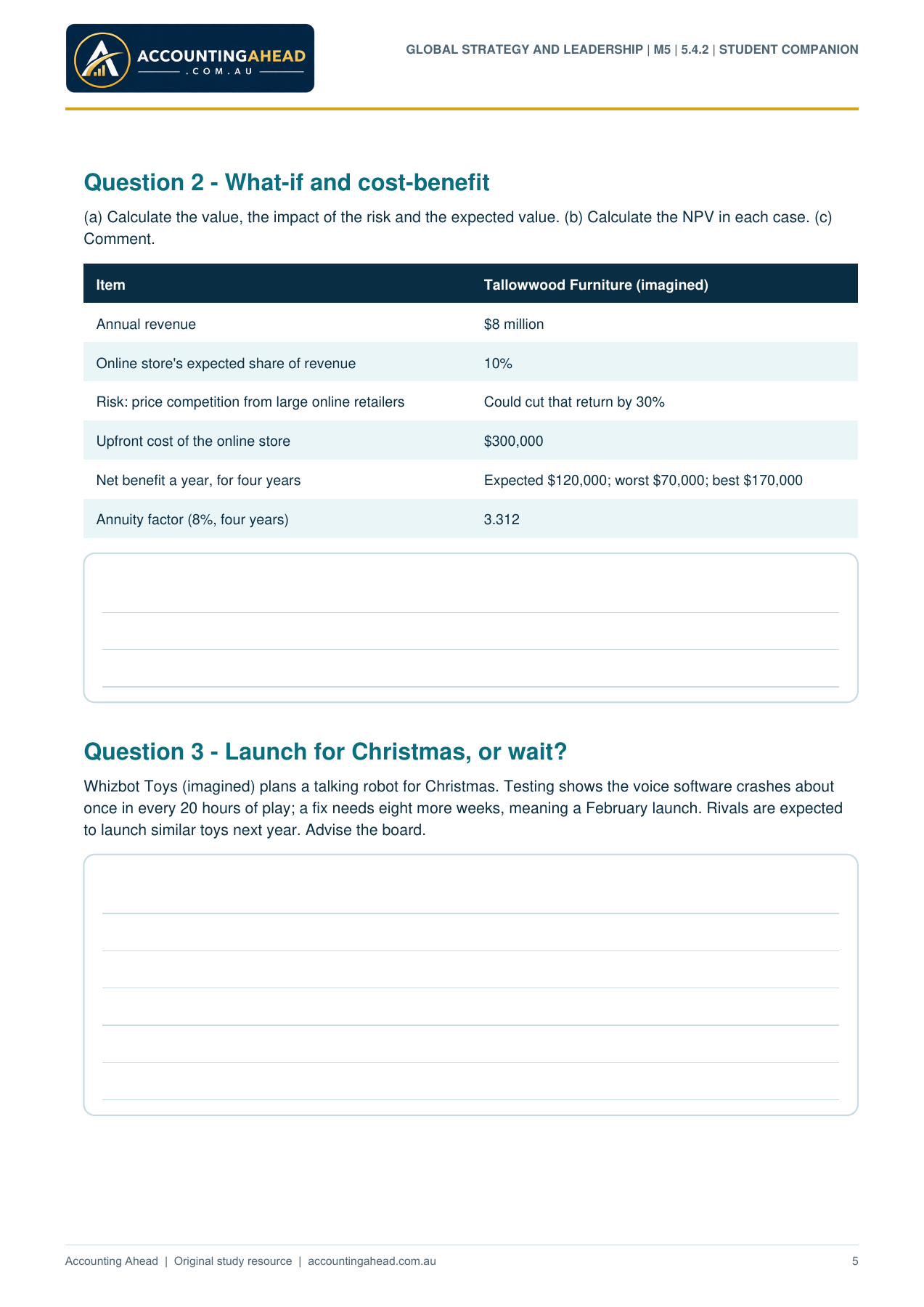
Question 2 - What-if and cost-benefit
(a) Calculate the value, the impact of the risk and the expected value. (b) Calculate the NPV in each case. (c)
Comment.
Item Tallowwood Furniture (imagined)
Annual revenue $8 million
Online store's expected share of revenue 10%
Risk: price competition from large online retailers Could cut that return by 30%
Upfront cost of the online store $300,000
Net benefit a year, for four years Expected $120,000; worst $70,000; best $170,000
Annuity factor (8%, four years) 3.312
Question 3 - Launch for Christmas, or wait?
Whizbot Toys (imagined) plans a talking robot for Christmas. Testing shows the voice software crashes about
once in every 20 hours of play; a fix needs eight more weeks, meaning a February launch. Rivals are expected
to launch similar toys next year. Advise the board.
GLOBAL STRATEGY AND LEADERSHIP | M5 | 5.4.2 | STUDENT COMPANION
5
Accounting Ahead | Original study resource | accountingahead.com.au
Worked answers
MODULE 5 | 5.4.2 | WORKED ANSWERS - ATTEMPT THE QUESTIONS FIRST
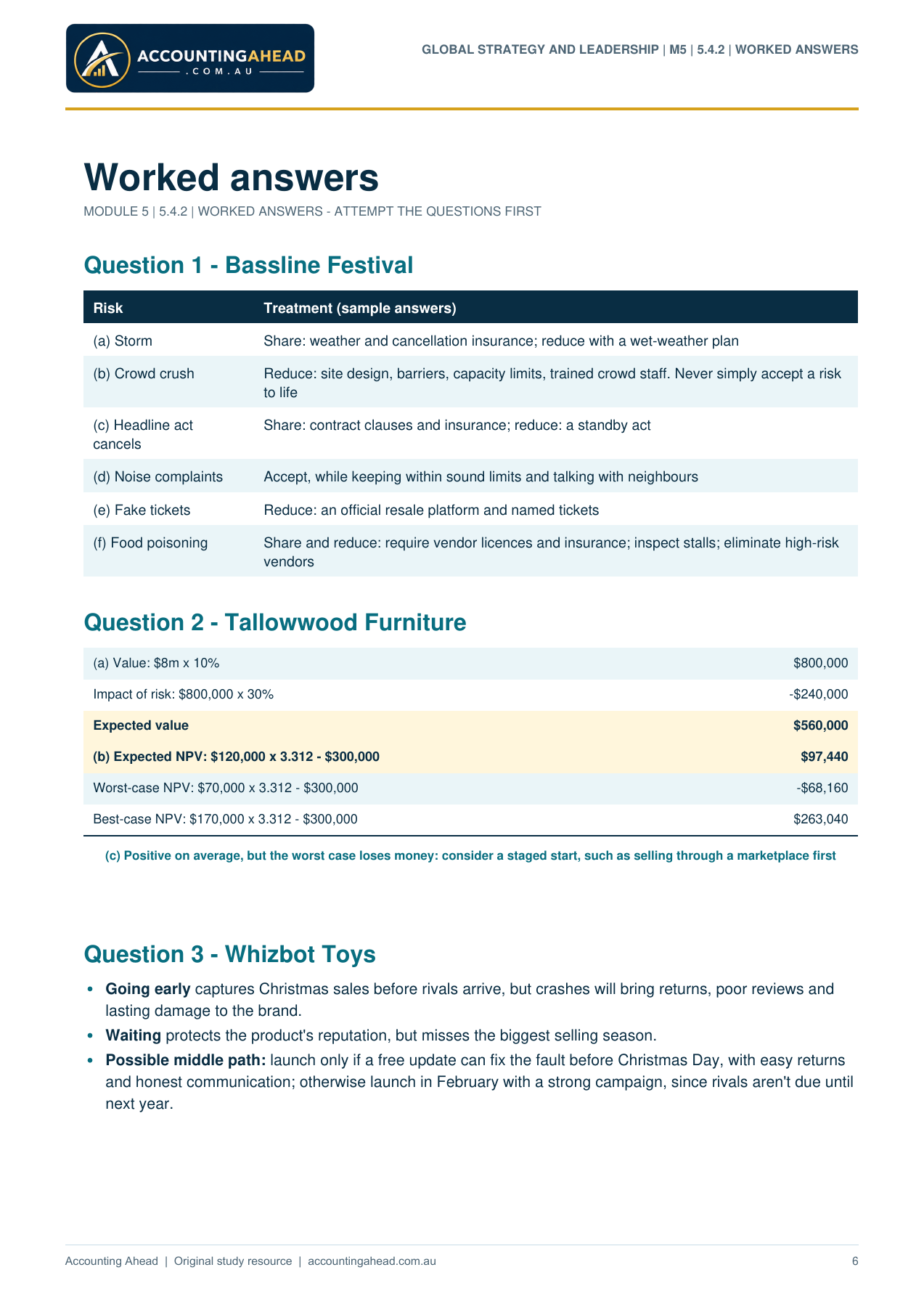
Question 1 - Bassline Festival
Risk Treatment (sample answers)
(a) Storm Share: weather and cancellation insurance; reduce with a wet-weather plan
(b) Crowd crush Reduce: site design, barriers, capacity limits, trained crowd staff. Never simply accept a risk
to life
(c) Headline act
cancels
Share: contract clauses and insurance; reduce: a standby act
(d) Noise complaints Accept, while keeping within sound limits and talking with neighbours
(e) Fake tickets Reduce: an official resale platform and named tickets
(f) Food poisoning Share and reduce: require vendor licences and insurance; inspect stalls; eliminate high-risk
vendors
Question 2 - Tallowwood Furniture
(a) Value: $8m x 10% $800,000
Impact of risk: $800,000 x 30% -$240,000
Expected value $560,000
(b) Expected NPV: $120,000 x 3.312 - $300,000 $97,440
Worst-case NPV: $70,000 x 3.312 - $300,000 -$68,160
Best-case NPV: $170,000 x 3.312 - $300,000 $263,040
(c) Positive on average, but the worst case loses money: consider a staged start, such as selling through a marketplace first
Question 3 - Whizbot Toys
Going early captures Christmas sales before rivals arrive, but crashes will bring returns, poor reviews and
lasting damage to the brand.
Waiting protects the product's reputation, but misses the biggest selling season.
Possible middle path: launch only if a free update can fix the fault before Christmas Day, with easy returns
and honest communication; otherwise launch in February with a strong campaign, since rivals aren't due until
next year.
GLOBAL STRATEGY AND LEADERSHIP | M5 | 5.4.2 | WORKED ANSWERS
6