
Finalising the strategy
Printable study notes to use alongside Part 5.6.
Read the handout text
Accounting Ahead | Original study resource | accountingahead.com.au
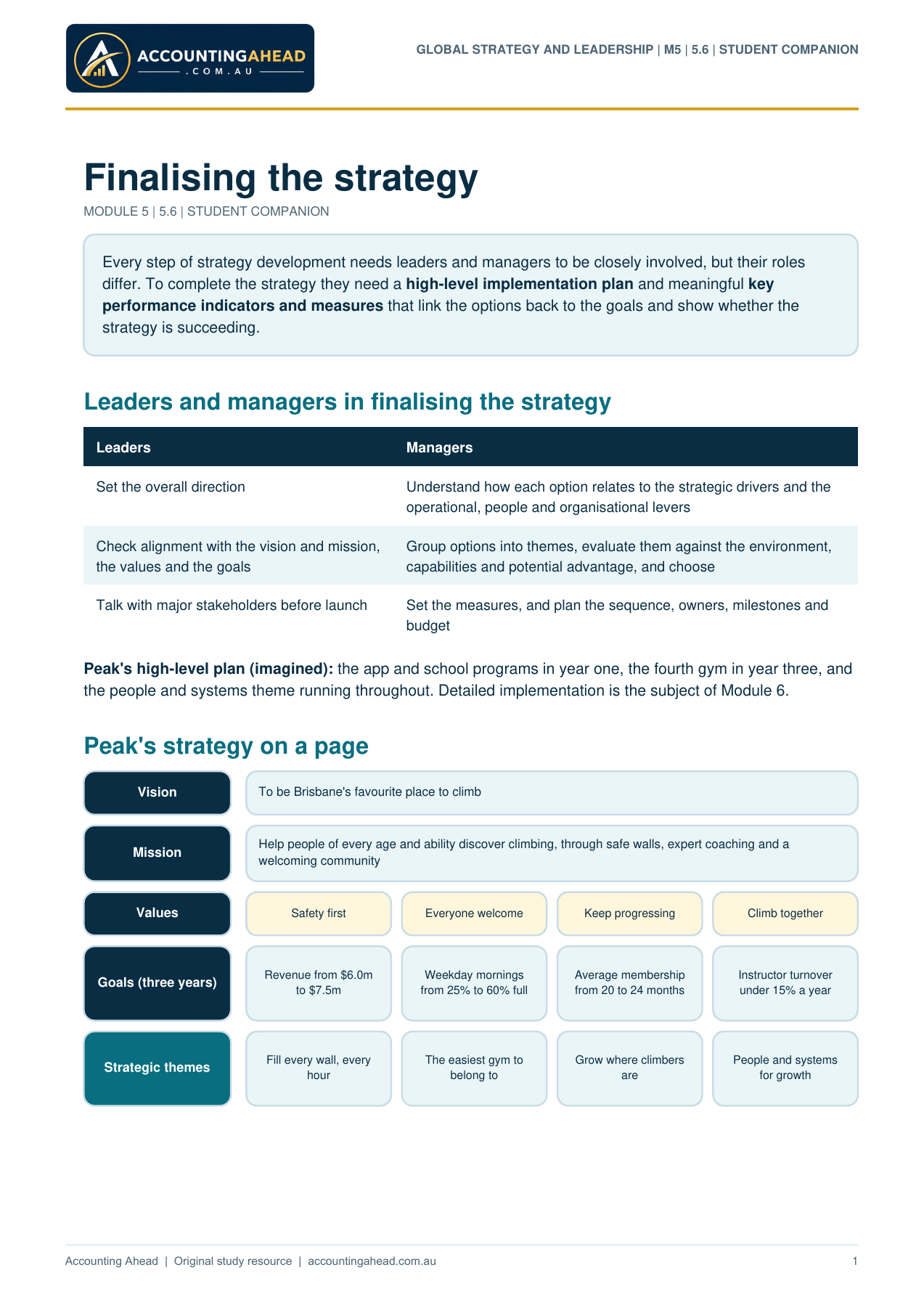
Finalising the strategy
MODULE 5 | 5.6 | STUDENT COMPANION
Every step of strategy development needs leaders and managers to be closely involved, but their roles
differ. To complete the strategy they need a high-level implementation plan and meaningful key
performance indicators and measures that link the options back to the goals and show whether the
strategy is succeeding.
Leaders and managers in finalising the strategy
Leaders Managers
Set the overall direction Understand how each option relates to the strategic drivers and the
operational, people and organisational levers
Check alignment with the vision and mission,
the values and the goals
Group options into themes, evaluate them against the environment,
capabilities and potential advantage, and choose
Talk with major stakeholders before launch Set the measures, and plan the sequence, owners, milestones and
budget
Peak's high-level plan (imagined): the app and school programs in year one, the fourth gym in year three, and
the people and systems theme running throughout. Detailed implementation is the subject of Module 6.
Peak's strategy on a page
Vision To be Brisbane's favourite place to climb
Mission Help people of every age and ability discover climbing, through safe walls, expert coaching and a
welcoming community
Values Safety first Everyone welcome Keep progressing Climb together
Goals (three years) Revenue from $6.0m
to $7.5m
Weekday mornings
from 25% to 60% full
Average membership
from 20 to 24 months
Instructor turnover
under 15% a year
Strategic themes Fill every wall, every
hour
The easiest gym to
belong to
Grow where climbers
are
People and systems
for growth
GLOBAL STRATEGY AND LEADERSHIP | M5 | 5.6 | STUDENT COMPANION
1
Accounting Ahead | Original study resource | accountingahead.com.au
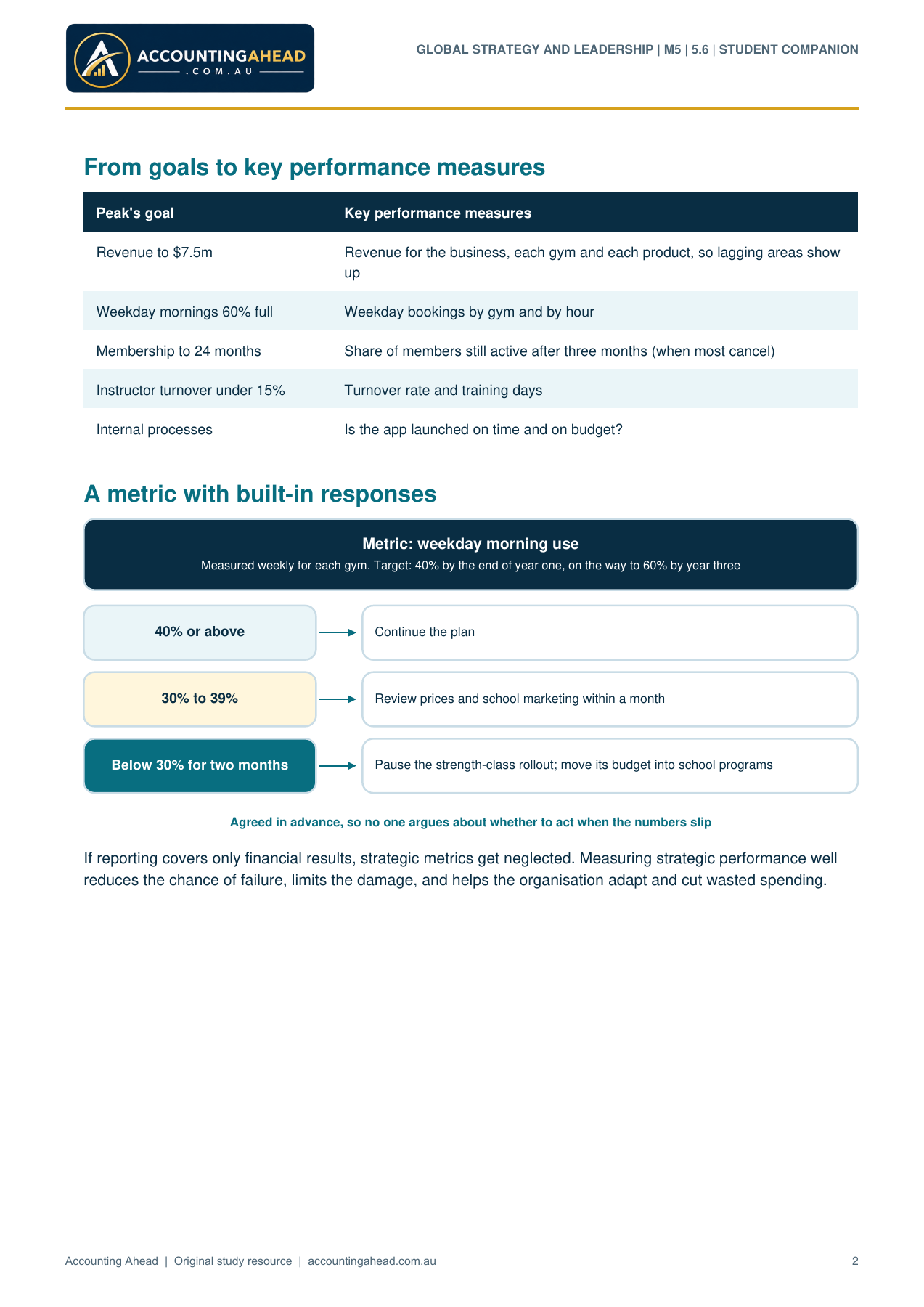
From goals to key performance measures
Peak's goal Key performance measures
Revenue to $7.5m Revenue for the business, each gym and each product, so lagging areas show
up
Weekday mornings 60% full Weekday bookings by gym and by hour
Membership to 24 months Share of members still active after three months (when most cancel)
Instructor turnover under 15% Turnover rate and training days
Internal processes Is the app launched on time and on budget?
A metric with built-in responses
Metric: weekday morning use
Measured weekly for each gym. Target: 40% by the end of year one, on the way to 60% by year three
40% or above Continue the plan
30% to 39% Review prices and school marketing within a month
Below 30% for two months Pause the strength-class rollout; move its budget into school programs
Agreed in advance, so no one argues about whether to act when the numbers slip
If reporting covers only financial results, strategic metrics get neglected. Measuring strategic performance well
reduces the chance of failure, limits the damage, and helps the organisation adapt and cut wasted spending.
GLOBAL STRATEGY AND LEADERSHIP | M5 | 5.6 | STUDENT COMPANION
2
Accounting Ahead | Original study resource | accountingahead.com.au
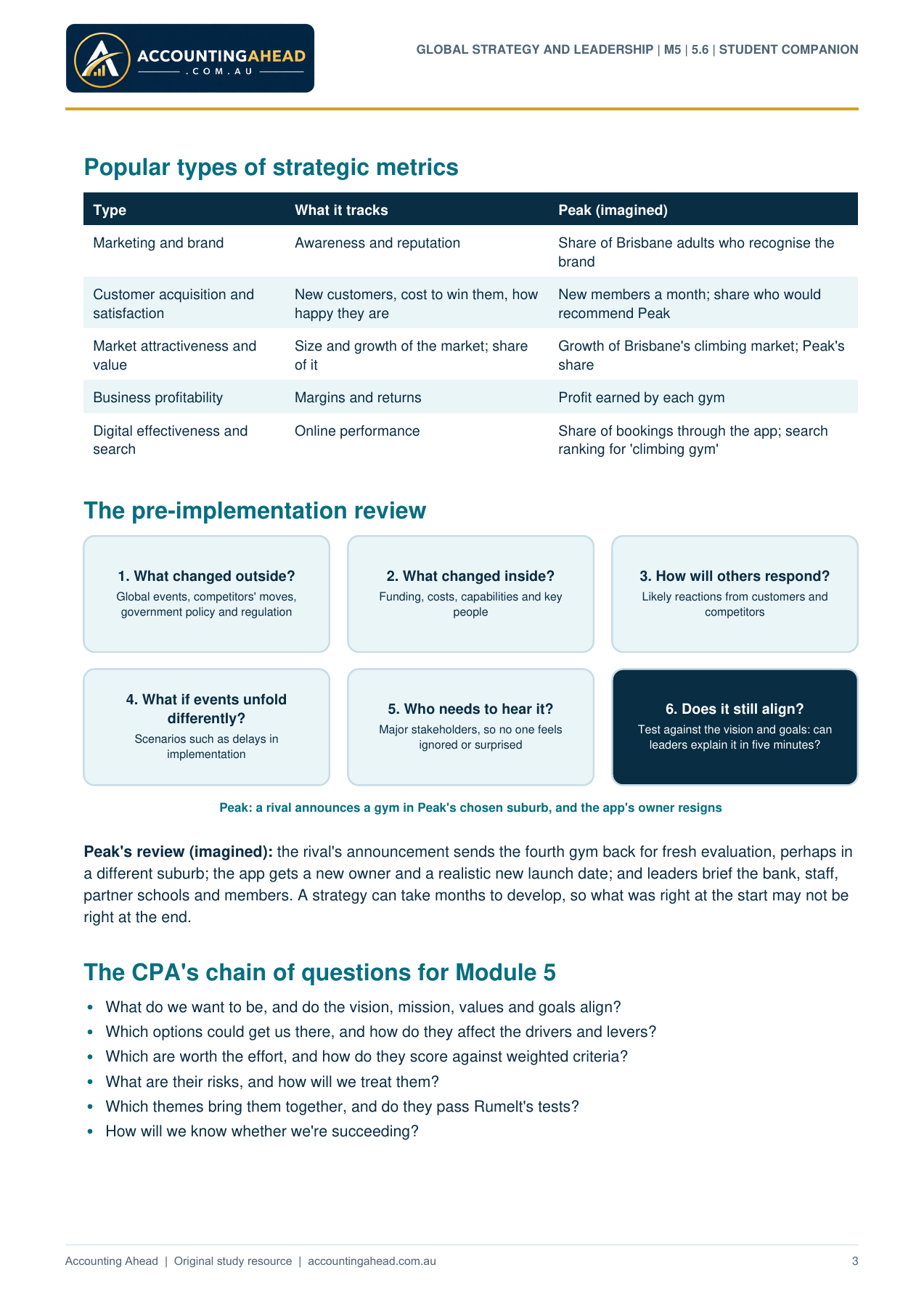
Popular types of strategic metrics
Type What it tracks Peak (imagined)
Marketing and brand Awareness and reputation Share of Brisbane adults who recognise the
brand
Customer acquisition and
satisfaction
New customers, cost to win them, how
happy they are
New members a month; share who would
recommend Peak
Market attractiveness and
value
Size and growth of the market; share
of it
Growth of Brisbane's climbing market; Peak's
share
Business profitability Margins and returns Profit earned by each gym
Digital effectiveness and
search
Online performance Share of bookings through the app; search
ranking for 'climbing gym'
The pre-implementation review
1. What changed outside?
Global events, competitors' moves,
government policy and regulation
2. What changed inside?
Funding, costs, capabilities and key
people
3. How will others respond?
Likely reactions from customers and
competitors
4. What if events unfold
differently?
Scenarios such as delays in
implementation
5. Who needs to hear it?
Major stakeholders, so no one feels
ignored or surprised
6. Does it still align?
Test against the vision and goals: can
leaders explain it in five minutes?
Peak: a rival announces a gym in Peak's chosen suburb, and the app's owner resigns
Peak's review (imagined): the rival's announcement sends the fourth gym back for fresh evaluation, perhaps in
a different suburb; the app gets a new owner and a realistic new launch date; and leaders brief the bank, staff,
partner schools and members. A strategy can take months to develop, so what was right at the start may not be
right at the end.
The CPA's chain of questions for Module 5
What do we want to be, and do the vision, mission, values and goals align?
Which options could get us there, and how do they affect the drivers and levers?
Which are worth the effort, and how do they score against weighted criteria?
What are their risks, and how will we treat them?
Which themes bring them together, and do they pass Rumelt's tests?
How will we know whether we're succeeding?
GLOBAL STRATEGY AND LEADERSHIP | M5 | 5.6 | STUDENT COMPANION
3
Accounting Ahead | Original study resource | accountingahead.com.au
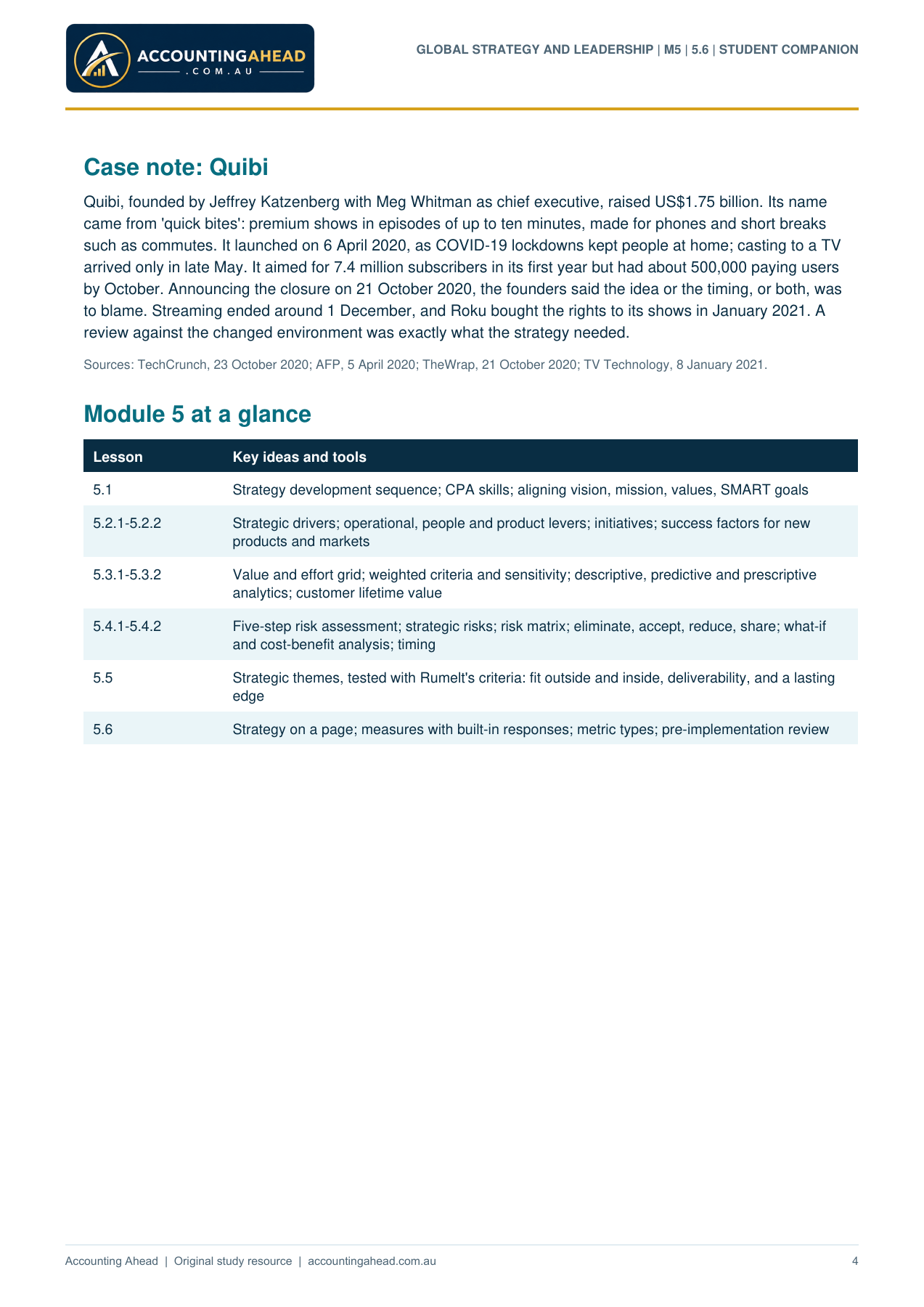
Case note: Quibi
Quibi, founded by Jeffrey Katzenberg with Meg Whitman as chief executive, raised US$1.75 billion. Its name
came from 'quick bites': premium shows in episodes of up to ten minutes, made for phones and short breaks
such as commutes. It launched on 6 April 2020, as COVID-19 lockdowns kept people at home; casting to a TV
arrived only in late May. It aimed for 7.4 million subscribers in its first year but had about 500,000 paying users
by October. Announcing the closure on 21 October 2020, the founders said the idea or the timing, or both, was
to blame. Streaming ended around 1 December, and Roku bought the rights to its shows in January 2021. A
review against the changed environment was exactly what the strategy needed.
Sources: TechCrunch, 23 October 2020; AFP, 5 April 2020; TheWrap, 21 October 2020; TV Technology, 8 January 2021.
Module 5 at a glance
Lesson Key ideas and tools
5.1 Strategy development sequence; CPA skills; aligning vision, mission, values, SMART goals
5.2.1-5.2.2 Strategic drivers; operational, people and product levers; initiatives; success factors for new
products and markets
5.3.1-5.3.2 Value and effort grid; weighted criteria and sensitivity; descriptive, predictive and prescriptive
analytics; customer lifetime value
5.4.1-5.4.2 Five-step risk assessment; strategic risks; risk matrix; eliminate, accept, reduce, share; what-if
and cost-benefit analysis; timing
5.5 Strategic themes, tested with Rumelt's criteria: fit outside and inside, deliverability, and a lasting
edge
5.6 Strategy on a page; measures with built-in responses; metric types; pre-implementation review
GLOBAL STRATEGY AND LEADERSHIP | M5 | 5.6 | STUDENT COMPANION
4
Accounting Ahead | Original study resource | accountingahead.com.au
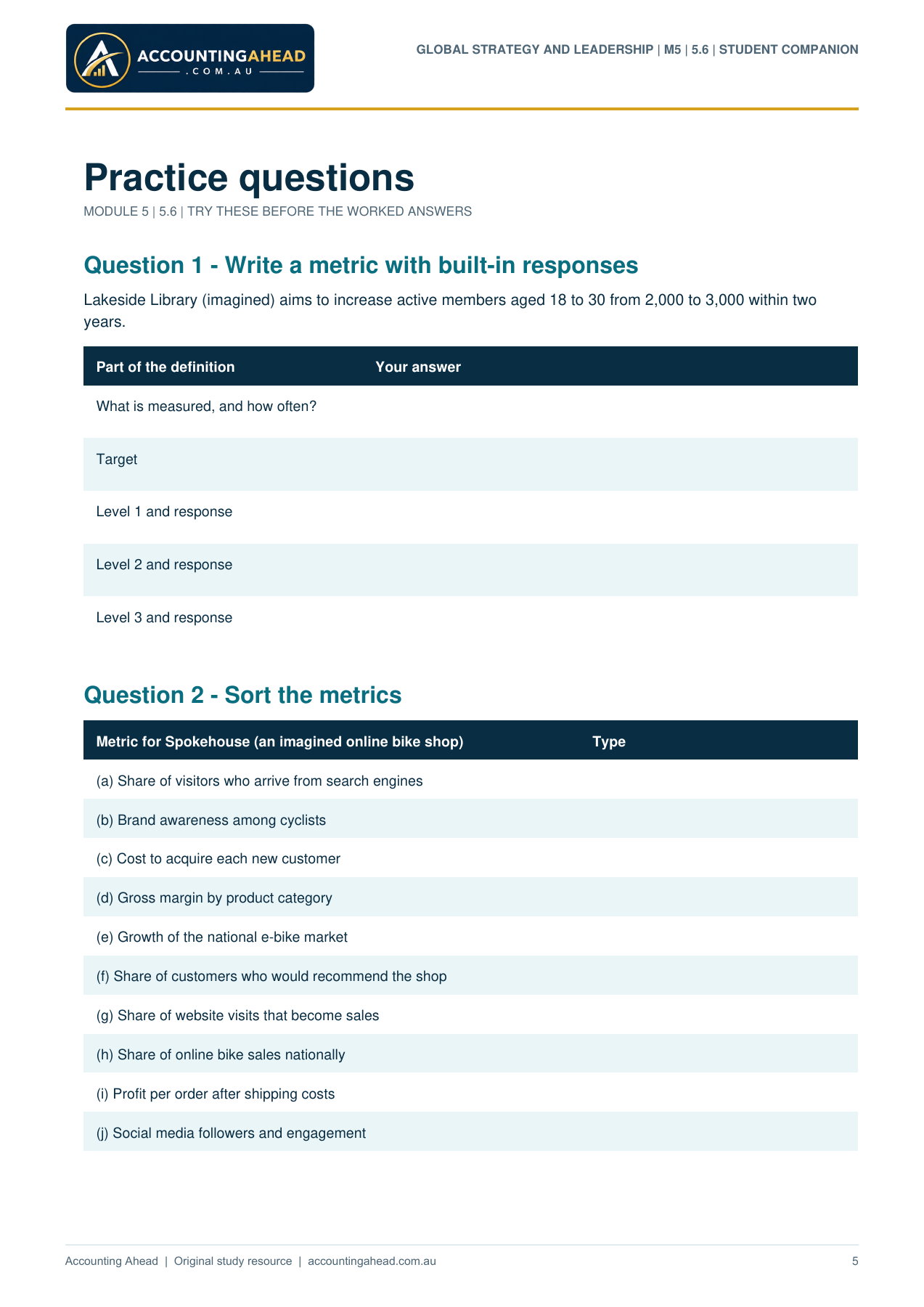
Practice questions
MODULE 5 | 5.6 | TRY THESE BEFORE THE WORKED ANSWERS
Question 1 - Write a metric with built-in responses
Lakeside Library (imagined) aims to increase active members aged 18 to 30 from 2,000 to 3,000 within two
years.
Part of the definition Your answer
What is measured, and how often?
Target
Level 1 and response
Level 2 and response
Level 3 and response
Question 2 - Sort the metrics
Metric for Spokehouse (an imagined online bike shop) Type
(a) Share of visitors who arrive from search engines
(b) Brand awareness among cyclists
(c) Cost to acquire each new customer
(d) Gross margin by product category
(e) Growth of the national e-bike market
(f) Share of customers who would recommend the shop
(g) Share of website visits that become sales
(h) Share of online bike sales nationally
(i) Profit per order after shipping costs
(j) Social media followers and engagement
GLOBAL STRATEGY AND LEADERSHIP | M5 | 5.6 | STUDENT COMPANION
5
Accounting Ahead | Original study resource | accountingahead.com.au
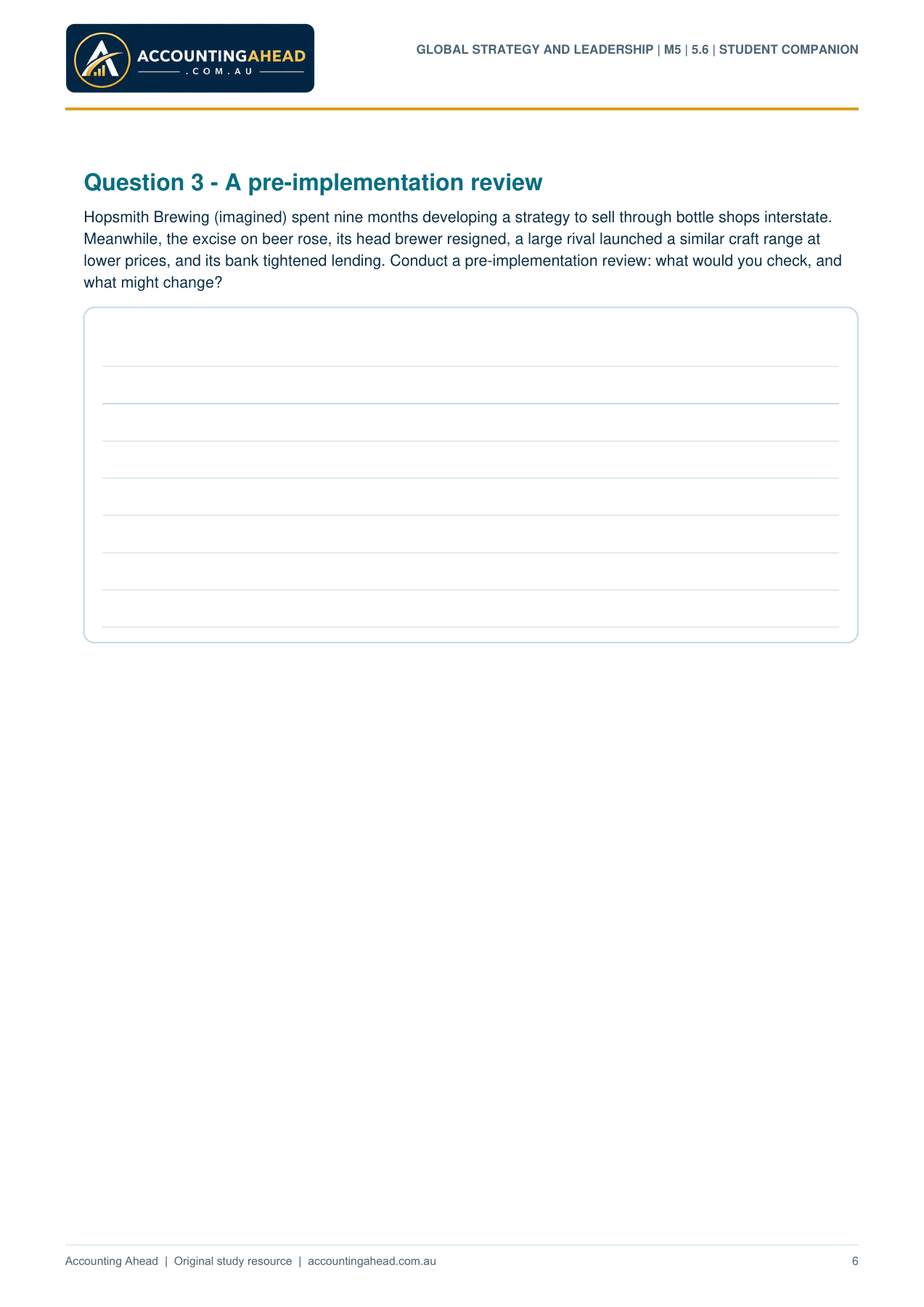
Question 3 - A pre-implementation review
Hopsmith Brewing (imagined) spent nine months developing a strategy to sell through bottle shops interstate.
Meanwhile, the excise on beer rose, its head brewer resigned, a large rival launched a similar craft range at
lower prices, and its bank tightened lending. Conduct a pre-implementation review: what would you check, and
what might change?
GLOBAL STRATEGY AND LEADERSHIP | M5 | 5.6 | STUDENT COMPANION
6
Accounting Ahead | Original study resource | accountingahead.com.au
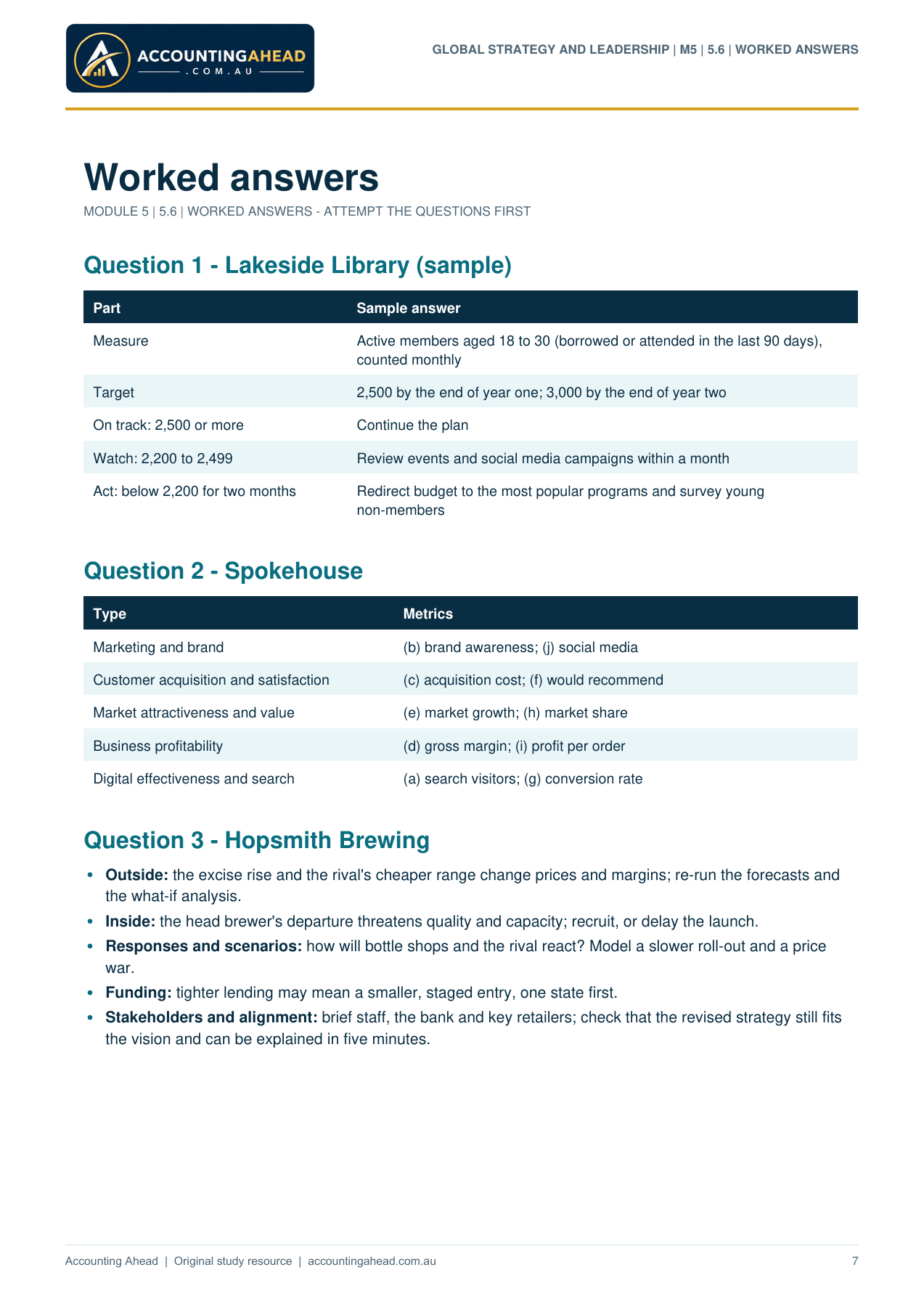
Worked answers
MODULE 5 | 5.6 | WORKED ANSWERS - ATTEMPT THE QUESTIONS FIRST
Question 1 - Lakeside Library (sample)
Part Sample answer
Measure Active members aged 18 to 30 (borrowed or attended in the last 90 days),
counted monthly
Target 2,500 by the end of year one; 3,000 by the end of year two
On track: 2,500 or more Continue the plan
Watch: 2,200 to 2,499 Review events and social media campaigns within a month
Act: below 2,200 for two months Redirect budget to the most popular programs and survey young
non-members
Question 2 - Spokehouse
Type Metrics
Marketing and brand (b) brand awareness; (j) social media
Customer acquisition and satisfaction (c) acquisition cost; (f) would recommend
Market attractiveness and value (e) market growth; (h) market share
Business profitability (d) gross margin; (i) profit per order
Digital effectiveness and search (a) search visitors; (g) conversion rate
Question 3 - Hopsmith Brewing
Outside: the excise rise and the rival's cheaper range change prices and margins; re-run the forecasts and
the what-if analysis.
Inside: the head brewer's departure threatens quality and capacity; recruit, or delay the launch.
Responses and scenarios: how will bottle shops and the rival react? Model a slower roll-out and a price
war.
Funding: tighter lending may mean a smaller, staged entry, one state first.
Stakeholders and alignment: brief staff, the bank and key retailers; check that the revised strategy still fits
the vision and can be explained in five minutes.
GLOBAL STRATEGY AND LEADERSHIP | M5 | 5.6 | WORKED ANSWERS
7