
Implementation plans and the seven-S framework
Printable study notes to use alongside Part 6.1-6.2.1.
Read the handout text
Accounting Ahead | Original study resource | accountingahead.com.au
Implementation plans and the seven-S
framework
MODULE 6 | 6.1-6.2.1 | STUDENT COMPANION
Implementation is the last step in the strategy process: the practical tasks that carry a strategic option
from paper into business-as-usual, so the strategy is delivered and its advantage created. Because a new
strategy changes the organisation, the plan must show how its technical systems, politics and culture
will shift to support it.
Implementation is a leadership task, not just an administrative one. Leaders build a culture open to change by
explaining what is needed, listening to concerns and involving people; effective leaders draw more positive than
negative reactions. Sound project management (on time, on budget, to specification) raises the odds of success.
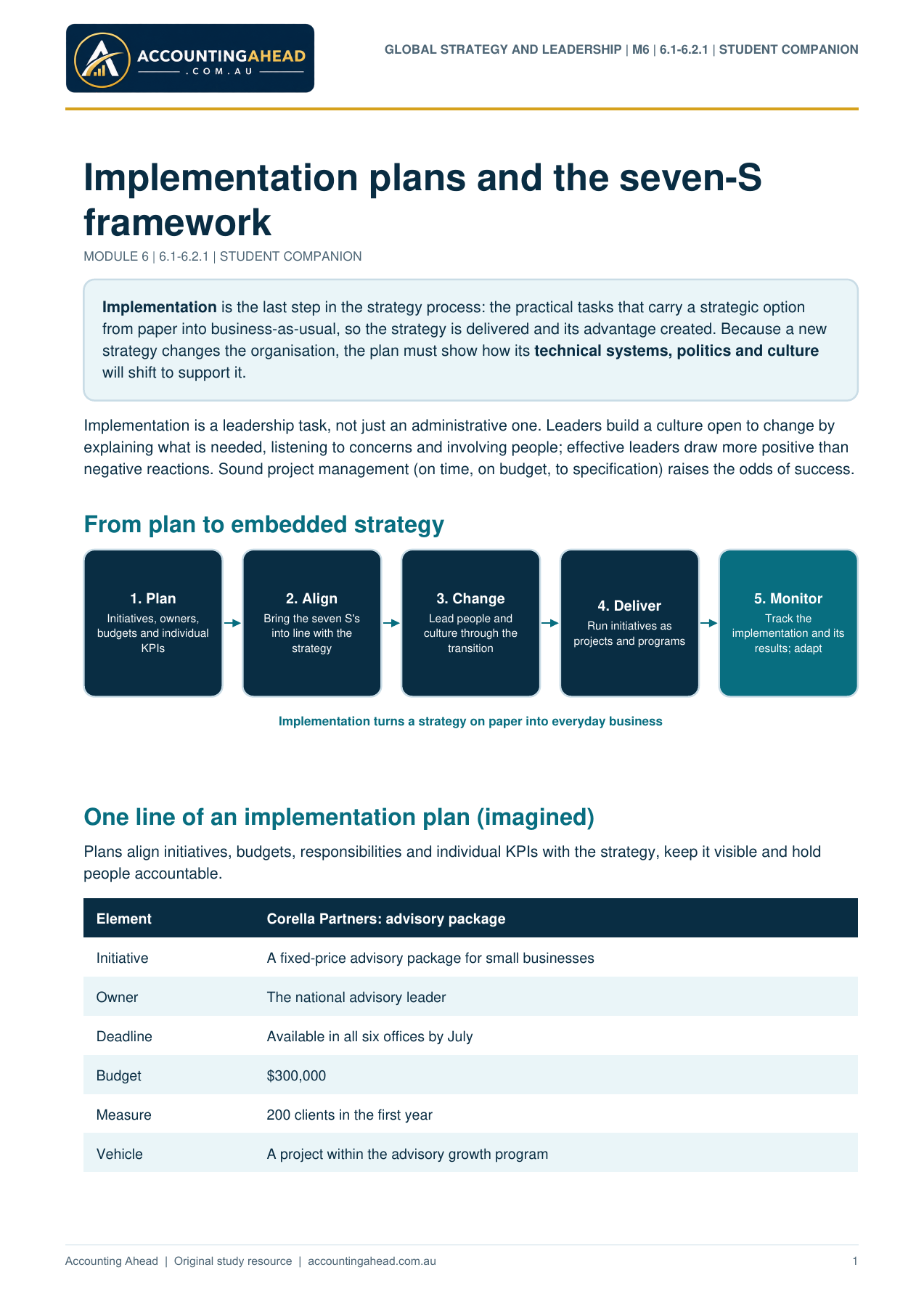
From plan to embedded strategy
1. Plan
Initiatives, owners,
budgets and individual
KPIs
2. Align
Bring the seven S's
into line with the
strategy
3. Change
Lead people and
culture through the
transition
4. Deliver
Run initiatives as
projects and programs
5. Monitor
Track the
implementation and its
results; adapt
Implementation turns a strategy on paper into everyday business
One line of an implementation plan (imagined)
Plans align initiatives, budgets, responsibilities and individual KPIs with the strategy, keep it visible and hold
people accountable.
Element Corella Partners: advisory package
Initiative A fixed-price advisory package for small businesses
Owner The national advisory leader
Deadline Available in all six offices by July
Budget $300,000
Measure 200 clients in the first year
Vehicle A project within the advisory growth program
GLOBAL STRATEGY AND LEADERSHIP | M6 | 6.1-6.2.1 | STUDENT COMPANION
1
Accounting Ahead | Original study resource | accountingahead.com.au
Monitor two things: how the strategy is being implemented, and whether it is achieving its intended outcomes.
The process is iterative, so stages are revisited as information arrives. Speed matters: faster implementers tend
to deliver more customer value, and implementation goes furthest where managers at every level use many
implementation methods (O'Reilly, Caldwell and others, 2010).
Why execution stalls
Endless loops of analysis, and indecision under uncertainty
Missing implementation capabilities
No way to turn chosen options into concrete themes, goals and actions (the strategy is never made
operational)
Resistance, internal politics and power games (lesson 6.6.2)
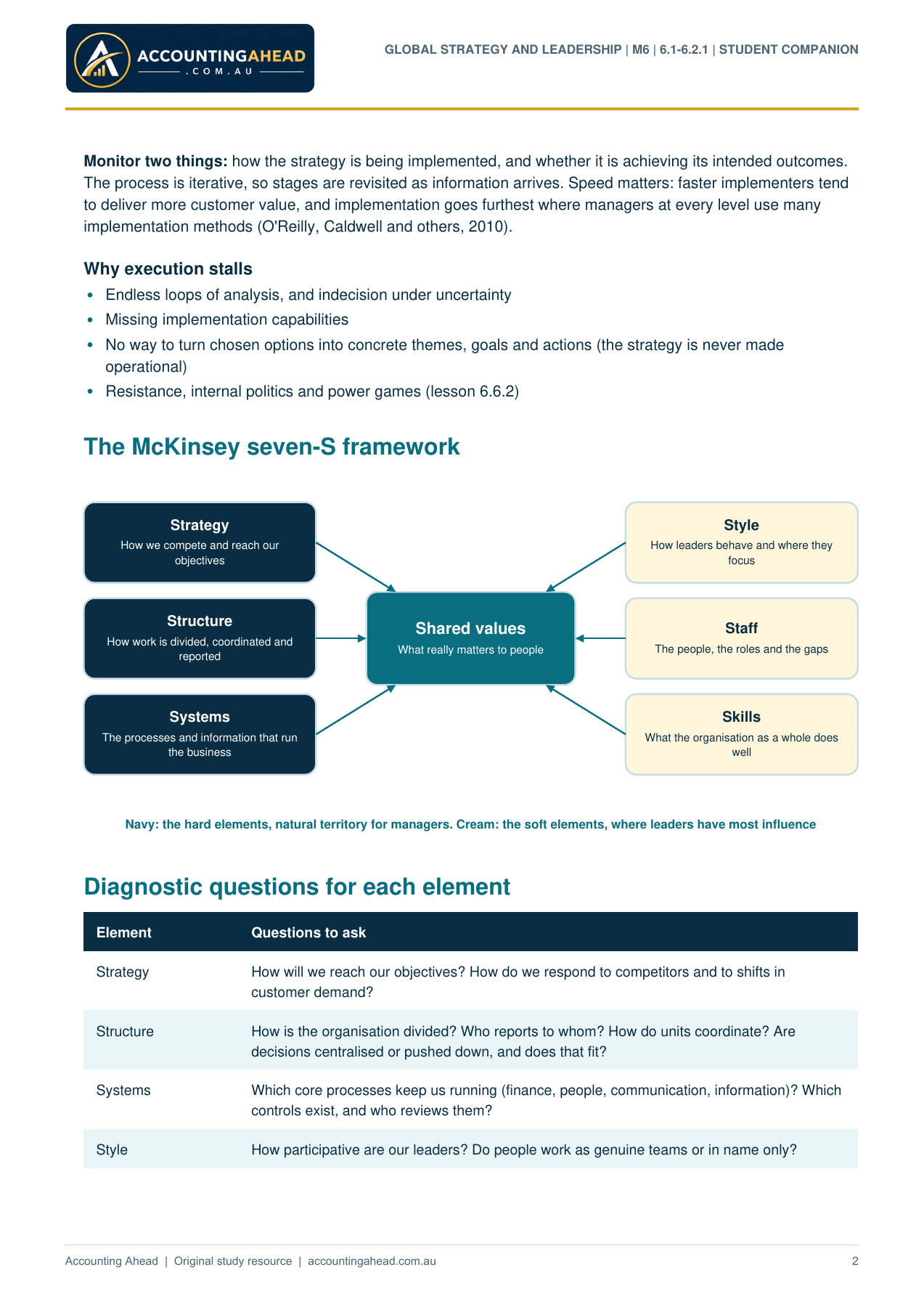
The McKinsey seven-S framework
Shared values
What really matters to people
Strategy
How we compete and reach our
objectives
Style
How leaders behave and where they
focus
Structure
How work is divided, coordinated and
reported
Staff
The people, the roles and the gaps
Systems
The processes and information that run
the business
Skills
What the organisation as a whole does
well
Navy: the hard elements, natural territory for managers. Cream: the soft elements, where leaders have most influence
Diagnostic questions for each element
Element Questions to ask
Strategy How will we reach our objectives? How do we respond to competitors and to shifts in
customer demand?
Structure How is the organisation divided? Who reports to whom? How do units coordinate? Are
decisions centralised or pushed down, and does that fit?
Systems Which core processes keep us running (finance, people, communication, information)? Which
controls exist, and who reviews them?
Style How participative are our leaders? Do people work as genuine teams or in name only?
GLOBAL STRATEGY AND LEADERSHIP | M6 | 6.1-6.2.1 | STUDENT COMPANION
2
Accounting Ahead | Original study resource | accountingahead.com.au
Element Questions to ask
Staff Which roles exist, which need filling, and where are the gaps?
Skills What are we known for doing well? Where do our capabilities fall short? How are skills
tracked?
Shared values What really matters here? Which values was the organisation founded on, and how firmly are
they held?
Using the grid: record the current state and the target state of each element. The gaps become an action plan
and a way to track progress. The hard/soft split is a tendency, not a rule: leaders and managers share most of
the work.
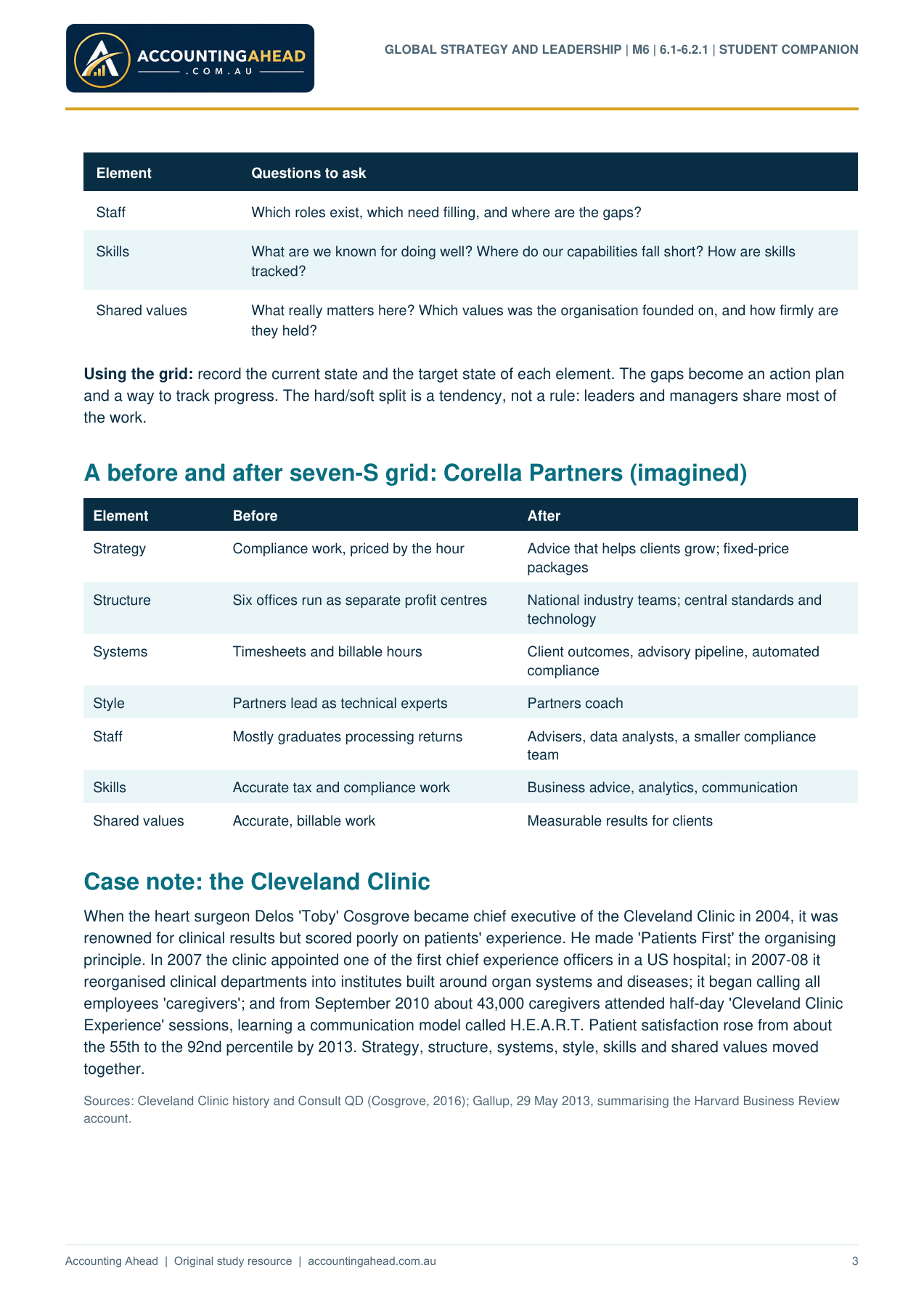
A before and after seven-S grid: Corella Partners (imagined)
Element Before After
Strategy Compliance work, priced by the hour Advice that helps clients grow; fixed-price
packages
Structure Six offices run as separate profit centres National industry teams; central standards and
technology
Systems Timesheets and billable hours Client outcomes, advisory pipeline, automated
compliance
Style Partners lead as technical experts Partners coach
Staff Mostly graduates processing returns Advisers, data analysts, a smaller compliance
team
Skills Accurate tax and compliance work Business advice, analytics, communication
Shared values Accurate, billable work Measurable results for clients
Case note: the Cleveland Clinic
When the heart surgeon Delos 'Toby' Cosgrove became chief executive of the Cleveland Clinic in 2004, it was
renowned for clinical results but scored poorly on patients' experience. He made 'Patients First' the organising
principle. In 2007 the clinic appointed one of the first chief experience officers in a US hospital; in 2007-08 it
reorganised clinical departments into institutes built around organ systems and diseases; it began calling all
employees 'caregivers'; and from September 2010 about 43,000 caregivers attended half-day 'Cleveland Clinic
Experience' sessions, learning a communication model called H.E.A.R.T. Patient satisfaction rose from about
the 55th to the 92nd percentile by 2013. Strategy, structure, systems, style, skills and shared values moved
together.
Sources: Cleveland Clinic history and Consult QD (Cosgrove, 2016); Gallup, 29 May 2013, summarising the Harvard Business Review
account.
GLOBAL STRATEGY AND LEADERSHIP | M6 | 6.1-6.2.1 | STUDENT COMPANION
3
Accounting Ahead | Original study resource | accountingahead.com.au
Practice questions
MODULE 6 | 6.1-6.2.1 | TRY THESE BEFORE THE WORKED ANSWERS
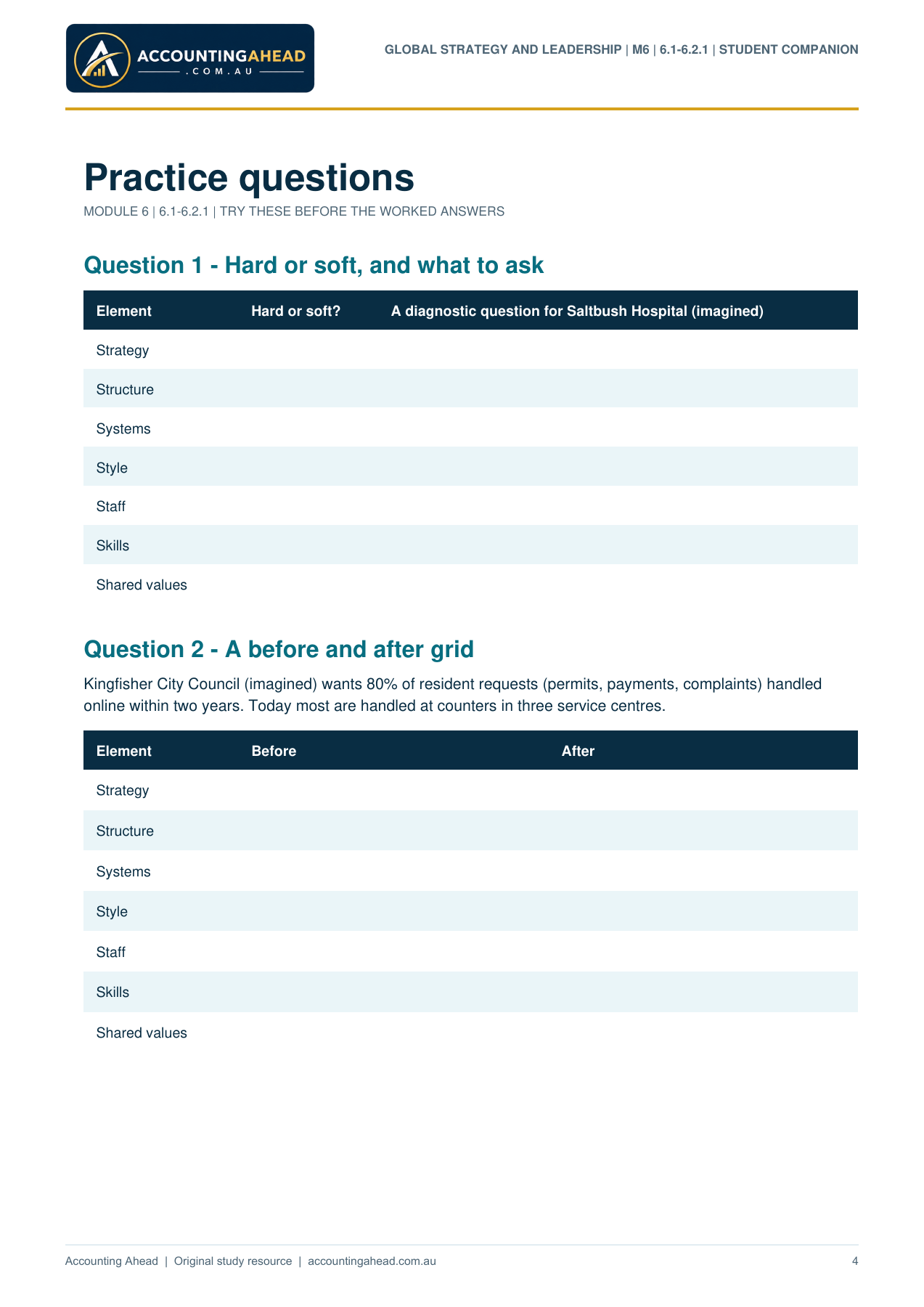
Question 1 - Hard or soft, and what to ask
Element Hard or soft? A diagnostic question for Saltbush Hospital (imagined)
Strategy
Structure
Systems
Style
Staff
Skills
Shared values
Question 2 - A before and after grid
Kingfisher City Council (imagined) wants 80% of resident requests (permits, payments, complaints) handled
online within two years. Today most are handled at counters in three service centres.
Element Before After
Strategy
Structure
Systems
Style
Staff
Skills
Shared values
GLOBAL STRATEGY AND LEADERSHIP | M6 | 6.1-6.2.1 | STUDENT COMPANION
4
Accounting Ahead | Original study resource | accountingahead.com.au
Question 3 - Why has the strategy stalled?
Eighteen months ago, Tallow & Twine (an imagined homewares retailer with 40 stores) announced a strategy to
become a leading online retailer. Since then the board has commissioned three consultants' reports on which
customers to target; store managers say they have never seen the plan; no budget has moved from stores to
online; and the IT team lacks e-commerce skills. Diagnose why the strategy has stalled and recommend three
actions.
GLOBAL STRATEGY AND LEADERSHIP | M6 | 6.1-6.2.1 | STUDENT COMPANION
5
Accounting Ahead | Original study resource | accountingahead.com.au
Worked answers
MODULE 6 | 6.1-6.2.1 | WORKED ANSWERS - ATTEMPT THE QUESTIONS FIRST
Question 1 - Saltbush Hospital (sample questions)
Element Type Sample question
Strategy Hard How will we cut waiting times while staying within budget?
Structure Hard Do wards and departments coordinate patient flow, and who decides on beds?
Systems Hard Do our patient-record and rostering systems give timely information?
Style Soft Do senior clinicians involve nurses and allied staff in decisions?
Staff Soft Which specialist roles are vacant, and where are the shortages?
Skills Soft What are we known for clinically, and where do we lack capability?
Shared values Soft Do staff genuinely put patient safety and dignity first?
Question 2 - Kingfisher City Council (sample)
Element Before After
Strategy Counter-based service Digital first, with help for those who need it
Structure Three service centres run separately One digital service team plus outreach staff
Systems Paper forms, separate databases Online portal linked to a single customer
record
Style Rule-bound supervision Coaching staff to solve residents' problems
Staff Counter officers Digital designers, data staff, community
helpers
Skills Processing forms Service design, digital support,
plain-language writing
Shared values Follow the procedure Make it easy for residents
Question 3 - Tallow & Twine
Diagnosis: paralysis by analysis (three reports, no decision); the strategy was never made operational (no
plan reaching store managers, no budget moved); missing capabilities (no e-commerce skills); misaligned S's
(structure, systems and staff still built for stores).
Actions: (1) stop commissioning studies and approve a target segment and a sequenced plan by a set date;
(2) move budget to online and name owners, deadlines and KPIs for each initiative; (3) hire or partner for
e-commerce capability and brief every store manager on the store's role online (for example, click and
collect).
GLOBAL STRATEGY AND LEADERSHIP | M6 | 6.1-6.2.1 | WORKED ANSWERS
6