
Organisational structure and design
Printable study notes to use alongside Part 6.2.2.
Read the handout text
Accounting Ahead | Original study resource | accountingahead.com.au
Organisational structure and design
MODULE 6 | 6.2.2 | STUDENT COMPANION
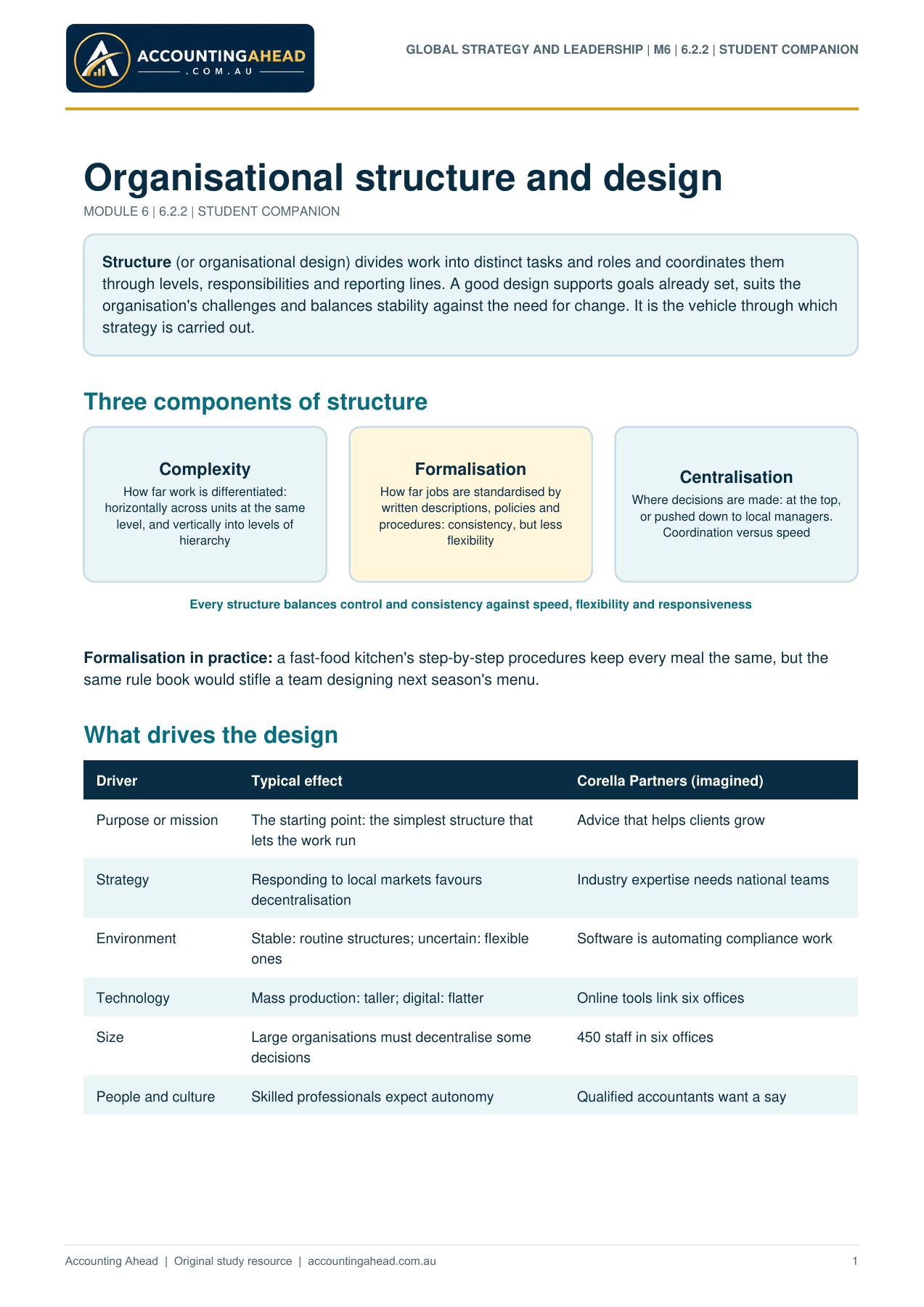
Structure (or organisational design) divides work into distinct tasks and roles and coordinates them
through levels, responsibilities and reporting lines. A good design supports goals already set, suits the
organisation's challenges and balances stability against the need for change. It is the vehicle through which
strategy is carried out.
Three components of structure
Complexity
How far work is differentiated:
horizontally across units at the same
level, and vertically into levels of
hierarchy
Formalisation
How far jobs are standardised by
written descriptions, policies and
procedures: consistency, but less
flexibility
Centralisation
Where decisions are made: at the top,
or pushed down to local managers.
Coordination versus speed
Every structure balances control and consistency against speed, flexibility and responsiveness
Formalisation in practice: a fast-food kitchen's step-by-step procedures keep every meal the same, but the
same rule book would stifle a team designing next season's menu.
What drives the design
Driver Typical effect Corella Partners (imagined)
Purpose or mission The starting point: the simplest structure that
lets the work run
Advice that helps clients grow
Strategy Responding to local markets favours
decentralisation
Industry expertise needs national teams
Environment Stable: routine structures; uncertain: flexible
ones
Software is automating compliance work
Technology Mass production: taller; digital: flatter Online tools link six offices
Size Large organisations must decentralise some
decisions
450 staff in six offices
People and culture Skilled professionals expect autonomy Qualified accountants want a say
GLOBAL STRATEGY AND LEADERSHIP | M6 | 6.2.2 | STUDENT COMPANION
1
Accounting Ahead | Original study resource | accountingahead.com.au
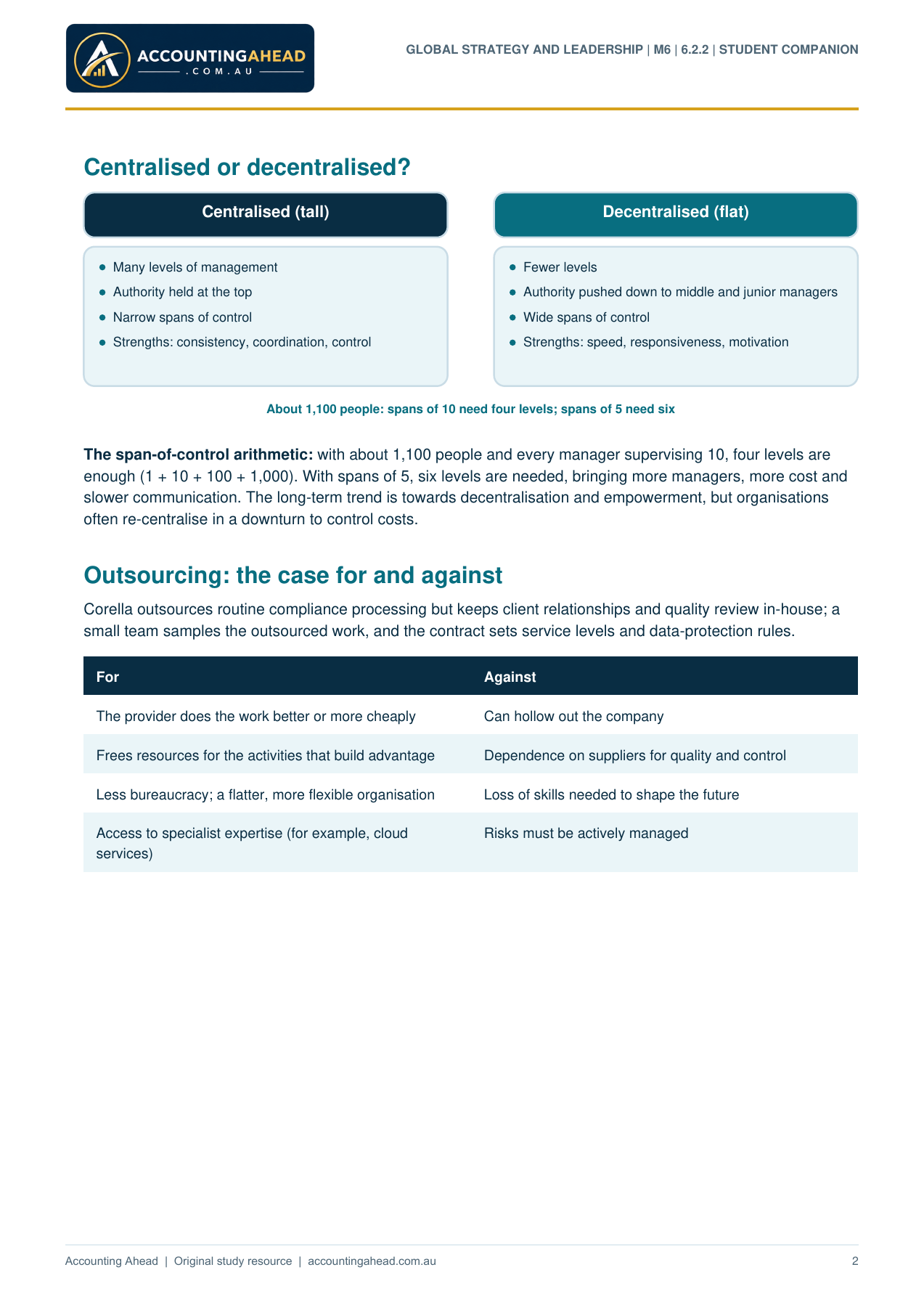
Centralised or decentralised?
Centralised (tall)
Many levels of management
Authority held at the top
Narrow spans of control
Strengths: consistency, coordination, control
Decentralised (flat)
Fewer levels
Authority pushed down to middle and junior managers
Wide spans of control
Strengths: speed, responsiveness, motivation
About 1,100 people: spans of 10 need four levels; spans of 5 need six
The span-of-control arithmetic: with about 1,100 people and every manager supervising 10, four levels are
enough (1 + 10 + 100 + 1,000). With spans of 5, six levels are needed, bringing more managers, more cost and
slower communication. The long-term trend is towards decentralisation and empowerment, but organisations
often re-centralise in a downturn to control costs.
Outsourcing: the case for and against
Corella outsources routine compliance processing but keeps client relationships and quality review in-house; a
small team samples the outsourced work, and the contract sets service levels and data-protection rules.
For Against
The provider does the work better or more cheaply Can hollow out the company
Frees resources for the activities that build advantage Dependence on suppliers for quality and control
Less bureaucracy; a flatter, more flexible organisation Loss of skills needed to shape the future
Access to specialist expertise (for example, cloud
services)
Risks must be actively managed
GLOBAL STRATEGY AND LEADERSHIP | M6 | 6.2.2 | STUDENT COMPANION
2
Accounting Ahead | Original study resource | accountingahead.com.au
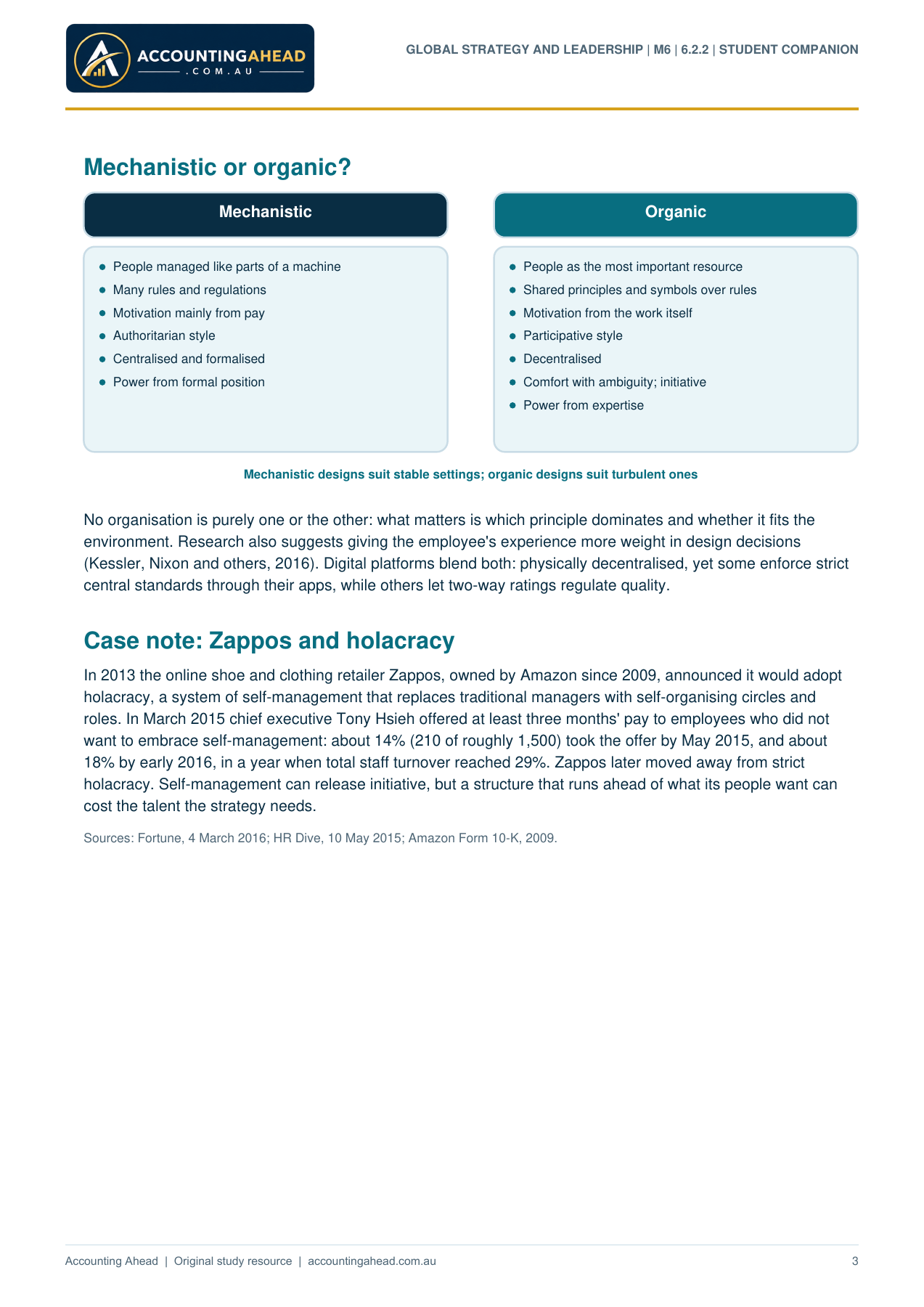
Mechanistic or organic?
Mechanistic
People managed like parts of a machine
Many rules and regulations
Motivation mainly from pay
Authoritarian style
Centralised and formalised
Power from formal position
Organic
People as the most important resource
Shared principles and symbols over rules
Motivation from the work itself
Participative style
Decentralised
Comfort with ambiguity; initiative
Power from expertise
Mechanistic designs suit stable settings; organic designs suit turbulent ones
No organisation is purely one or the other: what matters is which principle dominates and whether it fits the
environment. Research also suggests giving the employee's experience more weight in design decisions
(Kessler, Nixon and others, 2016). Digital platforms blend both: physically decentralised, yet some enforce strict
central standards through their apps, while others let two-way ratings regulate quality.
Case note: Zappos and holacracy
In 2013 the online shoe and clothing retailer Zappos, owned by Amazon since 2009, announced it would adopt
holacracy, a system of self-management that replaces traditional managers with self-organising circles and
roles. In March 2015 chief executive Tony Hsieh offered at least three months' pay to employees who did not
want to embrace self-management: about 14% (210 of roughly 1,500) took the offer by May 2015, and about
18% by early 2016, in a year when total staff turnover reached 29%. Zappos later moved away from strict
holacracy. Self-management can release initiative, but a structure that runs ahead of what its people want can
cost the talent the strategy needs.
Sources: Fortune, 4 March 2016; HR Dive, 10 May 2015; Amazon Form 10-K, 2009.
GLOBAL STRATEGY AND LEADERSHIP | M6 | 6.2.2 | STUDENT COMPANION
3
Accounting Ahead | Original study resource | accountingahead.com.au
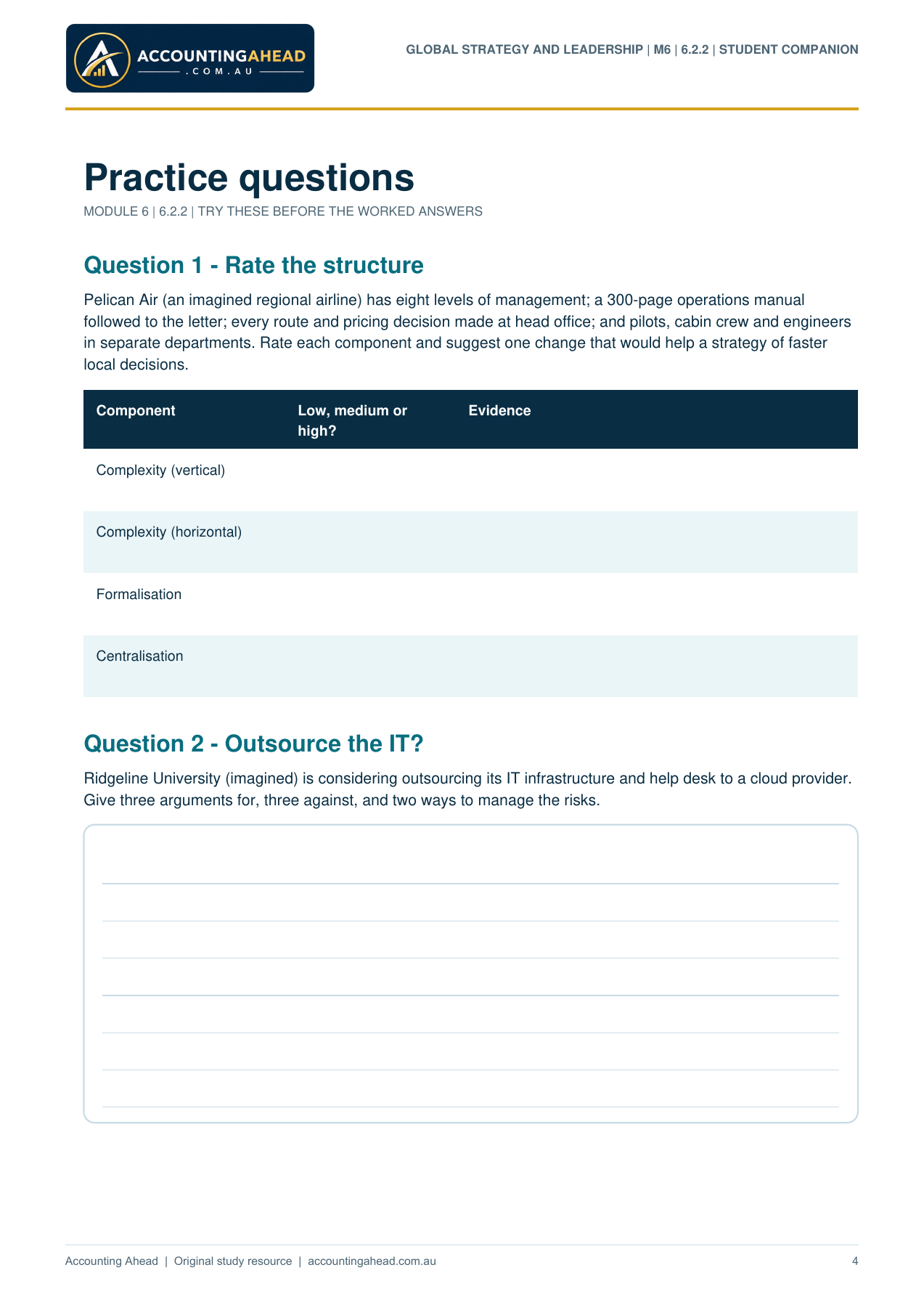
Practice questions
MODULE 6 | 6.2.2 | TRY THESE BEFORE THE WORKED ANSWERS
Question 1 - Rate the structure
Pelican Air (an imagined regional airline) has eight levels of management; a 300-page operations manual
followed to the letter; every route and pricing decision made at head office; and pilots, cabin crew and engineers
in separate departments. Rate each component and suggest one change that would help a strategy of faster
local decisions.
Component Low, medium or
high?
Evidence
Complexity (vertical)
Complexity (horizontal)
Formalisation
Centralisation
Question 2 - Outsource the IT?
Ridgeline University (imagined) is considering outsourcing its IT infrastructure and help desk to a cloud provider.
Give three arguments for, three against, and two ways to manage the risks.
GLOBAL STRATEGY AND LEADERSHIP | M6 | 6.2.2 | STUDENT COMPANION
4
Accounting Ahead | Original study resource | accountingahead.com.au
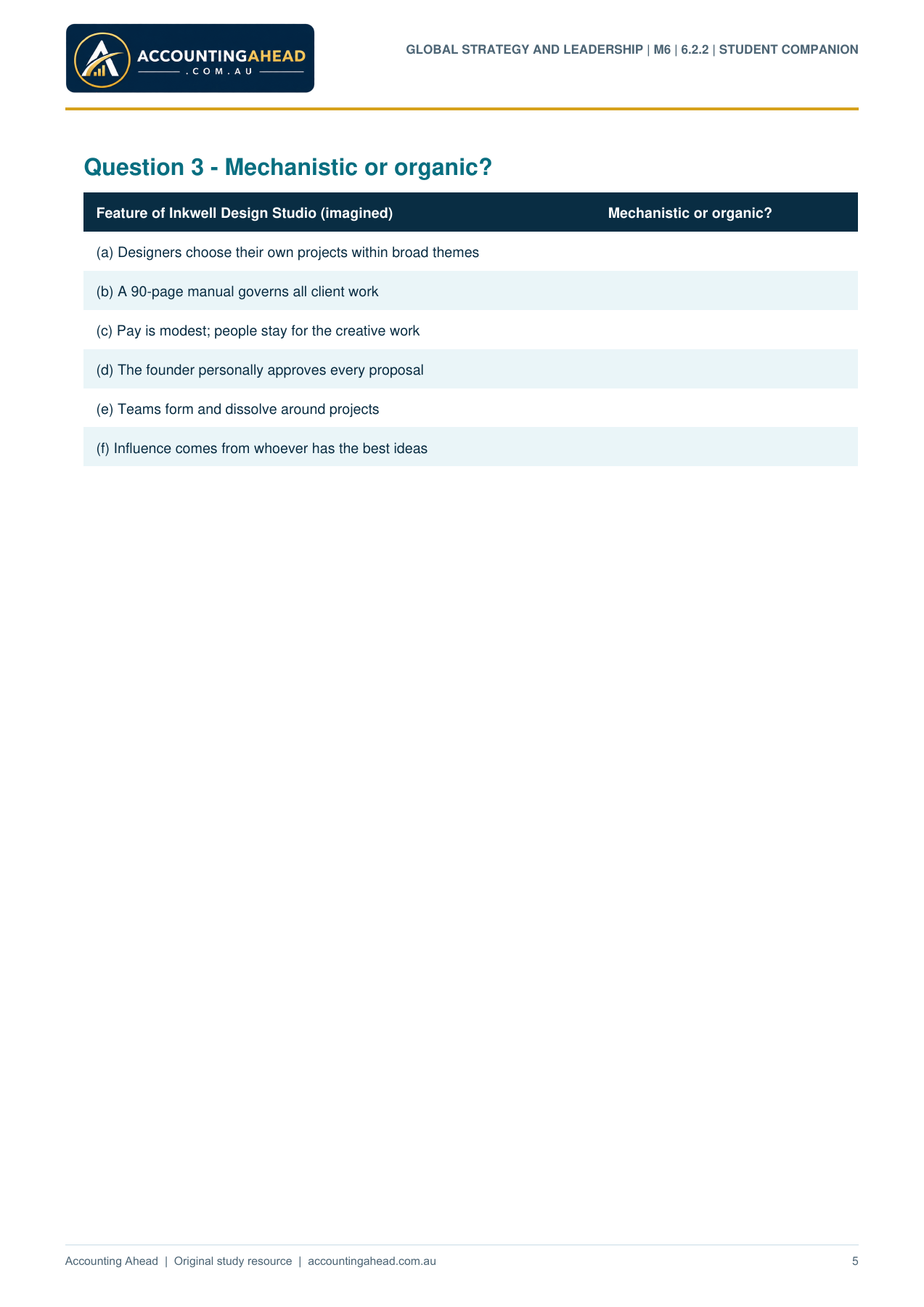
Question 3 - Mechanistic or organic?
Feature of Inkwell Design Studio (imagined) Mechanistic or organic?
(a) Designers choose their own projects within broad themes
(b) A 90-page manual governs all client work
(c) Pay is modest; people stay for the creative work
(d) The founder personally approves every proposal
(e) Teams form and dissolve around projects
(f) Influence comes from whoever has the best ideas
GLOBAL STRATEGY AND LEADERSHIP | M6 | 6.2.2 | STUDENT COMPANION
5
Accounting Ahead | Original study resource | accountingahead.com.au
Worked answers
MODULE 6 | 6.2.2 | WORKED ANSWERS - ATTEMPT THE QUESTIONS FIRST
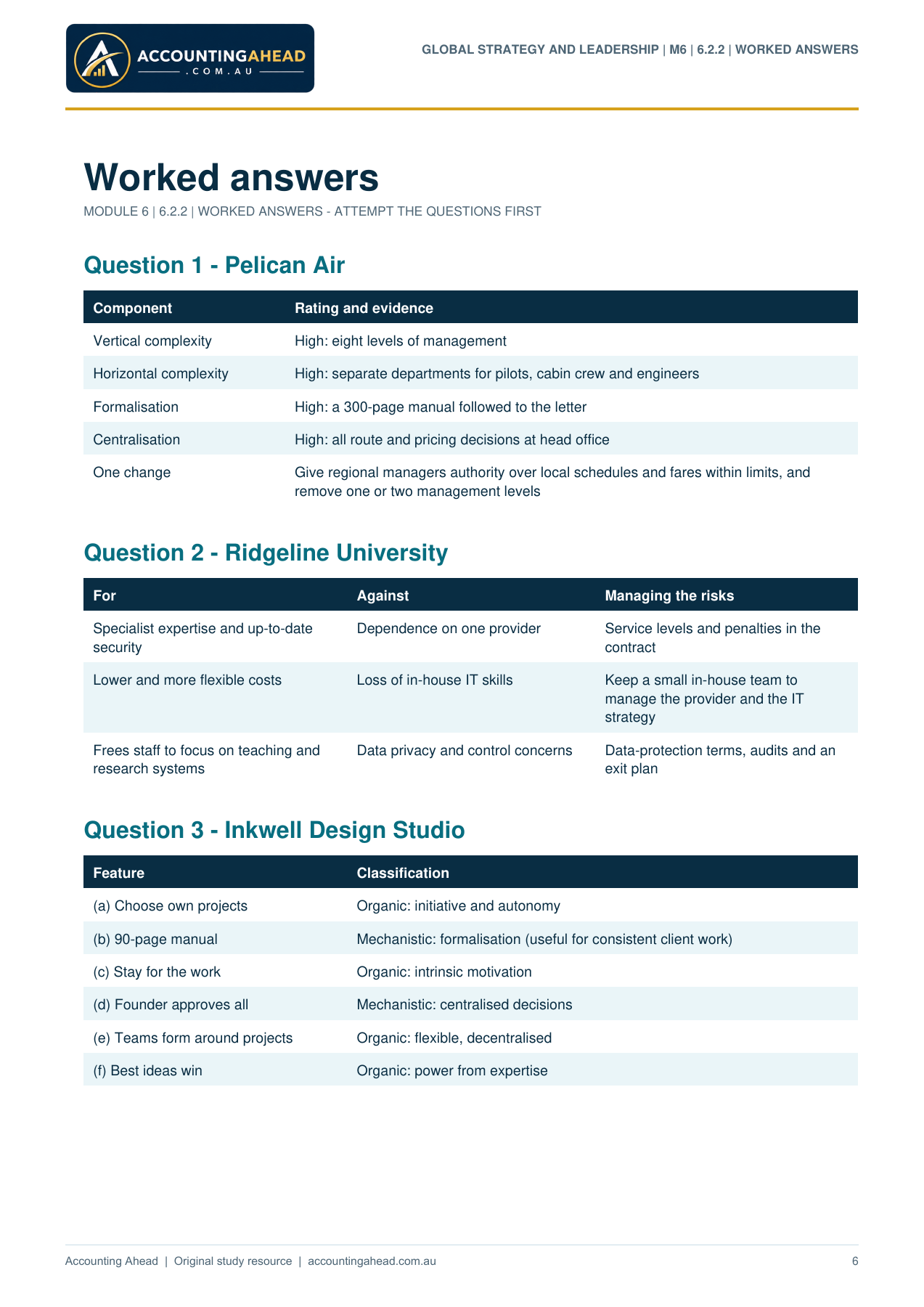
Question 1 - Pelican Air
Component Rating and evidence
Vertical complexity High: eight levels of management
Horizontal complexity High: separate departments for pilots, cabin crew and engineers
Formalisation High: a 300-page manual followed to the letter
Centralisation High: all route and pricing decisions at head office
One change Give regional managers authority over local schedules and fares within limits, and
remove one or two management levels
Question 2 - Ridgeline University
For Against Managing the risks
Specialist expertise and up-to-date
security
Dependence on one provider Service levels and penalties in the
contract
Lower and more flexible costs Loss of in-house IT skills Keep a small in-house team to
manage the provider and the IT
strategy
Frees staff to focus on teaching and
research systems
Data privacy and control concerns Data-protection terms, audits and an
exit plan
Question 3 - Inkwell Design Studio
Feature Classification
(a) Choose own projects Organic: initiative and autonomy
(b) 90-page manual Mechanistic: formalisation (useful for consistent client work)
(c) Stay for the work Organic: intrinsic motivation
(d) Founder approves all Mechanistic: centralised decisions
(e) Teams form around projects Organic: flexible, decentralised
(f) Best ideas win Organic: power from expertise
GLOBAL STRATEGY AND LEADERSHIP | M6 | 6.2.2 | WORKED ANSWERS
6