
Systems, teams and culture
Printable study notes to use alongside Part 6.2.3.
Read the handout text
Accounting Ahead | Original study resource | accountingahead.com.au
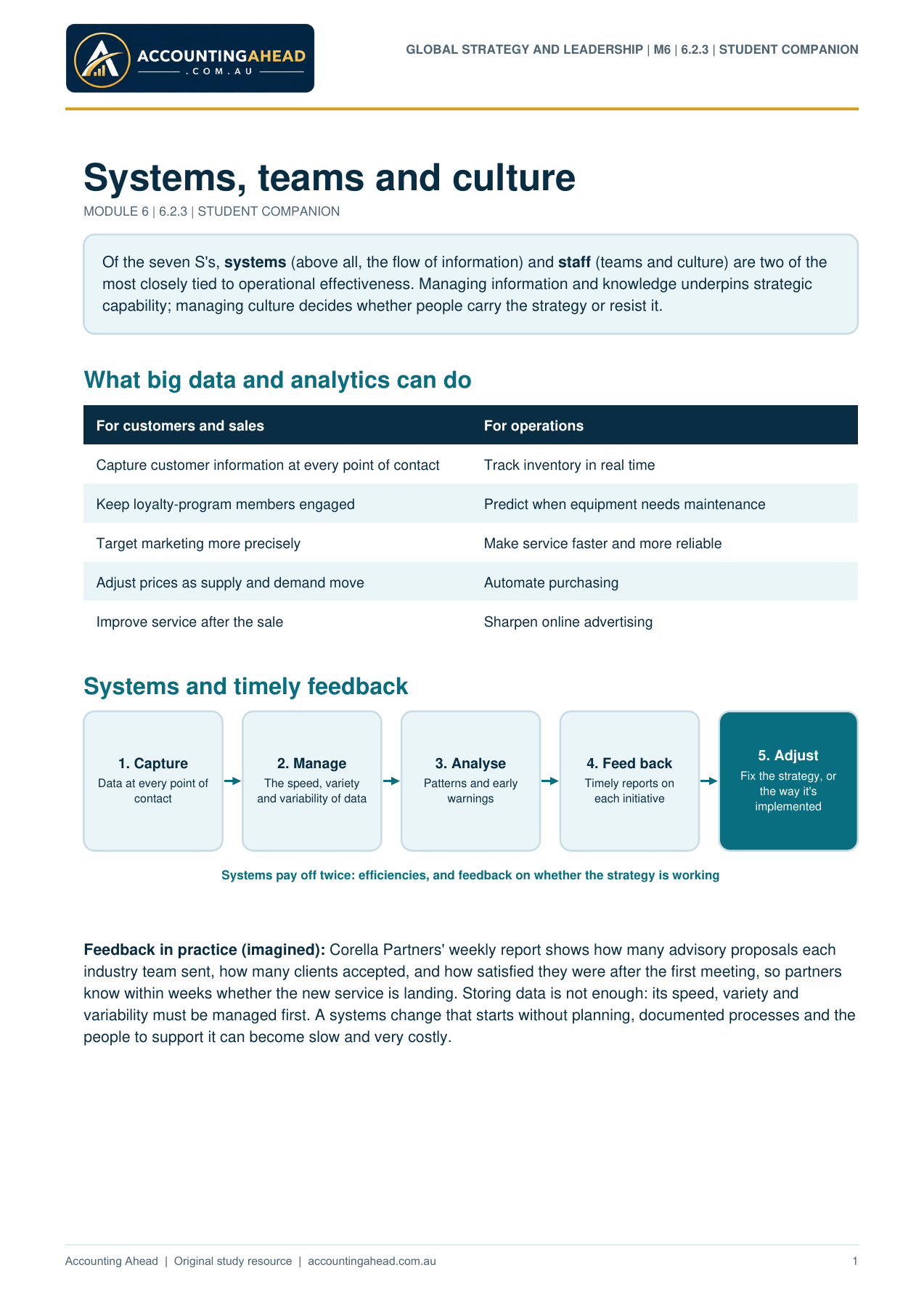
Systems, teams and culture
MODULE 6 | 6.2.3 | STUDENT COMPANION
Of the seven S's, systems (above all, the flow of information) and staff (teams and culture) are two of the
most closely tied to operational effectiveness. Managing information and knowledge underpins strategic
capability; managing culture decides whether people carry the strategy or resist it.
What big data and analytics can do
For customers and sales For operations
Capture customer information at every point of contact Track inventory in real time
Keep loyalty-program members engaged Predict when equipment needs maintenance
Target marketing more precisely Make service faster and more reliable
Adjust prices as supply and demand move Automate purchasing
Improve service after the sale Sharpen online advertising
Systems and timely feedback
1. Capture
Data at every point of
contact
2. Manage
The speed, variety
and variability of data
3. Analyse
Patterns and early
warnings
4. Feed back
Timely reports on
each initiative
5. Adjust
Fix the strategy, or
the way it's
implemented
Systems pay off twice: efficiencies, and feedback on whether the strategy is working
Feedback in practice (imagined): Corella Partners' weekly report shows how many advisory proposals each
industry team sent, how many clients accepted, and how satisfied they were after the first meeting, so partners
know within weeks whether the new service is landing. Storing data is not enough: its speed, variety and
variability must be managed first. A systems change that starts without planning, documented processes and the
people to support it can become slow and very costly.
GLOBAL STRATEGY AND LEADERSHIP | M6 | 6.2.3 | STUDENT COMPANION
1
Accounting Ahead | Original study resource | accountingahead.com.au
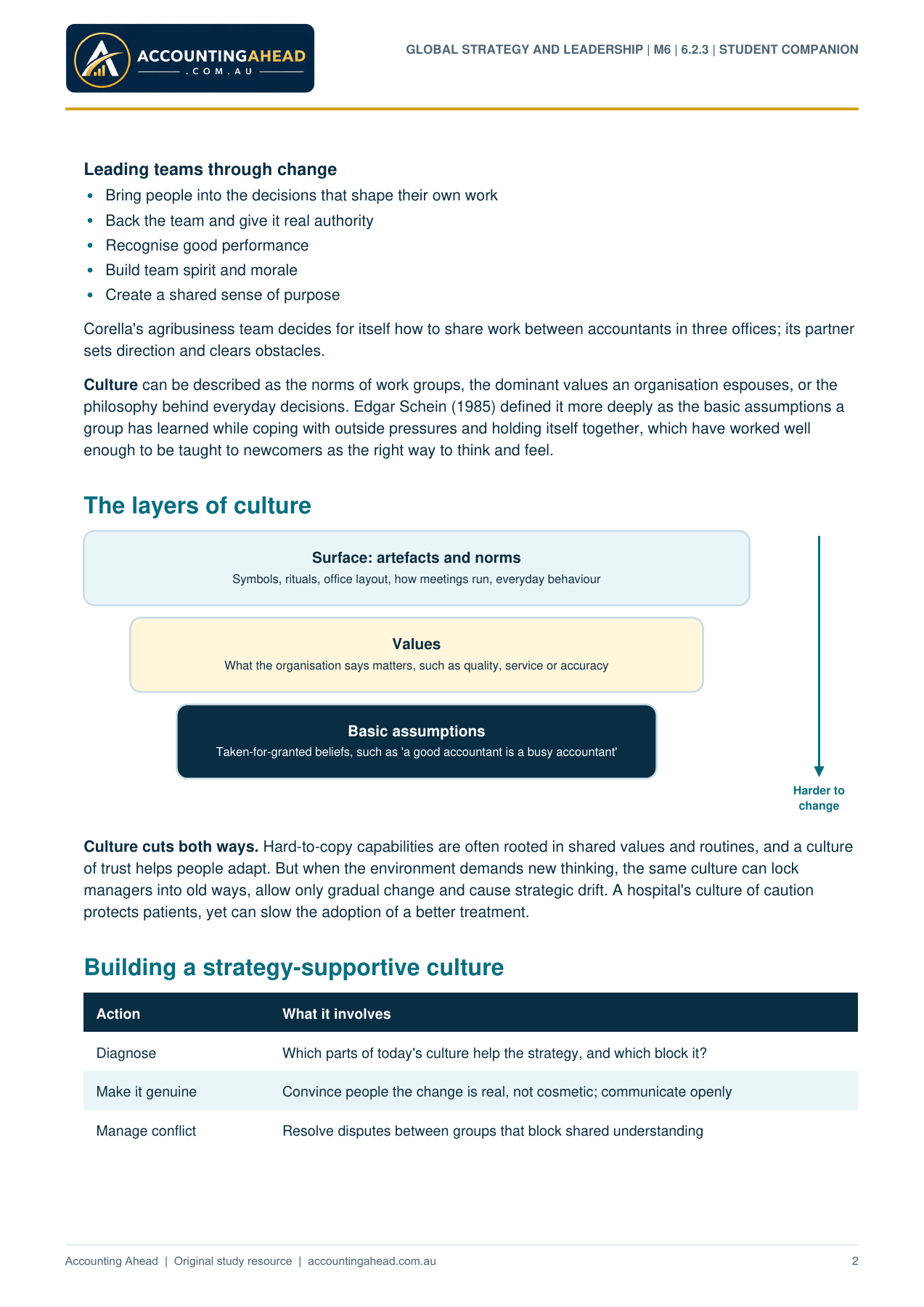
Leading teams through change
Bring people into the decisions that shape their own work
Back the team and give it real authority
Recognise good performance
Build team spirit and morale
Create a shared sense of purpose
Corella's agribusiness team decides for itself how to share work between accountants in three offices; its partner
sets direction and clears obstacles.
Culture can be described as the norms of work groups, the dominant values an organisation espouses, or the
philosophy behind everyday decisions. Edgar Schein (1985) defined it more deeply as the basic assumptions a
group has learned while coping with outside pressures and holding itself together, which have worked well
enough to be taught to newcomers as the right way to think and feel.
The layers of culture
Surface: artefacts and norms
Symbols, rituals, office layout, how meetings run, everyday behaviour
Values
What the organisation says matters, such as quality, service or accuracy
Basic assumptions
Taken-for-granted beliefs, such as 'a good accountant is a busy accountant'
Harder to
change
Culture cuts both ways. Hard-to-copy capabilities are often rooted in shared values and routines, and a culture
of trust helps people adapt. But when the environment demands new thinking, the same culture can lock
managers into old ways, allow only gradual change and cause strategic drift. A hospital's culture of caution
protects patients, yet can slow the adoption of a better treatment.
Building a strategy-supportive culture
Action What it involves
Diagnose Which parts of today's culture help the strategy, and which block it?
Make it genuine Convince people the change is real, not cosmetic; communicate openly
Manage conflict Resolve disputes between groups that block shared understanding
GLOBAL STRATEGY AND LEADERSHIP | M6 | 6.2.3 | STUDENT COMPANION
2
Accounting Ahead | Original study resource | accountingahead.com.au
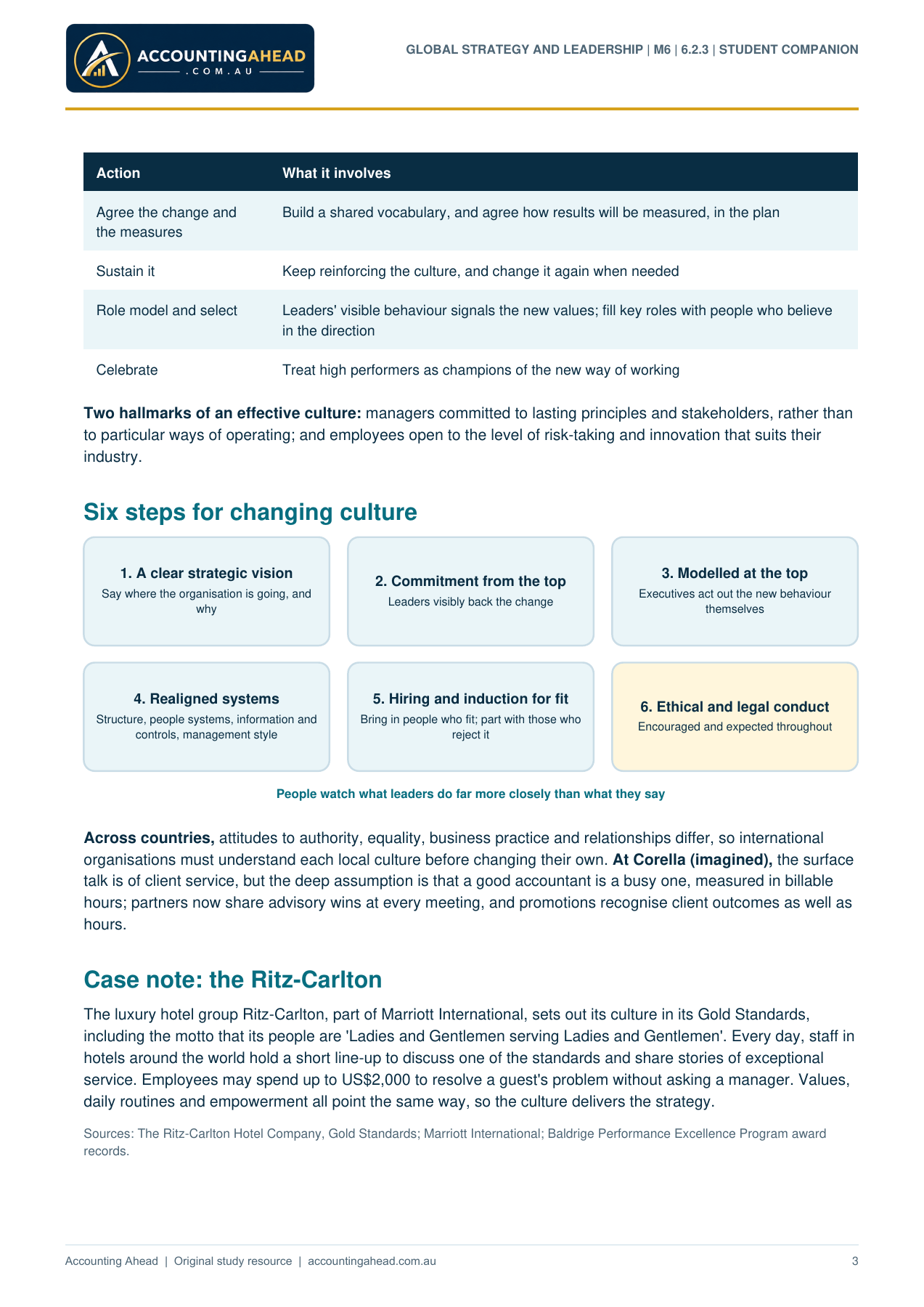
Action What it involves
Agree the change and
the measures
Build a shared vocabulary, and agree how results will be measured, in the plan
Sustain it Keep reinforcing the culture, and change it again when needed
Role model and select Leaders' visible behaviour signals the new values; fill key roles with people who believe
in the direction
Celebrate Treat high performers as champions of the new way of working
Two hallmarks of an effective culture: managers committed to lasting principles and stakeholders, rather than
to particular ways of operating; and employees open to the level of risk-taking and innovation that suits their
industry.
Six steps for changing culture
1. A clear strategic vision
Say where the organisation is going, and
why
2. Commitment from the top
Leaders visibly back the change
3. Modelled at the top
Executives act out the new behaviour
themselves
4. Realigned systems
Structure, people systems, information and
controls, management style
5. Hiring and induction for fit
Bring in people who fit; part with those who
reject it
6. Ethical and legal conduct
Encouraged and expected throughout
People watch what leaders do far more closely than what they say
Across countries, attitudes to authority, equality, business practice and relationships differ, so international
organisations must understand each local culture before changing their own. At Corella (imagined), the surface
talk is of client service, but the deep assumption is that a good accountant is a busy one, measured in billable
hours; partners now share advisory wins at every meeting, and promotions recognise client outcomes as well as
hours.
Case note: the Ritz-Carlton
The luxury hotel group Ritz-Carlton, part of Marriott International, sets out its culture in its Gold Standards,
including the motto that its people are 'Ladies and Gentlemen serving Ladies and Gentlemen'. Every day, staff in
hotels around the world hold a short line-up to discuss one of the standards and share stories of exceptional
service. Employees may spend up to US$2,000 to resolve a guest's problem without asking a manager. Values,
daily routines and empowerment all point the same way, so the culture delivers the strategy.
Sources: The Ritz-Carlton Hotel Company, Gold Standards; Marriott International; Baldrige Performance Excellence Program award
records.
GLOBAL STRATEGY AND LEADERSHIP | M6 | 6.2.3 | STUDENT COMPANION
3
Accounting Ahead | Original study resource | accountingahead.com.au
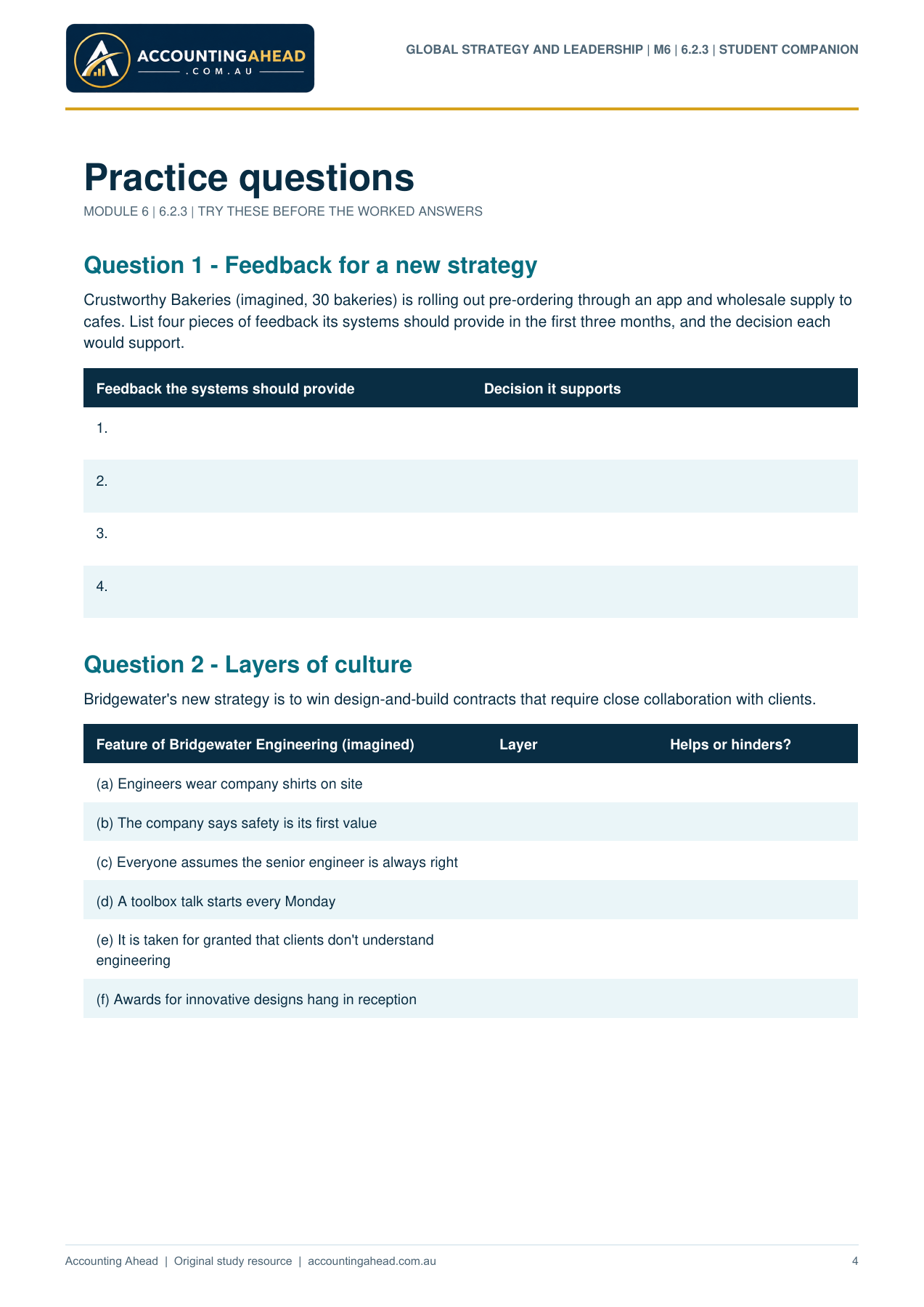
Practice questions
MODULE 6 | 6.2.3 | TRY THESE BEFORE THE WORKED ANSWERS
Question 1 - Feedback for a new strategy
Crustworthy Bakeries (imagined, 30 bakeries) is rolling out pre-ordering through an app and wholesale supply to
cafes. List four pieces of feedback its systems should provide in the first three months, and the decision each
would support.
Feedback the systems should provide Decision it supports
1.
2.
3.
4.
Question 2 - Layers of culture
Bridgewater's new strategy is to win design-and-build contracts that require close collaboration with clients.
Feature of Bridgewater Engineering (imagined) Layer Helps or hinders?
(a) Engineers wear company shirts on site
(b) The company says safety is its first value
(c) Everyone assumes the senior engineer is always right
(d) A toolbox talk starts every Monday
(e) It is taken for granted that clients don't understand
engineering
(f) Awards for innovative designs hang in reception
GLOBAL STRATEGY AND LEADERSHIP | M6 | 6.2.3 | STUDENT COMPANION
4
Accounting Ahead | Original study resource | accountingahead.com.au
Question 3 - Six steps at a hospital
Wattle Grove Hospital (imagined) wants to move from a doctor-centred culture to a patient-centred one, where
patients and families are partners in decisions. Apply the six steps for changing culture, giving one concrete
action for each.
GLOBAL STRATEGY AND LEADERSHIP | M6 | 6.2.3 | STUDENT COMPANION
5
Accounting Ahead | Original study resource | accountingahead.com.au
Worked answers
MODULE 6 | 6.2.3 | WORKED ANSWERS - ATTEMPT THE QUESTIONS FIRST
Question 1 - Crustworthy Bakeries (sample)
Feedback Decision it supports
App downloads and weekly pre-orders by bakery Where to promote the app, and whether to keep it
Share of pre-orders collected on time Whether ovens and staffing match morning demand
Wholesale orders, margins and late deliveries by cafe Which cafes to keep, and delivery routes
Waste and unsold stock per bakery Production quantities and pricing
Question 2 - Bridgewater Engineering
Feature Layer Effect on the strategy
(a) Company shirts Surface Neutral
(b) Safety first Values Helps: clients value safe delivery
(c) Senior engineer always right Assumption Hinders: discourages listening and collaboration
(d) Monday toolbox talk Surface Helps: a routine that could include client issues
(e) Clients don't understand engineering Assumption Hinders: undermines collaboration
(f) Innovation awards Surface Helps: signals pride in design
Question 3 - Wattle Grove Hospital (sample)
Step Action
1. Vision 'Every patient a partner in their care', explained with the evidence behind it
2. Commitment The board and executives fund training and track patient experience
3. Modelling Senior doctors visibly involve patients and families in ward rounds
4. Systems Patient-experience measures in reviews; family meetings built into care pathways
5. Hiring and induction Recruit and induct for communication skills; address persistent resistance
6. Ethics Reinforce informed consent, privacy and respect for patients' choices
GLOBAL STRATEGY AND LEADERSHIP | M6 | 6.2.3 | WORKED ANSWERS
6