
Success factors and Kotter's eight steps
Printable study notes to use alongside Part 6.3.2.

Read the handout text
Accounting Ahead | Original study resource | accountingahead.com.au
Success factors and Kotter's eight steps
MODULE 6 | 6.3.2 | STUDENT COMPANION
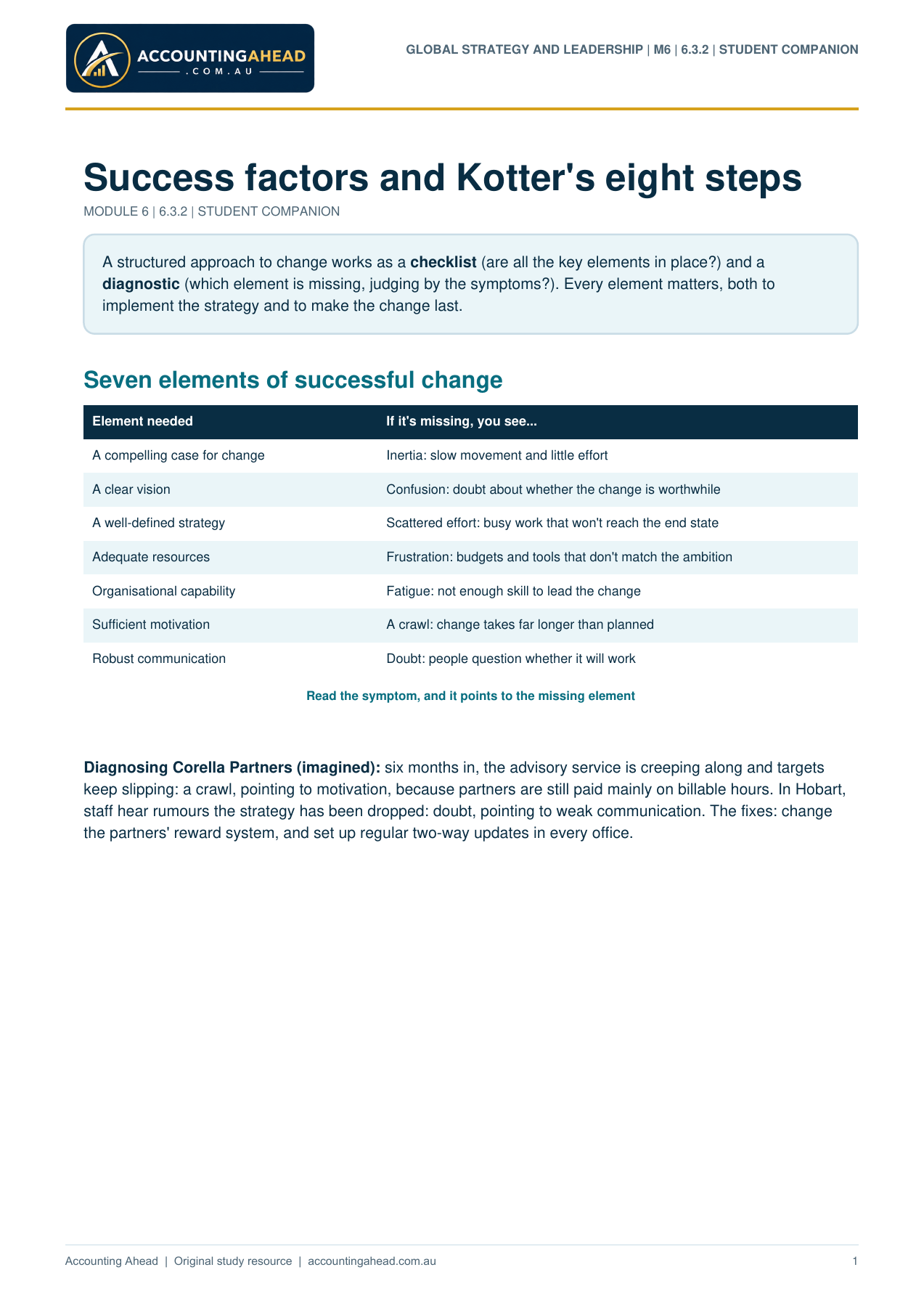
A structured approach to change works as a checklist (are all the key elements in place?) and a
diagnostic (which element is missing, judging by the symptoms?). Every element matters, both to
implement the strategy and to make the change last.
Seven elements of successful change
Element needed If it's missing, you see...
A compelling case for change Inertia: slow movement and little effort
A clear vision Confusion: doubt about whether the change is worthwhile
A well-defined strategy Scattered effort: busy work that won't reach the end state
Adequate resources Frustration: budgets and tools that don't match the ambition
Organisational capability Fatigue: not enough skill to lead the change
Sufficient motivation A crawl: change takes far longer than planned
Robust communication Doubt: people question whether it will work
Read the symptom, and it points to the missing element
Diagnosing Corella Partners (imagined): six months in, the advisory service is creeping along and targets
keep slipping: a crawl, pointing to motivation, because partners are still paid mainly on billable hours. In Hobart,
staff hear rumours the strategy has been dropped: doubt, pointing to weak communication. The fixes: change
the partners' reward system, and set up regular two-way updates in every office.
GLOBAL STRATEGY AND LEADERSHIP | M6 | 6.3.2 | STUDENT COMPANION
1
Accounting Ahead | Original study resource | accountingahead.com.au
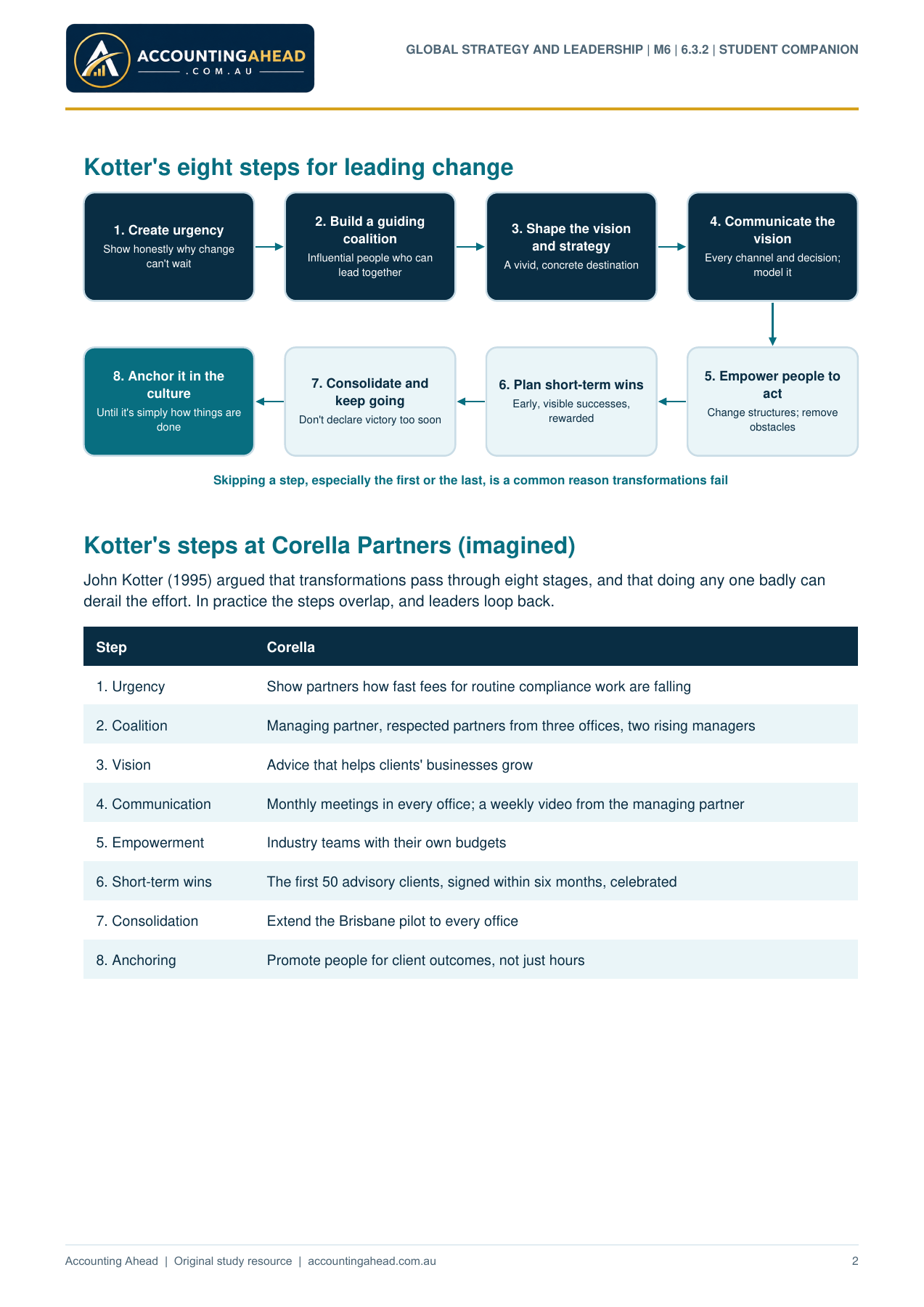
Kotter's eight steps for leading change
1. Create urgency
Show honestly why change
can't wait
2. Build a guiding
coalition
Influential people who can
lead together
3. Shape the vision
and strategy
A vivid, concrete destination
4. Communicate the
vision
Every channel and decision;
model it
5. Empower people to
act
Change structures; remove
obstacles
6. Plan short-term wins
Early, visible successes,
rewarded
7. Consolidate and
keep going
Don't declare victory too soon
8. Anchor it in the
culture
Until it's simply how things are
done
Skipping a step, especially the first or the last, is a common reason transformations fail
Kotter's steps at Corella Partners (imagined)
John Kotter (1995) argued that transformations pass through eight stages, and that doing any one badly can
derail the effort. In practice the steps overlap, and leaders loop back.
Step Corella
1. Urgency Show partners how fast fees for routine compliance work are falling
2. Coalition Managing partner, respected partners from three offices, two rising managers
3. Vision Advice that helps clients' businesses grow
4. Communication Monthly meetings in every office; a weekly video from the managing partner
5. Empowerment Industry teams with their own budgets
6. Short-term wins The first 50 advisory clients, signed within six months, celebrated
7. Consolidation Extend the Brisbane pilot to every office
8. Anchoring Promote people for client outcomes, not just hours
GLOBAL STRATEGY AND LEADERSHIP | M6 | 6.3.2 | STUDENT COMPANION
2
Accounting Ahead | Original study resource | accountingahead.com.au
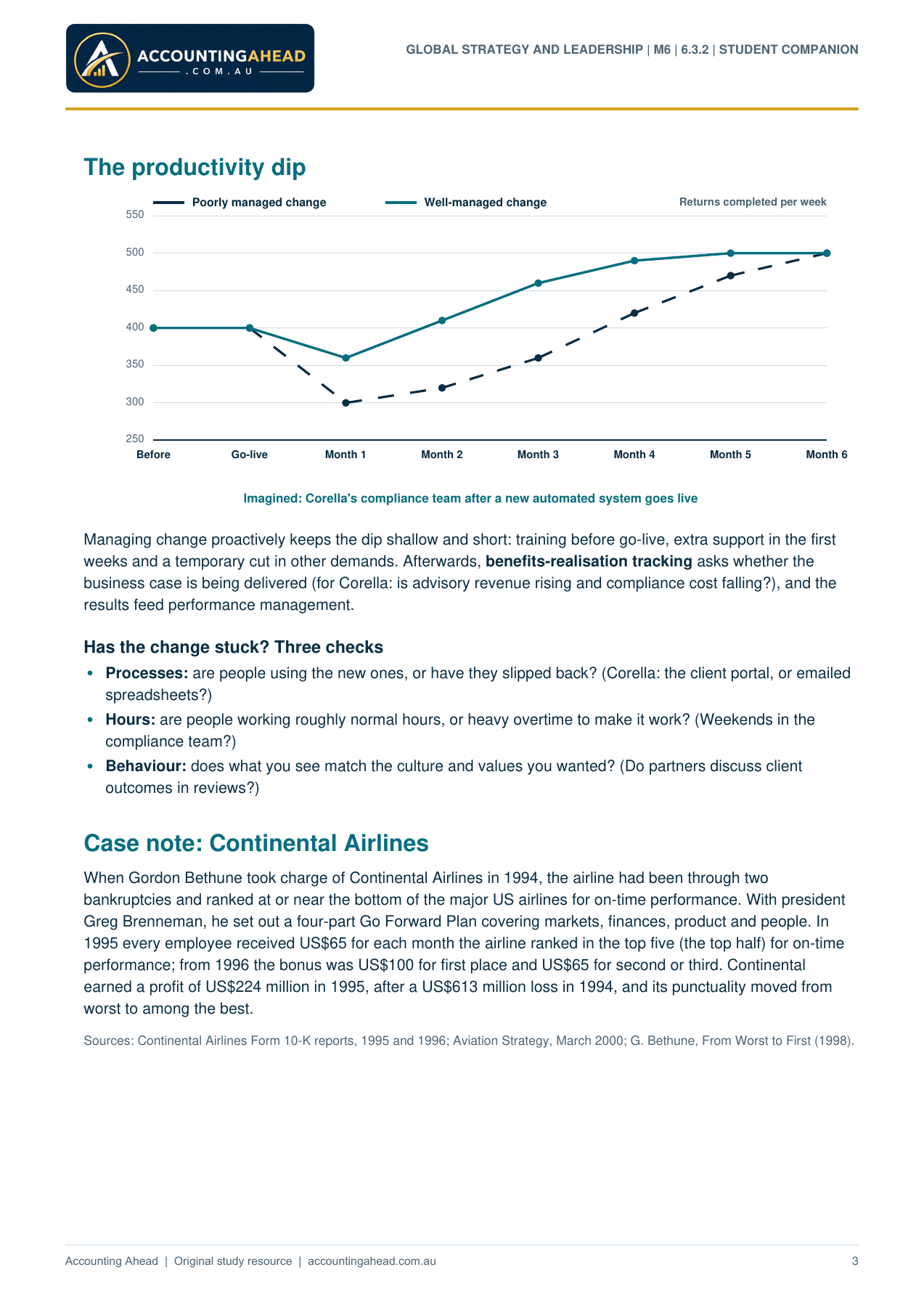
The productivity dip
250
300
350
400
450
500
550
Before Go-live Month 1 Month 2 Month 3 Month 4 Month 5 Month 6
Poorly managed change Well-managed change Returns completed per week
Imagined: Corella's compliance team after a new automated system goes live
Managing change proactively keeps the dip shallow and short: training before go-live, extra support in the first
weeks and a temporary cut in other demands. Afterwards, benefits-realisation tracking asks whether the
business case is being delivered (for Corella: is advisory revenue rising and compliance cost falling?), and the
results feed performance management.
Has the change stuck? Three checks
Processes: are people using the new ones, or have they slipped back? (Corella: the client portal, or emailed
spreadsheets?)
Hours: are people working roughly normal hours, or heavy overtime to make it work? (Weekends in the
compliance team?)
Behaviour: does what you see match the culture and values you wanted? (Do partners discuss client
outcomes in reviews?)
Case note: Continental Airlines
When Gordon Bethune took charge of Continental Airlines in 1994, the airline had been through two
bankruptcies and ranked at or near the bottom of the major US airlines for on-time performance. With president
Greg Brenneman, he set out a four-part Go Forward Plan covering markets, finances, product and people. In
1995 every employee received US$65 for each month the airline ranked in the top five (the top half) for on-time
performance; from 1996 the bonus was US$100 for first place and US$65 for second or third. Continental
earned a profit of US$224 million in 1995, after a US$613 million loss in 1994, and its punctuality moved from
worst to among the best.
Sources: Continental Airlines Form 10-K reports, 1995 and 1996; Aviation Strategy, March 2000; G. Bethune, From Worst to First (1998).
GLOBAL STRATEGY AND LEADERSHIP | M6 | 6.3.2 | STUDENT COMPANION
3
Accounting Ahead | Original study resource | accountingahead.com.au
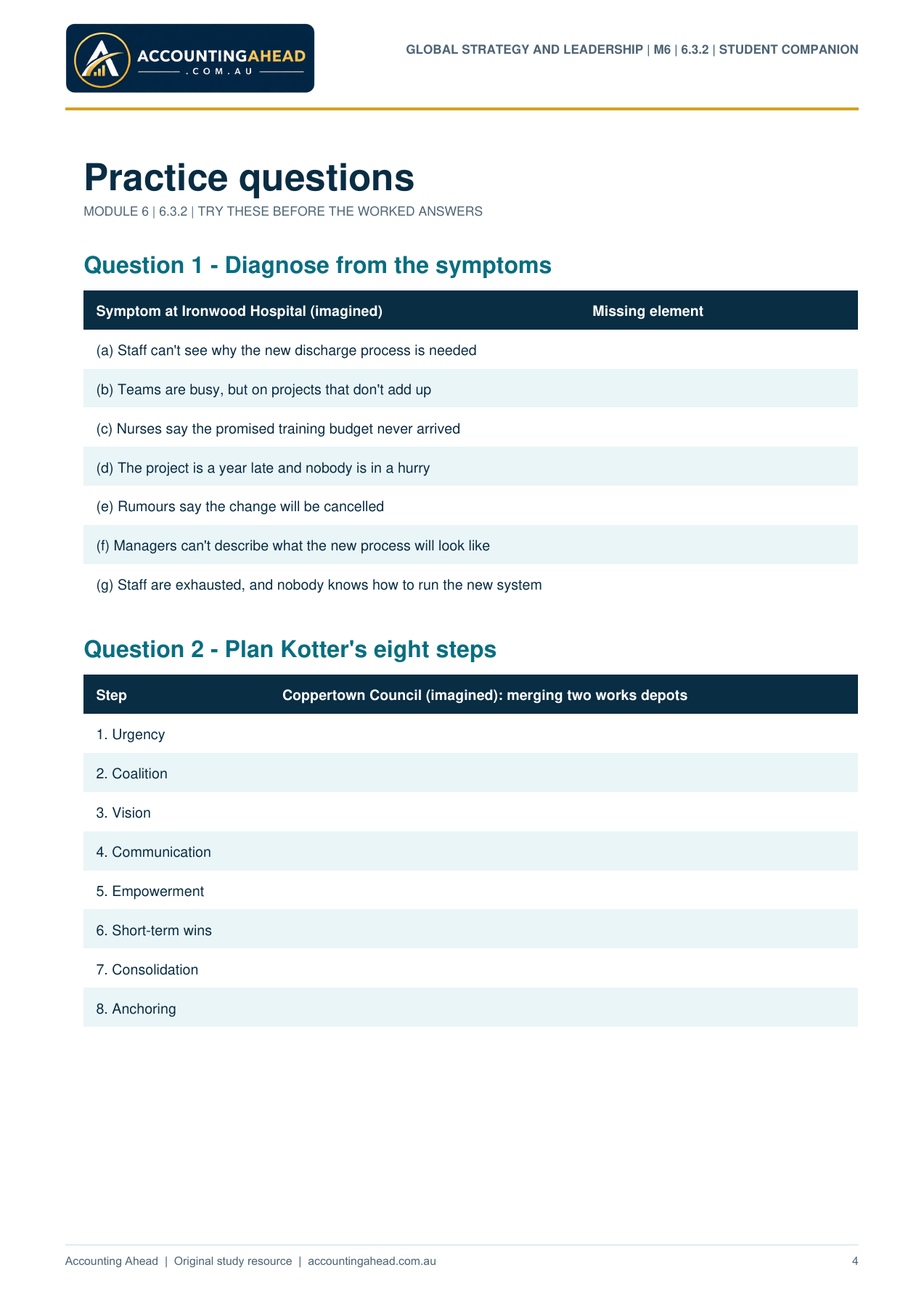
Practice questions
MODULE 6 | 6.3.2 | TRY THESE BEFORE THE WORKED ANSWERS
Question 1 - Diagnose from the symptoms
Symptom at Ironwood Hospital (imagined) Missing element
(a) Staff can't see why the new discharge process is needed
(b) Teams are busy, but on projects that don't add up
(c) Nurses say the promised training budget never arrived
(d) The project is a year late and nobody is in a hurry
(e) Rumours say the change will be cancelled
(f) Managers can't describe what the new process will look like
(g) Staff are exhausted, and nobody knows how to run the new system
Question 2 - Plan Kotter's eight steps
Step Coppertown Council (imagined): merging two works depots
1. Urgency
2. Coalition
3. Vision
4. Communication
5. Empowerment
6. Short-term wins
7. Consolidation
8. Anchoring
GLOBAL STRATEGY AND LEADERSHIP | M6 | 6.3.2 | STUDENT COMPANION
4
Accounting Ahead | Original study resource | accountingahead.com.au
Question 3 - Has it stuck?
Brightwater Retail (imagined) introduced a new digital rostering system in its 25 stores three months ago. Design
one check, with a measure, for each of the three tests of whether a change has stuck.
GLOBAL STRATEGY AND LEADERSHIP | M6 | 6.3.2 | STUDENT COMPANION
5
Accounting Ahead | Original study resource | accountingahead.com.au
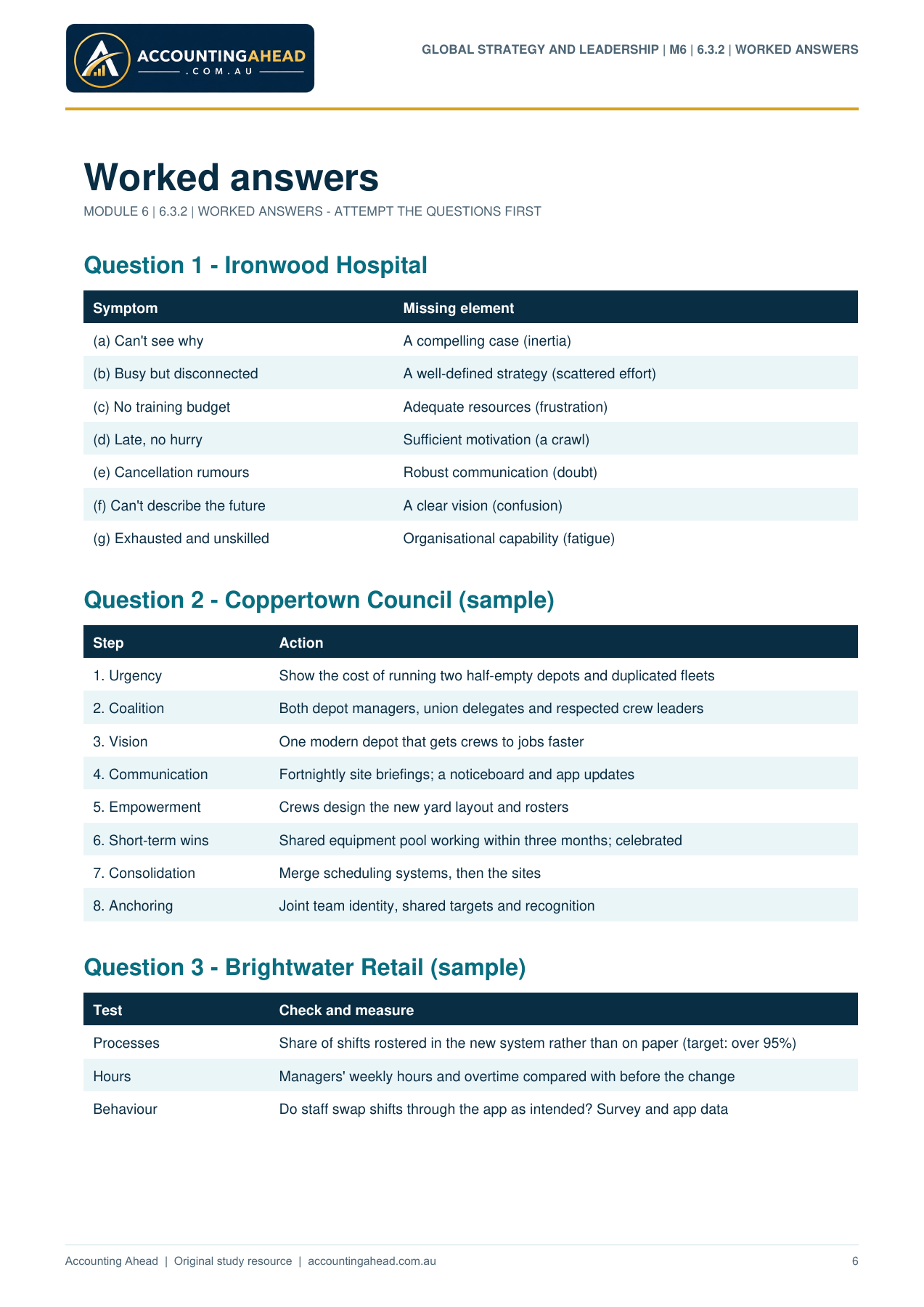
Worked answers
MODULE 6 | 6.3.2 | WORKED ANSWERS - ATTEMPT THE QUESTIONS FIRST
Question 1 - Ironwood Hospital
Symptom Missing element
(a) Can't see why A compelling case (inertia)
(b) Busy but disconnected A well-defined strategy (scattered effort)
(c) No training budget Adequate resources (frustration)
(d) Late, no hurry Sufficient motivation (a crawl)
(e) Cancellation rumours Robust communication (doubt)
(f) Can't describe the future A clear vision (confusion)
(g) Exhausted and unskilled Organisational capability (fatigue)
Question 2 - Coppertown Council (sample)
Step Action
1. Urgency Show the cost of running two half-empty depots and duplicated fleets
2. Coalition Both depot managers, union delegates and respected crew leaders
3. Vision One modern depot that gets crews to jobs faster
4. Communication Fortnightly site briefings; a noticeboard and app updates
5. Empowerment Crews design the new yard layout and rosters
6. Short-term wins Shared equipment pool working within three months; celebrated
7. Consolidation Merge scheduling systems, then the sites
8. Anchoring Joint team identity, shared targets and recognition
Question 3 - Brightwater Retail (sample)
Test Check and measure
Processes Share of shifts rostered in the new system rather than on paper (target: over 95%)
Hours Managers' weekly hours and overtime compared with before the change
Behaviour Do staff swap shifts through the app as intended? Survey and app data
GLOBAL STRATEGY AND LEADERSHIP | M6 | 6.3.2 | WORKED ANSWERS
6