
Projects and programs for implementation
Printable study notes to use alongside Part 6.4.
Read the handout text
Accounting Ahead | Original study resource | accountingahead.com.au
Projects and programs for implementation
MODULE 6 | 6.4 | STUDENT COMPANION
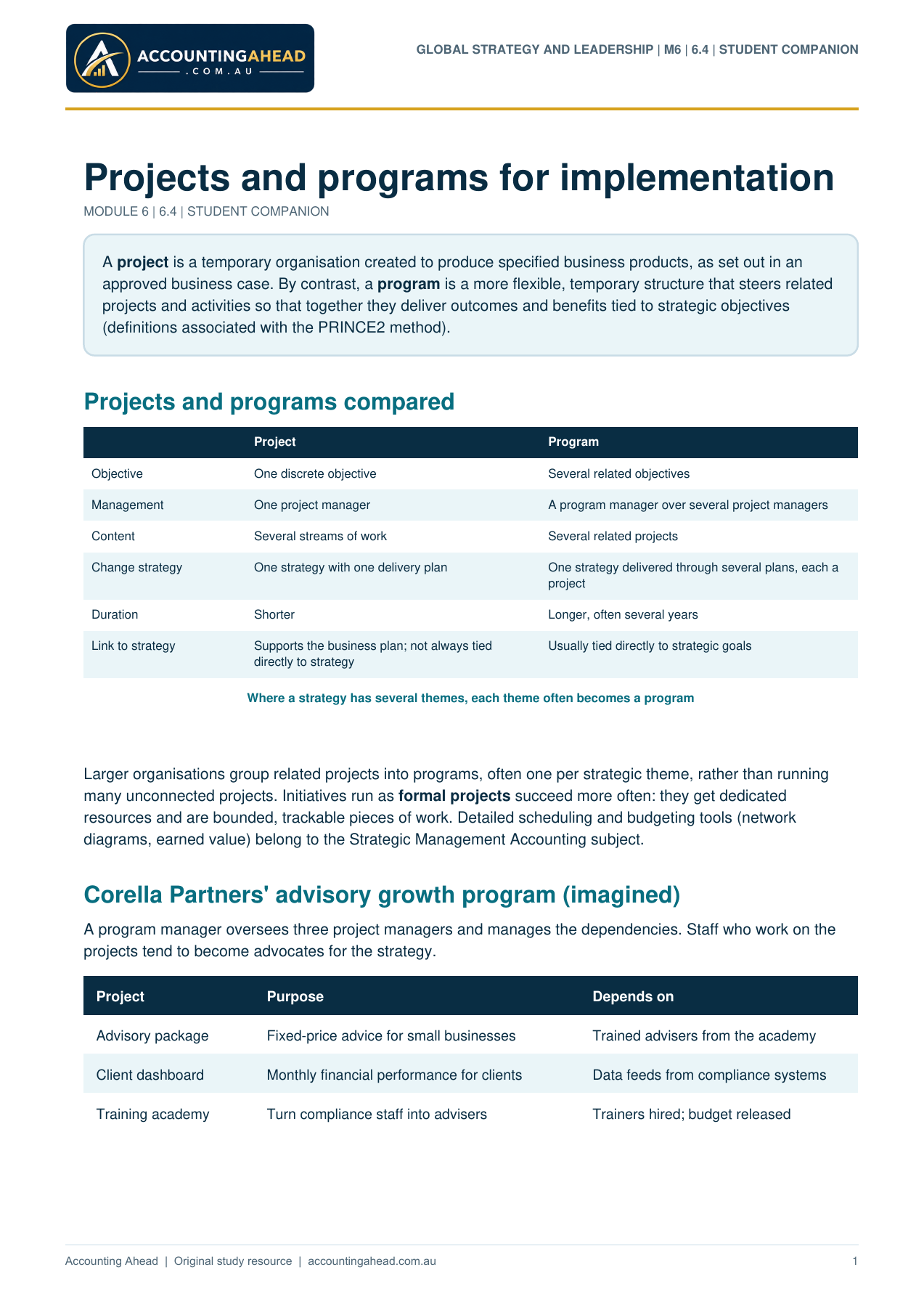
A project is a temporary organisation created to produce specified business products, as set out in an
approved business case. By contrast, a program is a more flexible, temporary structure that steers related
projects and activities so that together they deliver outcomes and benefits tied to strategic objectives
(definitions associated with the PRINCE2 method).
Projects and programs compared
Project Program
Objective One discrete objective Several related objectives
Management One project manager A program manager over several project managers
Content Several streams of work Several related projects
Change strategy One strategy with one delivery plan One strategy delivered through several plans, each a
project
Duration Shorter Longer, often several years
Link to strategy Supports the business plan; not always tied
directly to strategy
Usually tied directly to strategic goals
Where a strategy has several themes, each theme often becomes a program
Larger organisations group related projects into programs, often one per strategic theme, rather than running
many unconnected projects. Initiatives run as formal projects succeed more often: they get dedicated
resources and are bounded, trackable pieces of work. Detailed scheduling and budgeting tools (network
diagrams, earned value) belong to the Strategic Management Accounting subject.
Corella Partners' advisory growth program (imagined)
A program manager oversees three project managers and manages the dependencies. Staff who work on the
projects tend to become advocates for the strategy.
Project Purpose Depends on
Advisory package Fixed-price advice for small businesses Trained advisers from the academy
Client dashboard Monthly financial performance for clients Data feeds from compliance systems
Training academy Turn compliance staff into advisers Trainers hired; budget released
GLOBAL STRATEGY AND LEADERSHIP | M6 | 6.4 | STUDENT COMPANION
1
Accounting Ahead | Original study resource | accountingahead.com.au
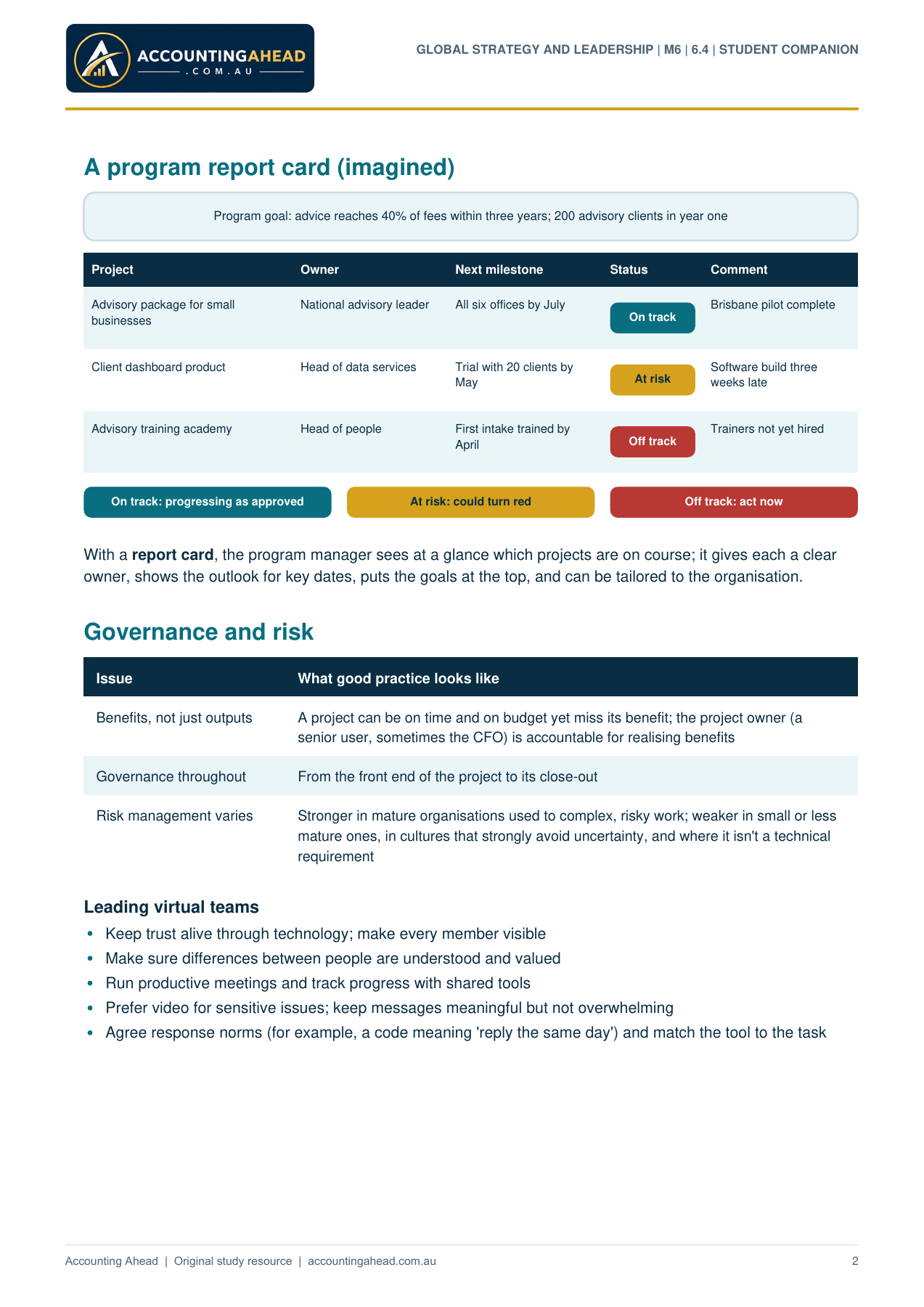
A program report card (imagined)
Program goal: advice reaches 40% of fees within three years; 200 advisory clients in year one
Project Owner Next milestone Status Comment
Advisory package for small
businesses
National advisory leader All six offices by July Brisbane pilot complete
On track
Client dashboard product Head of data services Trial with 20 clients by
May
Software build three
weeks lateAt risk
Advisory training academy Head of people First intake trained by
April
Trainers not yet hired
Off track
On track: progressing as approved At risk: could turn red Off track: act now
With a report card, the program manager sees at a glance which projects are on course; it gives each a clear
owner, shows the outlook for key dates, puts the goals at the top, and can be tailored to the organisation.
Governance and risk
Issue What good practice looks like
Benefits, not just outputs A project can be on time and on budget yet miss its benefit; the project owner (a
senior user, sometimes the CFO) is accountable for realising benefits
Governance throughout From the front end of the project to its close-out
Risk management varies Stronger in mature organisations used to complex, risky work; weaker in small or less
mature ones, in cultures that strongly avoid uncertainty, and where it isn't a technical
requirement
Leading virtual teams
Keep trust alive through technology; make every member visible
Make sure differences between people are understood and valued
Run productive meetings and track progress with shared tools
Prefer video for sensitive issues; keep messages meaningful but not overwhelming
Agree response norms (for example, a code meaning 'reply the same day') and match the tool to the task
GLOBAL STRATEGY AND LEADERSHIP | M6 | 6.4 | STUDENT COMPANION
2
Accounting Ahead | Original study resource | accountingahead.com.au
Cloud collaboration tools
Agile teams deliver in short sprints, each producing a usable part of the result; the traditional waterfall approach
moves step by step to one final outcome. Corella builds its dashboard in two-week sprints, with developers in
Perth, accountants in Sydney and testers in Manila.
Benefits Problems to plan for
Lower communication and collaboration costs Training and new skills
Better integration of knowledge and systems Time to implement
More flexibility and reliability Ongoing service costs
Stronger competitiveness; a smaller carbon footprint Security and data-control risks
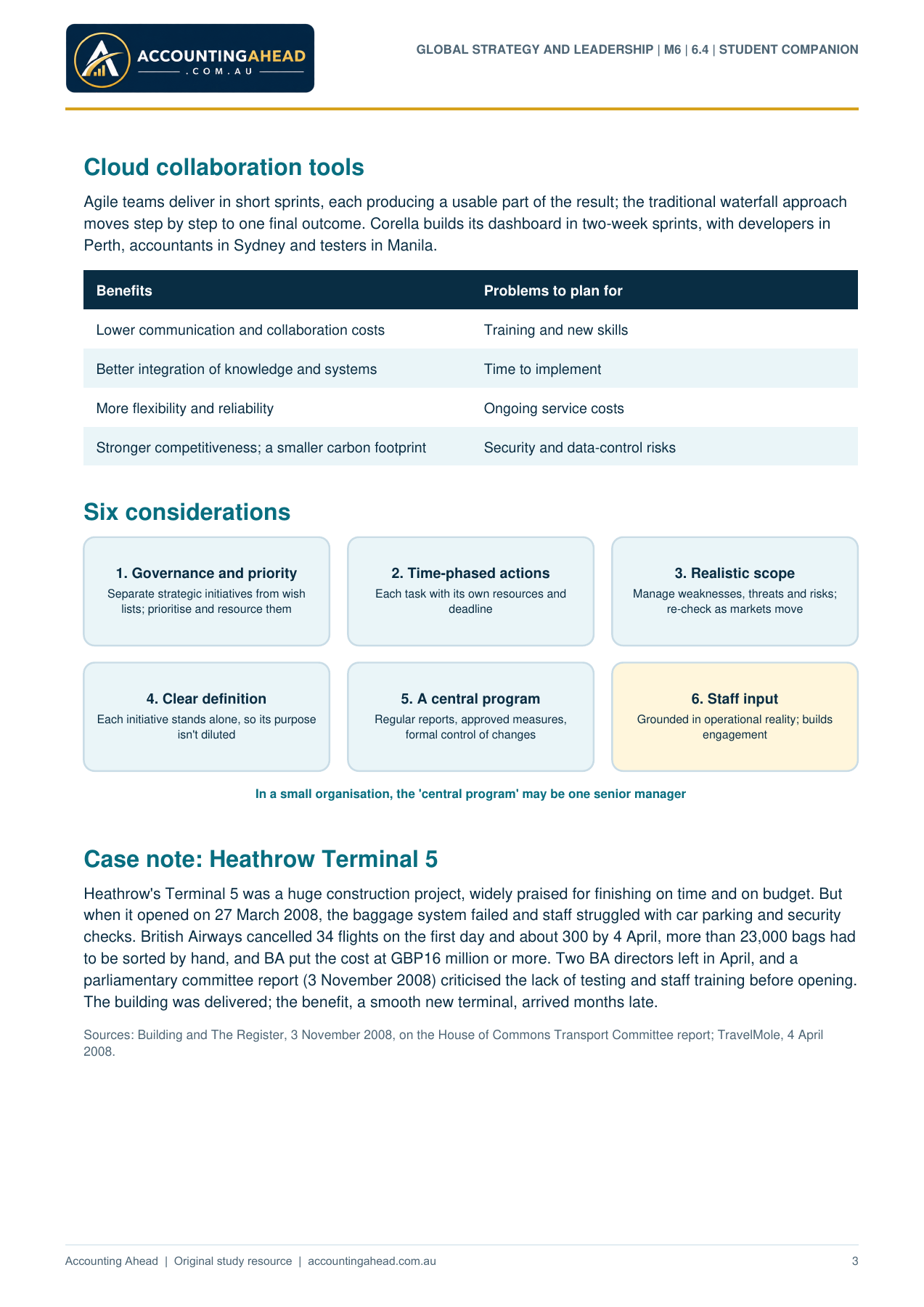
Six considerations
1. Governance and priority
Separate strategic initiatives from wish
lists; prioritise and resource them
2. Time-phased actions
Each task with its own resources and
deadline
3. Realistic scope
Manage weaknesses, threats and risks;
re-check as markets move
4. Clear definition
Each initiative stands alone, so its purpose
isn't diluted
5. A central program
Regular reports, approved measures,
formal control of changes
6. Staff input
Grounded in operational reality; builds
engagement
In a small organisation, the 'central program' may be one senior manager
Case note: Heathrow Terminal 5
Heathrow's Terminal 5 was a huge construction project, widely praised for finishing on time and on budget. But
when it opened on 27 March 2008, the baggage system failed and staff struggled with car parking and security
checks. British Airways cancelled 34 flights on the first day and about 300 by 4 April, more than 23,000 bags had
to be sorted by hand, and BA put the cost at GBP16 million or more. Two BA directors left in April, and a
parliamentary committee report (3 November 2008) criticised the lack of testing and staff training before opening.
The building was delivered; the benefit, a smooth new terminal, arrived months late.
Sources: Building and The Register, 3 November 2008, on the House of Commons Transport Committee report; TravelMole, 4 April
2008.
GLOBAL STRATEGY AND LEADERSHIP | M6 | 6.4 | STUDENT COMPANION
3
Accounting Ahead | Original study resource | accountingahead.com.au
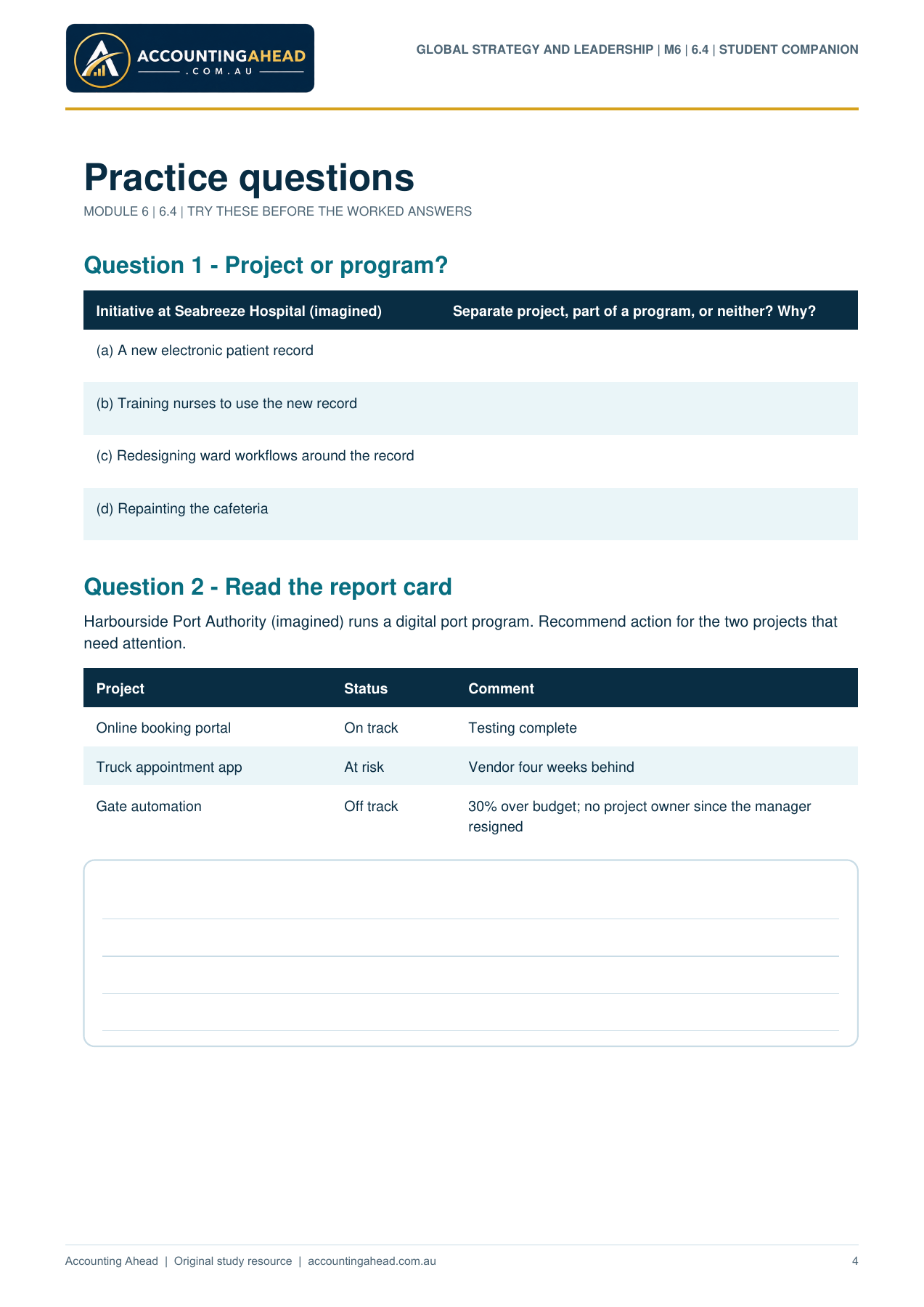
Practice questions
MODULE 6 | 6.4 | TRY THESE BEFORE THE WORKED ANSWERS
Question 1 - Project or program?
Initiative at Seabreeze Hospital (imagined) Separate project, part of a program, or neither? Why?
(a) A new electronic patient record
(b) Training nurses to use the new record
(c) Redesigning ward workflows around the record
(d) Repainting the cafeteria
Question 2 - Read the report card
Harbourside Port Authority (imagined) runs a digital port program. Recommend action for the two projects that
need attention.
Project Status Comment
Online booking portal On track Testing complete
Truck appointment app At risk Vendor four weeks behind
Gate automation Off track 30% over budget; no project owner since the manager
resigned
GLOBAL STRATEGY AND LEADERSHIP | M6 | 6.4 | STUDENT COMPANION
4
Accounting Ahead | Original study resource | accountingahead.com.au
Question 3 - Norms for a virtual team
An imagined engineering firm's design team works across Perth, Singapore and London. Propose five norms
covering meeting times, response expectations, tools and documentation.
GLOBAL STRATEGY AND LEADERSHIP | M6 | 6.4 | STUDENT COMPANION
5
Accounting Ahead | Original study resource | accountingahead.com.au
Worked answers
MODULE 6 | 6.4 | WORKED ANSWERS - ATTEMPT THE QUESTIONS FIRST
Question 1 - Seabreeze Hospital
Initiative Answer
(a) Electronic record Project within a 'digital wards' program: it depends on (b) and (c)
(b) Training nurses Project in the same program; timing must match go-live
(c) Ward workflows Project in the same program; benefits come only when all three align
(d) Cafeteria Neither: routine maintenance, handled through normal operations
Question 2 - Harbourside Port Authority
Truck appointment app (at risk): meet the vendor to agree a recovery plan; check whether penalties apply;
adjust the launch date of dependent projects; report weekly until green.
Gate automation (off track): appoint a new project owner immediately; review scope and budget with the
program board; decide whether to re-plan, cut scope or pause; apply formal change control to any variation.
Question 3 - Virtual team norms (sample)
A weekly video meeting at 4 pm Perth and Singapore time (morning in London), rotated monthly so no one
always meets out of hours
Message codes: 'today' for same-day replies, 'week' for less urgent items
One shared online workspace for drawings and decisions; no design files sent by email
Decisions recorded in a shared log within 24 hours of each meeting
Video, not email, for disagreements or sensitive feedback
GLOBAL STRATEGY AND LEADERSHIP | M6 | 6.4 | WORKED ANSWERS
6