
Measuring, monitoring and rewarding
Printable study notes to use alongside Part 6.5.
Read the handout text
Accounting Ahead | Original study resource | accountingahead.com.au
Measuring, monitoring and rewarding
MODULE 6 | 6.5 | STUDENT COMPANION
Implementation must be watched and adapted continuously, so managers respond to emerging
circumstances, keep learning and avoid clinging to plans that have gone out of date. Some organisations
build a digital model of themselves (a 'virtual twin') to test choices: how well resources are coordinated,
how far the culture supports the strategy, how well people are developed, and whether costs match
priorities.
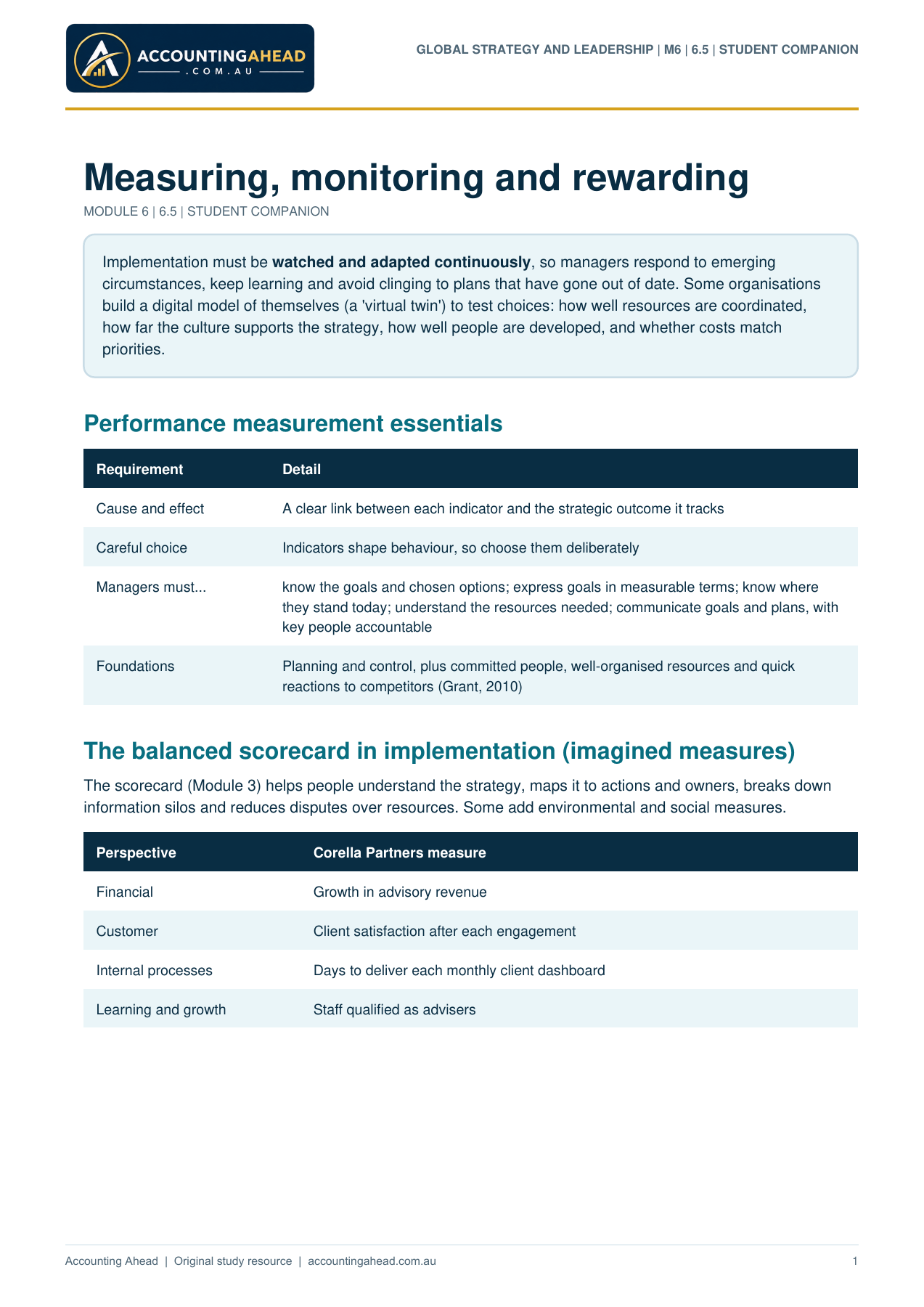
Performance measurement essentials
Requirement Detail
Cause and effect A clear link between each indicator and the strategic outcome it tracks
Careful choice Indicators shape behaviour, so choose them deliberately
Managers must... know the goals and chosen options; express goals in measurable terms; know where
they stand today; understand the resources needed; communicate goals and plans, with
key people accountable
Foundations Planning and control, plus committed people, well-organised resources and quick
reactions to competitors (Grant, 2010)
The balanced scorecard in implementation (imagined measures)
The scorecard (Module 3) helps people understand the strategy, maps it to actions and owners, breaks down
information silos and reduces disputes over resources. Some add environmental and social measures.
Perspective Corella Partners measure
Financial Growth in advisory revenue
Customer Client satisfaction after each engagement
Internal processes Days to deliver each monthly client dashboard
Learning and growth Staff qualified as advisers
GLOBAL STRATEGY AND LEADERSHIP | M6 | 6.5 | STUDENT COMPANION
1
Accounting Ahead | Original study resource | accountingahead.com.au
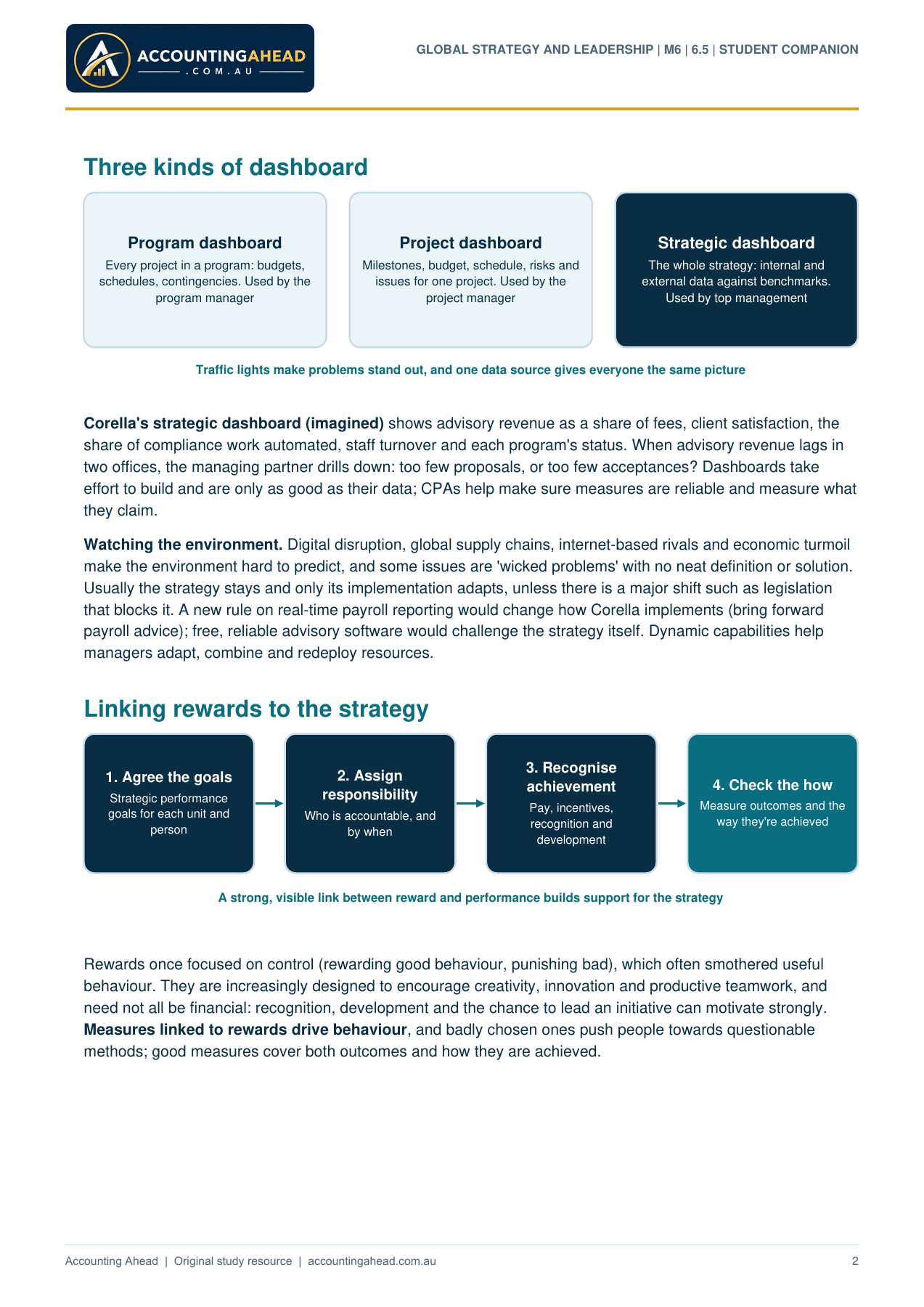
Three kinds of dashboard
Program dashboard
Every project in a program: budgets,
schedules, contingencies. Used by the
program manager
Project dashboard
Milestones, budget, schedule, risks and
issues for one project. Used by the
project manager
Strategic dashboard
The whole strategy: internal and
external data against benchmarks.
Used by top management
Traffic lights make problems stand out, and one data source gives everyone the same picture
Corella's strategic dashboard (imagined) shows advisory revenue as a share of fees, client satisfaction, the
share of compliance work automated, staff turnover and each program's status. When advisory revenue lags in
two offices, the managing partner drills down: too few proposals, or too few acceptances? Dashboards take
effort to build and are only as good as their data; CPAs help make sure measures are reliable and measure what
they claim.
Watching the environment. Digital disruption, global supply chains, internet-based rivals and economic turmoil
make the environment hard to predict, and some issues are 'wicked problems' with no neat definition or solution.
Usually the strategy stays and only its implementation adapts, unless there is a major shift such as legislation
that blocks it. A new rule on real-time payroll reporting would change how Corella implements (bring forward
payroll advice); free, reliable advisory software would challenge the strategy itself. Dynamic capabilities help
managers adapt, combine and redeploy resources.
Linking rewards to the strategy
1. Agree the goals
Strategic performance
goals for each unit and
person
2. Assign
responsibility
Who is accountable, and
by when
3. Recognise
achievement
Pay, incentives,
recognition and
development
4. Check the how
Measure outcomes and the
way they're achieved
A strong, visible link between reward and performance builds support for the strategy
Rewards once focused on control (rewarding good behaviour, punishing bad), which often smothered useful
behaviour. They are increasingly designed to encourage creativity, innovation and productive teamwork, and
need not all be financial: recognition, development and the chance to lead an initiative can motivate strongly.
Measures linked to rewards drive behaviour, and badly chosen ones push people towards questionable
methods; good measures cover both outcomes and how they are achieved.
GLOBAL STRATEGY AND LEADERSHIP | M6 | 6.5 | STUDENT COMPANION
2
Accounting Ahead | Original study resource | accountingahead.com.au
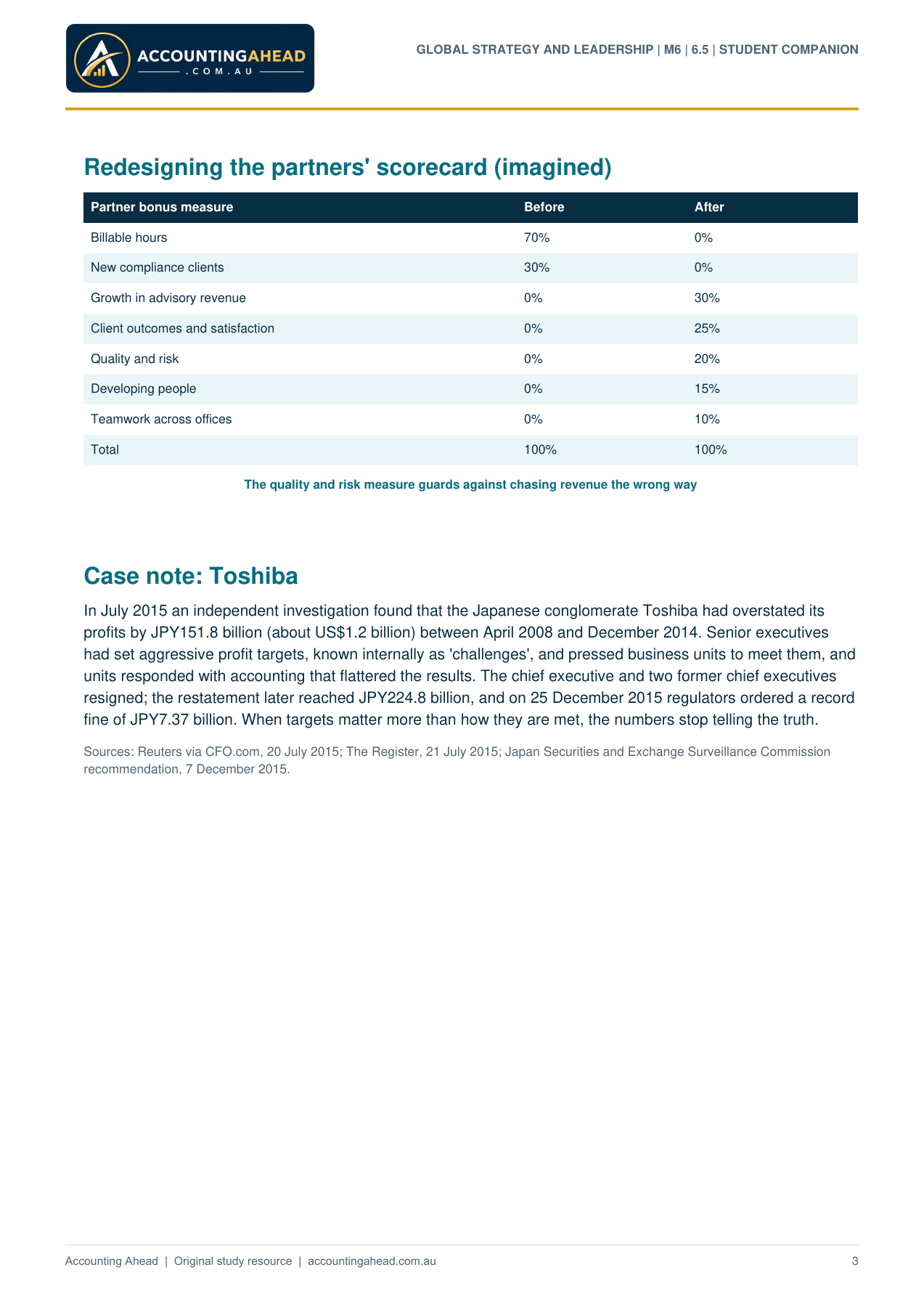
Redesigning the partners' scorecard (imagined)
Partner bonus measure Before After
Billable hours 70% 0%
New compliance clients 30% 0%
Growth in advisory revenue 0% 30%
Client outcomes and satisfaction 0% 25%
Quality and risk 0% 20%
Developing people 0% 15%
Teamwork across offices 0% 10%
Total 100% 100%
The quality and risk measure guards against chasing revenue the wrong way
Case note: Toshiba
In July 2015 an independent investigation found that the Japanese conglomerate Toshiba had overstated its
profits by JPY151.8 billion (about US$1.2 billion) between April 2008 and December 2014. Senior executives
had set aggressive profit targets, known internally as 'challenges', and pressed business units to meet them, and
units responded with accounting that flattered the results. The chief executive and two former chief executives
resigned; the restatement later reached JPY224.8 billion, and on 25 December 2015 regulators ordered a record
fine of JPY7.37 billion. When targets matter more than how they are met, the numbers stop telling the truth.
Sources: Reuters via CFO.com, 20 July 2015; The Register, 21 July 2015; Japan Securities and Exchange Surveillance Commission
recommendation, 7 December 2015.
GLOBAL STRATEGY AND LEADERSHIP | M6 | 6.5 | STUDENT COMPANION
3
Accounting Ahead | Original study resource | accountingahead.com.au
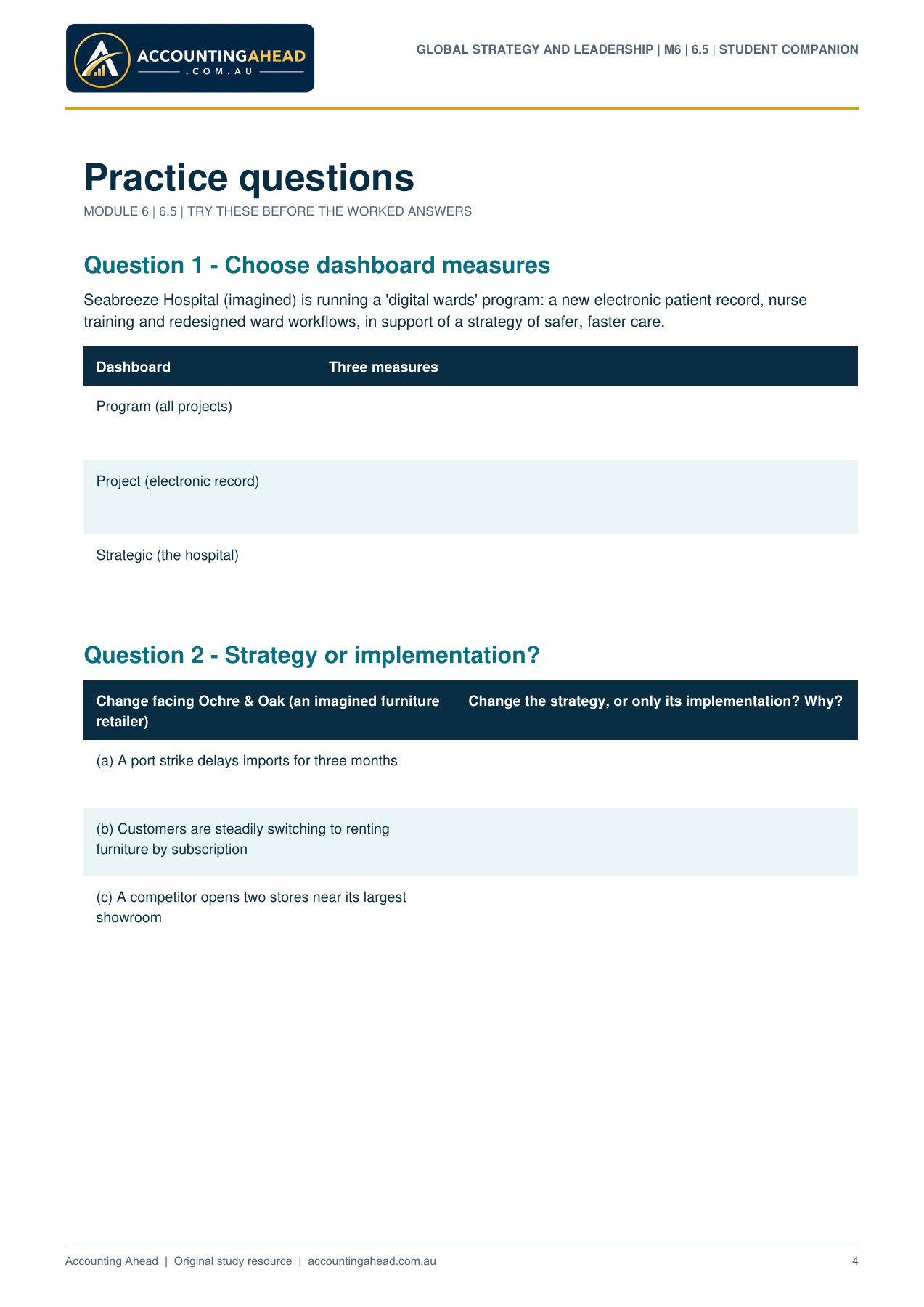
Practice questions
MODULE 6 | 6.5 | TRY THESE BEFORE THE WORKED ANSWERS
Question 1 - Choose dashboard measures
Seabreeze Hospital (imagined) is running a 'digital wards' program: a new electronic patient record, nurse
training and redesigned ward workflows, in support of a strategy of safer, faster care.
Dashboard Three measures
Program (all projects)
Project (electronic record)
Strategic (the hospital)
Question 2 - Strategy or implementation?
Change facing Ochre & Oak (an imagined furniture
retailer)
Change the strategy, or only its implementation? Why?
(a) A port strike delays imports for three months
(b) Customers are steadily switching to renting
furniture by subscription
(c) A competitor opens two stores near its largest
showroom
GLOBAL STRATEGY AND LEADERSHIP | M6 | 6.5 | STUDENT COMPANION
4
Accounting Ahead | Original study resource | accountingahead.com.au
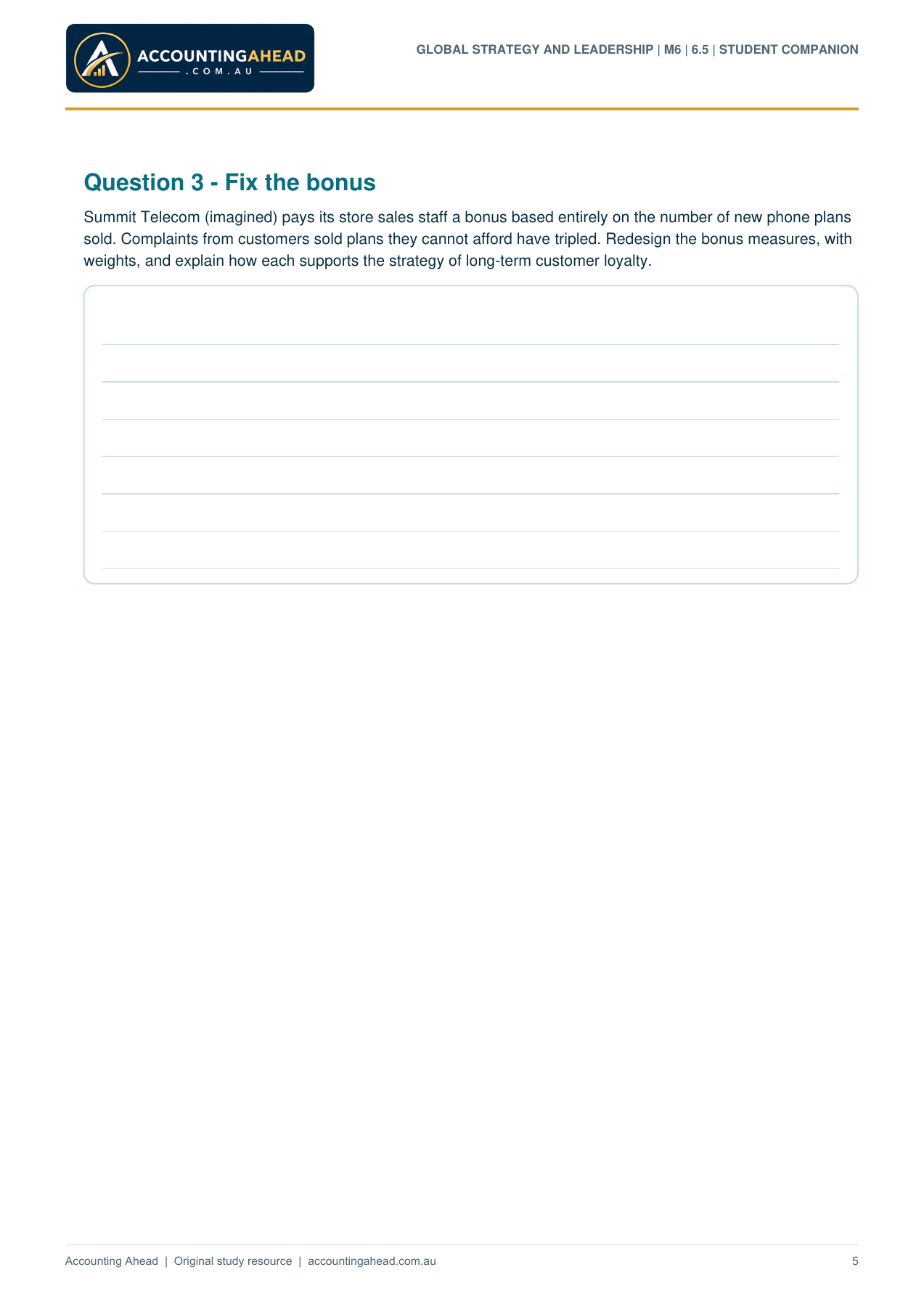
Question 3 - Fix the bonus
Summit Telecom (imagined) pays its store sales staff a bonus based entirely on the number of new phone plans
sold. Complaints from customers sold plans they cannot afford have tripled. Redesign the bonus measures, with
weights, and explain how each supports the strategy of long-term customer loyalty.
GLOBAL STRATEGY AND LEADERSHIP | M6 | 6.5 | STUDENT COMPANION
5
Accounting Ahead | Original study resource | accountingahead.com.au
Worked answers
MODULE 6 | 6.5 | WORKED ANSWERS - ATTEMPT THE QUESTIONS FIRST
Question 1 - Seabreeze Hospital (sample)
Dashboard Measures
Program Budget used against plan for each project; milestones met; open risks and issues by project
Project Wards live on the new record; data-migration errors; training completion before go-live
Strategic Medication errors; time from admission to treatment; patient satisfaction compared with peer
hospitals
Question 2 - Ochre & Oak
Change Answer
(a) Port strike Implementation only: temporary; adjust stock, delivery promises and marketing
(b) Subscription renting Potentially the strategy: a lasting shift in how customers buy; revisit in the next
planning cycle, sooner if it accelerates
(c) New competitor Mainly implementation: sharpen pricing, service and marketing; reconsider the
strategy only if it permanently changes the market
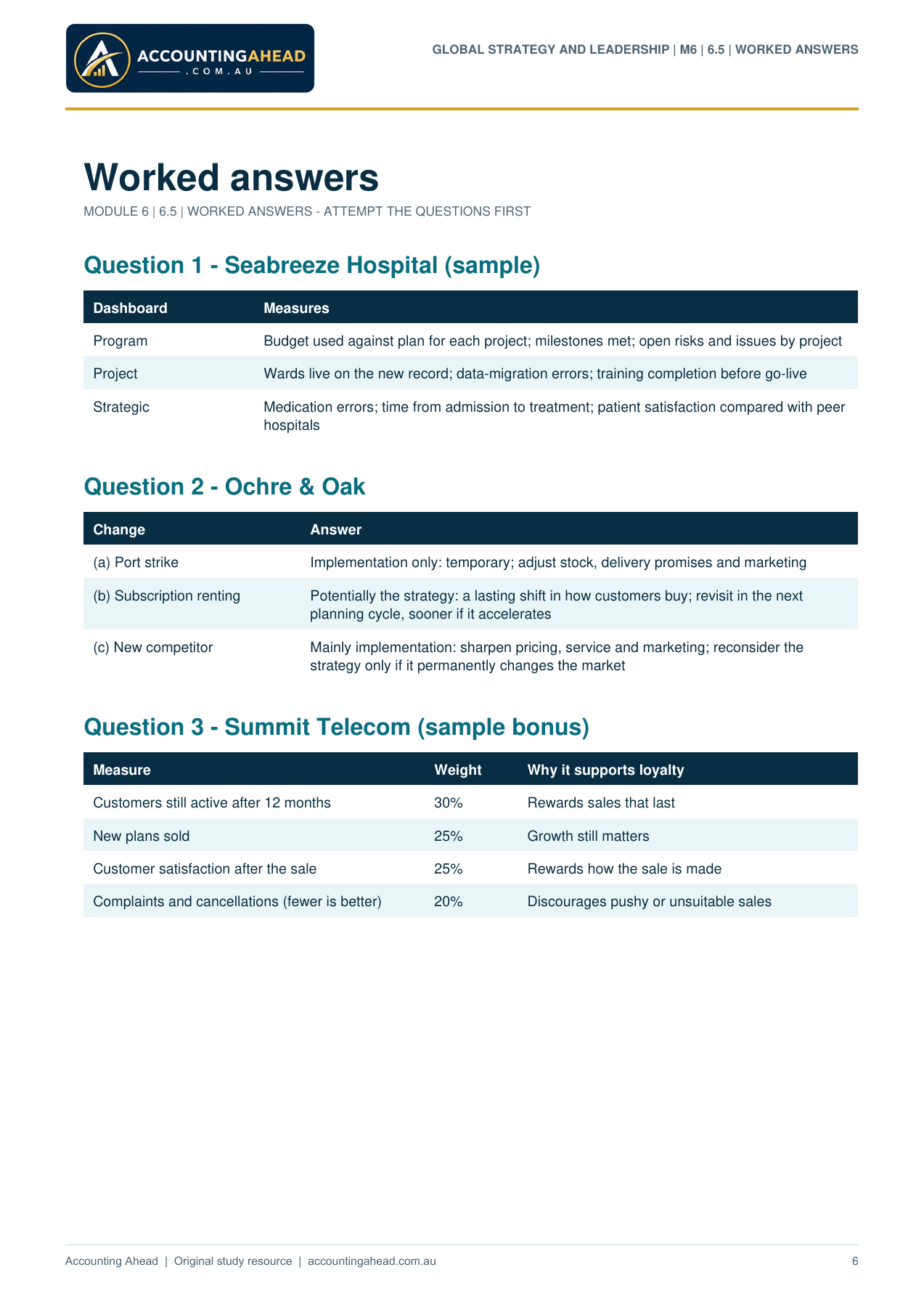
Question 3 - Summit Telecom (sample bonus)
Measure Weight Why it supports loyalty
Customers still active after 12 months 30% Rewards sales that last
New plans sold 25% Growth still matters
Customer satisfaction after the sale 25% Rewards how the sale is made
Complaints and cancellations (fewer is better) 20% Discourages pushy or unsuitable sales
GLOBAL STRATEGY AND LEADERSHIP | M6 | 6.5 | WORKED ANSWERS
6