
Why strategy implementation fails
Printable study notes to use alongside Part 6.6.1.
Read the handout text
Accounting Ahead | Original study resource | accountingahead.com.au
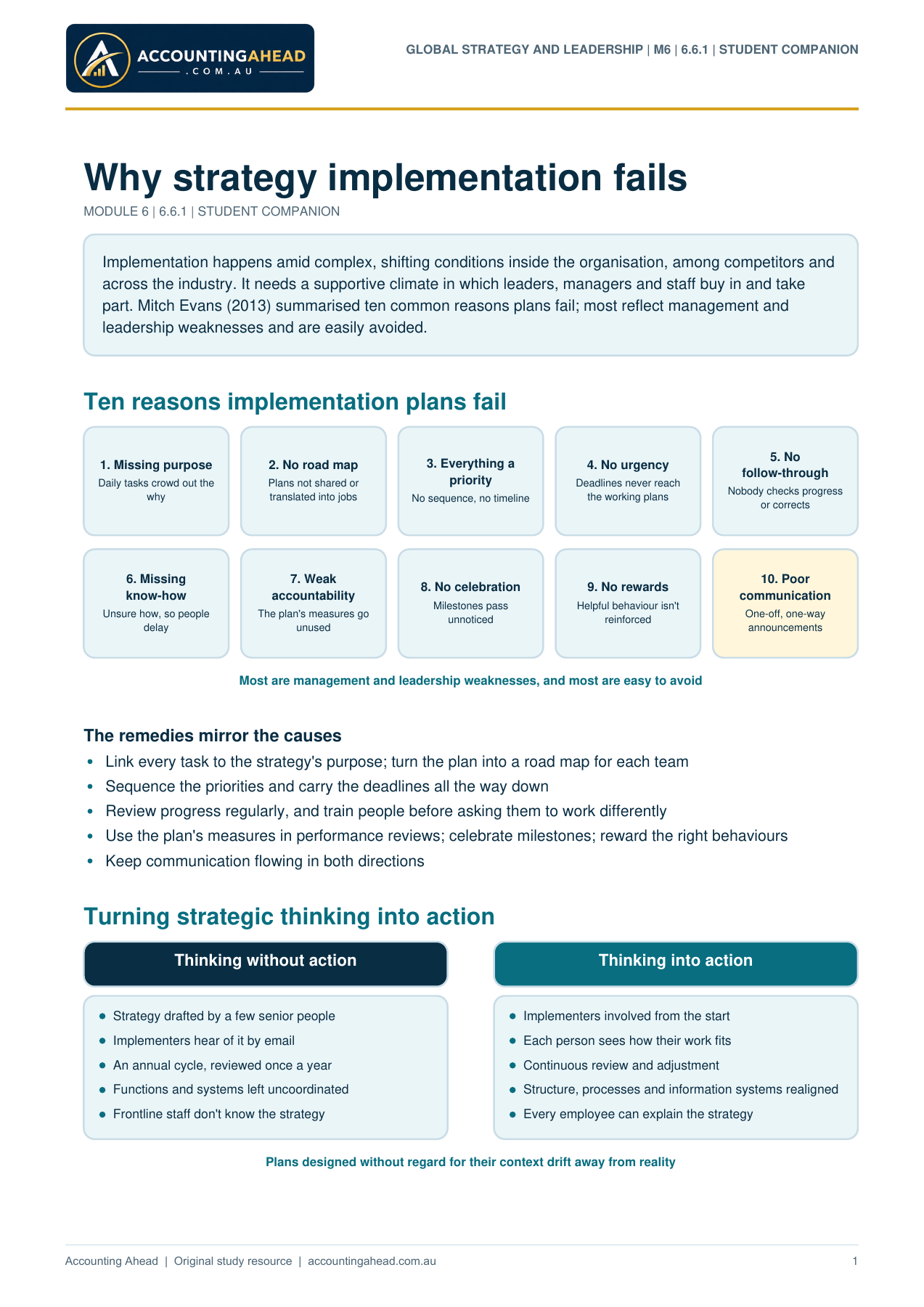
Why strategy implementation fails
MODULE 6 | 6.6.1 | STUDENT COMPANION
Implementation happens amid complex, shifting conditions inside the organisation, among competitors and
across the industry. It needs a supportive climate in which leaders, managers and staff buy in and take
part. Mitch Evans (2013) summarised ten common reasons plans fail; most reflect management and
leadership weaknesses and are easily avoided.
Ten reasons implementation plans fail
1. Missing purpose
Daily tasks crowd out the
why
2. No road map
Plans not shared or
translated into jobs
3. Everything a
priority
No sequence, no timeline
4. No urgency
Deadlines never reach
the working plans
5. No
follow-through
Nobody checks progress
or corrects
6. Missing
know-how
Unsure how, so people
delay
7. Weak
accountability
The plan's measures go
unused
8. No celebration
Milestones pass
unnoticed
9. No rewards
Helpful behaviour isn't
reinforced
10. Poor
communication
One-off, one-way
announcements
Most are management and leadership weaknesses, and most are easy to avoid
The remedies mirror the causes
Link every task to the strategy's purpose; turn the plan into a road map for each team
Sequence the priorities and carry the deadlines all the way down
Review progress regularly, and train people before asking them to work differently
Use the plan's measures in performance reviews; celebrate milestones; reward the right behaviours
Keep communication flowing in both directions
Turning strategic thinking into action
Thinking without action
Strategy drafted by a few senior people
Implementers hear of it by email
An annual cycle, reviewed once a year
Functions and systems left uncoordinated
Frontline staff don't know the strategy
Thinking into action
Implementers involved from the start
Each person sees how their work fits
Continuous review and adjustment
Structure, processes and information systems realigned
Every employee can explain the strategy
Plans designed without regard for their context drift away from reality
GLOBAL STRATEGY AND LEADERSHIP | M6 | 6.6.1 | STUDENT COMPANION
1
Accounting Ahead | Original study resource | accountingahead.com.au
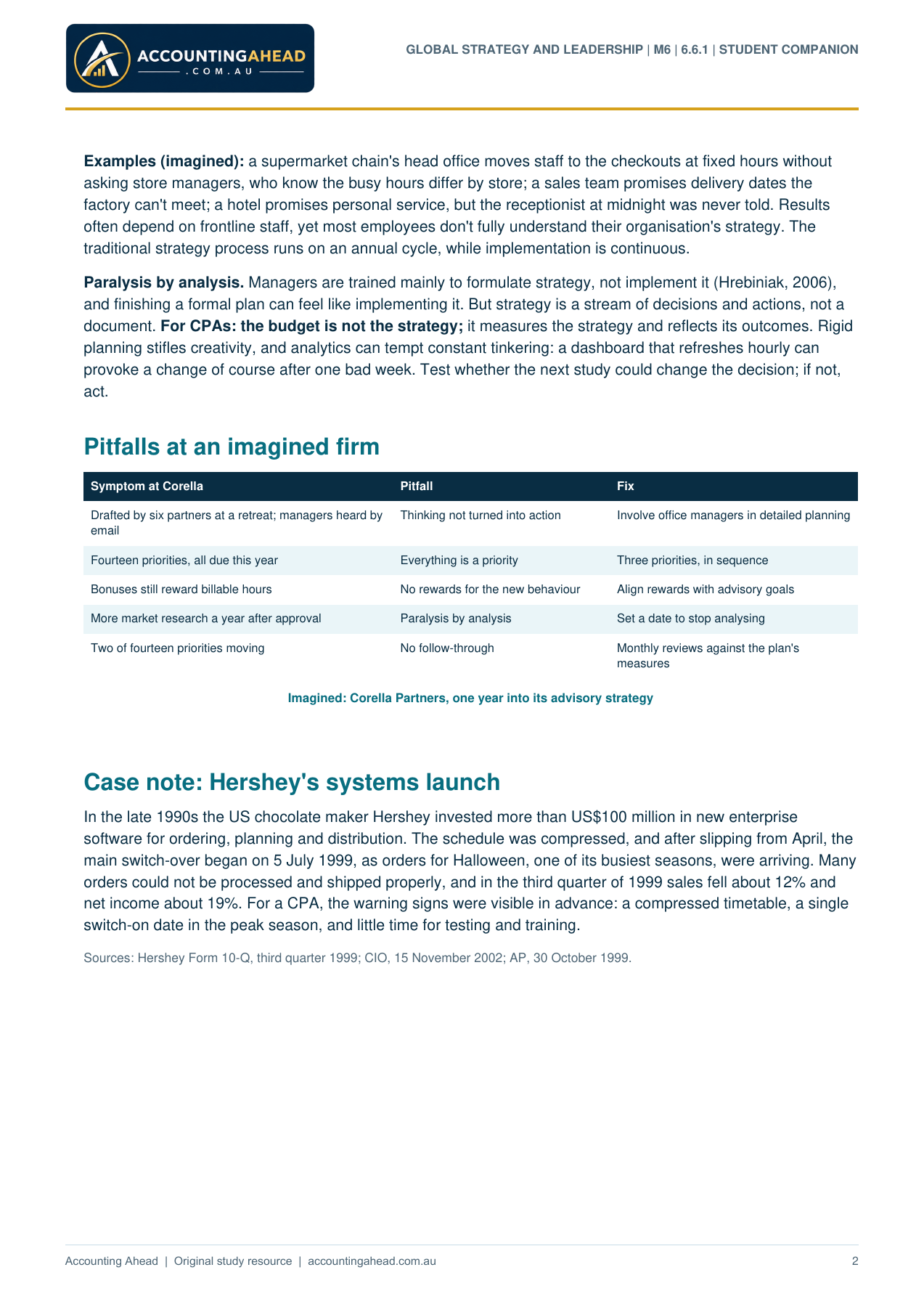
Examples (imagined): a supermarket chain's head office moves staff to the checkouts at fixed hours without
asking store managers, who know the busy hours differ by store; a sales team promises delivery dates the
factory can't meet; a hotel promises personal service, but the receptionist at midnight was never told. Results
often depend on frontline staff, yet most employees don't fully understand their organisation's strategy. The
traditional strategy process runs on an annual cycle, while implementation is continuous.
Paralysis by analysis. Managers are trained mainly to formulate strategy, not implement it (Hrebiniak, 2006),
and finishing a formal plan can feel like implementing it. But strategy is a stream of decisions and actions, not a
document. For CPAs: the budget is not the strategy; it measures the strategy and reflects its outcomes. Rigid
planning stifles creativity, and analytics can tempt constant tinkering: a dashboard that refreshes hourly can
provoke a change of course after one bad week. Test whether the next study could change the decision; if not,
act.
Pitfalls at an imagined firm
Symptom at Corella Pitfall Fix
Drafted by six partners at a retreat; managers heard by
Thinking not turned into action Involve office managers in detailed planning
Fourteen priorities, all due this year Everything is a priority Three priorities, in sequence
Bonuses still reward billable hours No rewards for the new behaviour Align rewards with advisory goals
More market research a year after approval Paralysis by analysis Set a date to stop analysing
Two of fourteen priorities moving No follow-through Monthly reviews against the plan's
measures
Imagined: Corella Partners, one year into its advisory strategy
Case note: Hershey's systems launch
In the late 1990s the US chocolate maker Hershey invested more than US$100 million in new enterprise
software for ordering, planning and distribution. The schedule was compressed, and after slipping from April, the
main switch-over began on 5 July 1999, as orders for Halloween, one of its busiest seasons, were arriving. Many
orders could not be processed and shipped properly, and in the third quarter of 1999 sales fell about 12% and
net income about 19%. For a CPA, the warning signs were visible in advance: a compressed timetable, a single
switch-on date in the peak season, and little time for testing and training.
Sources: Hershey Form 10-Q, third quarter 1999; CIO, 15 November 2002; AP, 30 October 1999.
GLOBAL STRATEGY AND LEADERSHIP | M6 | 6.6.1 | STUDENT COMPANION
2
Accounting Ahead | Original study resource | accountingahead.com.au
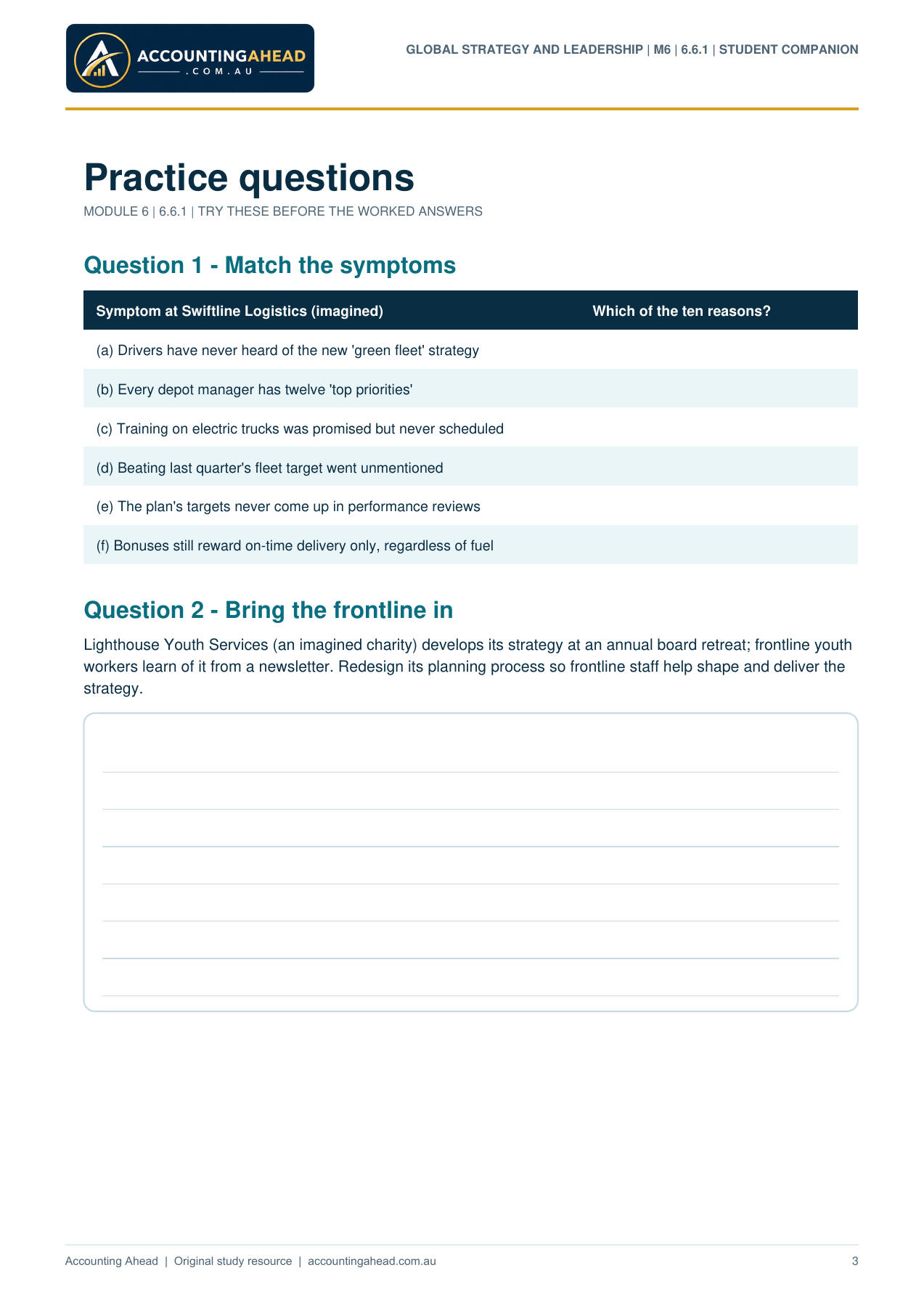
Practice questions
MODULE 6 | 6.6.1 | TRY THESE BEFORE THE WORKED ANSWERS
Question 1 - Match the symptoms
Symptom at Swiftline Logistics (imagined) Which of the ten reasons?
(a) Drivers have never heard of the new 'green fleet' strategy
(b) Every depot manager has twelve 'top priorities'
(c) Training on electric trucks was promised but never scheduled
(d) Beating last quarter's fleet target went unmentioned
(e) The plan's targets never come up in performance reviews
(f) Bonuses still reward on-time delivery only, regardless of fuel
Question 2 - Bring the frontline in
Lighthouse Youth Services (an imagined charity) develops its strategy at an annual board retreat; frontline youth
workers learn of it from a newsletter. Redesign its planning process so frontline staff help shape and deliver the
strategy.
GLOBAL STRATEGY AND LEADERSHIP | M6 | 6.6.1 | STUDENT COMPANION
3
Accounting Ahead | Original study resource | accountingahead.com.au
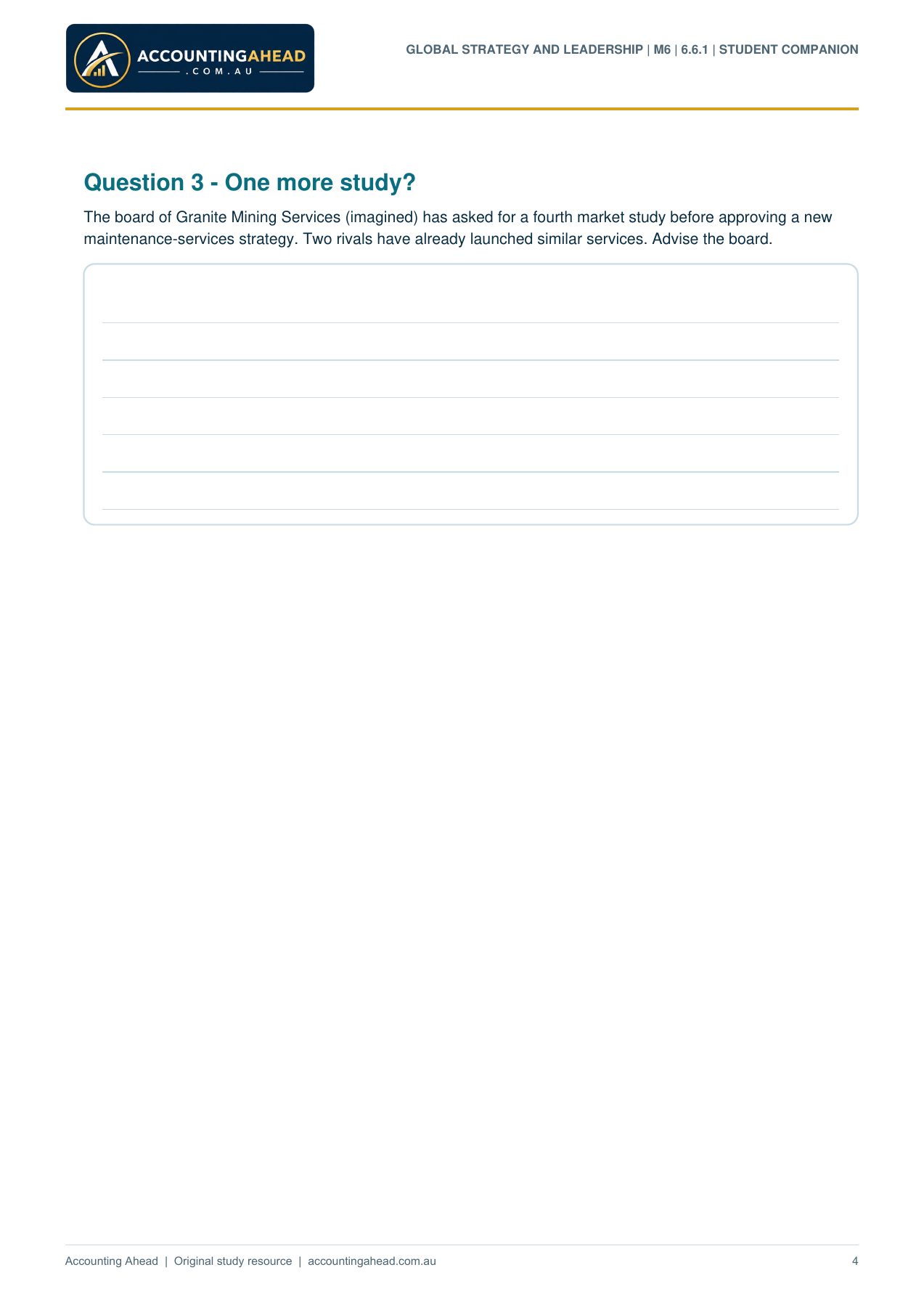
Question 3 - One more study?
The board of Granite Mining Services (imagined) has asked for a fourth market study before approving a new
maintenance-services strategy. Two rivals have already launched similar services. Advise the board.
GLOBAL STRATEGY AND LEADERSHIP | M6 | 6.6.1 | STUDENT COMPANION
4
Accounting Ahead | Original study resource | accountingahead.com.au
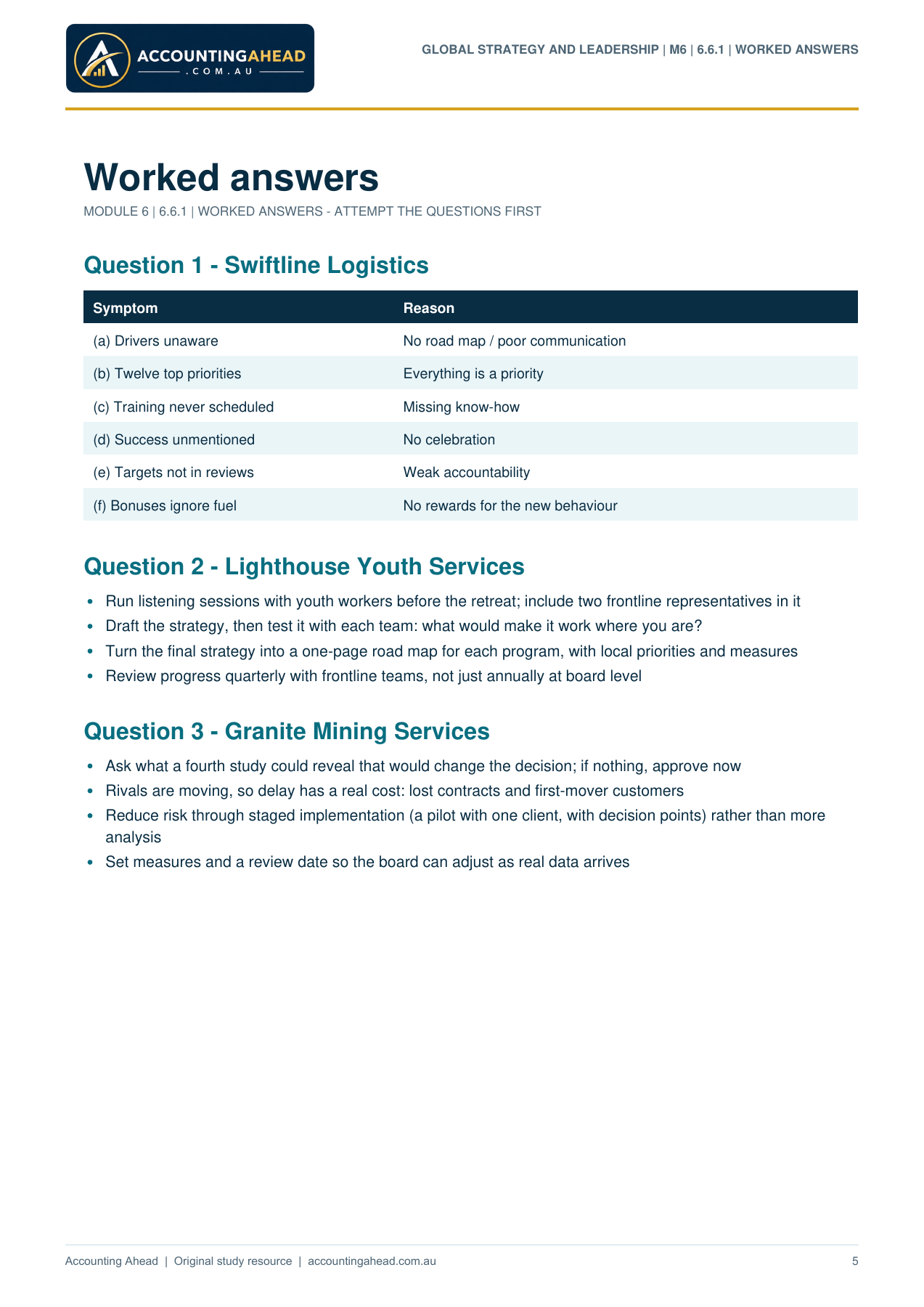
Worked answers
MODULE 6 | 6.6.1 | WORKED ANSWERS - ATTEMPT THE QUESTIONS FIRST
Question 1 - Swiftline Logistics
Symptom Reason
(a) Drivers unaware No road map / poor communication
(b) Twelve top priorities Everything is a priority
(c) Training never scheduled Missing know-how
(d) Success unmentioned No celebration
(e) Targets not in reviews Weak accountability
(f) Bonuses ignore fuel No rewards for the new behaviour
Question 2 - Lighthouse Youth Services
Run listening sessions with youth workers before the retreat; include two frontline representatives in it
Draft the strategy, then test it with each team: what would make it work where you are?
Turn the final strategy into a one-page road map for each program, with local priorities and measures
Review progress quarterly with frontline teams, not just annually at board level
Question 3 - Granite Mining Services
Ask what a fourth study could reveal that would change the decision; if nothing, approve now
Rivals are moving, so delay has a real cost: lost contracts and first-mover customers
Reduce risk through staged implementation (a pilot with one client, with decision points) rather than more
analysis
Set measures and a review date so the board can adjust as real data arrives
GLOBAL STRATEGY AND LEADERSHIP | M6 | 6.6.1 | WORKED ANSWERS
5