
Resistance, politics and uncertainty
Printable study notes to use alongside Part 6.6.2.
Read the handout text
Accounting Ahead | Original study resource | accountingahead.com.au
Resistance, politics and uncertainty
MODULE 6 | 6.6.2 | STUDENT COMPANION
Three more threats can undermine implementation: resistance at organisational and individual levels; the
politics and power that surround every strategy; and environmental uncertainty while the strategy is
being delivered.
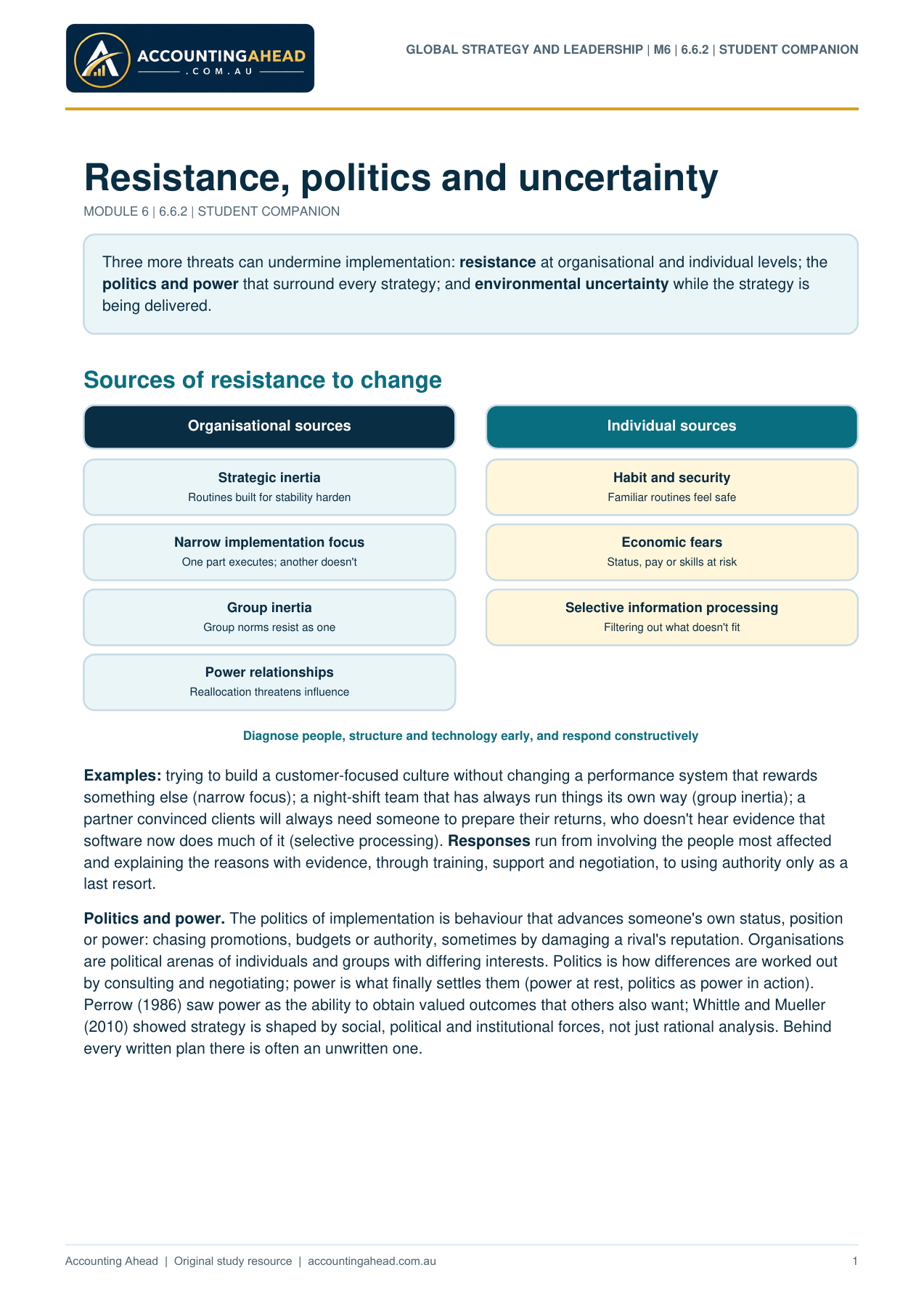
Sources of resistance to change
Organisational sources Individual sources
Strategic inertia
Routines built for stability harden
Narrow implementation focus
One part executes; another doesn't
Group inertia
Group norms resist as one
Power relationships
Reallocation threatens influence
Habit and security
Familiar routines feel safe
Economic fears
Status, pay or skills at risk
Selective information processing
Filtering out what doesn't fit
Diagnose people, structure and technology early, and respond constructively
Examples: trying to build a customer-focused culture without changing a performance system that rewards
something else (narrow focus); a night-shift team that has always run things its own way (group inertia); a
partner convinced clients will always need someone to prepare their returns, who doesn't hear evidence that
software now does much of it (selective processing). Responses run from involving the people most affected
and explaining the reasons with evidence, through training, support and negotiation, to using authority only as a
last resort.
Politics and power. The politics of implementation is behaviour that advances someone's own status, position
or power: chasing promotions, budgets or authority, sometimes by damaging a rival's reputation. Organisations
are political arenas of individuals and groups with differing interests. Politics is how differences are worked out
by consulting and negotiating; power is what finally settles them (power at rest, politics as power in action).
Perrow (1986) saw power as the ability to obtain valued outcomes that others also want; Whittle and Mueller
(2010) showed strategy is shaped by social, political and institutional forces, not just rational analysis. Behind
every written plan there is often an unwritten one.
GLOBAL STRATEGY AND LEADERSHIP | M6 | 6.6.2 | STUDENT COMPANION
1
Accounting Ahead | Original study resource | accountingahead.com.au
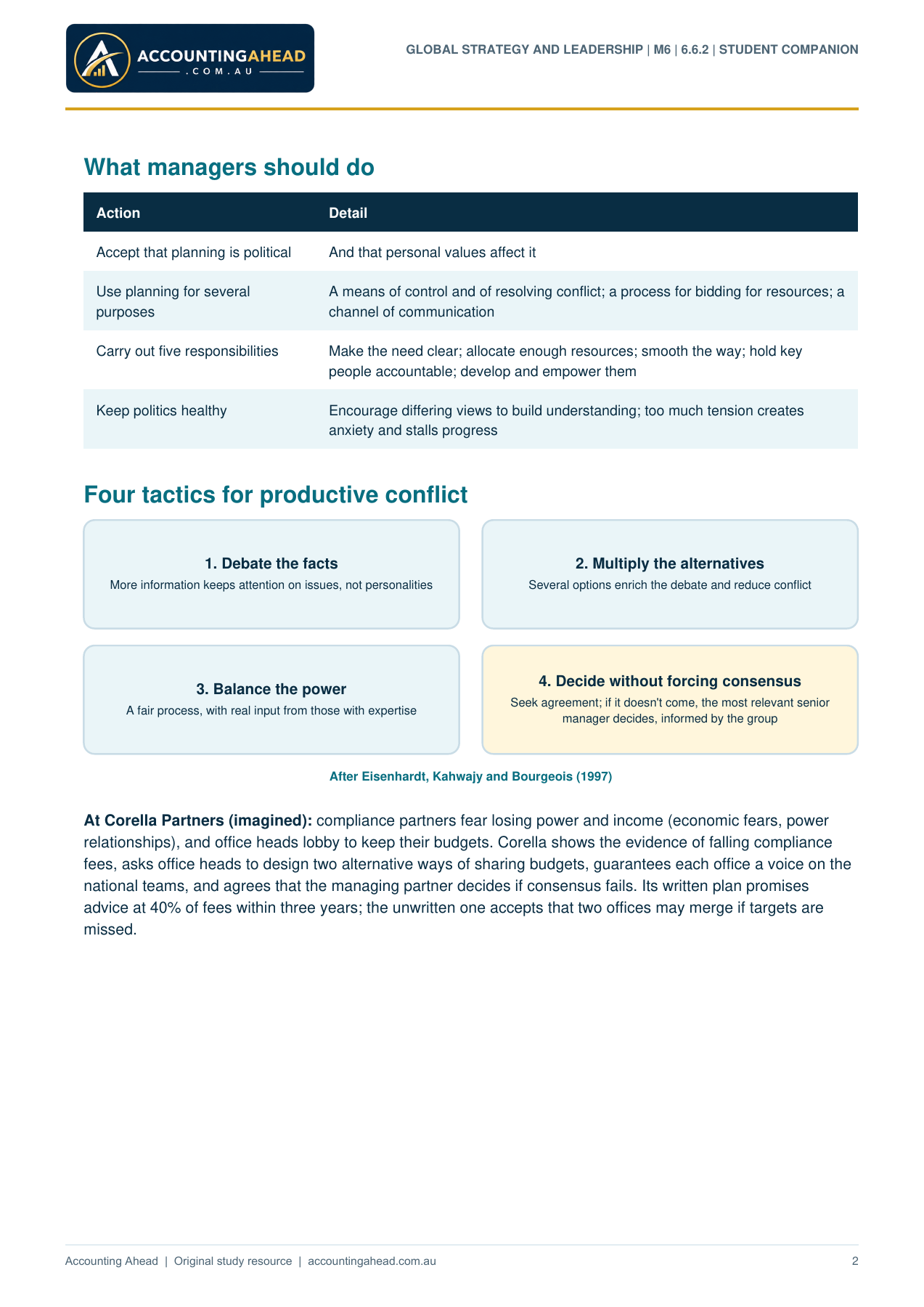
What managers should do
Action Detail
Accept that planning is political And that personal values affect it
Use planning for several
purposes
A means of control and of resolving conflict; a process for bidding for resources; a
channel of communication
Carry out five responsibilities Make the need clear; allocate enough resources; smooth the way; hold key
people accountable; develop and empower them
Keep politics healthy Encourage differing views to build understanding; too much tension creates
anxiety and stalls progress
Four tactics for productive conflict
1. Debate the facts
More information keeps attention on issues, not personalities
2. Multiply the alternatives
Several options enrich the debate and reduce conflict
3. Balance the power
A fair process, with real input from those with expertise
4. Decide without forcing consensus
Seek agreement; if it doesn't come, the most relevant senior
manager decides, informed by the group
After Eisenhardt, Kahwajy and Bourgeois (1997)
At Corella Partners (imagined): compliance partners fear losing power and income (economic fears, power
relationships), and office heads lobby to keep their budgets. Corella shows the evidence of falling compliance
fees, asks office heads to design two alternative ways of sharing budgets, guarantees each office a voice on the
national teams, and agrees that the managing partner decides if consensus fails. Its written plan promises
advice at 40% of fees within three years; the unwritten one accepts that two offices may merge if targets are
missed.
GLOBAL STRATEGY AND LEADERSHIP | M6 | 6.6.2 | STUDENT COMPANION
2
Accounting Ahead | Original study resource | accountingahead.com.au
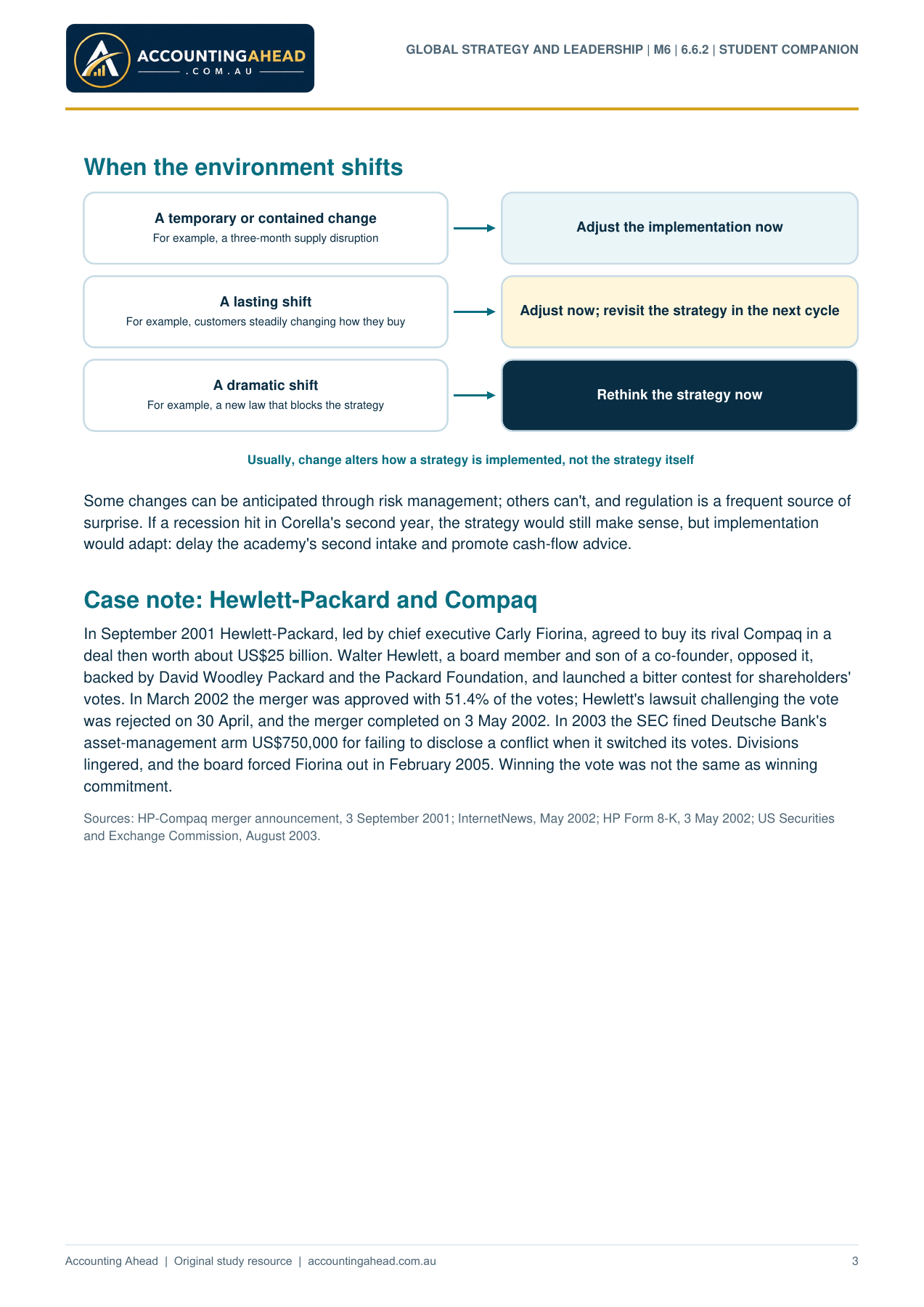
When the environment shifts
A temporary or contained change
For example, a three-month supply disruption
Adjust the implementation now
A lasting shift
For example, customers steadily changing how they buy
Adjust now; revisit the strategy in the next cycle
A dramatic shift
For example, a new law that blocks the strategy
Rethink the strategy now
Usually, change alters how a strategy is implemented, not the strategy itself
Some changes can be anticipated through risk management; others can't, and regulation is a frequent source of
surprise. If a recession hit in Corella's second year, the strategy would still make sense, but implementation
would adapt: delay the academy's second intake and promote cash-flow advice.
Case note: Hewlett-Packard and Compaq
In September 2001 Hewlett-Packard, led by chief executive Carly Fiorina, agreed to buy its rival Compaq in a
deal then worth about US$25 billion. Walter Hewlett, a board member and son of a co-founder, opposed it,
backed by David Woodley Packard and the Packard Foundation, and launched a bitter contest for shareholders'
votes. In March 2002 the merger was approved with 51.4% of the votes; Hewlett's lawsuit challenging the vote
was rejected on 30 April, and the merger completed on 3 May 2002. In 2003 the SEC fined Deutsche Bank's
asset-management arm US$750,000 for failing to disclose a conflict when it switched its votes. Divisions
lingered, and the board forced Fiorina out in February 2005. Winning the vote was not the same as winning
commitment.
Sources: HP-Compaq merger announcement, 3 September 2001; InternetNews, May 2002; HP Form 8-K, 3 May 2002; US Securities
and Exchange Commission, August 2003.
GLOBAL STRATEGY AND LEADERSHIP | M6 | 6.6.2 | STUDENT COMPANION
3
Accounting Ahead | Original study resource | accountingahead.com.au
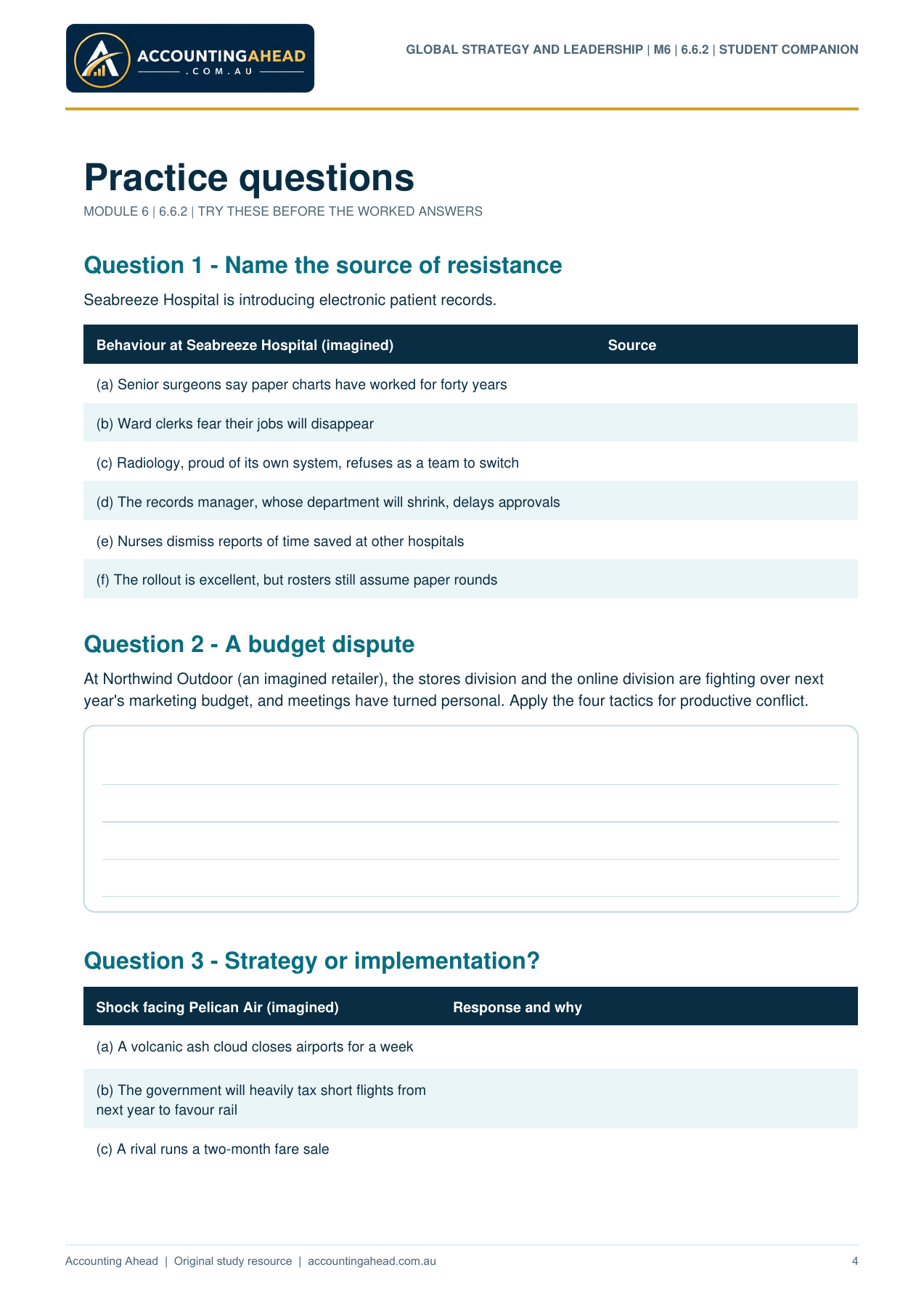
Practice questions
MODULE 6 | 6.6.2 | TRY THESE BEFORE THE WORKED ANSWERS
Question 1 - Name the source of resistance
Seabreeze Hospital is introducing electronic patient records.
Behaviour at Seabreeze Hospital (imagined) Source
(a) Senior surgeons say paper charts have worked for forty years
(b) Ward clerks fear their jobs will disappear
(c) Radiology, proud of its own system, refuses as a team to switch
(d) The records manager, whose department will shrink, delays approvals
(e) Nurses dismiss reports of time saved at other hospitals
(f) The rollout is excellent, but rosters still assume paper rounds
Question 2 - A budget dispute
At Northwind Outdoor (an imagined retailer), the stores division and the online division are fighting over next
year's marketing budget, and meetings have turned personal. Apply the four tactics for productive conflict.
Question 3 - Strategy or implementation?
Shock facing Pelican Air (imagined) Response and why
(a) A volcanic ash cloud closes airports for a week
(b) The government will heavily tax short flights from
next year to favour rail
(c) A rival runs a two-month fare sale
GLOBAL STRATEGY AND LEADERSHIP | M6 | 6.6.2 | STUDENT COMPANION
4
Accounting Ahead | Original study resource | accountingahead.com.au
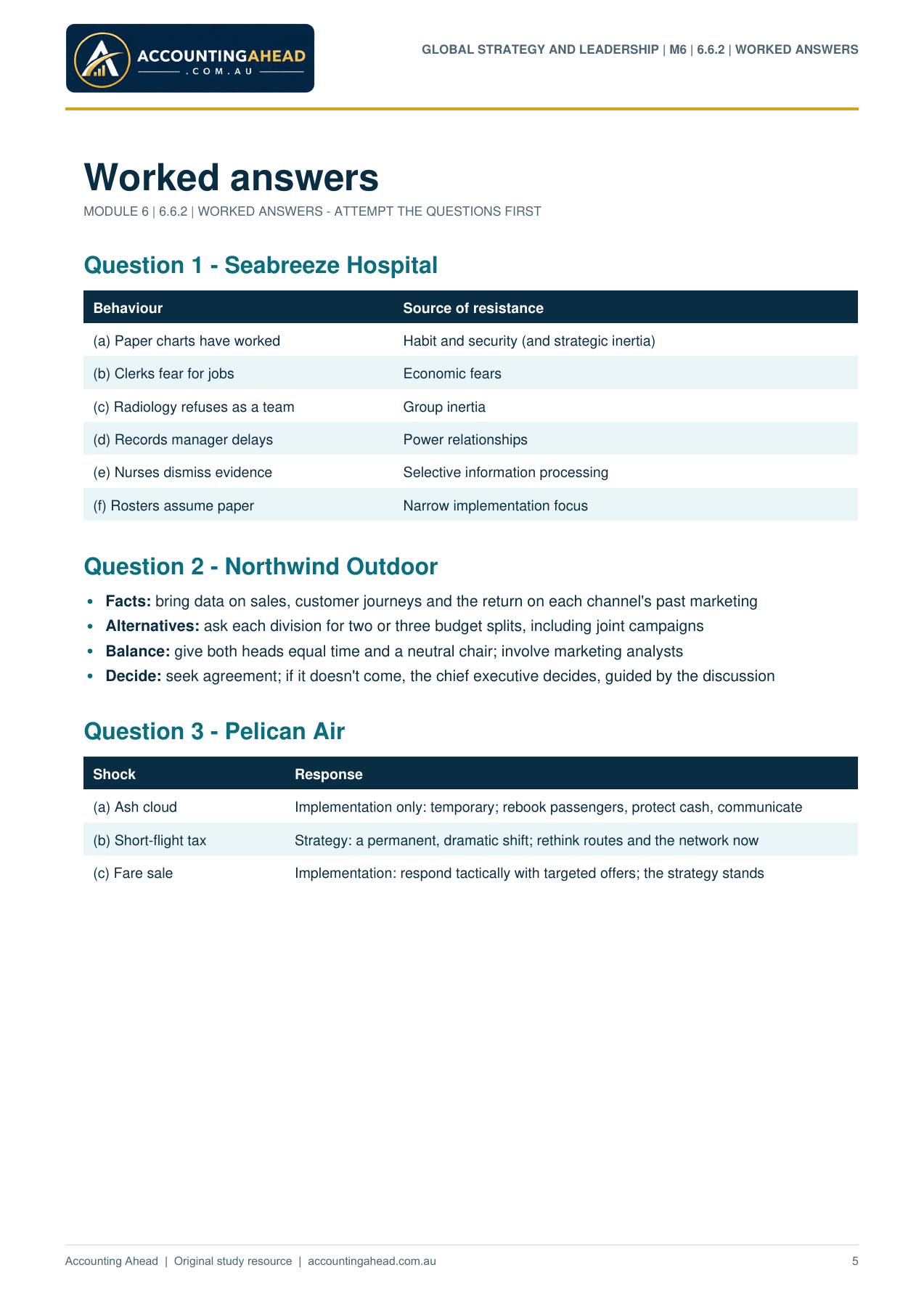
Worked answers
MODULE 6 | 6.6.2 | WORKED ANSWERS - ATTEMPT THE QUESTIONS FIRST
Question 1 - Seabreeze Hospital
Behaviour Source of resistance
(a) Paper charts have worked Habit and security (and strategic inertia)
(b) Clerks fear for jobs Economic fears
(c) Radiology refuses as a team Group inertia
(d) Records manager delays Power relationships
(e) Nurses dismiss evidence Selective information processing
(f) Rosters assume paper Narrow implementation focus
Question 2 - Northwind Outdoor
Facts: bring data on sales, customer journeys and the return on each channel's past marketing
Alternatives: ask each division for two or three budget splits, including joint campaigns
Balance: give both heads equal time and a neutral chair; involve marketing analysts
Decide: seek agreement; if it doesn't come, the chief executive decides, guided by the discussion
Question 3 - Pelican Air
Shock Response
(a) Ash cloud Implementation only: temporary; rebook passengers, protect cash, communicate
(b) Short-flight tax Strategy: a permanent, dramatic shift; rethink routes and the network now
(c) Fare sale Implementation: respond tactically with targeted offers; the strategy stands
GLOBAL STRATEGY AND LEADERSHIP | M6 | 6.6.2 | WORKED ANSWERS
5