
The changing business environment
Printable study notes to use alongside Part 7.1.
Read the handout text
Accounting Ahead | Original study resource | accountingahead.com.au
The changing business environment
MODULE 7 | 7.1 | STUDENT COMPANION
The rational process of Modules 2 to 6 remains valuable, but a full cycle can take a year while rivals keep
reinventing their business models. This module explores emergent approaches for high uncertainty, and
argues that organisations need agile structures, dynamic capabilities, an entrepreneurial orientation and an
innovation culture: a stable core with the flexibility to respond fast.
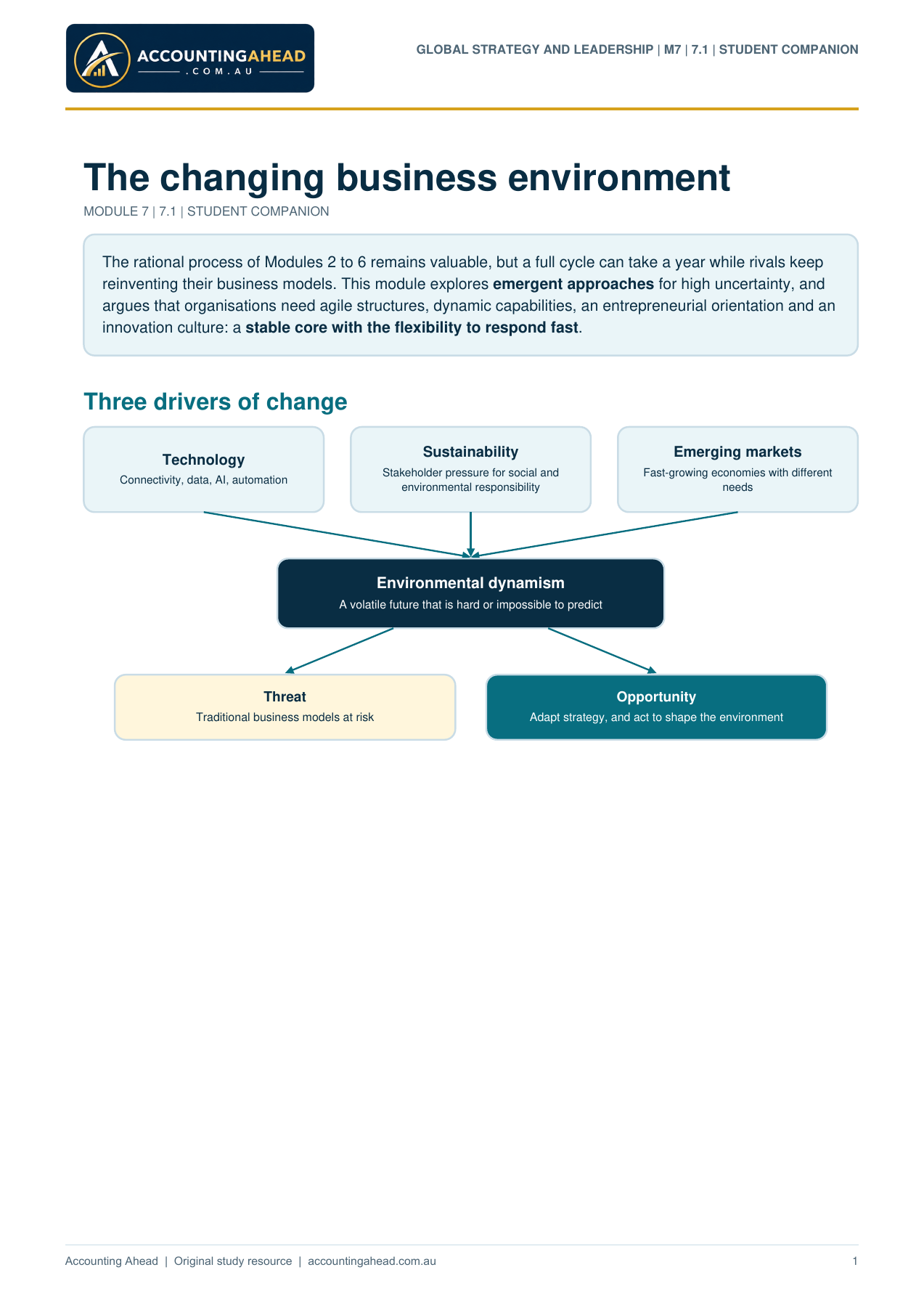
Three drivers of change
Technology
Connectivity, data, AI, automation
Sustainability
Stakeholder pressure for social and
environmental responsibility
Emerging markets
Fast-growing economies with different
needs
Environmental dynamism
A volatile future that is hard or impossible to predict
Threat
Traditional business models at risk
Opportunity
Adapt strategy, and act to shape the environment
GLOBAL STRATEGY AND LEADERSHIP | M7 | 7.1 | STUDENT COMPANION
1
Accounting Ahead | Original study resource | accountingahead.com.au
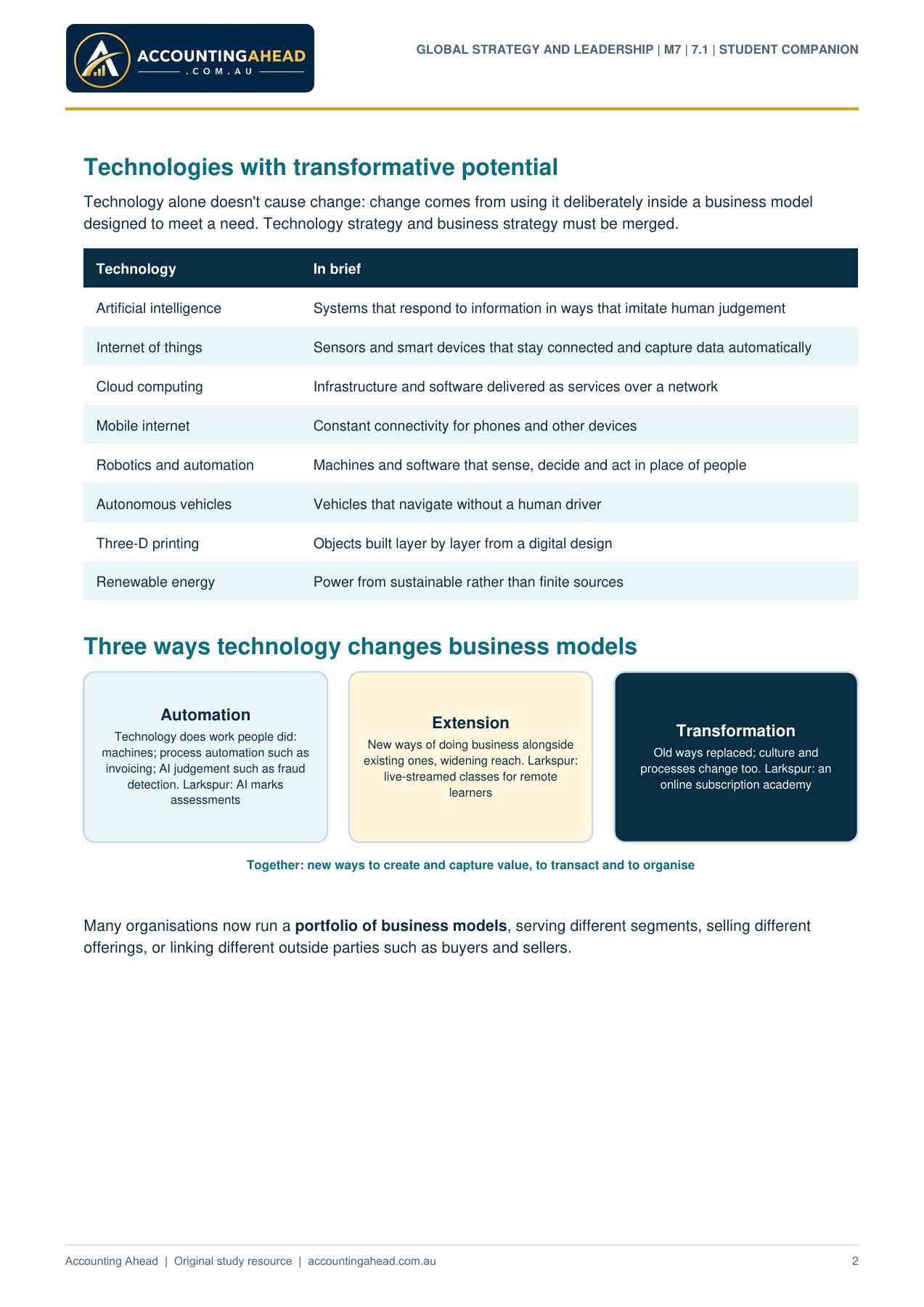
Technologies with transformative potential
Technology alone doesn't cause change: change comes from using it deliberately inside a business model
designed to meet a need. Technology strategy and business strategy must be merged.
Technology In brief
Artificial intelligence Systems that respond to information in ways that imitate human judgement
Internet of things Sensors and smart devices that stay connected and capture data automatically
Cloud computing Infrastructure and software delivered as services over a network
Mobile internet Constant connectivity for phones and other devices
Robotics and automation Machines and software that sense, decide and act in place of people
Autonomous vehicles Vehicles that navigate without a human driver
Three-D printing Objects built layer by layer from a digital design
Renewable energy Power from sustainable rather than finite sources
Three ways technology changes business models
Automation
Technology does work people did:
machines; process automation such as
invoicing; AI judgement such as fraud
detection. Larkspur: AI marks
assessments
Extension
New ways of doing business alongside
existing ones, widening reach. Larkspur:
live-streamed classes for remote
learners
Transformation
Old ways replaced; culture and
processes change too. Larkspur: an
online subscription academy
Together: new ways to create and capture value, to transact and to organise
Many organisations now run a portfolio of business models, serving different segments, selling different
offerings, or linking different outside parties such as buyers and sellers.
GLOBAL STRATEGY AND LEADERSHIP | M7 | 7.1 | STUDENT COMPANION
2
Accounting Ahead | Original study resource | accountingahead.com.au
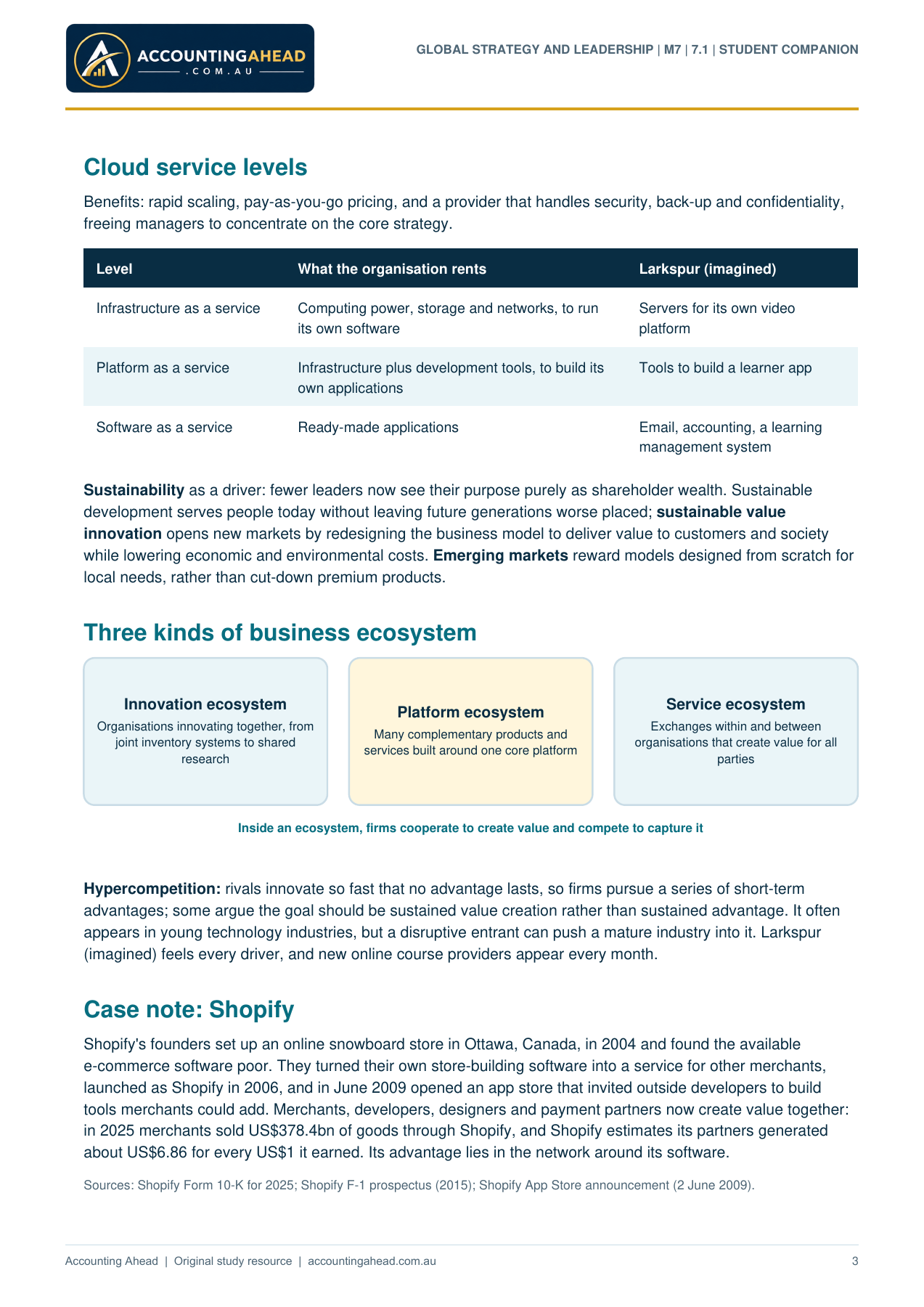
Cloud service levels
Benefits: rapid scaling, pay-as-you-go pricing, and a provider that handles security, back-up and confidentiality,
freeing managers to concentrate on the core strategy.
Level What the organisation rents Larkspur (imagined)
Infrastructure as a service Computing power, storage and networks, to run
its own software
Servers for its own video
platform
Platform as a service Infrastructure plus development tools, to build its
own applications
Tools to build a learner app
Software as a service Ready-made applications Email, accounting, a learning
management system
Sustainability as a driver: fewer leaders now see their purpose purely as shareholder wealth. Sustainable
development serves people today without leaving future generations worse placed; sustainable value
innovation opens new markets by redesigning the business model to deliver value to customers and society
while lowering economic and environmental costs. Emerging markets reward models designed from scratch for
local needs, rather than cut-down premium products.
Three kinds of business ecosystem
Innovation ecosystem
Organisations innovating together, from
joint inventory systems to shared
research
Platform ecosystem
Many complementary products and
services built around one core platform
Service ecosystem
Exchanges within and between
organisations that create value for all
parties
Inside an ecosystem, firms cooperate to create value and compete to capture it
Hypercompetition: rivals innovate so fast that no advantage lasts, so firms pursue a series of short-term
advantages; some argue the goal should be sustained value creation rather than sustained advantage. It often
appears in young technology industries, but a disruptive entrant can push a mature industry into it. Larkspur
(imagined) feels every driver, and new online course providers appear every month.
Case note: Shopify
Shopify's founders set up an online snowboard store in Ottawa, Canada, in 2004 and found the available
e-commerce software poor. They turned their own store-building software into a service for other merchants,
launched as Shopify in 2006, and in June 2009 opened an app store that invited outside developers to build
tools merchants could add. Merchants, developers, designers and payment partners now create value together:
in 2025 merchants sold US$378.4bn of goods through Shopify, and Shopify estimates its partners generated
about US$6.86 for every US$1 it earned. Its advantage lies in the network around its software.
Sources: Shopify Form 10-K for 2025; Shopify F-1 prospectus (2015); Shopify App Store announcement (2 June 2009).
GLOBAL STRATEGY AND LEADERSHIP | M7 | 7.1 | STUDENT COMPANION
3
Accounting Ahead | Original study resource | accountingahead.com.au
Practice questions
MODULE 7 | 7.1 | TRY THESE BEFORE THE WORKED ANSWERS
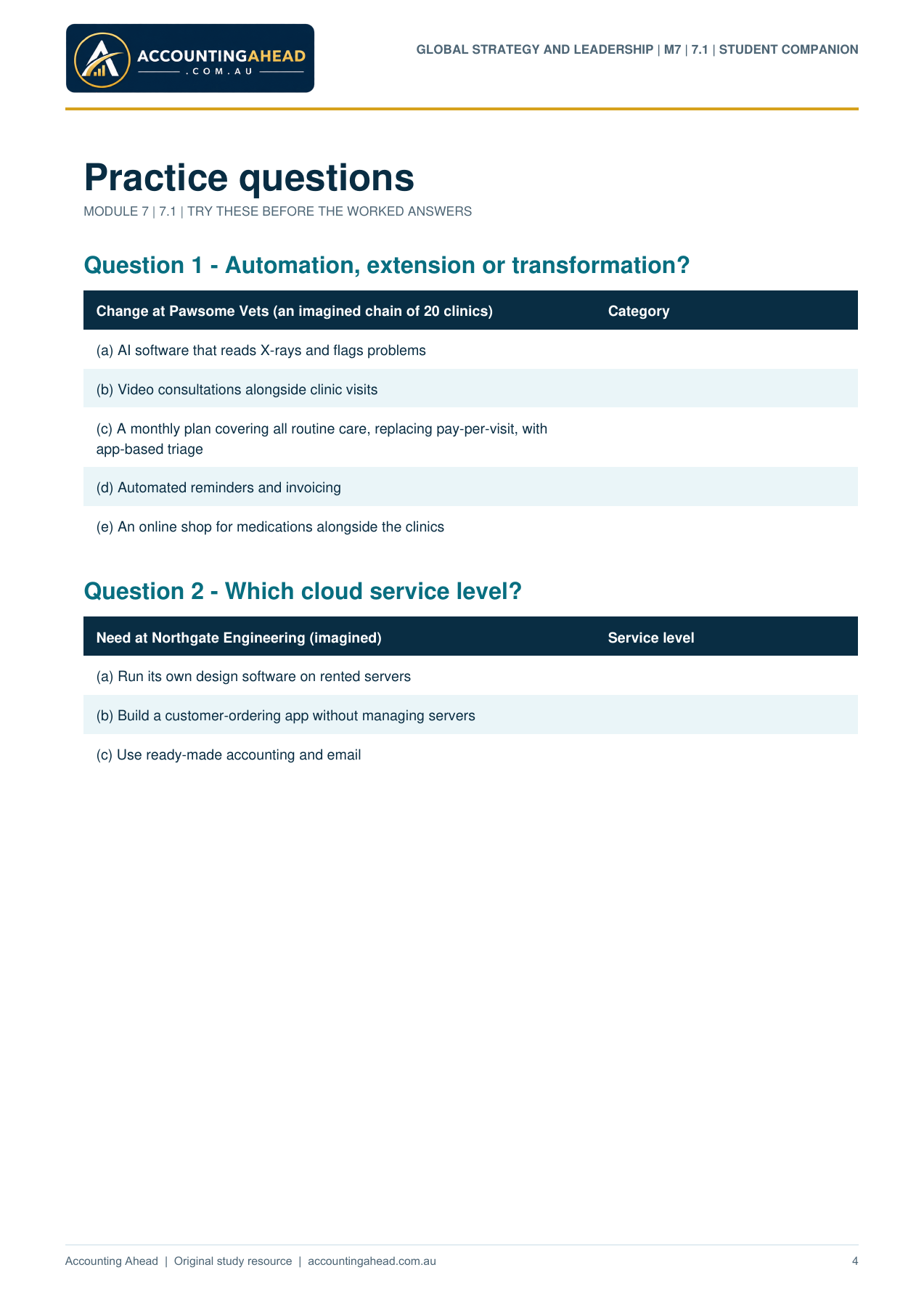
Question 1 - Automation, extension or transformation?
Change at Pawsome Vets (an imagined chain of 20 clinics) Category
(a) AI software that reads X-rays and flags problems
(b) Video consultations alongside clinic visits
(c) A monthly plan covering all routine care, replacing pay-per-visit, with
app-based triage
(d) Automated reminders and invoicing
(e) An online shop for medications alongside the clinics
Question 2 - Which cloud service level?
Need at Northgate Engineering (imagined) Service level
(a) Run its own design software on rented servers
(b) Build a customer-ordering app without managing servers
(c) Use ready-made accounting and email
GLOBAL STRATEGY AND LEADERSHIP | M7 | 7.1 | STUDENT COMPANION
4
Accounting Ahead | Original study resource | accountingahead.com.au
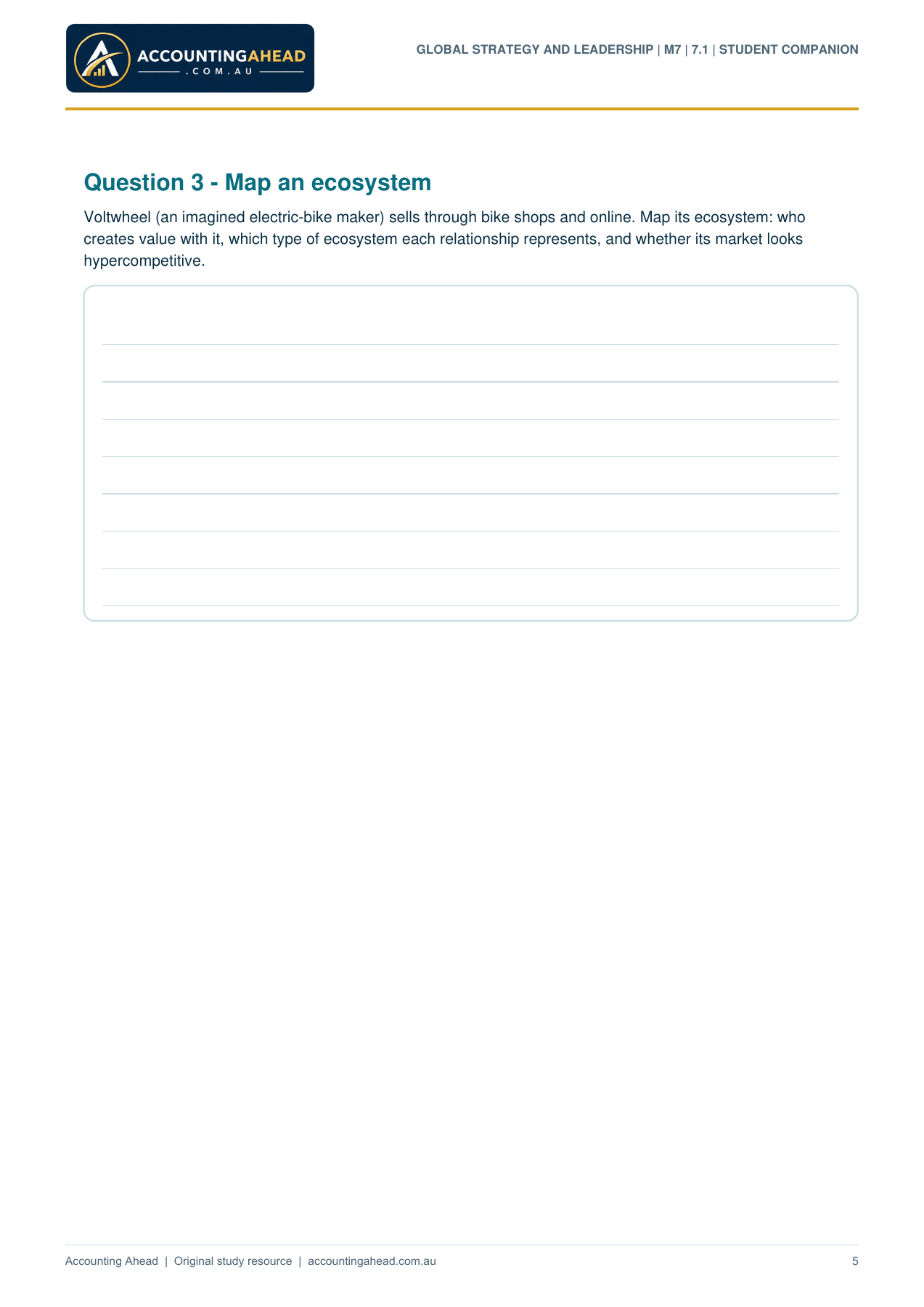
Question 3 - Map an ecosystem
Voltwheel (an imagined electric-bike maker) sells through bike shops and online. Map its ecosystem: who
creates value with it, which type of ecosystem each relationship represents, and whether its market looks
hypercompetitive.
GLOBAL STRATEGY AND LEADERSHIP | M7 | 7.1 | STUDENT COMPANION
5
Accounting Ahead | Original study resource | accountingahead.com.au
Worked answers
MODULE 7 | 7.1 | WORKED ANSWERS - ATTEMPT THE QUESTIONS FIRST
Question 1 - Pawsome Vets
Change Category
(a) AI reads X-rays Automation (AI imitating expert judgement)
(b) Video consultations Extension: a new channel alongside clinic visits
(c) Monthly care plan with app triage Transformation: a new revenue model and new processes
(d) Reminders and invoicing Automation (business process automation)
(e) Online shop Extension: widens reach alongside the clinics
Question 2 - Northgate Engineering
Need Level
(a) Own software on rented servers Infrastructure as a service
(b) Build an app without servers Platform as a service
(c) Ready-made accounting and email Software as a service
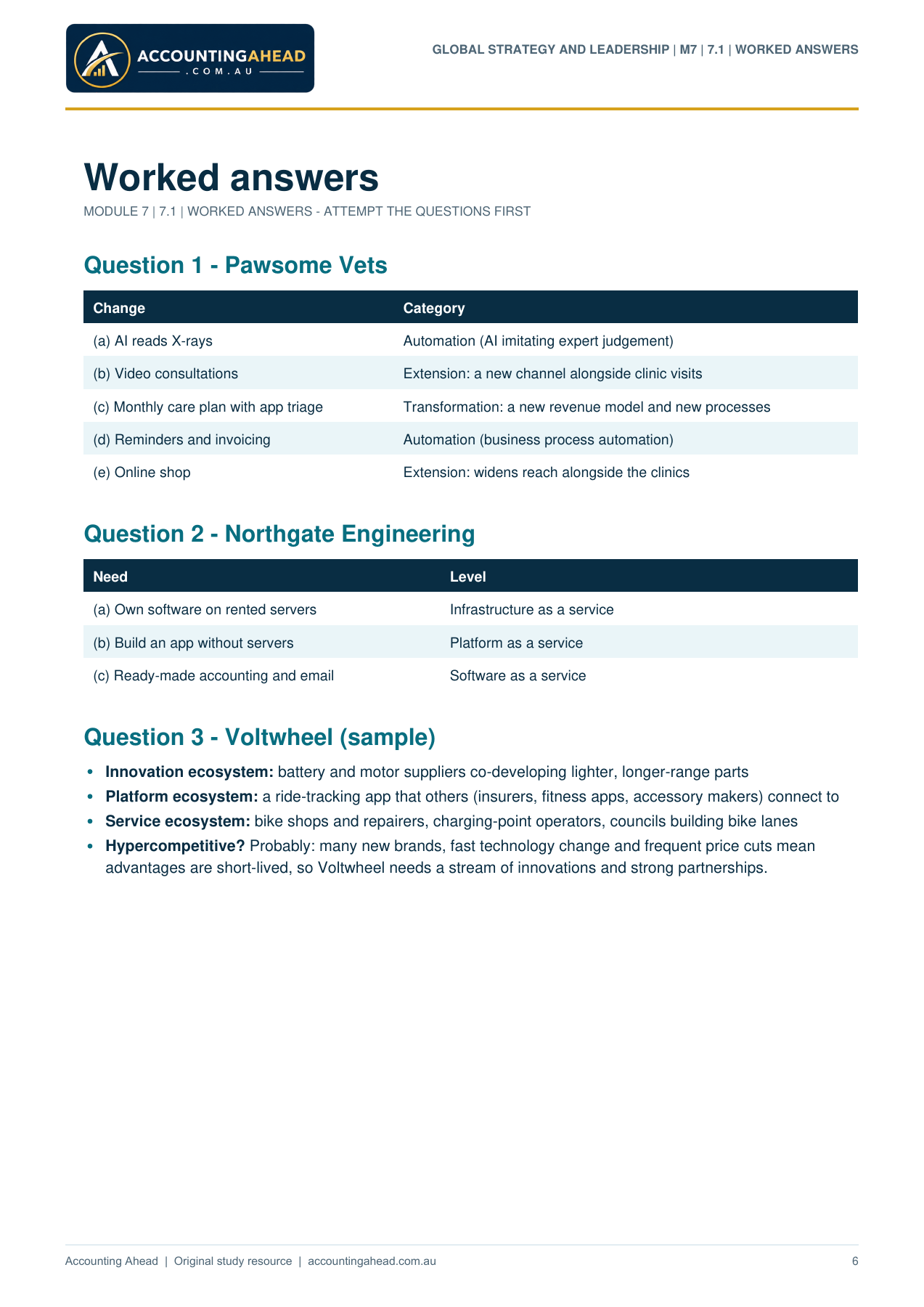
Question 3 - Voltwheel (sample)
Innovation ecosystem: battery and motor suppliers co-developing lighter, longer-range parts
Platform ecosystem: a ride-tracking app that others (insurers, fitness apps, accessory makers) connect to
Service ecosystem: bike shops and repairers, charging-point operators, councils building bike lanes
Hypercompetitive? Probably: many new brands, fast technology change and frequent price cuts mean
advantages are short-lived, so Voltwheel needs a stream of innovations and strong partnerships.
GLOBAL STRATEGY AND LEADERSHIP | M7 | 7.1 | WORKED ANSWERS
6