
Business models, the canvas and co-creation
Printable study notes to use alongside Part 7.2.1.
Read the handout text
Accounting Ahead | Original study resource | accountingahead.com.au
Business models, the canvas and
co-creation
MODULE 7 | 7.2.1 | STUDENT COMPANION
A business model sets out how an organisation runs and the economic logic that makes it pay: a system
of interacting features, often described as a customer value proposition, a profit formula, key resources and
key processes. A strategy explains how the organisation will outperform rivals or keep creating value. Two
gyms with the same low-cost, self-service model can follow different strategies (inner-city clusters versus
outer suburbs without rivals).
Business model innovation changes at least one element so the organisation creates or captures value
differently; formally, a design process that launches a substantially new model by changing the value
proposition, the arrangement of partners that delivers it, or both. Most managers rate it above new products or
services, but it lasts only if it is hard to copy. It is pursued by newcomers, by incumbents seeking an edge, and
by firms reacting to threats, and it is hard because of uncertainty and internal barriers.
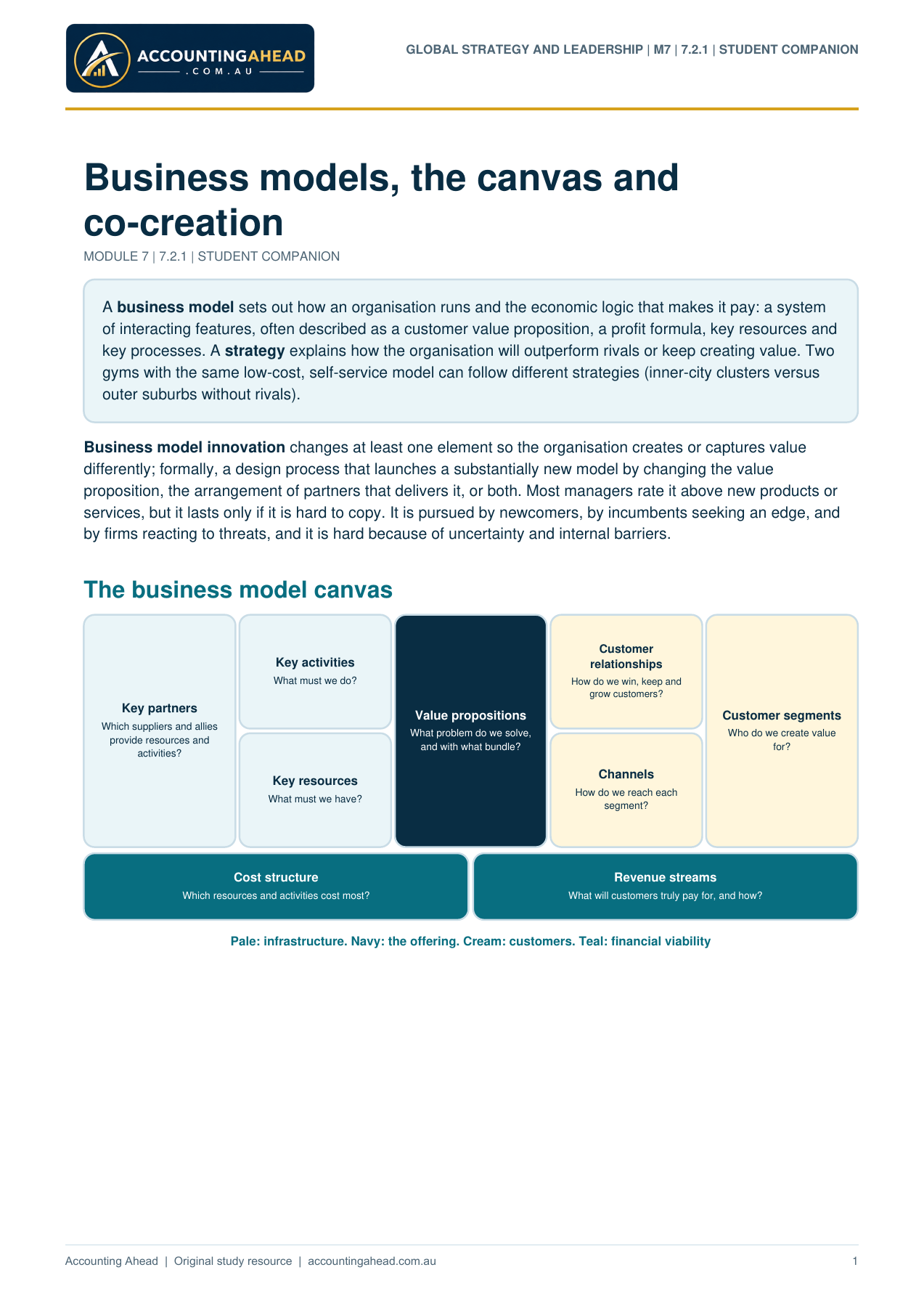
The business model canvas
Key partners
Which suppliers and allies
provide resources and
activities?
Key activities
What must we do?
Key resources
What must we have?
Value propositions
What problem do we solve,
and with what bundle?
Customer
relationships
How do we win, keep and
grow customers?
Channels
How do we reach each
segment?
Customer segments
Who do we create value
for?
Cost structure
Which resources and activities cost most?
Revenue streams
What will customers truly pay for, and how?
Pale: infrastructure. Navy: the offering. Cream: customers. Teal: financial viability
GLOBAL STRATEGY AND LEADERSHIP | M7 | 7.2.1 | STUDENT COMPANION
1
Accounting Ahead | Original study resource | accountingahead.com.au
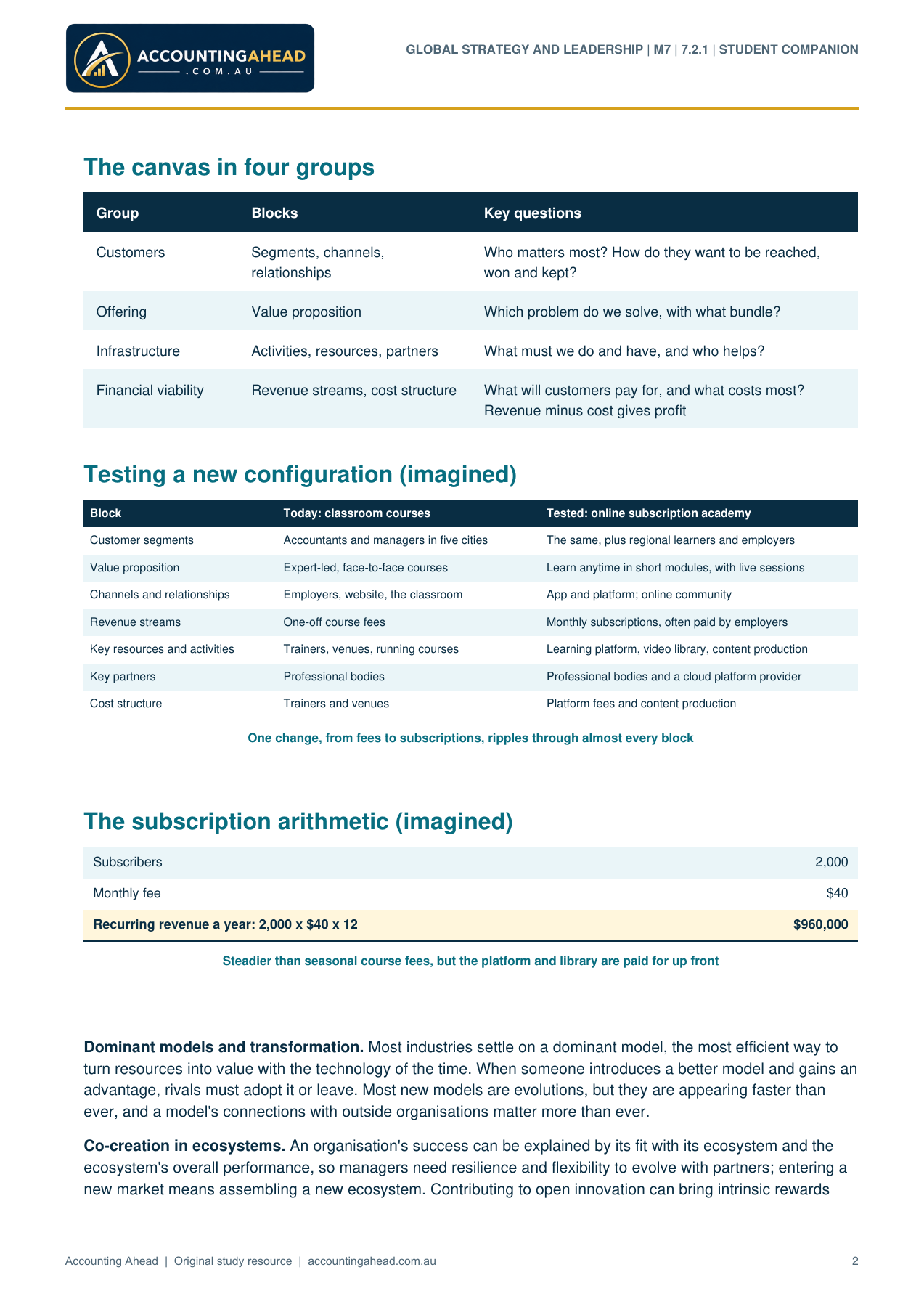
The canvas in four groups
Group Blocks Key questions
Customers Segments, channels,
relationships
Who matters most? How do they want to be reached,
won and kept?
Offering Value proposition Which problem do we solve, with what bundle?
Infrastructure Activities, resources, partners What must we do and have, and who helps?
Financial viability Revenue streams, cost structure What will customers pay for, and what costs most?
Revenue minus cost gives profit
Testing a new configuration (imagined)
Block Today: classroom courses Tested: online subscription academy
Customer segments Accountants and managers in five cities The same, plus regional learners and employers
Value proposition Expert-led, face-to-face courses Learn anytime in short modules, with live sessions
Channels and relationships Employers, website, the classroom App and platform; online community
Revenue streams One-off course fees Monthly subscriptions, often paid by employers
Key resources and activities Trainers, venues, running courses Learning platform, video library, content production
Key partners Professional bodies Professional bodies and a cloud platform provider
Cost structure Trainers and venues Platform fees and content production
One change, from fees to subscriptions, ripples through almost every block
The subscription arithmetic (imagined)
Subscribers 2,000
Monthly fee $40
Recurring revenue a year: 2,000 x $40 x 12 $960,000
Steadier than seasonal course fees, but the platform and library are paid for up front
Dominant models and transformation. Most industries settle on a dominant model, the most efficient way to
turn resources into value with the technology of the time. When someone introduces a better model and gains an
advantage, rivals must adopt it or leave. Most new models are evolutions, but they are appearing faster than
ever, and a model's connections with outside organisations matter more than ever.
Co-creation in ecosystems. An organisation's success can be explained by its fit with its ecosystem and the
ecosystem's overall performance, so managers need resilience and flexibility to evolve with partners; entering a
new market means assembling a new ecosystem. Contributing to open innovation can bring intrinsic rewards
GLOBAL STRATEGY AND LEADERSHIP | M7 | 7.2.1 | STUDENT COMPANION
2
Accounting Ahead | Original study resource | accountingahead.com.au
(satisfaction), social rewards (standing in the community) and extrinsic rewards (learning, reputation). Partners
cooperate to create value and compete to capture it.
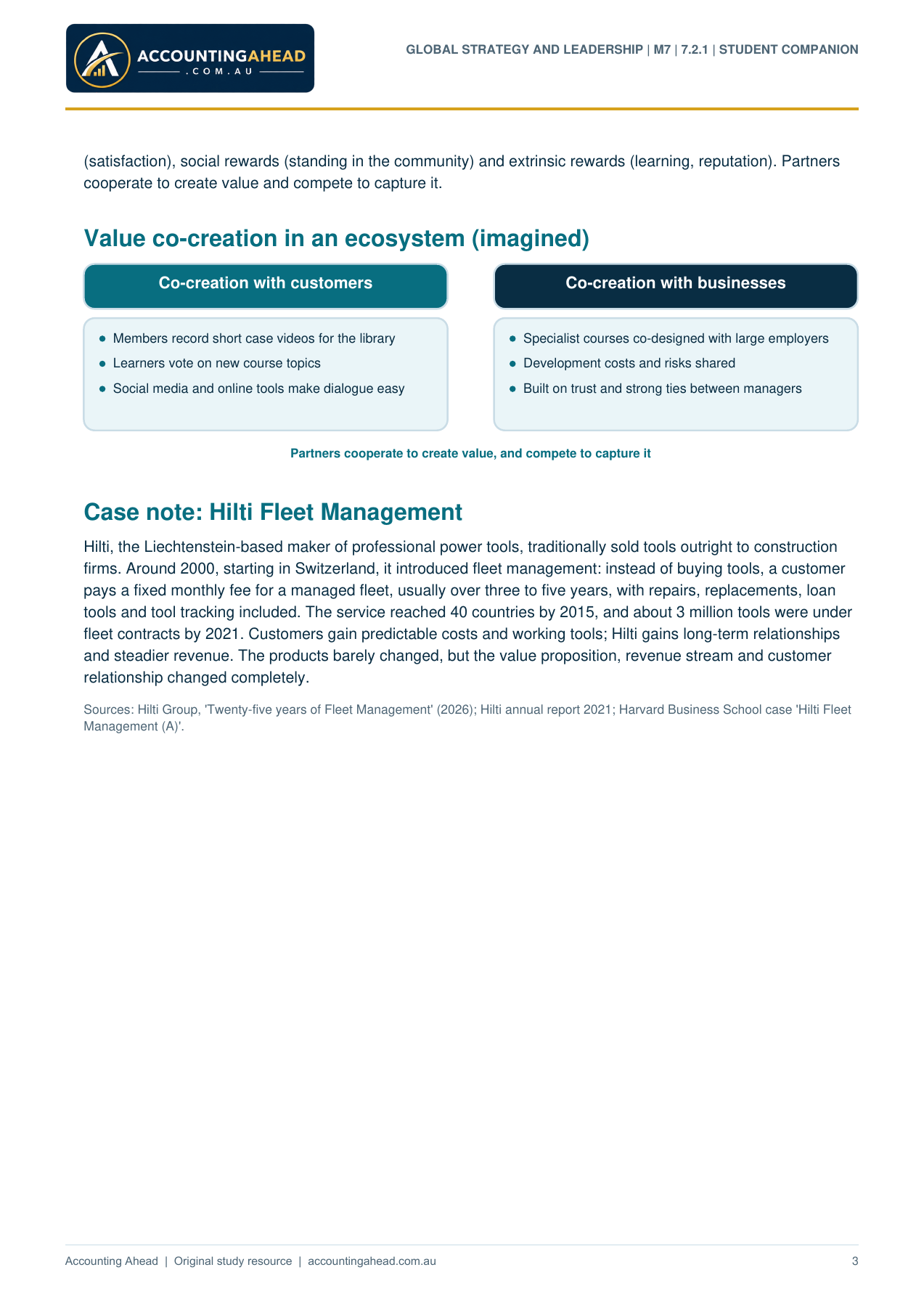
Value co-creation in an ecosystem (imagined)
Co-creation with customers
Members record short case videos for the library
Learners vote on new course topics
Social media and online tools make dialogue easy
Co-creation with businesses
Specialist courses co-designed with large employers
Development costs and risks shared
Built on trust and strong ties between managers
Partners cooperate to create value, and compete to capture it
Case note: Hilti Fleet Management
Hilti, the Liechtenstein-based maker of professional power tools, traditionally sold tools outright to construction
firms. Around 2000, starting in Switzerland, it introduced fleet management: instead of buying tools, a customer
pays a fixed monthly fee for a managed fleet, usually over three to five years, with repairs, replacements, loan
tools and tool tracking included. The service reached 40 countries by 2015, and about 3 million tools were under
fleet contracts by 2021. Customers gain predictable costs and working tools; Hilti gains long-term relationships
and steadier revenue. The products barely changed, but the value proposition, revenue stream and customer
relationship changed completely.
Sources: Hilti Group, 'Twenty-five years of Fleet Management' (2026); Hilti annual report 2021; Harvard Business School case 'Hilti Fleet
Management (A)'.
GLOBAL STRATEGY AND LEADERSHIP | M7 | 7.2.1 | STUDENT COMPANION
3
Accounting Ahead | Original study resource | accountingahead.com.au
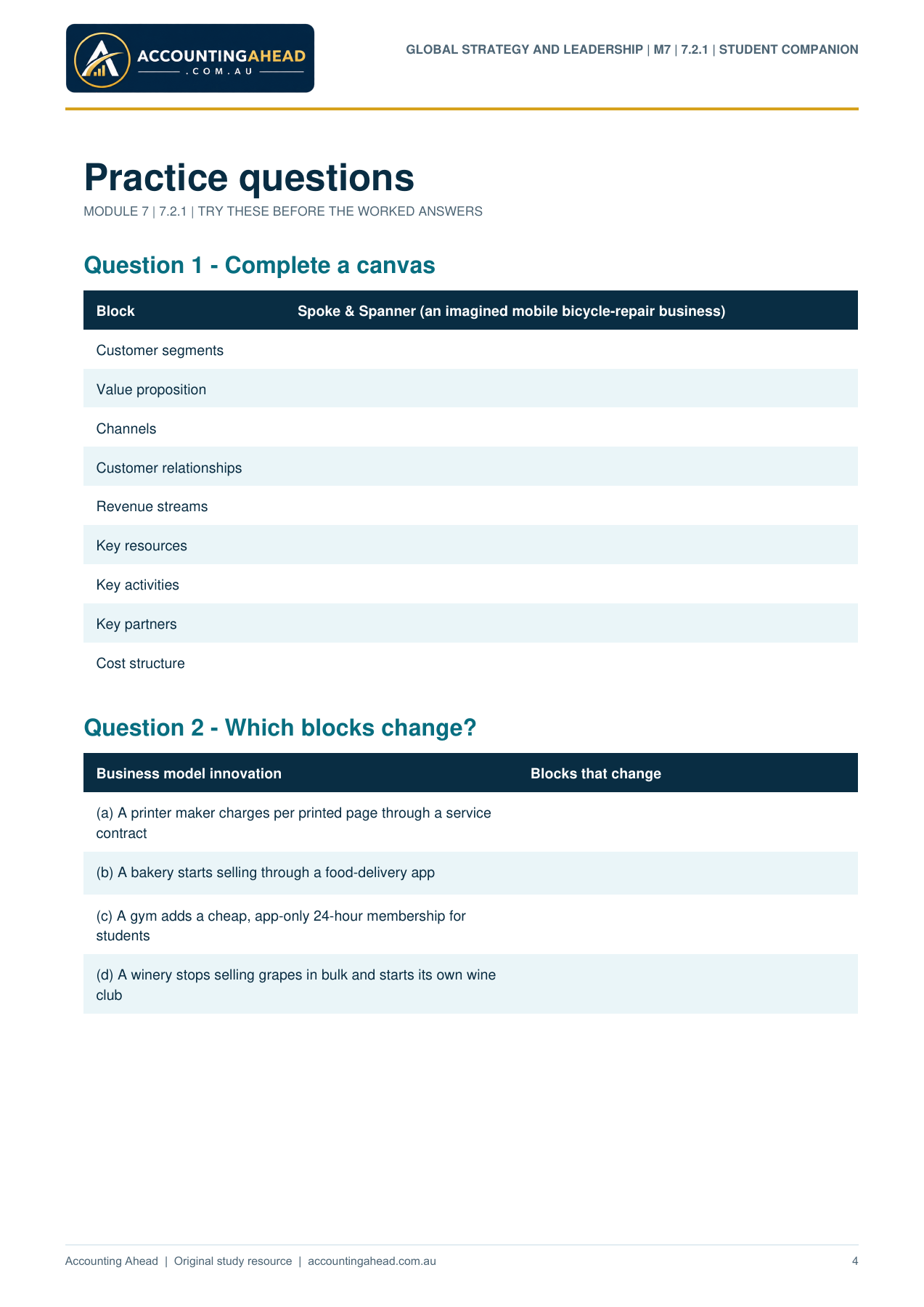
Practice questions
MODULE 7 | 7.2.1 | TRY THESE BEFORE THE WORKED ANSWERS
Question 1 - Complete a canvas
Block Spoke & Spanner (an imagined mobile bicycle-repair business)
Customer segments
Value proposition
Channels
Customer relationships
Revenue streams
Key resources
Key activities
Key partners
Cost structure
Question 2 - Which blocks change?
Business model innovation Blocks that change
(a) A printer maker charges per printed page through a service
contract
(b) A bakery starts selling through a food-delivery app
(c) A gym adds a cheap, app-only 24-hour membership for
students
(d) A winery stops selling grapes in bulk and starts its own wine
club
GLOBAL STRATEGY AND LEADERSHIP | M7 | 7.2.1 | STUDENT COMPANION
4
Accounting Ahead | Original study resource | accountingahead.com.au
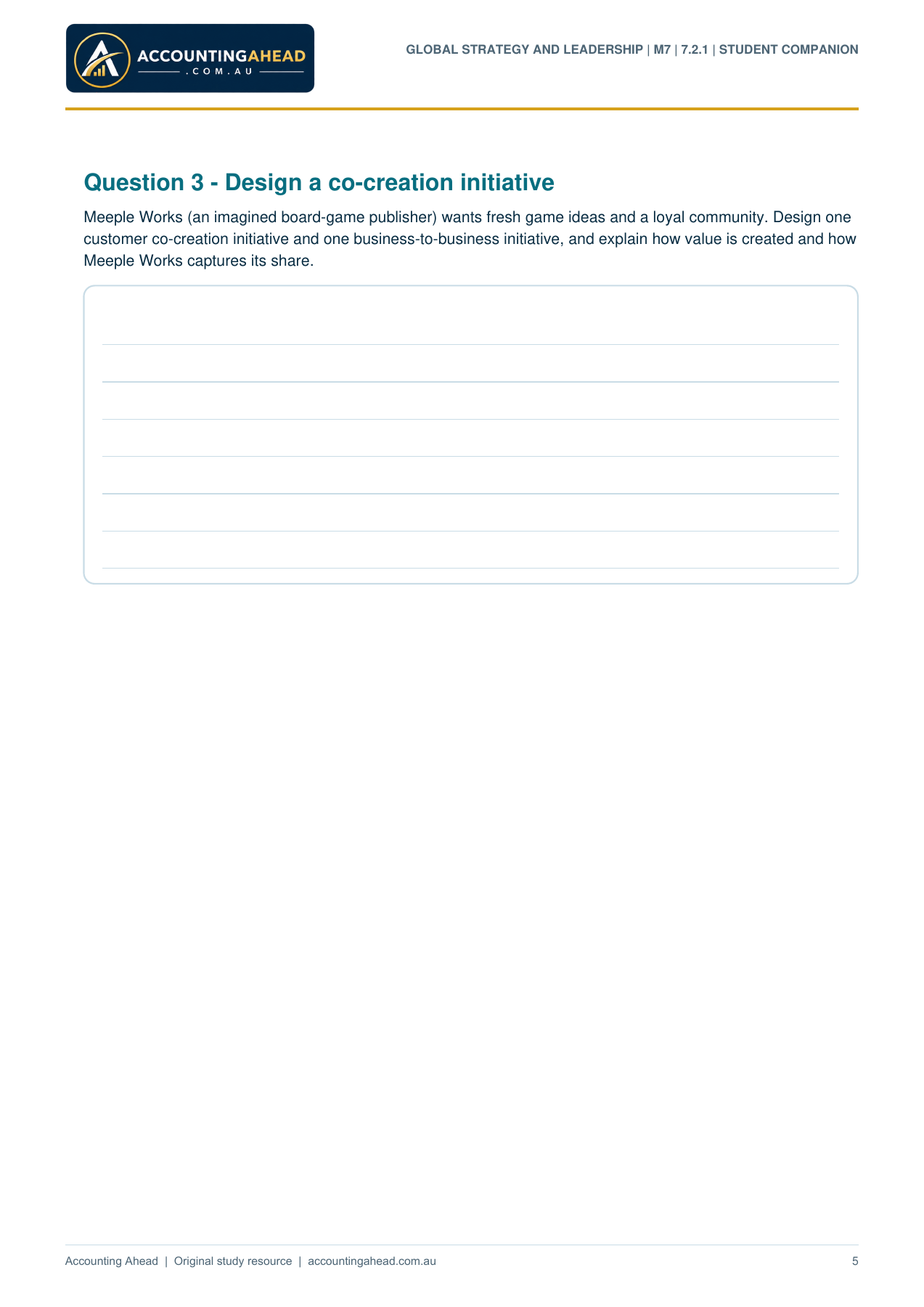
Question 3 - Design a co-creation initiative
Meeple Works (an imagined board-game publisher) wants fresh game ideas and a loyal community. Design one
customer co-creation initiative and one business-to-business initiative, and explain how value is created and how
Meeple Works captures its share.
GLOBAL STRATEGY AND LEADERSHIP | M7 | 7.2.1 | STUDENT COMPANION
5
Accounting Ahead | Original study resource | accountingahead.com.au
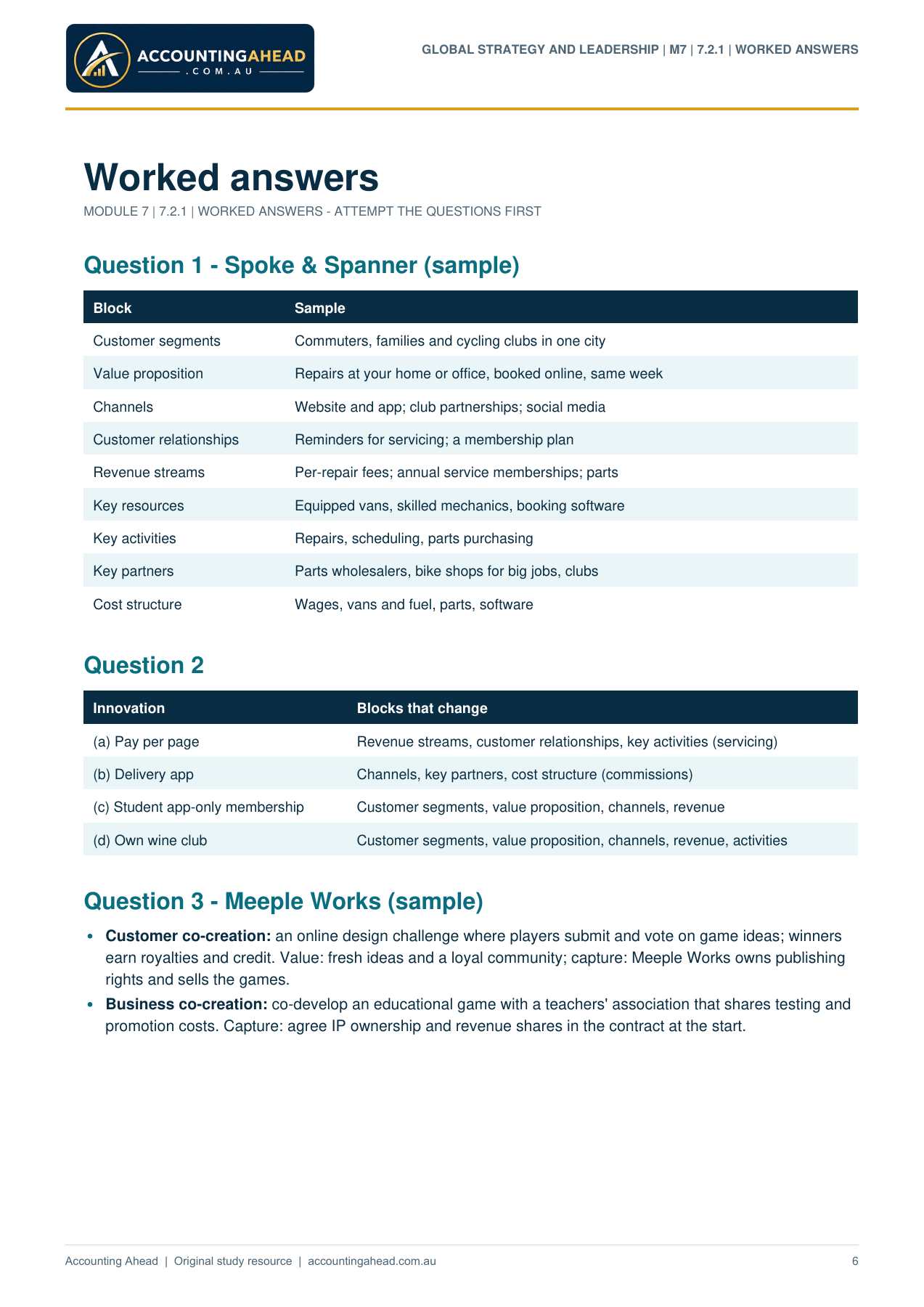
Worked answers
MODULE 7 | 7.2.1 | WORKED ANSWERS - ATTEMPT THE QUESTIONS FIRST
Question 1 - Spoke & Spanner (sample)
Block Sample
Customer segments Commuters, families and cycling clubs in one city
Value proposition Repairs at your home or office, booked online, same week
Channels Website and app; club partnerships; social media
Customer relationships Reminders for servicing; a membership plan
Revenue streams Per-repair fees; annual service memberships; parts
Key resources Equipped vans, skilled mechanics, booking software
Key activities Repairs, scheduling, parts purchasing
Key partners Parts wholesalers, bike shops for big jobs, clubs
Cost structure Wages, vans and fuel, parts, software
Question 2
Innovation Blocks that change
(a) Pay per page Revenue streams, customer relationships, key activities (servicing)
(b) Delivery app Channels, key partners, cost structure (commissions)
(c) Student app-only membership Customer segments, value proposition, channels, revenue
(d) Own wine club Customer segments, value proposition, channels, revenue, activities
Question 3 - Meeple Works (sample)
Customer co-creation: an online design challenge where players submit and vote on game ideas; winners
earn royalties and credit. Value: fresh ideas and a loyal community; capture: Meeple Works owns publishing
rights and sells the games.
Business co-creation: co-develop an educational game with a teachers' association that shares testing and
promotion costs. Capture: agree IP ownership and revenue shares in the contract at the start.
GLOBAL STRATEGY AND LEADERSHIP | M7 | 7.2.1 | WORKED ANSWERS
6