
Leadership challenges and development
Printable study notes to use alongside Part 7.6.2.
Read the handout text
Accounting Ahead | Original study resource | accountingahead.com.au
Leadership challenges and development
MODULE 7 | 7.6.2 | STUDENT COMPANION
Clayton Christensen saw a tension between running an established business well (listening to customers,
building capabilities, investing carefully) and responding to disruptors. With Michael Raynor he argued that
resource-allocation processes tuned to improving existing products leave incumbents structurally unable to
respond. Other researchers disagree: most firms do spot disruption, and many fight it off.
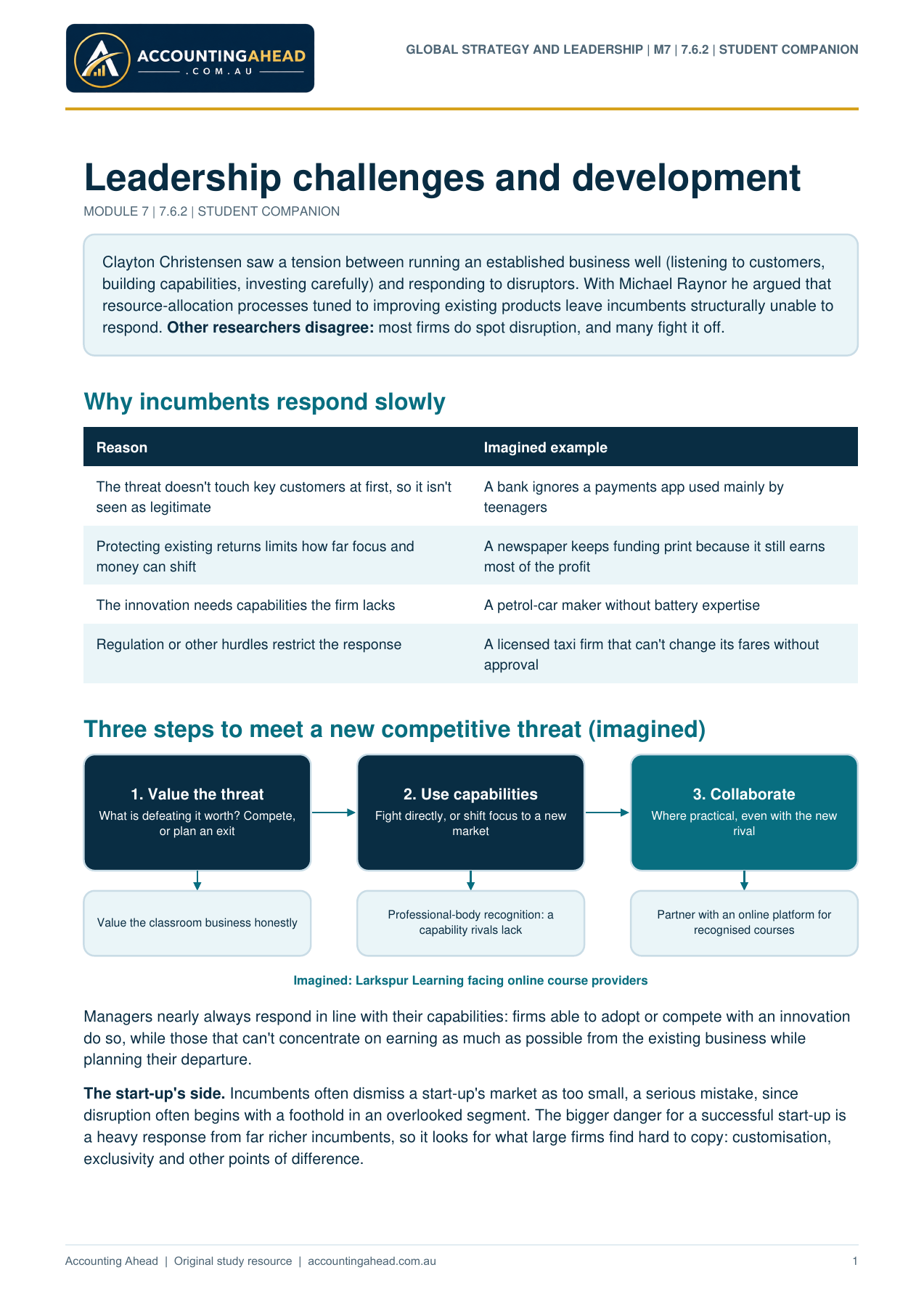
Why incumbents respond slowly
Reason Imagined example
The threat doesn't touch key customers at first, so it isn't
seen as legitimate
A bank ignores a payments app used mainly by
teenagers
Protecting existing returns limits how far focus and
money can shift
A newspaper keeps funding print because it still earns
most of the profit
The innovation needs capabilities the firm lacks A petrol-car maker without battery expertise
Regulation or other hurdles restrict the response A licensed taxi firm that can't change its fares without
approval
Three steps to meet a new competitive threat (imagined)
1. Value the threat
What is defeating it worth? Compete,
or plan an exit
Value the classroom business honestly
2. Use capabilities
Fight directly, or shift focus to a new
market
Professional-body recognition: a
capability rivals lack
3. Collaborate
Where practical, even with the new
rival
Partner with an online platform for
recognised courses
Imagined: Larkspur Learning facing online course providers
Managers nearly always respond in line with their capabilities: firms able to adopt or compete with an innovation
do so, while those that can't concentrate on earning as much as possible from the existing business while
planning their departure.
The start-up's side. Incumbents often dismiss a start-up's market as too small, a serious mistake, since
disruption often begins with a foothold in an overlooked segment. The bigger danger for a successful start-up is
a heavy response from far richer incumbents, so it looks for what large firms find hard to copy: customisation,
exclusivity and other points of difference.
GLOBAL STRATEGY AND LEADERSHIP | M7 | 7.6.2 | STUDENT COMPANION
1
Accounting Ahead | Original study resource | accountingahead.com.au
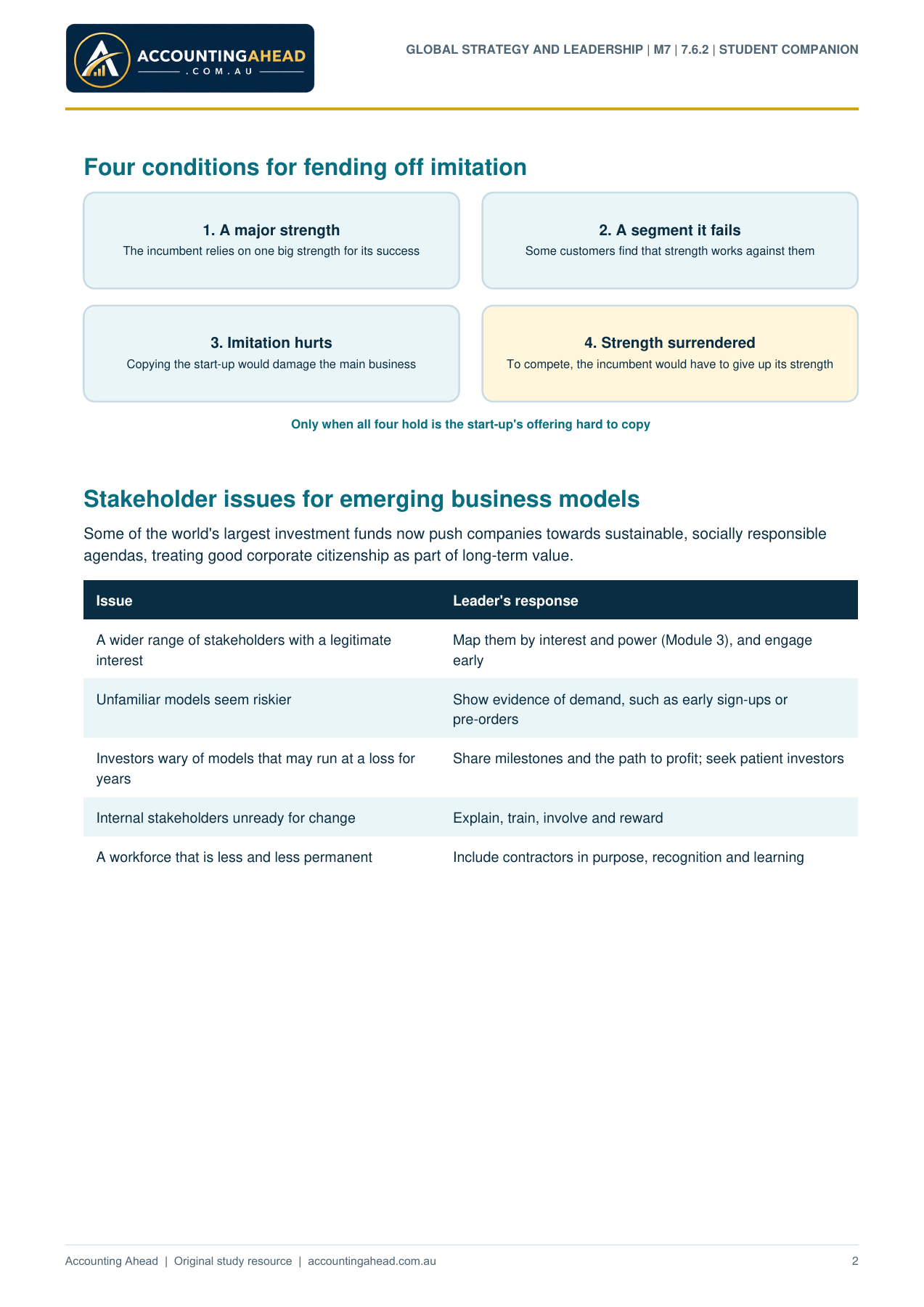
Four conditions for fending off imitation
1. A major strength
The incumbent relies on one big strength for its success
2. A segment it fails
Some customers find that strength works against them
3. Imitation hurts
Copying the start-up would damage the main business
4. Strength surrendered
To compete, the incumbent would have to give up its strength
Only when all four hold is the start-up's offering hard to copy
Stakeholder issues for emerging business models
Some of the world's largest investment funds now push companies towards sustainable, socially responsible
agendas, treating good corporate citizenship as part of long-term value.
Issue Leader's response
A wider range of stakeholders with a legitimate
interest
Map them by interest and power (Module 3), and engage
early
Unfamiliar models seem riskier Show evidence of demand, such as early sign-ups or
pre-orders
Investors wary of models that may run at a loss for
years
Share milestones and the path to profit; seek patient investors
Internal stakeholders unready for change Explain, train, involve and reward
A workforce that is less and less permanent Include contractors in purpose, recognition and learning
GLOBAL STRATEGY AND LEADERSHIP | M7 | 7.6.2 | STUDENT COMPANION
2
Accounting Ahead | Original study resource | accountingahead.com.au
What shapes readiness for change
Organisations need to be adaptable by nature. Readiness rises with training and skills development, and when
workloads are lightened to free time for new ways of working. Larkspur (imagined) includes its contract trainers
in team meetings, recognition and training, so they share the purpose as well as the work.
Factor Question to ask
Stage of life Is the organisation young and fluid, or mature and settled?
Attitude to risk How are failed experiments treated?
Culture Do people expect change, or resist it?
Social relationships Do colleagues trust and help each other?
Management and leadership Do managers and leaders pull in the same direction?
Job knowledge and skills Do people have the skills the new model needs?
Leaders keep developing. No chief executive can make every important decision, so leaders increasingly guide
how the organisation evolves. Gary Hamel saw the leader's job as designing the organisation's social system
(structures, ground rules and meaningful work) so that everyone can collaborate, innovate and excel. McKinsey
research found two attributes that most set effective leaders apart: openness to different perspectives and the
ability to support others. Middle managers are moving from administering and controlling towards acting as
entrepreneurs, coaches and team leaders.
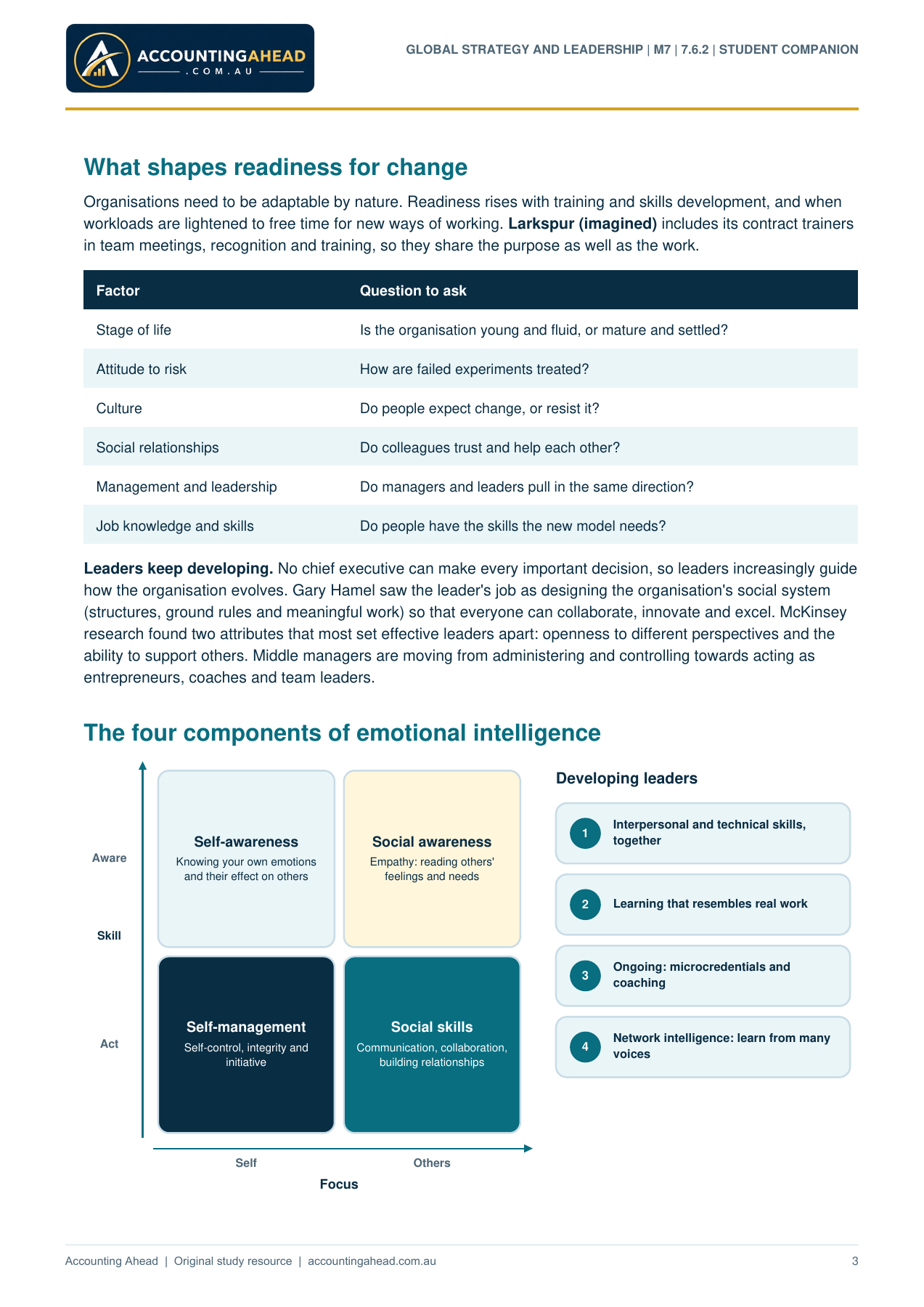
The four components of emotional intelligence
Self-awareness
Knowing your own emotions
and their effect on others
Social awareness
Empathy: reading others'
feelings and needs
Self-management
Self-control, integrity and
initiative
Social skills
Communication, collaboration,
building relationships
Self Others
Focus
Aware
Act
Skill
Developing leaders
1 Interpersonal and technical skills,
together
2 Learning that resembles real work
3 Ongoing: microcredentials and
coaching
4 Network intelligence: learn from many
voices
GLOBAL STRATEGY AND LEADERSHIP | M7 | 7.6.2 | STUDENT COMPANION
3
Accounting Ahead | Original study resource | accountingahead.com.au
Making development stick
Principle In practice
Teach interpersonal skills alongside
technical ones
A finance lead practises presenting a budget to sceptical managers
Make learning resemble the workplace Personalised, social and interactive, ideally at work
Keep it ongoing Short, assessed microcredentials, with personal coaching
Use network intelligence Talk with, question and listen to people across the organisation and
its ecosystem, not only the most senior
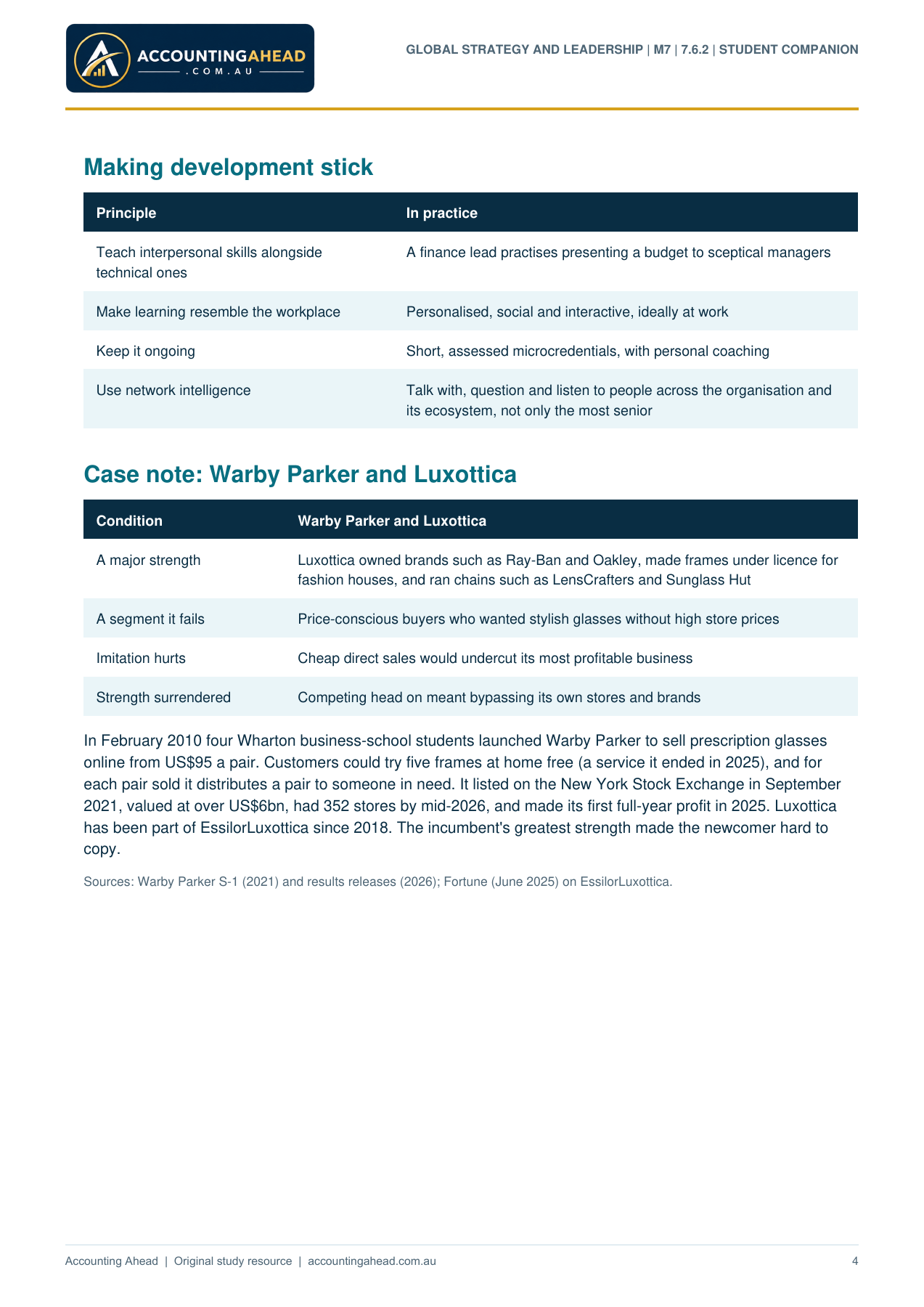
Case note: Warby Parker and Luxottica
Condition Warby Parker and Luxottica
A major strength Luxottica owned brands such as Ray-Ban and Oakley, made frames under licence for
fashion houses, and ran chains such as LensCrafters and Sunglass Hut
A segment it fails Price-conscious buyers who wanted stylish glasses without high store prices
Imitation hurts Cheap direct sales would undercut its most profitable business
Strength surrendered Competing head on meant bypassing its own stores and brands
In February 2010 four Wharton business-school students launched Warby Parker to sell prescription glasses
online from US$95 a pair. Customers could try five frames at home free (a service it ended in 2025), and for
each pair sold it distributes a pair to someone in need. It listed on the New York Stock Exchange in September
2021, valued at over US$6bn, had 352 stores by mid-2026, and made its first full-year profit in 2025. Luxottica
has been part of EssilorLuxottica since 2018. The incumbent's greatest strength made the newcomer hard to
copy.
Sources: Warby Parker S-1 (2021) and results releases (2026); Fortune (June 2025) on EssilorLuxottica.
GLOBAL STRATEGY AND LEADERSHIP | M7 | 7.6.2 | STUDENT COMPANION
4
Accounting Ahead | Original study resource | accountingahead.com.au
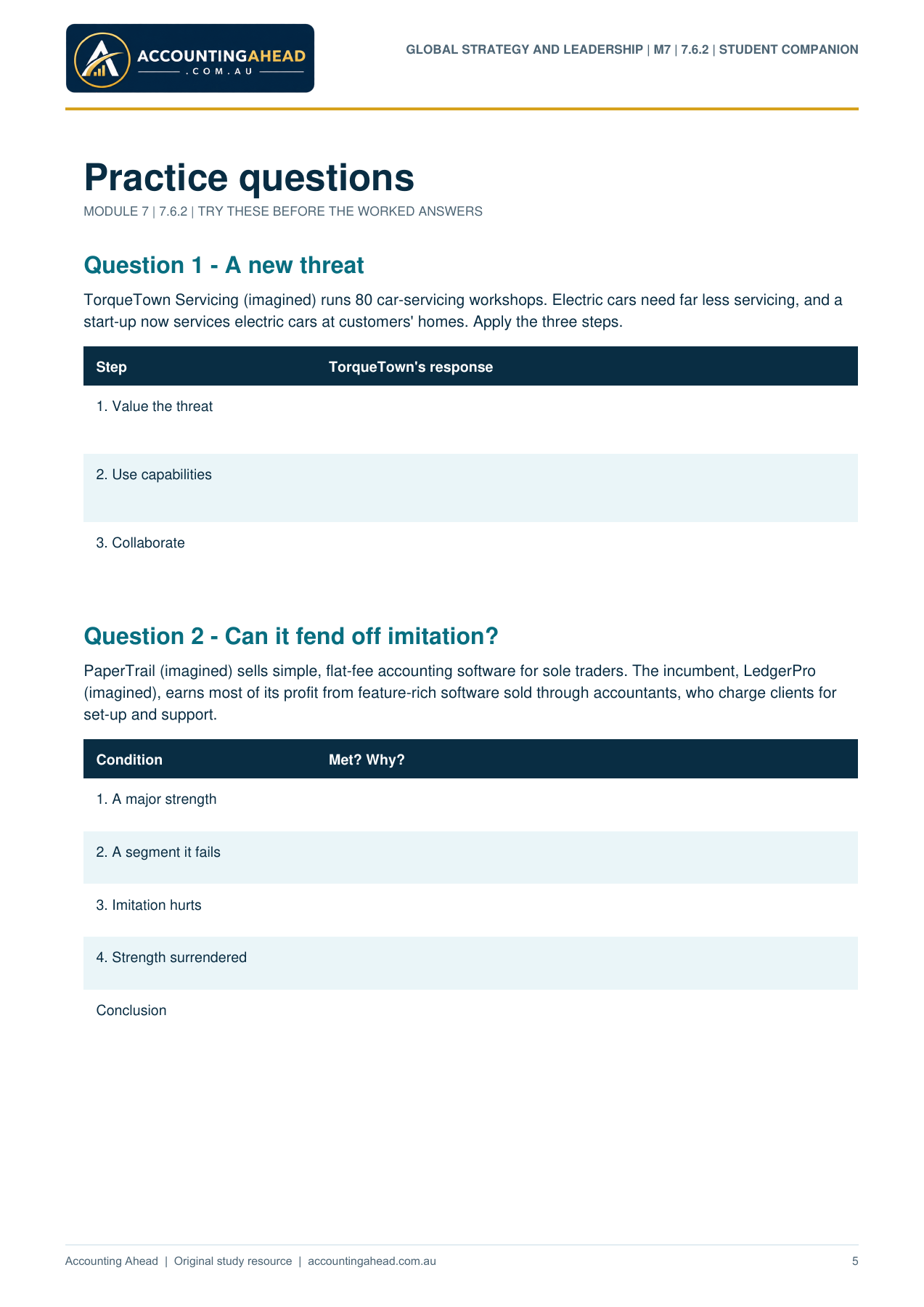
Practice questions
MODULE 7 | 7.6.2 | TRY THESE BEFORE THE WORKED ANSWERS
Question 1 - A new threat
TorqueTown Servicing (imagined) runs 80 car-servicing workshops. Electric cars need far less servicing, and a
start-up now services electric cars at customers' homes. Apply the three steps.
Step TorqueTown's response
1. Value the threat
2. Use capabilities
3. Collaborate
Question 2 - Can it fend off imitation?
PaperTrail (imagined) sells simple, flat-fee accounting software for sole traders. The incumbent, LedgerPro
(imagined), earns most of its profit from feature-rich software sold through accountants, who charge clients for
set-up and support.
Condition Met? Why?
1. A major strength
2. A segment it fails
3. Imitation hurts
4. Strength surrendered
Conclusion
GLOBAL STRATEGY AND LEADERSHIP | M7 | 7.6.2 | STUDENT COMPANION
5
Accounting Ahead | Original study resource | accountingahead.com.au
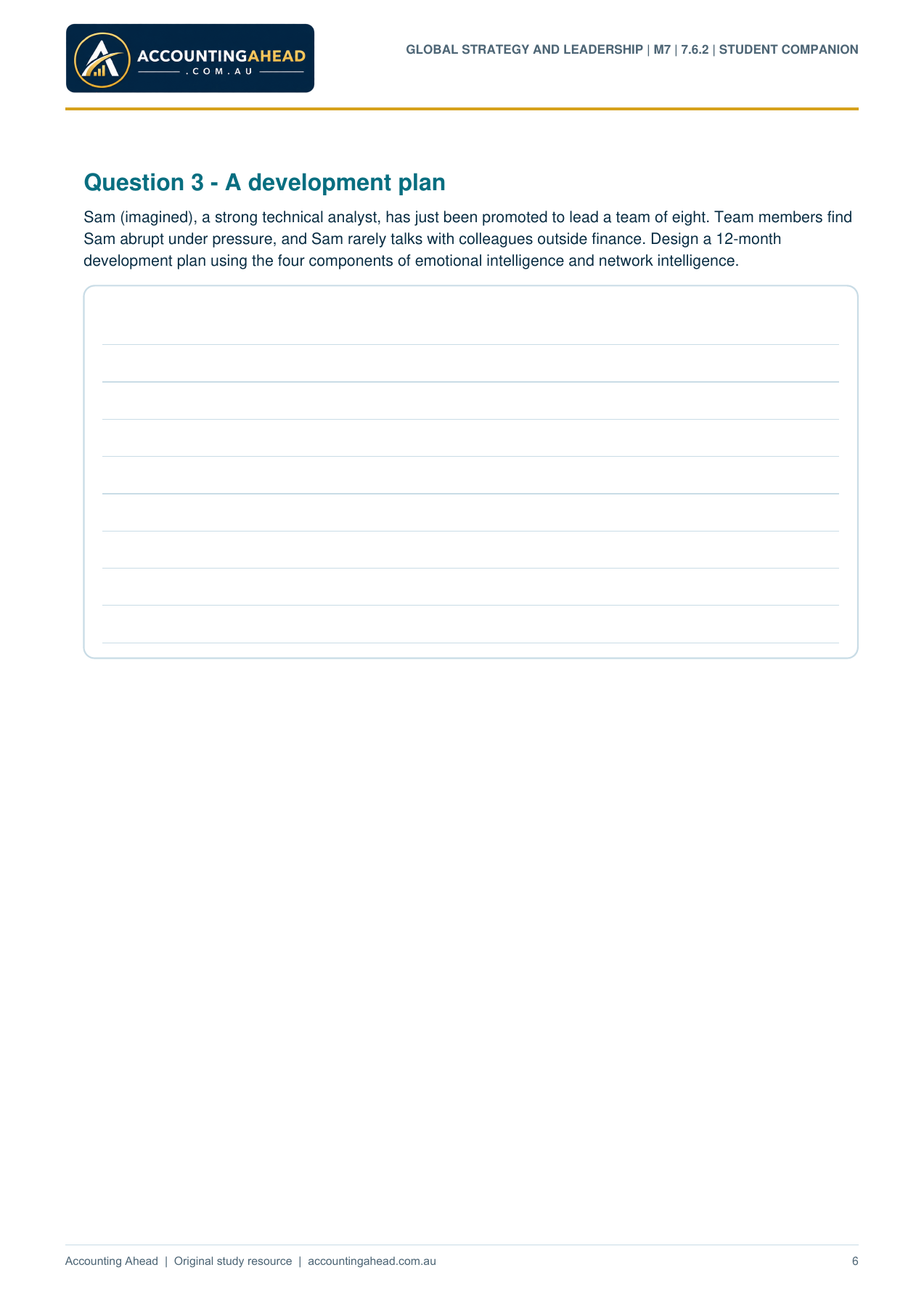
Question 3 - A development plan
Sam (imagined), a strong technical analyst, has just been promoted to lead a team of eight. Team members find
Sam abrupt under pressure, and Sam rarely talks with colleagues outside finance. Design a 12-month
development plan using the four components of emotional intelligence and network intelligence.
GLOBAL STRATEGY AND LEADERSHIP | M7 | 7.6.2 | STUDENT COMPANION
6
Accounting Ahead | Original study resource | accountingahead.com.au
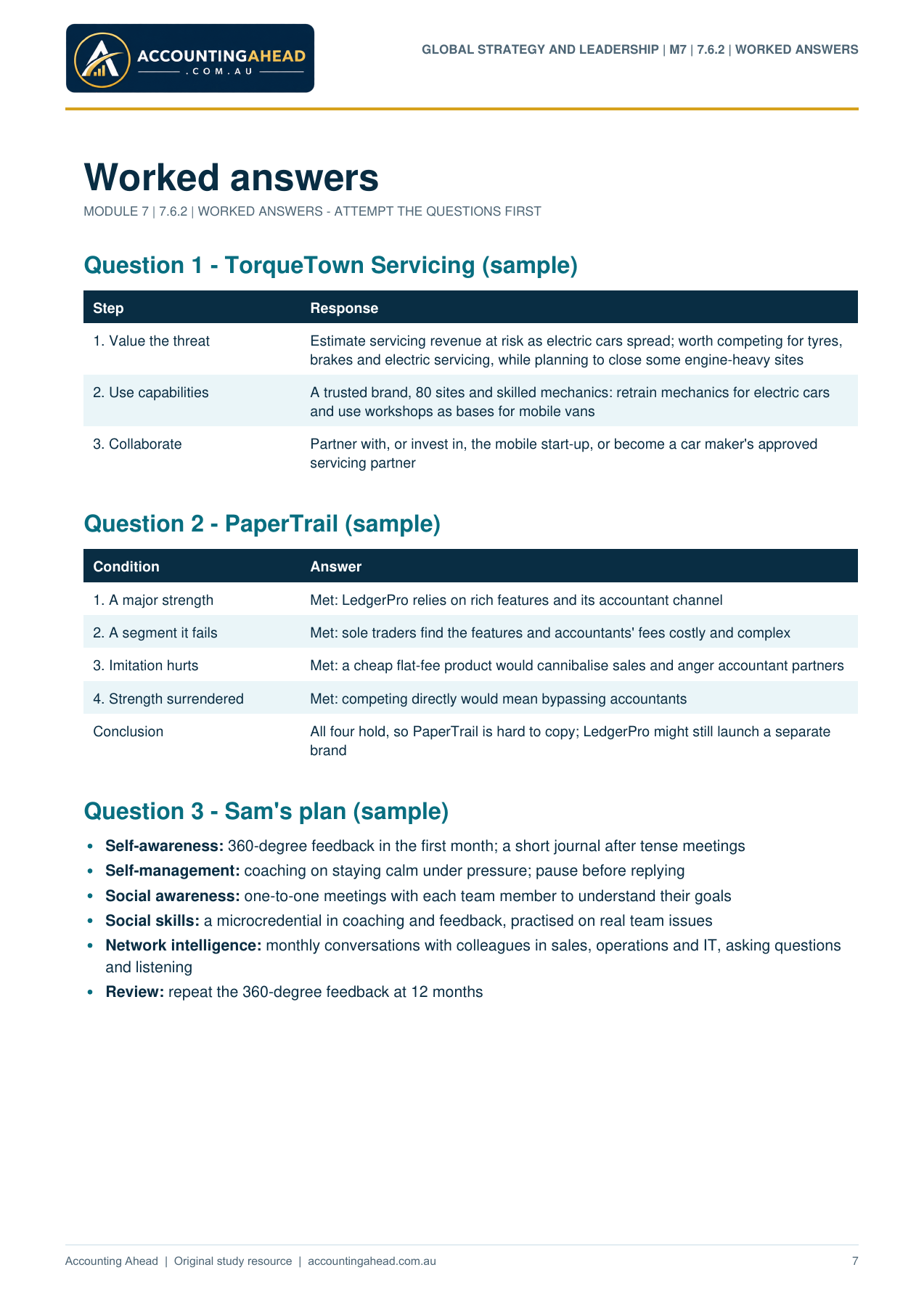
Worked answers
MODULE 7 | 7.6.2 | WORKED ANSWERS - ATTEMPT THE QUESTIONS FIRST
Question 1 - TorqueTown Servicing (sample)
Step Response
1. Value the threat Estimate servicing revenue at risk as electric cars spread; worth competing for tyres,
brakes and electric servicing, while planning to close some engine-heavy sites
2. Use capabilities A trusted brand, 80 sites and skilled mechanics: retrain mechanics for electric cars
and use workshops as bases for mobile vans
3. Collaborate Partner with, or invest in, the mobile start-up, or become a car maker's approved
servicing partner
Question 2 - PaperTrail (sample)
Condition Answer
1. A major strength Met: LedgerPro relies on rich features and its accountant channel
2. A segment it fails Met: sole traders find the features and accountants' fees costly and complex
3. Imitation hurts Met: a cheap flat-fee product would cannibalise sales and anger accountant partners
4. Strength surrendered Met: competing directly would mean bypassing accountants
Conclusion All four hold, so PaperTrail is hard to copy; LedgerPro might still launch a separate
brand
Question 3 - Sam's plan (sample)
Self-awareness: 360-degree feedback in the first month; a short journal after tense meetings
Self-management: coaching on staying calm under pressure; pause before replying
Social awareness: one-to-one meetings with each team member to understand their goals
Social skills: a microcredential in coaching and feedback, practised on real team issues
Network intelligence: monthly conversations with colleagues in sales, operations and IT, asking questions
and listening
Review: repeat the 360-degree feedback at 12 months
GLOBAL STRATEGY AND LEADERSHIP | M7 | 7.6.2 | WORKED ANSWERS
7