
Customers 2: profit strategies
Printable study notes to use alongside Part F.1.2.
Read the handout text
Accounting Ahead | Original study resource | accountingahead.com.au
Customers 2: profit strategies
MODULE 6 | PART F.1.2 | STUDENT COMPANION
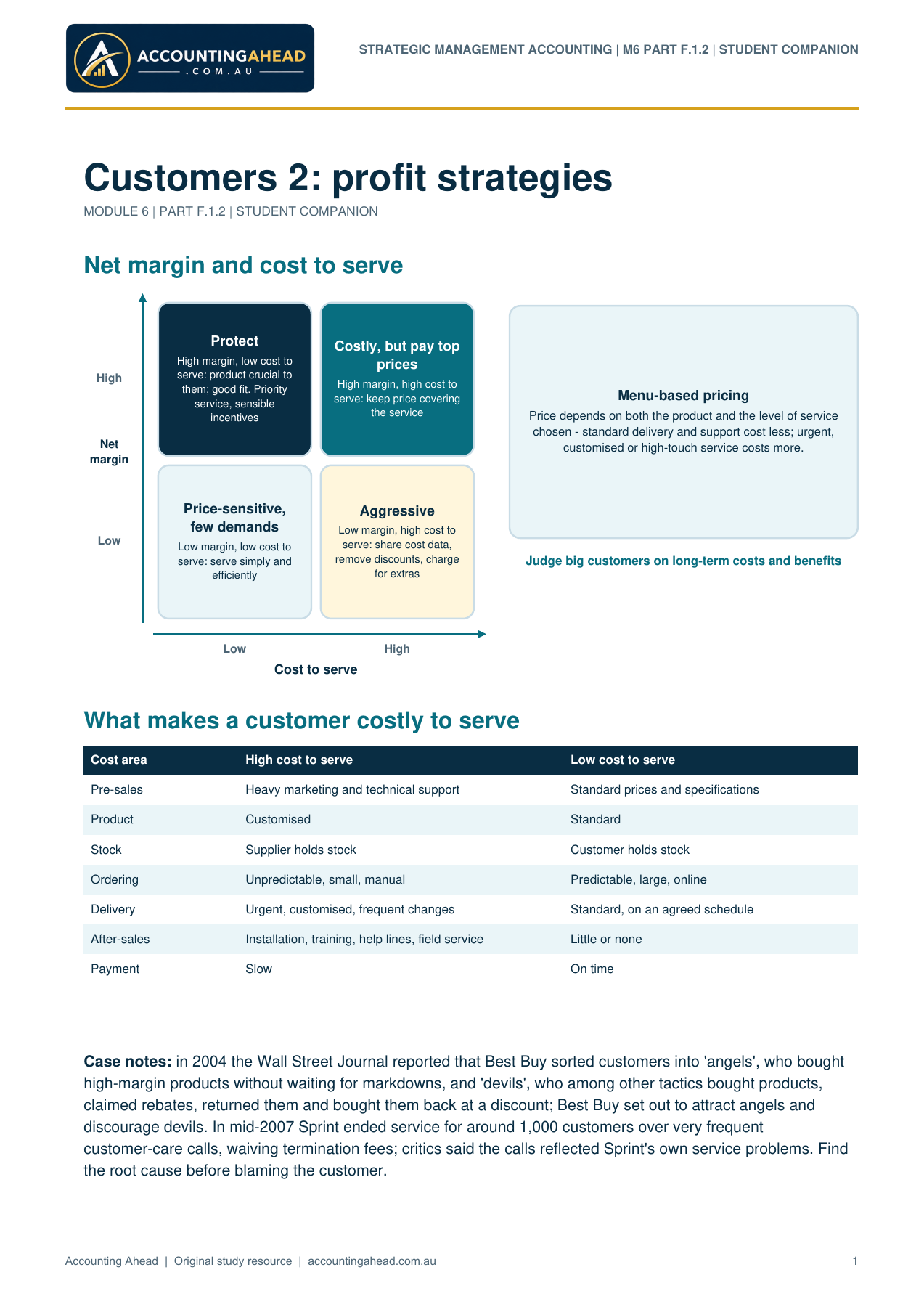
Net margin and cost to serve
Protect
High margin, low cost to
serve: product crucial to
them; good fit. Priority
service, sensible
incentives
Costly, but pay top
prices
High margin, high cost to
serve: keep price covering
the service
Price-sensitive,
few demands
Low margin, low cost to
serve: serve simply and
efficiently
Aggressive
Low margin, high cost to
serve: share cost data,
remove discounts, charge
for extras
Low High
Cost to serve
High
Low
Net
margin
Menu-based pricing
Price depends on both the product and the level of service
chosen - standard delivery and support cost less; urgent,
customised or high-touch service costs more.
Judge big customers on long-term costs and benefits
What makes a customer costly to serve
Cost area High cost to serve Low cost to serve
Pre-sales Heavy marketing and technical support Standard prices and specifications
Product Customised Standard
Stock Supplier holds stock Customer holds stock
Ordering Unpredictable, small, manual Predictable, large, online
Delivery Urgent, customised, frequent changes Standard, on an agreed schedule
After-sales Installation, training, help lines, field service Little or none
Payment Slow On time
Case notes: in 2004 the Wall Street Journal reported that Best Buy sorted customers into 'angels', who bought
high-margin products without waiting for markdowns, and 'devils', who among other tactics bought products,
claimed rebates, returned them and bought them back at a discount; Best Buy set out to attract angels and
discourage devils. In mid-2007 Sprint ended service for around 1,000 customers over very frequent
customer-care calls, waiving termination fees; critics said the calls reflected Sprint's own service problems. Find
the root cause before blaming the customer.
STRATEGIC MANAGEMENT ACCOUNTING | M6 PART F.1.2 | STUDENT COMPANION
1
Accounting Ahead | Original study resource | accountingahead.com.au
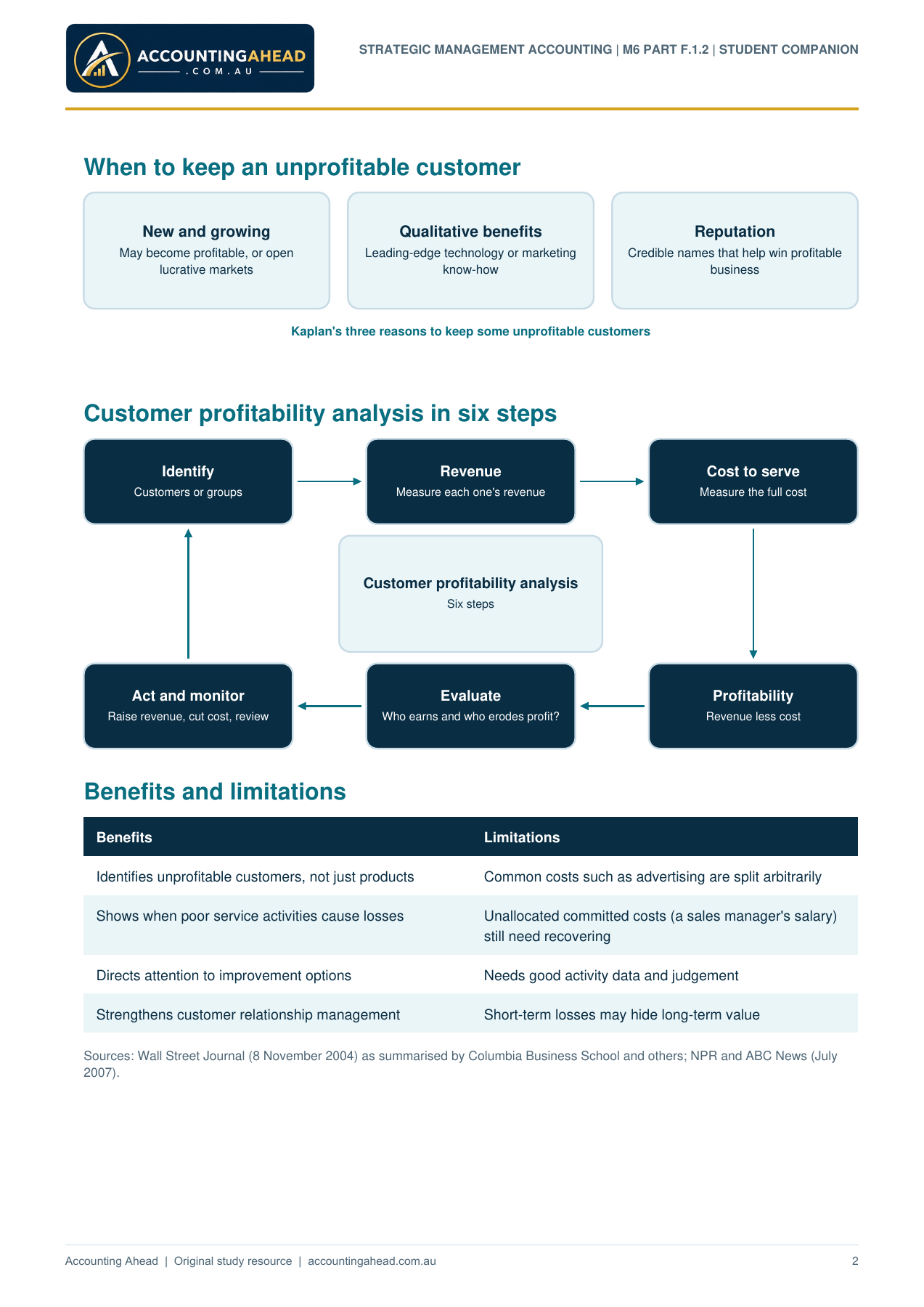
When to keep an unprofitable customer
New and growing
May become profitable, or open
lucrative markets
Qualitative benefits
Leading-edge technology or marketing
know-how
Reputation
Credible names that help win profitable
business
Kaplan's three reasons to keep some unprofitable customers
Customer profitability analysis in six steps
Identify
Customers or groups
Revenue
Measure each one's revenue
Cost to serve
Measure the full cost
Profitability
Revenue less cost
Evaluate
Who earns and who erodes profit?
Act and monitor
Raise revenue, cut cost, review
Customer profitability analysis
Six steps
Benefits and limitations
Benefits Limitations
Identifies unprofitable customers, not just products Common costs such as advertising are split arbitrarily
Shows when poor service activities cause losses Unallocated committed costs (a sales manager's salary)
still need recovering
Directs attention to improvement options Needs good activity data and judgement
Strengthens customer relationship management Short-term losses may hide long-term value
Sources: Wall Street Journal (8 November 2004) as summarised by Columbia Business School and others; NPR and ABC News (July
2007).
STRATEGIC MANAGEMENT ACCOUNTING | M6 PART F.1.2 | STUDENT COMPANION
2
Accounting Ahead | Original study resource | accountingahead.com.au
Formulas and rules
Item Rule
Ideal customer High net margin, low cost to serve - protect, but watch incentive costs
Aggressive customer Low margin, high cost - share cost data, remove discounts, charge for special
services
Menu-based pricing Price varies with product and service level
Retention Converting an existing unprofitable customer can be cheaper than finding new
profitable ones
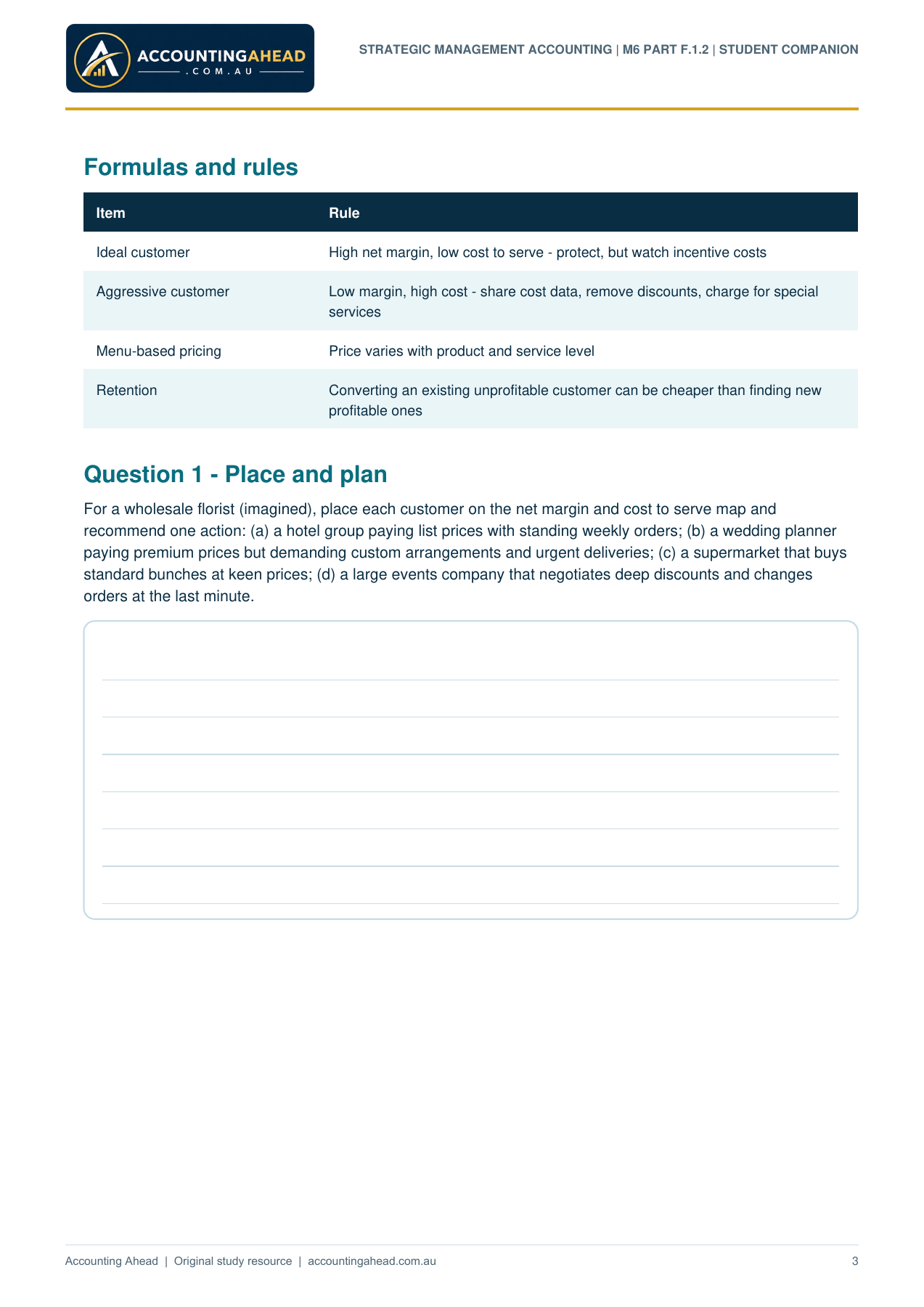
Question 1 - Place and plan
For a wholesale florist (imagined), place each customer on the net margin and cost to serve map and
recommend one action: (a) a hotel group paying list prices with standing weekly orders; (b) a wedding planner
paying premium prices but demanding custom arrangements and urgent deliveries; (c) a supermarket that buys
standard bunches at keen prices; (d) a large events company that negotiates deep discounts and changes
orders at the last minute.
STRATEGIC MANAGEMENT ACCOUNTING | M6 PART F.1.2 | STUDENT COMPANION
3
Accounting Ahead | Original study resource | accountingahead.com.au
Worked answers
MODULE 6 | PART F.1.2 | WORKED ANSWERS - ATTEMPT THE QUESTIONS FIRST
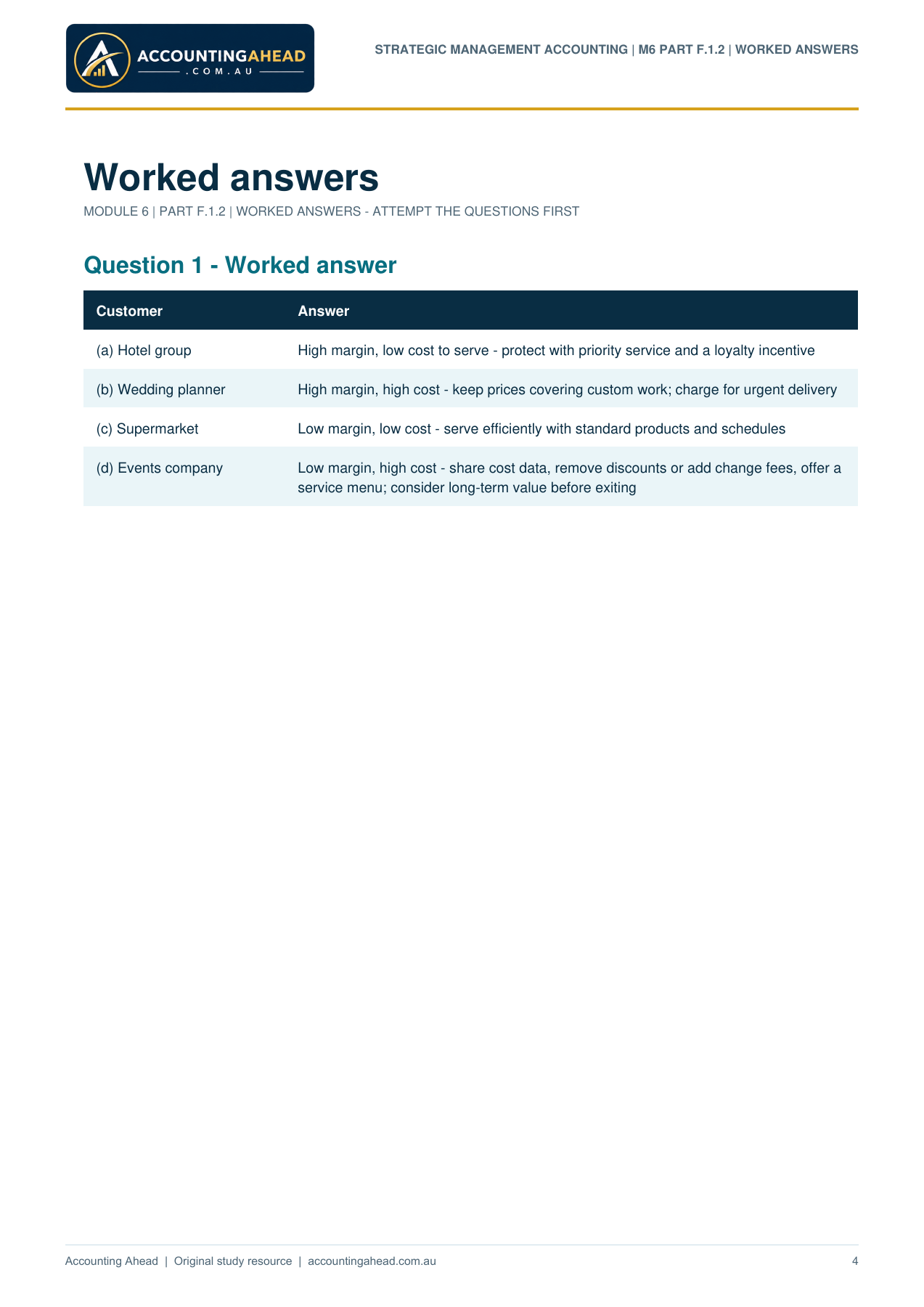
Question 1 - Worked answer
Customer Answer
(a) Hotel group High margin, low cost to serve - protect with priority service and a loyalty incentive
(b) Wedding planner High margin, high cost - keep prices covering custom work; charge for urgent delivery
(c) Supermarket Low margin, low cost - serve efficiently with standard products and schedules
(d) Events company Low margin, high cost - share cost data, remove discounts or add change fees, offer a
service menu; consider long-term value before exiting
STRATEGIC MANAGEMENT ACCOUNTING | M6 PART F.1.2 | WORKED ANSWERS
4