
Quality management and fair discipline
About this video lesson
Connect quality systems, corrective action and fair discipline through an original practice activity.
Study files for this lecture
Read the lecture transcript
Quality management asks how a firm can make dependable work its normal practice. Professional discipline asks how an alleged failure should be examined fairly. Let's connect prevention, correction and accountability without confusing a complaint with a proven breach.
A quality system is more than a manual kept ready for an inspection. It shapes which work the firm accepts, who performs it, how difficult questions are resolved and how completed work is checked. Leadership needs to make quality matter in everyday decisions. A promise of careful work means little if the schedule gives nobody time to review it.
First identify the services. For non-assurance practice, A P E S three twenty addresses quality management. For an assurance practice, A S Q M one addresses the firm's quality system. A S Q M two deals with engagement quality reviews where required, while A S A two twenty addresses quality management at audit-engagement level. These aren't interchangeable labels, and every engagement doesn't automatically require the same review arrangements.
There is a useful qualification for agreed-upon procedures. The practitioner performs the specified procedures and reports findings, rather than giving an assurance conclusion. These engagements aren't themselves assurance. For the quality management of engagements, a firm that performs no audits, reviews or other assurance engagements applies the non-assurance standard. A mixed practice needs to identify the applicable requirements for its different services carefully.
The non-assurance quality system has seven connected elements. Leadership establishes the culture; professional standards establish the conduct expected. Client acceptance asks whether the firm should undertake the work. Resources and engagement performance concern whether capable people have the tools, supervision and review needed to do it properly. Information and communication keep relevant knowledge moving. Monitoring and remediation find weaknesses, address their causes and check whether the response works. The elements support each other; a checklist alone can't replace their operation.
Professional practice reviews add scrutiny and feedback. They examine how a practice manages quality and risk, rather than merely trusting a promise that everything is fine. Improvements can involve resources, training or changes to supervision. Finding a weakness should lead to a considered response, followed by checking that the response actually improves the work.
A real example shows why both individual conduct and firm systems matter. In two thousand and twenty-four, ASIC accepted a court-enforceable undertaking from auditor Robert Johnson and audit firm Hardwickes. Johnson admitted an ethical failure in an audit. The firm admitted failing to maintain an adequate quality-control system. He undertook to cancel his auditor registration and not reapply; the firm committed to an independent quality-management review and reporting its remedial action plan. These were admissions and an undertaking, rather than a criminal conviction.
The teaching point is the combination of accountability and correction. Addressing one person's registration doesn't automatically repair a firm's procedures. Rewriting procedures doesn't erase an individual's responsibilities either. The response needs to fit the problem. We shouldn't infer from this case that every long client relationship breaches independence, or that every non-audit service is prohibited.
Fair discipline starts with evidence. Where direct resolution doesn't settle a concern, a written complaint with supporting documents can be assessed and investigated. The member is told the issue and can respond. An assessment determines whether there is a case to answer; an appropriate tribunal then considers a referred case and makes a determination. Procedural fairness, confidentiality, independence and appeal rights protect the process. A serious allegation deserves careful examination, rather than an automatic presumption of guilt.
Sanctions can include education, reprimands, restrictions, suspension or loss of membership, depending on the circumstances and applicable rules. Professional discipline concerns professional obligations. It doesn't replace courts or promise compensation to a dissatisfied client. An ordinary disagreement about the amount of a fee is a commercial dispute. Alleged dishonesty or another professional breach associated with billing raises a different question.
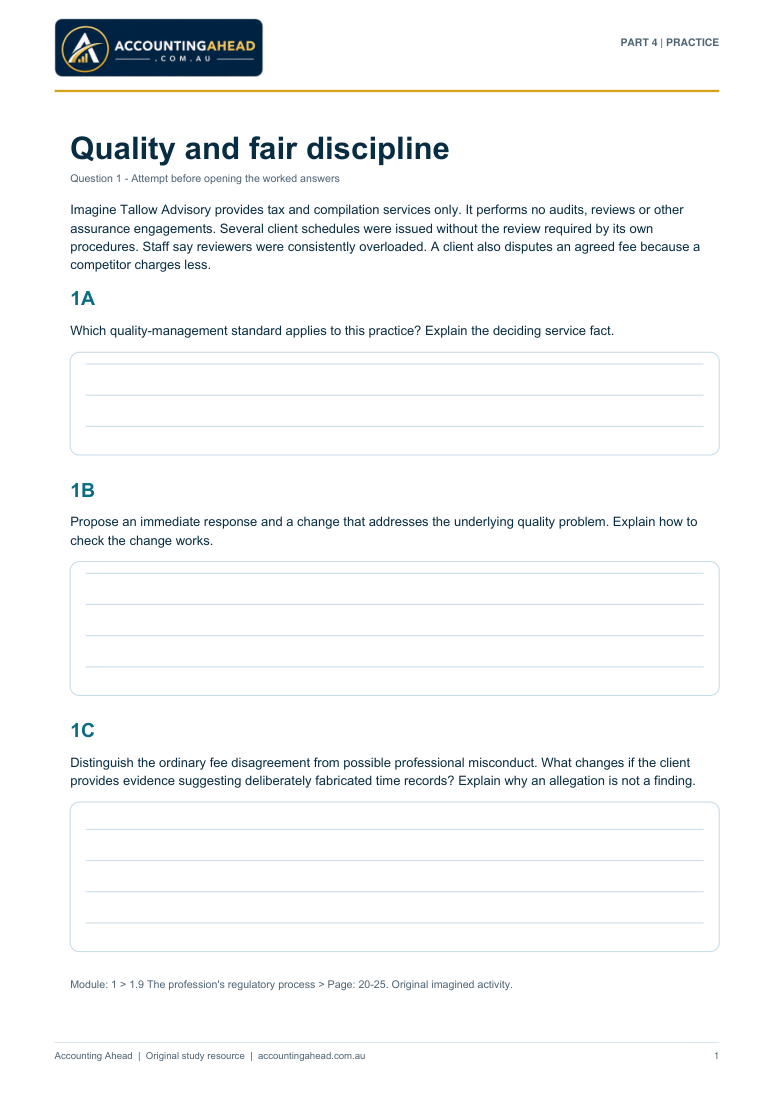
Try Question One in the quality practice sheet provided with this lesson. Imagine a firm called Tallow Advisory that provides tax and compilation services, with no audit, review or other assurance work. Several client schedules have gone out without the review required by its own procedures. Staff say reviewers were consistently overloaded. One client also disputes an agreed fee because a competitor charges less. Write which quality framework applies, a useful corrective response, and how the two concerns should be distinguished. Pause playback if you want time to attempt it, then resume for the explanation.
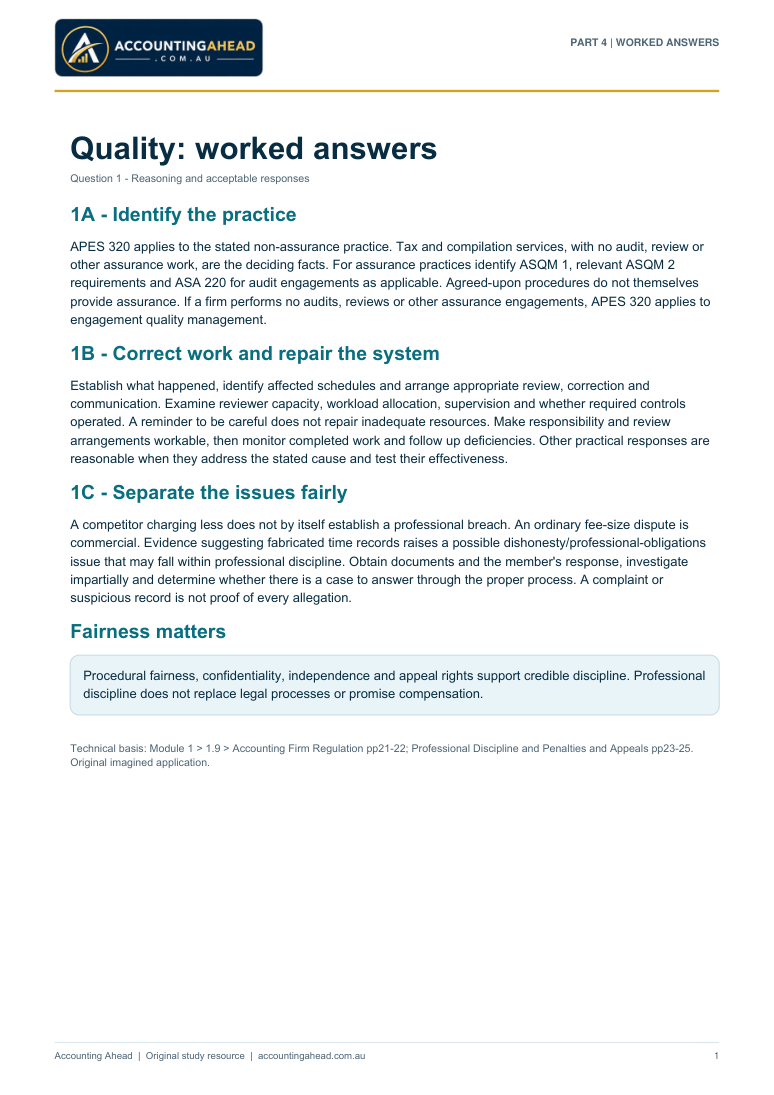
The non-assurance quality standard applies to the stated practice. The firm should establish what happened, assess affected work and arrange appropriate review and correction. It should examine workloads, reviewer availability and whether its controls were followed. Simply reminding staff to be careful leaves the resource problem untouched. Monitoring should then test whether the revised arrangements work. Those facts justify investigation and improvement; they don't establish every person's culpability.
The competitor's lower price doesn't by itself establish misconduct. The fee disagreement can be discussed commercially. Now change one fact: the client produces evidence suggesting time records were deliberately fabricated. That raises a possible professional breach deserving fair assessment, even though the concern involves fees. The allegation still needs evidence and a member response. The separate worked answers explain that distinction.
Quality management prevents and corrects weaknesses; fair discipline establishes responsibility through a proper process. Ask yourself whether a proposed response fixes the underlying cause, respects the evidence and protects those relying on the work. For a fuller understanding, read and study the relevant sections of your CPA study guide alongside this lesson.
Sources for the examples
Historical examples illustrate the concepts in this lesson. They do not change the syllabus context.