
Co-regulation: who does what?
About this video lesson
Distinguish standard setting, oversight, legal enforcement and professional membership.
Study files for this lecture
Read the lecture transcript
Who makes an accountant follow professional standards? There isn't one organisation doing every job. Co-regulation combines professional responsibilities with external rules and oversight. Let's separate those jobs so that a familiar collection of initials becomes a useful system.
Self-regulation means a profession takes responsibility for its members. It sets entry requirements, supports continuing education and uses disciplinary processes to uphold conduct. That draws on professional expertise: experienced peers can recognise poor practice that someone outside the field might miss. But expertise doesn't remove the risk of protecting colleagues or commercial interests. Public confidence also needs credible external scrutiny.
Co-regulation adds that external layer. Governments establish legal obligations and public authorities oversee or enforce them, while professional bodies continue regulating their members. The responsibilities operate alongside each other. An accountant can face professional discipline and, where the conduct also breaks the law, a separate legal process. External regulation doesn't make the professional code redundant.
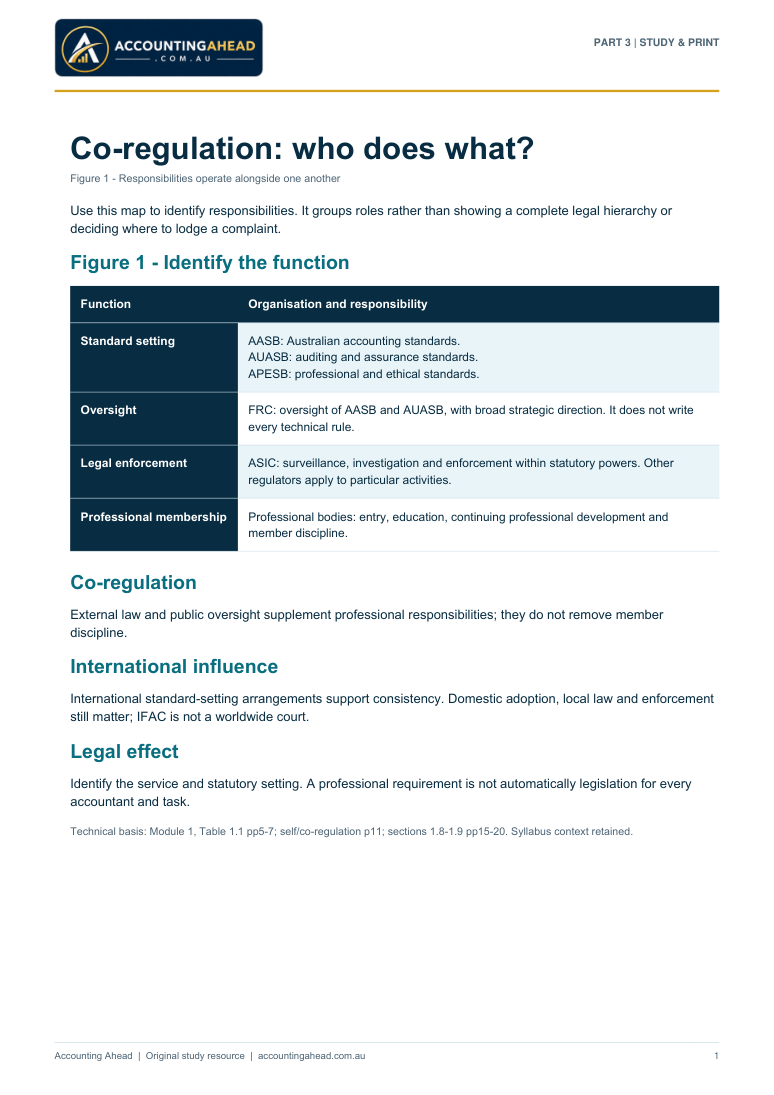
Keep three functions separate: setting a standard, overseeing the system, and enforcing a requirement. Writing a rule is different from deciding whether a particular person breached it. If you have the co-regulation map provided with this lesson, start with those three functions. The map organises responsibilities; its layout doesn't mean every organisation controls every other organisation.
The Australian Accounting Standards Board develops and maintains Australian accounting standards. These concern how financial information is recognised, measured, presented and disclosed. The Auditing and Assurance Standards Board develops standards and guidance for auditing and assurance work. Preparing financial information and examining it are connected activities, but they need different professional requirements. That's why these two standard-setting jobs should stay distinct in your thinking.
The Accounting Professional and Ethical Standards Board sets professional and ethical standards for members of the Australian accounting bodies involved. Its code addresses the conduct expected of professional accountants. Members of CPA Australia, Chartered Accountants Australia and New Zealand, and the Institute of Public Accountants must comply with the board's applicable standards. The ethical standards board isn't the accountant's employer, and it doesn't investigate every individual complaint itself.
The Financial Reporting Council oversees the Australian financial reporting framework, including the work of the domestic accounting and auditing standard setters. Think oversight and broad strategic direction, rather than writing each technical paragraph. The Australian Securities and Investments Commission, usually called ASIC, has corporate, markets and financial-services regulatory responsibilities. Its work includes surveillance, investigation and enforcement within its legal powers. The oversight council and the enforcement regulator therefore perform different jobs.
Professional bodies still manage matters such as membership, education, professional development and member discipline. Other regulators become relevant to particular activities. Tax work, for instance, can bring the Tax Practitioners Board into the picture. The right question is which activity and obligation are involved, rather than which organisation has the most impressive name. The initials won't organise themselves, unfortunately.
Here's a concrete example of standard setting in action. In September two thousand and twenty-three, the ethical standards board issued proposed technology-related changes to its code. Its later explanation records four submissions from professional bodies and a large accounting firm. Stakeholders raised concerns about how a confidentiality provision would operate, and the board explained how it addressed those concerns. That is consultation and reasoned standard development, rather than a disciplinary decision about one accountant.
Notice why that process matters. Accountants contribute practical knowledge, while an independent board considers the wider public interest and explains its decisions. Consultation doesn't mean respondents can veto a rule they find inconvenient. Nor does issuing a draft mean every proposal is already mandatory. A proposal, a final standard and the date that standard takes effect are different things.
International organisations add another layer. The international accounting federation represents professional accountancy organisations and promotes the profession's development. International accounting, auditing and ethics standards come through their respective standard-setting arrangements. Australia draws on international work through its domestic institutions. This supports consistency across borders, while local adoption, legislation and enforcement still matter. An international body isn't a worldwide court that automatically overrides Australian law.
Legal force also needs care. Accounting and auditing standards have legal effect in the statutory settings to which they apply. Ethical requirements referenced through legally enforceable auditing obligations can also acquire legal significance. That doesn't turn every professional rule into legislation for every accountant in every task. Work out the service, the applicable professional requirements and the relevant law before drawing that conclusion.
Suppose someone says, "No regulator has prosecuted me, so my professional conduct must be acceptable." What is missing from that reasoning? Professional obligations can go beyond conduct that attracts a prosecution. A membership body may examine an alleged code breach even where there is no separate criminal case. Equally, a complaint or investigation isn't proof that a breach occurred. Each process needs its own evidence and proper decision making.
Return to the map and trace the distinction: standard setters establish requirements, oversight supports the system, regulators enforce relevant law, and professional bodies uphold membership obligations. Together, those roles support trust without concentrating every function in one organisation. When a question feels confusing, identify the job being performed before choosing the organisation. For a fuller understanding, read and study the relevant sections of your CPA study guide alongside this lesson.
Sources for the examples
Historical examples illustrate the concepts in this lesson. They do not change the syllabus context.