
What makes a profession?
About this video lesson
Explore eight professional attributes and apply judgement to an uncertain cash forecast.
Study files for this lecture
Read the lecture transcript
A capable accountant can calculate an answer. A professional accountant must also decide whether the right question is being answered. We'll connect the eight attributes of a profession, then use one business decision to explore what professional judgement adds to technical skill.
Professional work rests on specialised knowledge, education, ethical responsibility and judgement. Calling somebody professional can simply mean they work skilfully and conscientiously. Membership of a profession carries wider obligations. There isn't a perfectly sharp boundary between occupations and professions; the strength and combination of their attributes matter.
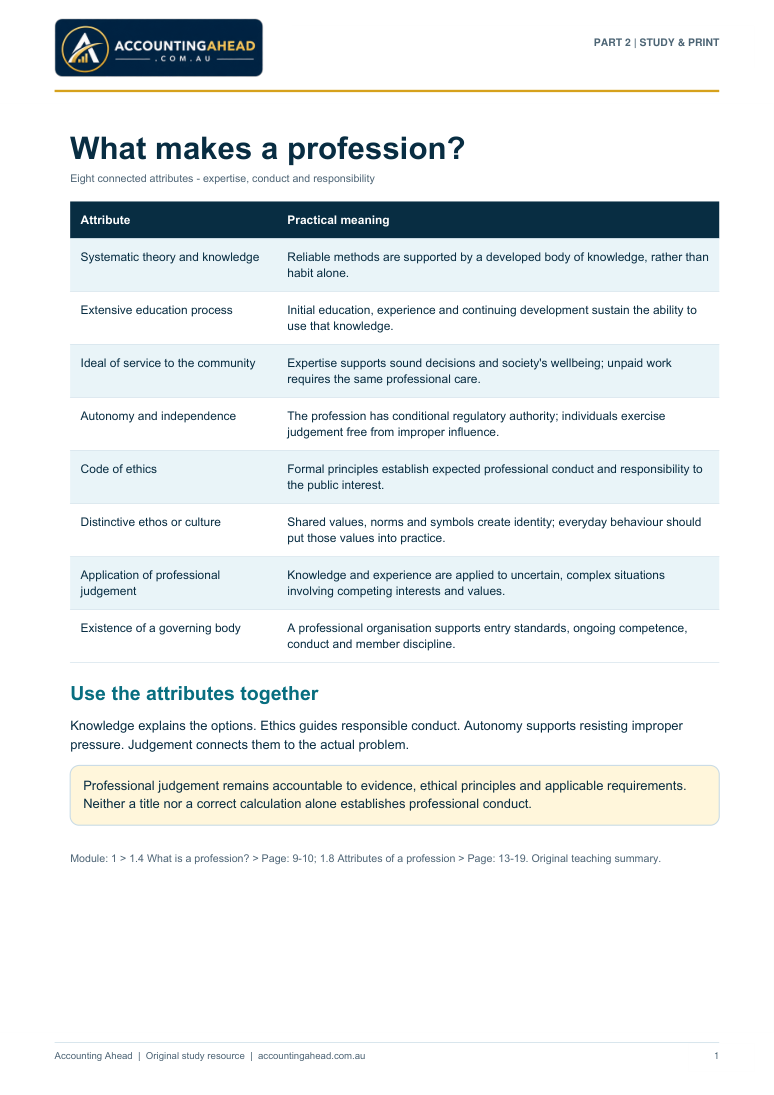
The profession comparison sheet provided with this lesson places each attribute beside its practical meaning. You can use it as a reference while listening. Begin with the first two rows: a systematic body of theory and knowledge, and an extensive education process. The knowledge explains why methods work. Education develops the ability to use them, with experience and continuing development helping keep that ability current.
Knowing a procedure from memory is different from understanding when it is appropriate. Equally, an initial qualification isn't a lifetime supply of competence. Work changes, knowledge develops, and an accountant's responsibilities may expand. Both the knowledge base and the learning process are needed to sustain reliable professional work.
The third attribute is an ideal of service to the community. Accountants use their expertise to support sound decisions and contribute to society's wellbeing. Service also includes maintaining high standards in ordinary paid work. Unpaid community work can be valuable, but it doesn't receive a lower standard of professional care simply because no invoice follows.
The fourth attribute is autonomy and independence. At the collective level, this concerns the profession's authority to regulate aspects of its work and membership. At the individual level, it concerns being able to exercise professional judgement without improper influence. Neither means freedom from accountability. Autonomy is exercised within ethical and professional requirements, rather than outside them.
The fifth attribute, a code of ethics, makes expected conduct explicit. The sixth, a distinctive ethos or culture, concerns the profession's shared values, norms and symbols. A code expresses expectations; culture influences how those expectations are lived. Titles and certificates can signal membership, but professional culture must be reflected in behaviour as well as displayed on a wall.
The seventh attribute is professional judgement. This involves applying knowledge and experience where circumstances are uncertain, interests compete, and a mechanical rule doesn't settle everything. The eighth is a governing body. It supports entry standards, ongoing competence, professional conduct and discipline. These eight attributes reinforce one another: expertise without ethics is dangerous, while good intentions without competence are insufficient.
Imagine a company called Cedar Stagecraft. It builds temporary exhibition displays. Its manager wants a long equipment lease and asks the accountant to make a cash forecast showing that repayments will be affordable. The forecast relies heavily on a repeat exhibition contract. The customer has expressed interest, but has made no commitment. The manager wants the optimistic version presented as the expected outcome.
The accountant could check every addition and produce a mathematically correct forecast. But correct arithmetic would leave the central uncertainty unresolved. The real question is whether the proposed commitment is supportable when an important source of future cash remains uncertain. Defining that problem properly changes the work that needs to be done.
Professional judgement starts by distinguishing evidence from hope. What does the customer's expression of interest actually establish? What cash would be available without the repeat contract? Who will use the forecast, and what would they need to understand about its assumptions? The accountant should seek relevant evidence, explain uncertainty and consider alternative outcomes. That doesn't require pretending to predict the future perfectly.
There is also a conflict of values. The manager wants the lease approved. The accountant wants to support the business, but cannot make the information misleading to achieve that result. Professional autonomy allows the accountant to challenge the proposed presentation. Accountability requires a reasoned explanation of the assumptions and conclusion. Technical knowledge helps construct the forecast; ethical responsibility shapes how it is used.
Now change one fact. The customer signs a firm repeat contract on terms the business can fulfil. Does that remove every uncertainty from the forecast? No. It strengthens the evidence about that revenue source, but collection timing, other costs and the lease obligations still need consideration. Good judgement responds to better evidence without turning it into certainty about everything else.
A professional conclusion can later prove mistaken without automatically being negligent. Outcomes depend on uncertain events. The quality of the reasoning, care taken and evidence available matter; so do the circumstances and applicable responsibilities. Calling something a judgement doesn't excuse an unsupported conclusion, and an unfavourable outcome alone doesn't settle whether proper care was exercised.
Return to the profession comparison sheet and connect knowledge, ethics, autonomy and judgement. Knowledge helps explain the options; ethics guides responsible conduct; autonomy supports resisting improper pressure; judgement brings them to the actual problem. In your own words, why wasn't checking Cedar's arithmetic enough? Pause playback if useful. The forecast needed justified assumptions and an honest explanation of uncertainty. For a fuller understanding, read and study the relevant sections of your C P A study guide alongside this lesson.