Understand the physical issue before the accounting response
Greenhouse gases influence the Earth's energy balance by absorbing and re-emitting outgoing infrared radiation. Human activities have increased their atmospheric concentrations. The IPCC's 2023 synthesis attributes observed global warming unequivocally to human activities, principally through greenhouse-gas emissions.
Climate change affects organisations through physical conditions, policy, technology, markets and social expectations. The fact that an individual organisation is a small part of global emissions does not remove its exposure to these effects or its responsibility for the accuracy of its own claims.
For an accountant, the task is to connect this context with assets, operations, finance and decisions. Scientific uncertainty about the precise timing of a local event does not mean there is no risk to assess.
Physical risk includes acute events and longer-term changes in conditions. Flooding can damage a warehouse; persistent heat can reduce productivity or increase cooling costs. Effects can arise through suppliers, customers and infrastructure as well as the entity's own premises.
Transition risk arises through the move towards a lower-emissions economy. Policy changes, technology, customer preferences and legal or reputational pressures can affect demand, operating costs and asset values. Transition can also create opportunities for different products, services and processes.
Distinguish international agreements from domestic implementation
The UN climate framework supports international cooperation. The Kyoto Protocol used quantified commitments for participating developed-country parties, with distinct commitment periods and mechanisms. It should not be described as imposing an identical emissions cap on every country.
The Paris Agreement was adopted in 2015 and entered into force in 2016. It combines temperature goals with nationally determined contributions and recurring processes for communication, review and increasing ambition. Its treaty obligations should not be confused with a single globally allocated set of company-level emissions limits.
Domestic laws and policies determine many of the practical requirements faced by organisations. A country's international commitment does not, by itself, identify the reporting threshold or carbon price applying to a particular business.
Understand how a trading system creates incentives
An emissions trading system sets rules for covered emissions and the units needed to meet compliance obligations. Within a cap-and-trade design, entities can compare the cost of reducing emissions with the cost of obtaining allowances. The cap, coverage, allocation, monitoring, enforcement and treatment of offsets all influence the outcome.
An allowance represents a permission under a particular scheme. A credit generally represents an emissions reduction or removal assessed against a defined baseline and method. They are not automatically interchangeable. Eligibility depends on the scheme's rules.
The guide compares several national and regional approaches. Their design differs and changes over time. Use the 2023 context to understand mechanisms rather than memorising an old target as if it were today's rule.
An emissions inventory needs an organisational boundary, an operational boundary and a reporting period. The approach to ownership and control affects which operations enter the inventory. Outsourcing an activity can change its classification without removing the underlying emissions from the value chain.
Document sources, activity data, emissions factors, assumptions and exclusions. Where estimates are used, explain their basis and limitations. A precise-looking total calculated from weak information can be misleading.
Carbon dioxide equivalent expresses different greenhouse gases on a common basis using the specified global-warming potentials. Keep the time horizon and source of factors consistent. A tonne of CO2e is not necessarily a tonne of carbon dioxide physically emitted: it can include the equivalent warming effect of other gases.
Scope 1 covers direct emissions from sources owned or controlled by the reporting organisation. Scope 2 covers indirect emissions associated with purchased electricity, steam, heat or cooling consumed by it. Scope 3 covers other indirect emissions in its value chain, across upstream and downstream categories.
Fictional retailer's activity
Likely classification under the stated facts
Question to verify
Diesel burned in its controlled delivery fleet
Scope 1
Is the fleet inside the organisational boundary?
Purchased electricity used in its stores
Scope 2
Is consumption complete and the method appropriate?
Production of goods purchased for resale
Scope 3
Which value-chain category and supplier data apply?
Customer use of an electricity-consuming product it sells
Scope 3
What use assumptions and product-life estimates are justified?
The same physical emissions can be one company's Scope 1 and another company's Scope 3. That is a feature of value-chain reporting, not permission to add every company's three scopes together as a global emissions total.
State the units beside every quantity. One kilotonne equals 1,000 tonnes; one megatonne equals one million tonnes. Confusing kilograms, tonnes and megatonnes can overwhelm an otherwise careful analysis.
Distinguish gross emissions from removals or offsets. Explain any offset claim separately and apply the chosen framework's rules rather than silently deducting purchased credits from an inventory. Report changes in activity and intensity so readers can distinguish operational improvement from a change in output or boundaries.
The GHG Protocol family includes tools for different purposes. Corporate inventories address an organisation and its value chain; product accounting follows a product's life cycle; project accounting evaluates specified emissions reductions against a baseline. A result prepared for one purpose cannot automatically answer the other questions.
A supplier's company-wide emissions intensity may be useful as an estimate but is not necessarily a product-specific footprint. Likewise, a project reduction claim does not directly establish that the whole organisation's absolute emissions fell.
Record methodological choices and use compatible data when making comparisons. If the comparison changes its boundary or baseline, disclose that change and assess whether the conclusion still holds.
Concept sources:GHG Protocol, Product Standard explains the distinction between product and corporate value-chain accounting.
Climate information can affect impairment assessments, asset useful lives, provisions, operating forecasts, financing and the resilience of strategy. Apply the relevant accounting requirements to the facts rather than creating a separate climate adjustment without a basis.
Scenario analysis explores how an organisation might perform under different plausible conditions. It is not a forecast guaranteeing one outcome. Explain assumptions, time horizons, dependencies and limitations so decision-makers can see what would change the conclusion.
The 2023 version of IFRS S2 connects climate-related governance, strategy, risk management, and metrics and targets. It includes Scope 1, Scope 2 and Scope 3 greenhouse-gas disclosure requirements and climate-resilience analysis, with specified measurement provisions and reliefs.
The original standard includes first-year transition relief for Scope 3 disclosures and, in specified circumstances, continued use of a previous emissions-measurement method. These reliefs relate to an entity's initial application; they are not a permanent removal of value-chain emissions from climate reporting.
Distinguish the standard from the national legal route that makes reporting compulsory. The guide's June 2023 Australian proposals belong to that historical context. Later amendments and domestic commencement dates should be studied separately if a later course edition requires them.
Greenwashing can arise through unsupported claims, vague language, selective boundaries, omitted qualifications or a mismatch between a product's description and actual practices. A statement can mislead through its overall impression even if a narrow sentence is technically defensible.
Ask what is claimed, over what period, for which activities and against what baseline. Separate achieved results from future targets. A credible target needs defined coverage, a pathway, resources, responsibilities and evidence supporting the assumptions. Disclose material dependence on credits or technologies that are not yet secured.
ASIC's 2018 review of listed-company climate disclosure and its 2023 greenwashing interventions illustrate concerns about useful disclosure and misleading sustainability claims. The lesson is to substantiate and explain the claim, not to replace unsupported optimism with an equally unsupported claim of certainty.
Bring accountability back to decisions and evidence
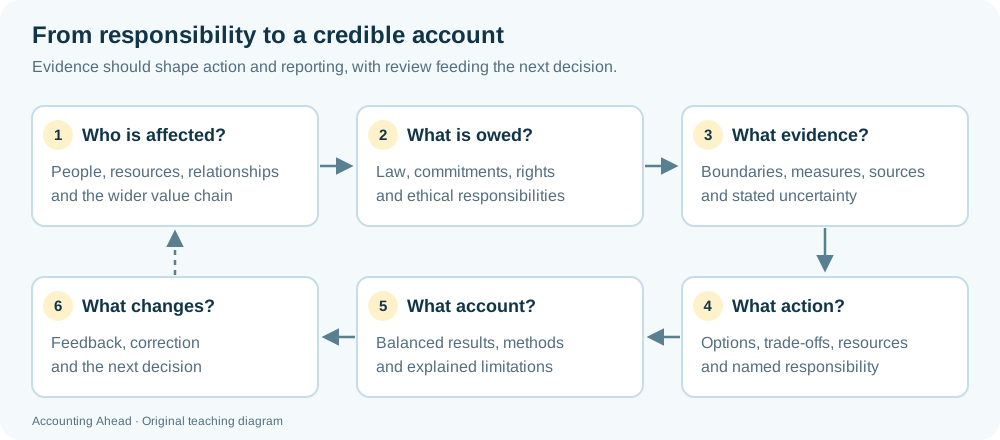
From responsibility to a credible account Scroll sideways on small screens, or open the diagram for a larger view.A decision path
Define the claim or decision
identify affected activities and stakeholders
select the appropriate requirements
establish boundaries and evidence
evaluate trade-offs and uncertainty
approve action and explain results.
CHECK: A fictional distributor calls its whole business carbon neutral because it purchased credits equal to the fuel emissions of its own vehicles. Purchased electricity, outsourced deliveries and other value-chain emissions were not assessed. What should the accountant challenge?
ANSWER: The scope of the claim is broader than the evidence. Check the organisational and operational boundaries, the applicable claim criteria, completeness of emissions data, quality and treatment of credits, and the wording presented to users. The company should not imply whole-business neutrality from a partial calculation. Reducing the claim to what is substantiated may be necessary while the missing work is completed.
This connects the module's themes: reporting boundaries, stakeholder responsibility, motives for disclosure, measurement, reporting requirements and climate governance. Accountability requires both sound decisions and a faithful explanation of them.