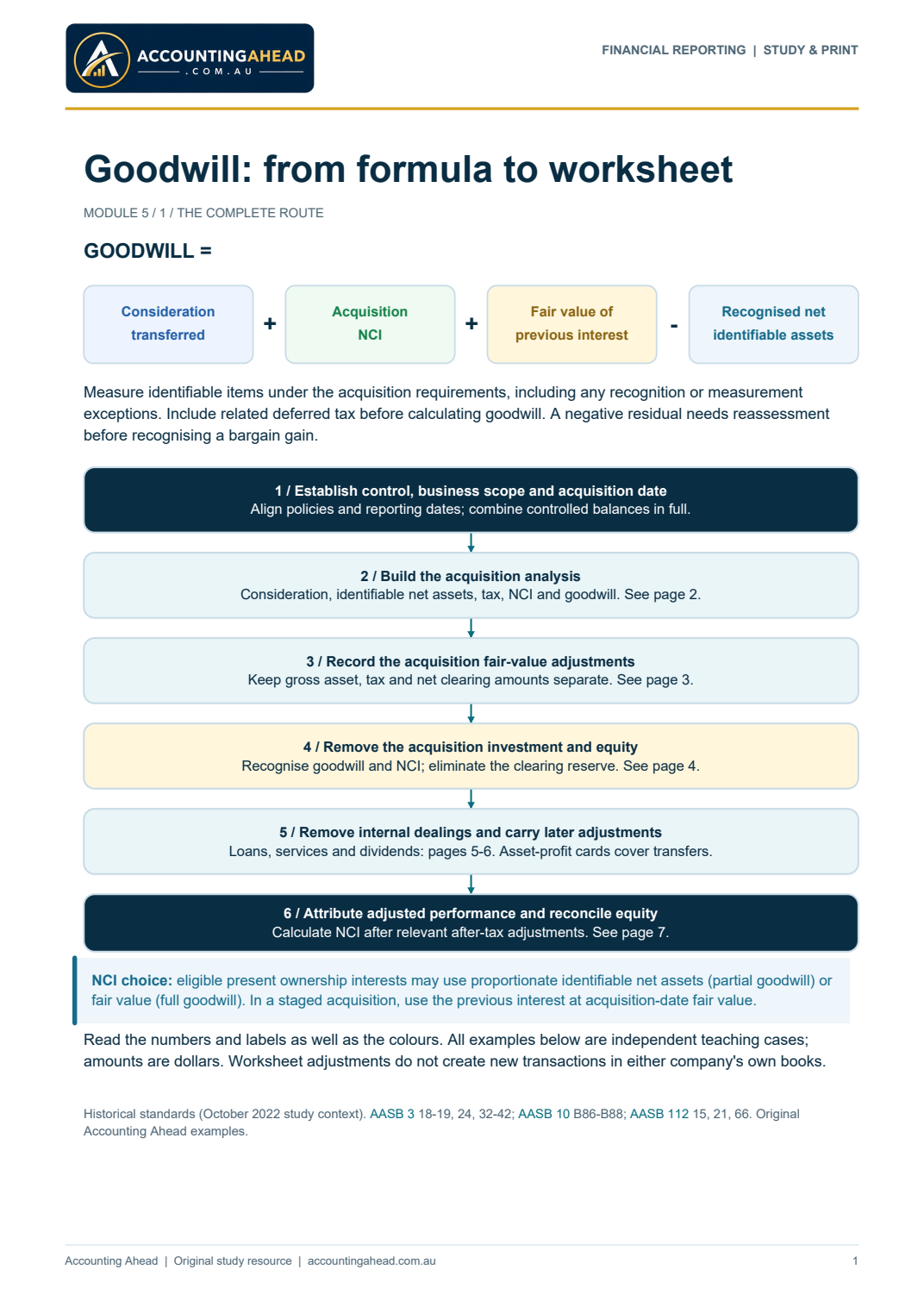
Identify the acquired business, measure what was exchanged, recognise the identifiable net assets and calculate the residual only after the tax effects are understood.
A business combination brings a business under an acquirer's control. The legal form may be a direct purchase of net assets, a share acquisition, or another arrangement that gives control. A share transaction is not automatically a business combination if the acquired set is only an asset or asset group.
Assess whether the acquired set includes inputs and a substantive process that together can contribute to creating outputs. Existing revenue is not essential in every case. The optional concentration test can simplify the assessment when substantially all the fair value of gross assets is concentrated in one identifiable asset or a group of similar identifiable assets. If that test is not met, it does not automatically prove a business: continue the substantive assessment.
Common-control combinations are outside the ordinary IFRS 3 acquisition-method scope. The formation of a joint arrangement is excluded when accounting in the financial statements of the joint arrangement itself; this is not a blanket exclusion for every purchase by a joint operator or venturer. In an asset acquisition, allocate the cost to the identifiable assets and liabilities under the applicable requirements; do not manufacture goodwill. These distinctions change both recognition and the treatment of transaction costs.
Keep the Goodwill and consolidation: step-by-step guide beside this topic. Its seven printable pages connect the core formula and flowchart to one acquisition analysis, fair-value journals, pre-acquisition elimination, loan and service balances, dividends and NCI. Download the full PDF or any individual page image.
Identify the acquirer, establish the date it obtains control, recognise and measure identifiable net assets and NCI, then calculate goodwill or a reassessed bargain gain. The legal signing date and the date cash is paid may differ from the acquisition date.
In a cash exchange, the entity transferring cash is usually the acquirer. In an equity exchange, the issuer is usually the acquirer, but examine relative voting rights, a large minority block, the governing body, senior management and terms of exchange. In a reverse acquisition the legal issuer can be the accounting acquiree. Apply the control assessment before relying on a transaction's legal label.
Measure consideration transferred at acquisition-date fair value. Cash, shares issued, deferred payments and contingent consideration can all be relevant. Discount a material deferred payment using an appropriate rate. Distinguish payments for the business from settlement of an old relationship, payment for future employee service or other separate transactions.
Acquisition-related professional costs are generally expensed. Debt and equity issue costs follow their own standards. Do not add every fee to consideration simply because it arose on the same day. Contingent consideration needs classification and subsequent accounting; a later change in a liability is not automatically an adjustment to goodwill.
Fair values include items missing from the subsidiary's books
The subsidiary's carrying amounts are a starting point. An identifiable customer relationship, brand, contractual right or technology may need separate recognition even when the subsidiary did not recognise it internally. Identifiability can arise from separability or contractual/legal rights. An assembled workforce is different; do not use goodwill as a hiding place for every unrecorded intangible.
Apply the relevant recognition and measurement exceptions. An acquired present obligation can qualify as a contingent liability at acquisition when fair value is reliably measurable even if an ordinary provision would not be recognised because an outflow is not probable. A merely possible obligation does not become a present obligation just because it is acquired. Contingent assets are not recognised by analogy.
Acquisition item
Specific requirement to check
Income taxes and employee benefits
Apply IAS 12 and IAS 19 recognition/measurement rather than a blanket fair-value rule
Indemnification assets
Use a basis consistent with the indemnified item, allowing for collectibility and contractual limits
Acquiree as lessee
Apply the acquisition lease rules, including relevant short-term/low-value exceptions and right-of-use adjustments
Reacquired rights
Measure using the remaining contractual term, excluding assumed renewals
Share-based payment arrangements
Apply the relevant IFRS 2 measurement requirements and distinguish acquisition consideration from post-combination service
Assets held for sale
Apply IFRS 5 fair value less costs to sell
These are prompts to apply the specific exception, not permission to omit an inconvenient acquired balance. The paragraph references below identify the detailed requirements.
The acquisition and goodwill workbook shows consideration, identifiable net assets and two NCI measurement approaches in separate calculation boxes. This keeps the residual traceable.
Compare the acquisition-date accounting amounts with their tax bases. If an asset is uplifted but its tax base stays unchanged, a taxable temporary difference can create a DTL. A recognised obligation deductible on settlement may create a DTA, subject to the recognition requirements. Neither result follows solely from the label 'intangible' or 'contingent liability'.
The initial-recognition exception prevents a DTL arising from the initial recognition of goodwill itself. It does not remove deferred tax on the separately identified assets or mean every later goodwill tax consequence is ignored. Keep goodwill and identifiable intangible assets distinct.
An acquiree's previously unrecognised tax-loss benefit that meets recognition at acquisition enters identifiable net assets and affects goodwill or a bargain gain. If the combination instead makes the acquirer's own previously unrecognised DTA recoverable, that benefit normally affects income tax, not acquisition goodwill. Neither follows merely from joining a profitable group: establish lawful access to the deductions and probable relevant taxable profits. Later recognition needs the measurement-period and subsequent-tax rules applied to the actual facts.
Core goodwill formula and the six-step consolidation route. Open the image to enlarge it, or use the linked step-by-step guide for all workings.
For present ownership interests entitled to a proportionate share of net assets on liquidation, NCI can be measured at fair value or at its proportionate share of identifiable net assets, on a combination-by-combination basis. The method affects both goodwill and NCI. Fair-value NCI is not necessarily the price paid per parent share multiplied by the NCI shares; a control premium can make that shortcut wrong.
Harbour and Lumen
Proportionate-share NCI
Fair-value NCI
Consideration for 80%
450,000
450,000
Acquisition NCI
456,000 × 20% = 91,200
Independently measured 110,000
Less identifiable net assets
(456,000)
(456,000)
Goodwill
85,200
104,000
With proportionate NCI, goodwill is also $450,000 - 80% × $456,000 = $85,200. The general goodwill formula includes the fair value of a previously held interest when control is obtained in stages. Do not omit that interest simply because only the last purchase involved new cash.
Negative residuals, provisional amounts and later events
A negative residual requires reassessment of the identified assets, liabilities, NCI, consideration and any previously held interest before recognising a bargain purchase gain in profit or loss. It is not 'negative goodwill' carried as a liability. An unexpectedly attractive result is a reason to check the acquisition schedule.
If acquisition accounting is incomplete, provisional amounts may be adjusted during the measurement period for new information about facts existing at acquisition. Events arising after acquisition follow their own accounting; a later trading loss is not an excuse to rewrite acquisition goodwill.
The measurement period ends when the required information is obtained, or when the acquirer learns it is unavailable, and cannot extend beyond one year. One year is a maximum, not an automatic period to keep changing completed figures.
Goodwill is allocated for impairment testing to the appropriate cash-generating unit or group of units. Test annually and when impairment indicators arise. It is not amortised. A goodwill impairment loss is not reversed. When only parent goodwill is recognised, the impairment test requires attention to the unrecognised NCI share; do not mechanically allocate a full-goodwill calculation to a partial-goodwill case.