Identify the accounting contract, separate its promises and decide what an approved change means for revenue already recorded and revenue still to come.
An invoice, a payment and earned revenue can occur on three different dates. Revenue accounting asks what the customer obtains and when control transfers. A deposit can create an obligation to provide a service; an unpaid delivery can create a receivable. Neither the bank balance nor the invoice total answers the recognition question by itself.
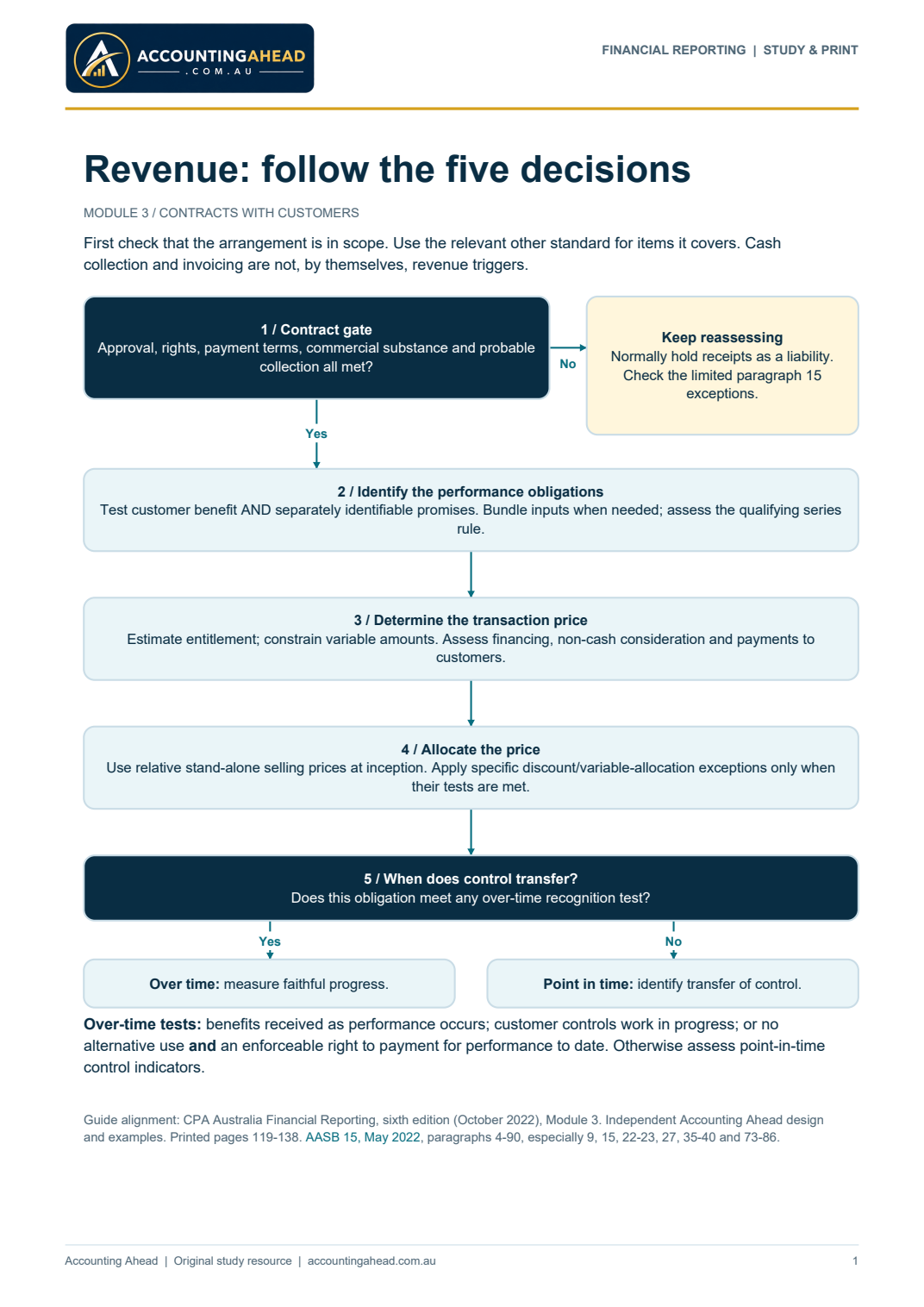
Use the Module 3 study index to locate the relevant lesson and printable. The revenue decision map gives a compact route through the five steps. Keep the contract facts beside the map: a decision without supporting facts is only a label.
Revenue: five decisions, one connected model. Open the image to enlarge it, or use the linked resource for its printable PDF.A decision path
Check the customer and scope
Establish the contract
Identify separate promises
Measure and allocate consideration
Recognise as control transfers
Explain balances and judgements
IFRS 15 deals with exchanges for outputs of an entity's ordinary activities. Some transactions belong under other standards, including leases, financial instruments and insurance arrangements. A collaboration in which both parties share development risks is not automatically a customer contract. Identify which party obtains an output, rather than assuming every incoming payment is sales revenue.
A mixed arrangement can contain components governed by different standards. Apply another standard's separation or initial-measurement requirements first where it specifies them, then apply IFRS 15 to the remaining component. Otherwise use IFRS 15's separation and measurement requirements. Non-monetary exchanges between entities in the same business that merely facilitate sales to customers are excluded from IFRS 15.
Some asset-disposal standards refer to IFRS 15's control and consideration principles. That does not turn every disposal gain into revenue from ordinary activities. Identify the applicable asset standard and present the resulting gain or loss appropriately.
A contract may be written, spoken or supported by customary practices, but its rights and obligations must be enforceable. Check approval and commitment, identifiable rights, identifiable payment terms, commercial substance and probable collection of the consideration to which the supplier expects to be entitled. For collection, consider the customer's ability and intention to pay when due, including any genuine price concession.
Check
Evidence to look for
Common mistake
Approval and commitment
Agreed enforceable terms and conduct consistent with them
Treating an unsigned draft as automatically binding
Rights and payment terms
What must be supplied and how payment is determined
Assuming every disputed amount is enforceable
Commercial substance
A change in the risk, timing or amount of future cash flows
Recording artificial circular transactions as sales
Collection
Customer capacity, intention and expected entitlement
Confusing a price concession with a later credit loss
If the criteria fail, receiving cash does not automatically allow revenue. Normally keep the receipt as a liability while reassessing the criteria. Under IFRS 15 paragraph 15, non-refundable receipts can become revenue if there are no remaining obligations and all or substantially all promised consideration has been received, or if the contract has been terminated and the consideration received is non-refundable. Apply the complete conditions rather than using a general 'cash received' rule.
Once the criteria are met, reassess them if significant changes in facts indicate a need. A deterioration in a customer's finances may affect the assessment and also require credit-loss accounting. Do not reverse all properly earned revenue merely because a receivable later becomes doubtful.
Contracts entered into at or near the same time with the same customer, or related parties of that customer, are combined when the standard's conditions identify one economic arrangement. These include a single commercial objective, interdependent prices or performance, or promises that form one performance obligation.
Keep this mandatory combination assessment separate from the portfolio practical expedient. The expedient allows similar contracts or obligations to be assessed together when the result is not expected to differ materially from individual accounting. It does not permit an entity to ignore a required combination because combining changes the answer.
A promised good or service is distinct only if the customer can benefit from it, alone or with readily available resources, and the promise is separately identifiable in the arrangement. The second test asks whether the supplier is providing individual outputs or integrating inputs into a combined output. Significant integration, substantial customisation and strong interdependence can mean that several inputs form one obligation.
Arrangement
Reasoning
Standard equipment works with the customer's existing system; optional training is independently useful
Equipment and training may be separate promises if the contract does not integrate them into one output
Design, fabrication and testing jointly produce one bespoke safety enclosure
Assess the combined output; separately purchasable inputs do not by themselves establish separate obligations
Internal administration before providing service
No separate promise if it transfers no service to the customer
A marketed 'free' item promised with a paid service
Consider whether it is a separate promise; a zero invoice line does not prove zero allocated revenue
If a promise is not distinct, combine it with other promises until a distinct bundle is identified. Two distinct items delivered on the same day do not become one obligation solely because their timing matches.
A series of substantially similar distinct services is treated as one performance obligation when each qualifies for over-time recognition and the same progress measure would apply. Daily monitoring of a customer's equipment can meet the rule if the customer receives the benefit as monitoring occurs. A series is not simply any collection of similar products.
Document implied promises as well as written promises. A published service policy or customary conduct can create a valid expectation when the customer enters the arrangement. Conversely, a supplier's internal intention to provide a future courtesy does not automatically establish an enforceable customer promise.
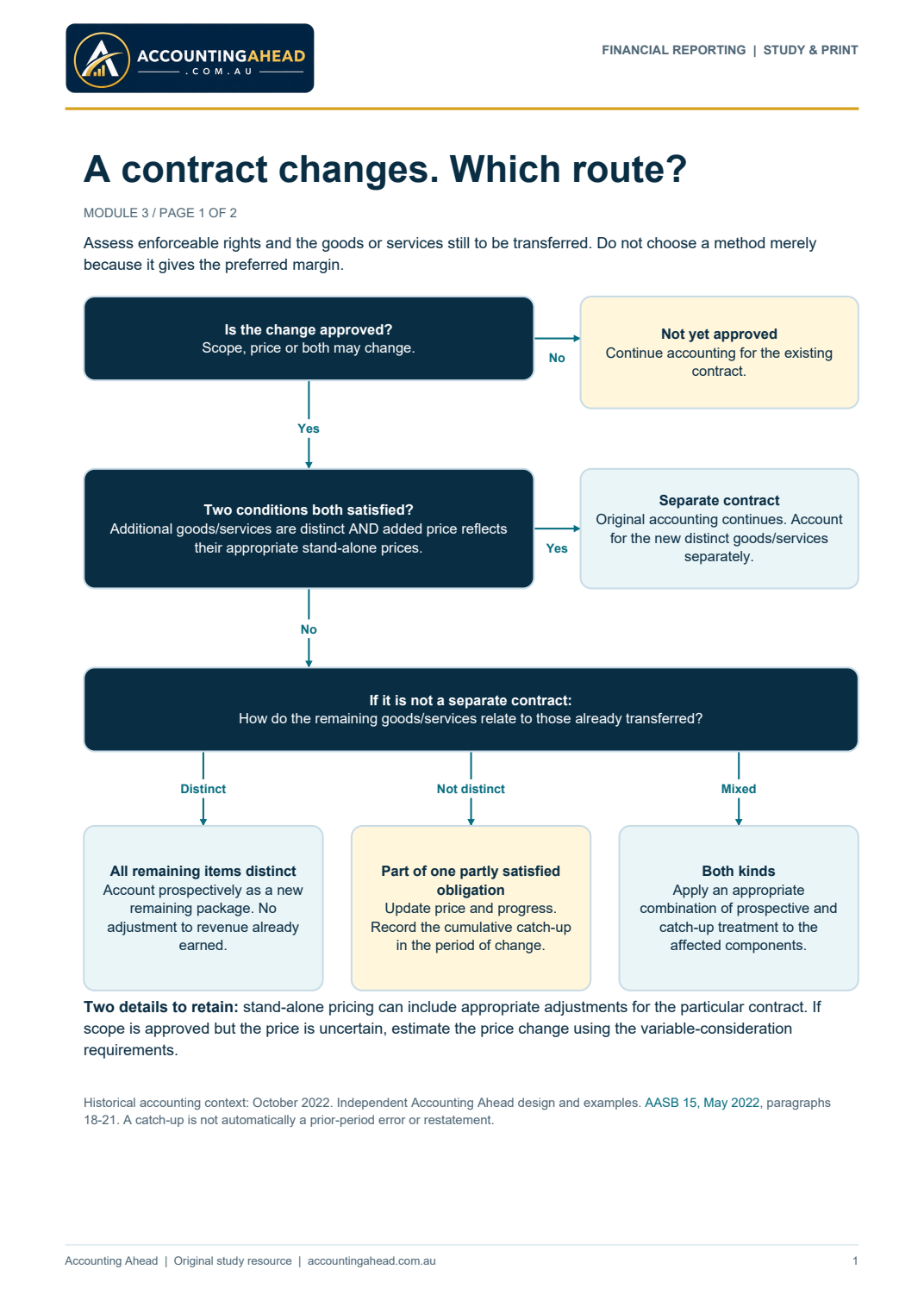
An approved modification changes enforceable scope, price or both. Continue accounting for the existing contract until a change is approved. If scope is approved but the price remains uncertain, estimate the change using the variable-consideration rules where applicable.
Question
Treatment
Are additional distinct goods/services priced at their appropriate stand-alone selling prices?
A separate contract, if both requirements are met
If not separate, are the remaining goods/services distinct from those already transferred?
Account prospectively for the remaining package
Are the remaining goods/services part of an existing, partly satisfied obligation?
Update that obligation and record a cumulative catch-up
Does the change contain both kinds?
Apply the appropriate combination to its components
The first route requires both conditions. If either fails, move to the remaining-goods analysis. A catch-up is an adjustment in the period of modification; it is not automatically a prior-period error or a restatement of earlier financial statements.
Finch Training originally promises twelve distinct workshops for $28,800. Four have been completed, earning $9,600. An approved change adds four workshops for $6,600. Assume the added price does not represent the appropriate stand-alone selling price, and the remaining workshops are distinct and have equal stand-alone values. Remaining consideration is $19,200 + $6,600 = $25,800. Twelve workshops remain, so recognise $2,150 for each as delivered. The $9,600 already earned is unchanged.
If instead the four new workshops were appropriately priced at their stand-alone amount of $7,200, the two requirements for separate-contract treatment would be satisfied. The original eight remaining workshops retain $19,200 of revenue; the new four have $7,200. The treatment is driven by the conditions, not by whichever approach produces a preferred margin.
In a separate original example, Mosaic Archive Services has one integrated obligation satisfied over time. Its original price is $280,000, estimated cost $200,000, and qualifying cost incurred $60,000. A suitable cost-based measure gives 30% progress and $84,000 cumulative revenue. A non-distinct modification changes the price to $360,000 and total expected cost to $240,000. With unchanged qualifying cost incurred, revised progress is 25%; cumulative revenue becomes $90,000. The current catch-up is $6,000. Reassess whether the input measure still depicts performance before applying the arithmetic.
Concept sources: CPA Australia Financial Reporting study guide, sixth edition (October 2022), Module 3, printed pages 119-127. AASB 15, May 2022 compilation, paragraphs 4-30 and Appendix A. The portfolio expedient and required contract combination are different tests. All scenarios and amounts on this page are original.