Move from a calculated difference to a supportable deferred tax balance, and distinguish the closing balance from the expense or income for the period.
Taxable temporary differences generally produce DTLs, subject to specified exceptions. Deductible temporary differences produce DTAs only to the extent sufficient taxable profit is probable and the applicable recognition requirements are met. Keep identification, recognition, measurement and allocation as separate steps.
A decision path
Determine CA and tax base
Classify the difference
Apply recognition conditions and exceptions
Measure the closing balance
Reconcile movements and allocate tax
Present and disclose
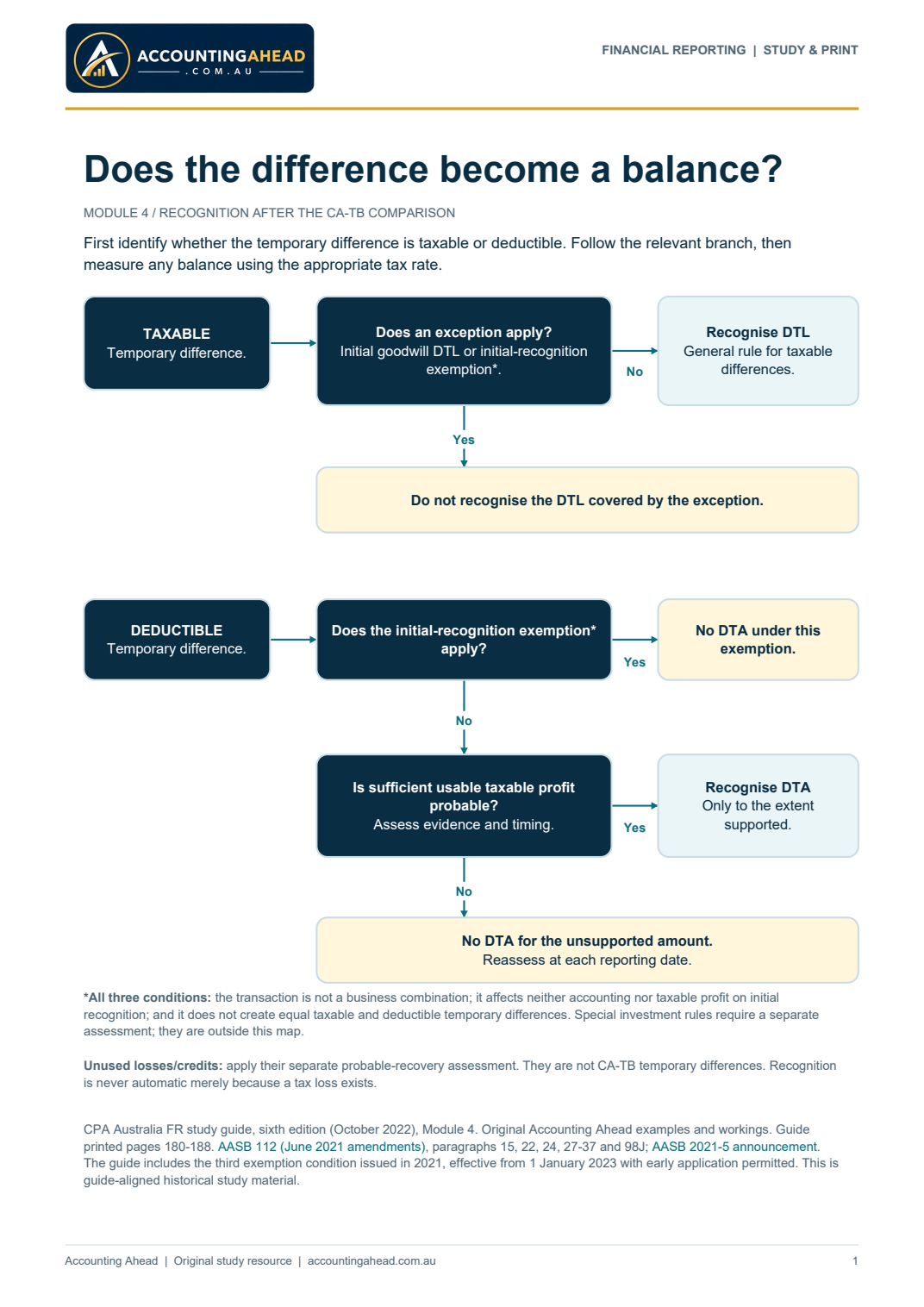
The deferred-tax recognition map provides the decision route. It is a study tool, not permission to ignore evidence about recoverability.
Recognition requires more than multiplying a difference by the tax rate.
Initial-recognition exceptions: all conditions matter
A DTL is not recognised for the initial recognition of goodwill. Other assets and liabilities have a narrower initial-recognition exception. Under the issued amendment incorporated in the supplied guide, the transaction must not be a business combination, must affect neither accounting profit nor taxable profit at that time, and must not create equal taxable and deductible temporary differences. These conditions are cumulative.
Assume an independently purchased asset costs $54,000, only $36,000 is deductible over its life, neither profit is affected on acquisition, no business combination occurs and no matching deductible difference arises. The initial $18,000 difference falls within the exception under these stated facts. Do not record a DTL and gross up the asset. The exempt initial component is not subsequently recognised merely as the asset depreciates.
By contrast, a transaction creating equal taxable and deductible differences does not qualify for that exception. The issued amendment is particularly relevant to certain leases and restoration obligations. The DTA still requires its own recoverability assessment. Later new differences or changed circumstances must be analysed; they should not all be labelled exempt because an asset once had an initial difference.
First consider suitable taxable temporary differences that reverse in the right period, for the same tax authority and taxable entity. Then assess future taxable profit supported by forecasts, contracts and credible assumptions, along with available tax-planning opportunities. Tax law can restrict the kind of income against which a deduction can be used.
Do not count the same taxable profit twice. Forecast profit must be considered before the deductions from the deductible differences being tested. Future deductible differences cannot generate the taxable profit that justifies their own asset. Recent losses are negative evidence requiring careful consideration, especially for loss carry-forwards.
An expected deduction of $22,000 does not justify a $6,600 DTA merely because management hopes to trade profitably. If only $15,000 can probably be used within the relevant constraints, recognise $4,500 at 30%. Keep the remaining $2,100 potential benefit outside recognised assets and reassess it later.
Measure deferred tax with the enacted or substantively enacted rate expected when the asset is recovered or liability settled. If a $24,000 taxable difference will reverse at an enacted 28% rate, closing DTL is $6,720. It is not $7,200 simply because current tax uses 30%.
Do not discount deferred tax. Even a difference expected to reverse several years later is measured under IAS 12's no-discounting requirement. For a progressive rate structure, use the appropriate expected average rate for the periods of reversal. The expected manner of recovery may affect both the tax base and the rate; the revaluation topic develops this point.
Reassess recognised DTAs at each reporting date and reduce them if sufficient utilisation is no longer probable. Reassess previously unrecognised amounts too. Restore recognition when the evidence supports it. A review is an accounting requirement, not an optional reaction to an adverse tax assessment.
Suppose a DTL is $4,500 at the start and must be $7,200 at the end. With no acquisitions, OCI, equity, rate changes or other movements, record only the $2,700 increase: Dr deferred tax expense; Cr DTL. Recording $7,200 again would overstate both expense and liability.
Suppose a DTA rises from $1,200 to $2,280 on the same assumptions. Record Dr DTA $1,080; Cr deferred tax income $1,080. If that DTA instead falls, the usual direction reverses. A combined journal can be used, but maintain separate supporting schedules.
Balance movement allocated to P/L
Debit
Credit
DTL increases
Deferred tax expense
DTL
DTL decreases
DTL
Deferred tax income
DTA increases
DTA
Deferred tax income
DTA decreases
Deferred tax expense
DTA
These patterns assume the underlying tax belongs to profit or loss. A DTL created by an OCI revaluation is allocated to OCI instead. The deferred-tax movement sheets include an original reversal schedule and a rate-change check.
Juniper Services recognises an $8,400 obligation in Year 1, fully deductible only when paid in Year 2. The DTA qualifies for recognition and the rate is 30%. Each year has $70,000 accounting profit before this obligation and no other differences.
In Year 1, accounting profit after the expense is $61,600; taxable profit is $70,000. Current tax is $21,000 and DTA recognition produces $2,520 tax income. Net tax expense is $18,480, equal to 30% of $61,600.
In Year 2, settlement creates no new accounting expense. Accounting profit is $70,000 and taxable profit is $61,600. Current tax is $18,480, while the DTA reverses through $2,520 deferred tax expense. Total tax expense is $21,000. Across both years the $2,520 shifts timing; it does not create a second deduction.
Concept sources: CPA Australia, Financial Reporting study guide, sixth edition (October 2022), Module 4, sections 4.3–4.5, printed pages 173–187, and reassessment at page 192. Original Juniper Services case and other figures.
Concept sources:AASB 112, June 2021 compilation, corresponding IAS 12 paragraphs 15, 21–24, 27–31, 37, 47–56 and 98J. The 2021 issued amendment is used consistently with the supplied guide.