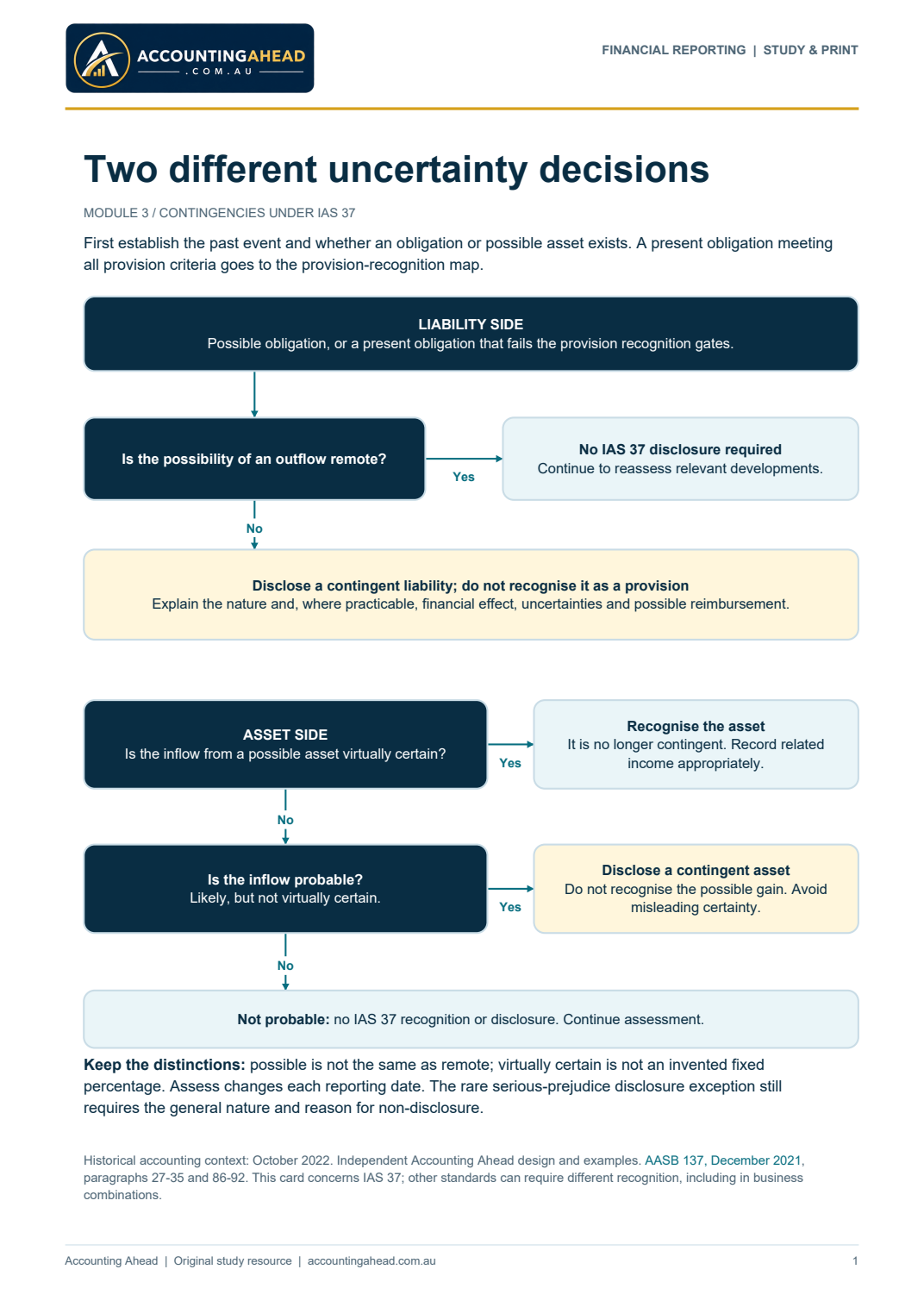
Distinguish a recognised amount from a note disclosure, use the different inflow and outflow thresholds, and explain conclusions supported by reporting-date evidence.
A contingent asset depends on uncertain future events not wholly controlled by the entity confirming the existence of a possible asset arising from past events. A disputed claim for compensation can be an example. A business forecast of future sales is not automatically a contingent asset: identify the past event and the possible right.
Do not recognise contingent assets. When the inflow is probable, disclose the nature and, where practicable, the financial effect. When realisation becomes virtually certain, the asset is no longer contingent and recognition is appropriate under the applicable requirements. If inflow is not probable, IAS 37 does not require contingent-asset disclosure. Avoid statements that all contingencies must always appear in the notes.
The contingency decision card puts the inflow and outflow routes beside each other. The asymmetry is deliberate: the recognition threshold for a possible gain is not simply the mirror of a provision.
Compare the liability and asset routes without treating them as mirror images.
A contingent liability can be a possible obligation whose existence awaits an uncertain event, or a present obligation not recognised because outflow is not probable or sufficiently reliable measurement is exceptionally unavailable. Disclose unless the chance of an outflow is remote. If subsequent evidence supports a present obligation, probable outflow and reliable measurement, recognise a provision in the period the recognition requirements are met.
Possible obligation or present obligation with non-probable but non-remote outflow
No provision
Contingent-liability disclosure
Outflow remote
No provision
Normally no IAS 37 contingent-liability disclosure
Present obligation and probable outflow, but reliable estimation exceptionally impossible
No provision
Disclose contingent liability and explain measurement limitation
Possible inflow probable but not virtually certain
No asset
Contingent-asset disclosure
Inflow virtually certain
Recognise the asset under applicable requirements
No longer a contingent asset
For joint and several obligations, consider the portion the entity expects others to settle and the portion for which its own outflow is probable. Do not mechanically record the entire legal maximum as the best estimate or assume another party's involvement eliminates all exposure.
Vela Lighting is in a dispute over delivery damage. Its reporting-date legal assessment indicates a possible obligation and a non-remote outflow, but a present obligation is not more likely than not. On those facts, disclose a contingent liability rather than recognising the full claim as a provision. The note should explain the nature and uncertainty without presenting the disputed allegation as an established fact.
In an independent case, Osprey Services has already accepted a contractual repair obligation. Settlement is probable and a reliable estimate is $32,000. Recognise a provision for $32,000; describing the obligation as 'under discussion' does not turn it into a contingent liability. If an unrelated customer later gives Osprey a binding settlement entitlement to compensation and receipt is virtually certain, assess recognition of that asset separately. Do not net unrelated claims against the repair provision.
These cases deliberately use different facts. Probability and evidence can change a conclusion, but a decision is not made by replacing a few words in a standard disclosure template.
For a contingent liability, explain its nature, an estimate of financial effect where practicable, uncertainty about amount or timing and possible reimbursement. For a contingent asset with probable inflow, explain its nature and an estimate where practicable, avoiding misleading suggestions that income is assured. Where required information cannot practicably be supplied, state that fact.
Separate different classes if combining them would hide material differences. If a provision and contingent liability arise from the same circumstances, make their relationship clear. Update the assessment rather than carrying the same note forward unchanged for years.
The seriously-prejudicial exception applies only in extremely rare circumstances and retains minimum explanatory disclosure. Commercial sensitivity alone is not a blanket exemption. Keep the evidence supporting any omission available for review.
Consider four separate matters at Coastline Makers. First, already-sold goods create assurance-warranty obligations expected to cost $15,600, reliably measured. Second, an internal budget includes $24,000 for next year's optional brand relaunch. Third, a past-event legal dispute creates a possible obligation with a non-remote outflow but insufficient evidence of a present obligation. Fourth, a separate compensation claim has a probable but not virtually certain inflow.
The first requires a provision and related disclosure, assuming IAS 37 applies. The second creates no liability merely from budgeting. The third calls for contingent-liability disclosure. The fourth calls for contingent-asset disclosure, with no recognised asset. Do not add the four amounts together, offset the possible gain against the warranty, or treat 'not recognised' as meaning 'never disclosed'. The third and fourth deliberately have no stated reliable amount; inventing one would not improve the answer.
Use the original practice case to practise the full sequence, then compare the answer with the evidence you identified. It includes blank working space and separate answers for printing.
Identify the event, date, parties and relevant standard.
Decide whether the issue is revenue, a cost asset, a liability or a possible right/obligation.
Apply the recognition conditions before calculating.
State assumptions and calculate using the appropriate measurement method.
Write balanced entries, separating cash, performance and financing.
Reconcile balances and explain the required disclosures.
For revenue, repeatedly ask what has transferred. For a provision, ask what has already made settlement unavoidable. For a contingency, ask what remains uncertain and which disclosure threshold applies. These questions prevent both premature income and invented reserves.
Concept sources: CPA Australia Financial Reporting study guide, sixth edition (October 2022), Module 3, printed pages 152-156. AASB 137, December 2021 compilation, paragraphs 10-35 and 86-92. The probability thresholds are applied with evidence, not invented fixed percentages. Business-combination exceptions belong to the relevant separate standard. All practice questions and scenarios are original.