The transaction price represents the consideration expected in exchange for the promised transfers. Exclude amounts collected for others, such as GST. Separate measurement from timing: deciding that an amount belongs in the transaction price does not mean it is already earned.
Compare expected value and most likely amount, then apply the revenue constraint.
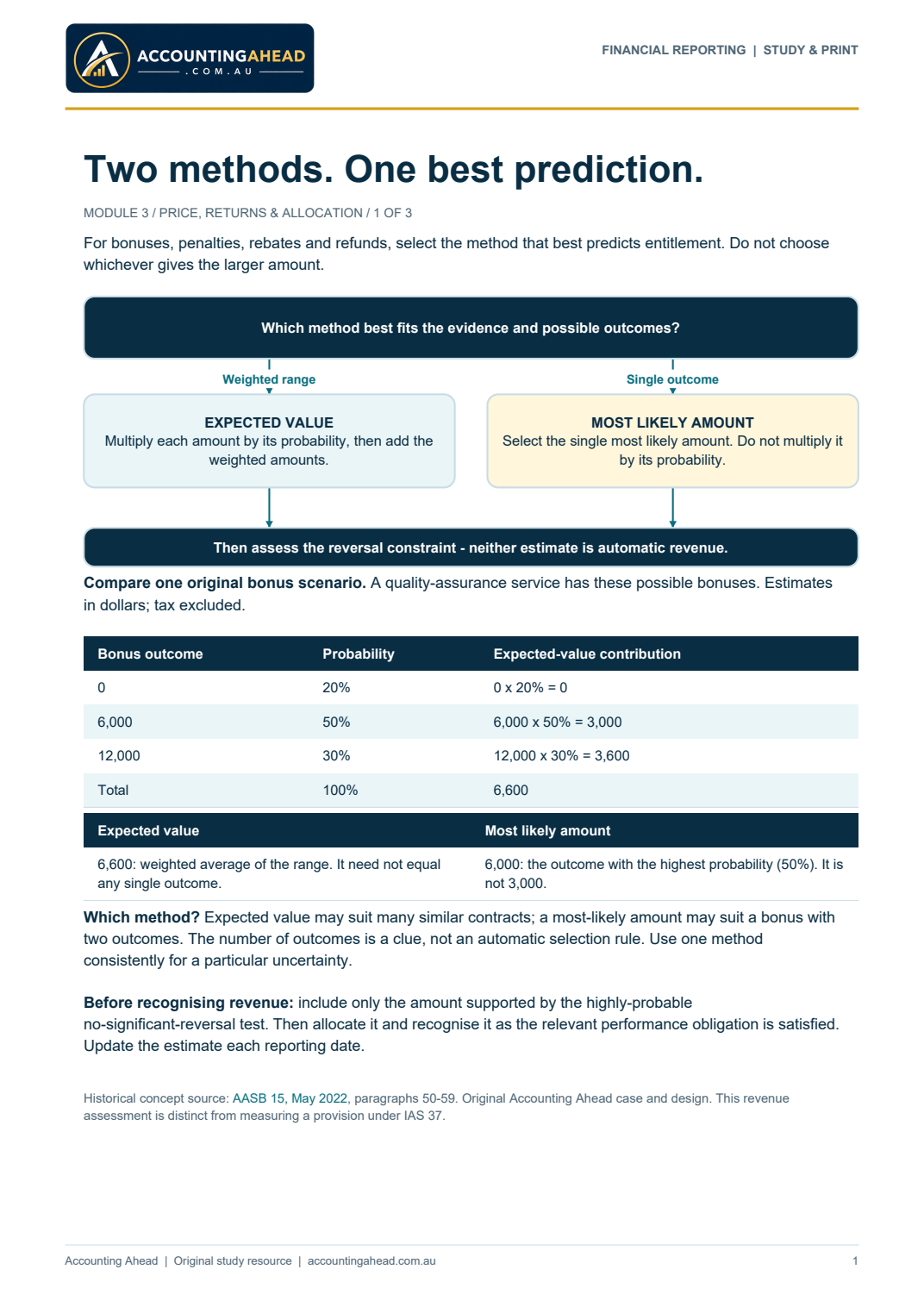
Bonuses, penalties, refunds, rebates and price concessions can make consideration variable. Choose the estimation method that best predicts entitlement. Expected value weights a suitable range of outcomes by probabilities; the most likely amount selects one outcome without multiplying it by its probability. More than two outcomes does not automatically compel expected value, and two outcomes do not remove the need for judgement.
Original bonus outcomes for a quality-assurance service
Probability
Weighted amount
$0
20%
$0
$6,000
50%
$3,000
$12,000
30%
$3,600
Total
100%
$6,600
Expected value is $6,600. The most likely amount is $6,000. Suppose experience shows expected value best predicts this class of bonuses. That selects the estimation method; it does not finish the recognition assessment. Include only the amount for which a significant later reversal of cumulative revenue is highly unlikely under the standard's 'highly probable' threshold. Document why the amount passes, rather than assigning an invented universal percentage to 'highly probable'.
Uncertainty outside the supplier's influence, a long resolution period, little predictive experience and a wide range of outcomes may limit inclusion. Reassess at each reporting date. An excluded bonus can be included later when evidence supports it; an earlier estimate can also fall. Apply a consistent method to the relevant uncertainty and explain significant changes.
Revenue excludes the amount expected to be refunded. Recognise a refund liability and, where relevant, a separate asset for the right to recover returned products. Measure that recovery asset using the former carrying amount adjusted for recovery costs and expected reductions in value. It is not measured at the selling price.
Entry
Debit
Credit
Record the sale and expected refunds
Cash $11,520
Revenue $10,944; refund liability $576
Record inventory and recovery right
Cost of sales $6,156; recovery asset $324
Inventory $6,480
Update the liability and recovery asset when expectations change. Do not offset them in presentation. An exchange of a defective item for a functioning item is assessed under warranty requirements rather than automatically treated as a normal right of return.
When a customer pays long after receiving an output, the supplier may be financing the customer and earning interest. When a customer prepays substantially before delivery, the customer may be financing the supplier; the supplier may recognise interest expense. Keep that financing effect separate from revenue for transferring goods or services.
A long timing gap is evidence to investigate, not proof by itself. Assess the cash selling price, timing and market rates. Some arrangements have a different substantive purpose, such as protection against non-performance, or let the customer decide when to use a prepaid service. Apply the standard's exclusions. An optional practical expedient permits no financing adjustment when the expected transfer-to-payment period is one year or less; it does not redefine every such contract as economically interest-free.
Birch Survey Instruments delivers equipment with a cash selling price of $72,000. The customer pays $80,899.20 two years later. Assume a significant financing component, a suitable inception rate of 6%, no credit loss and no payments in between. Revenue on delivery is $72,000. Interest is $4,320 in year one and $4,579.20 in year two. The receivable reaches $80,899.20.
Date
Debit
Credit
Delivery
Receivable $72,000
Revenue $72,000
End of year one
Receivable $4,320
Interest income $4,320
End of year two
Receivable $4,579.20
Interest income $4,579.20
Collection
Cash $80,899.20
Receivable $80,899.20
The rate is set at inception to reflect a separate financing transaction, including the credit characteristics of the financing recipient. Do not update it merely for later market-rate or credit-risk changes. Credit losses are a separate assessment. Cost of the equipment and its cost-of-sales entry are omitted from this financing-only example, not assumed to be zero.
Measure non-cash consideration at fair value where reasonably estimable. If it cannot be reasonably estimated, use the stand-alone selling price of the goods or services promised in exchange. Distinguish variability caused by the form of consideration from variability caused by other reasons, such as performance; the latter can engage the variable-consideration constraint.
Payments or credits to a customer generally reduce the transaction price unless they purchase a distinct good or service. For a genuine purchase, use ordinary purchase accounting up to its fair value. An excess payment reduces revenue; if fair value cannot be reasonably estimated, treat the whole payment as a reduction. The timing rules for a revenue reduction also matter: do not automatically expense every customer incentive immediately as marketing.
Allocation normally uses the stand-alone selling prices at contract inception, not arbitrary invoice labels. For each promise: allocated amount = transaction price multiplied by that promise's stand-alone price divided by the total stand-alone prices. The allocated amounts must add back to the transaction price.
Aurora Field Systems bundle
Stand-alone price
Share of total
Allocation of $9,000
Standard field kit
$6,000
60%
$5,400
Distinct setup and training visit
$1,500
15%
$1,350
Twelve months of remote monitoring
$2,500
25%
$2,250
Total
$10,000
100%
$9,000
Assume all three promises are distinct, setup does not integrate or significantly alter the kit, no special discount or variable-allocation exception applies, and any financing effect has been assessed as immaterial. The $1,000 package discount is allocated proportionately. A label saying 'free monitoring' would not remove monitoring's $2,250 allocation. Recognition then follows each promise's transfer pattern.
Observable separate sales to similar customers are strong evidence. When absent, estimate using market evidence, expected cost plus an appropriate margin, or a permitted residual approach. The residual approach is restricted to the standard's highly variable or uncertain pricing circumstances; it is not a convenient way to put every unexplained amount into one item. Distinguish a percentage mark-up on cost from a gross margin percentage on sales.
A discount can be allocated to a particular bundle only when the required observable evidence supports it. Regular separate sales, regular discounted bundle sales and evidence linking substantially the same discount to that bundle all matter. Do not select an item simply because management wants its margin reduced.
Variable consideration can be allocated entirely to a particular obligation, or to a distinct item within a series, when its terms specifically relate to that item and the allocation remains consistent with the overall allocation objective. Otherwise apply the general allocation rules. Subsequent transaction-price changes ordinarily use the original allocation basis; changing stand-alone prices after inception does not by itself cause reallocation.